


what goes here?
 Feb 28, 2011 | 12:13 PM
#1

Thread Starter
Registered User
Joined: Mar 2009
Posts: 15
Likes: 0
From: San Antonio, TX
what goes here?
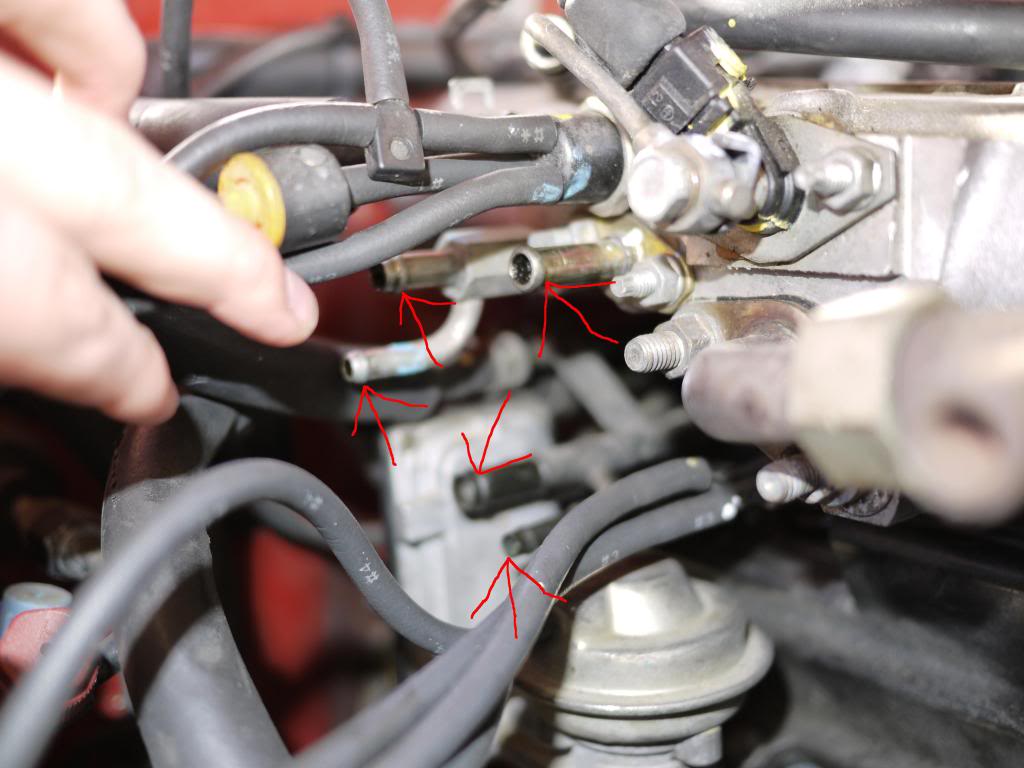
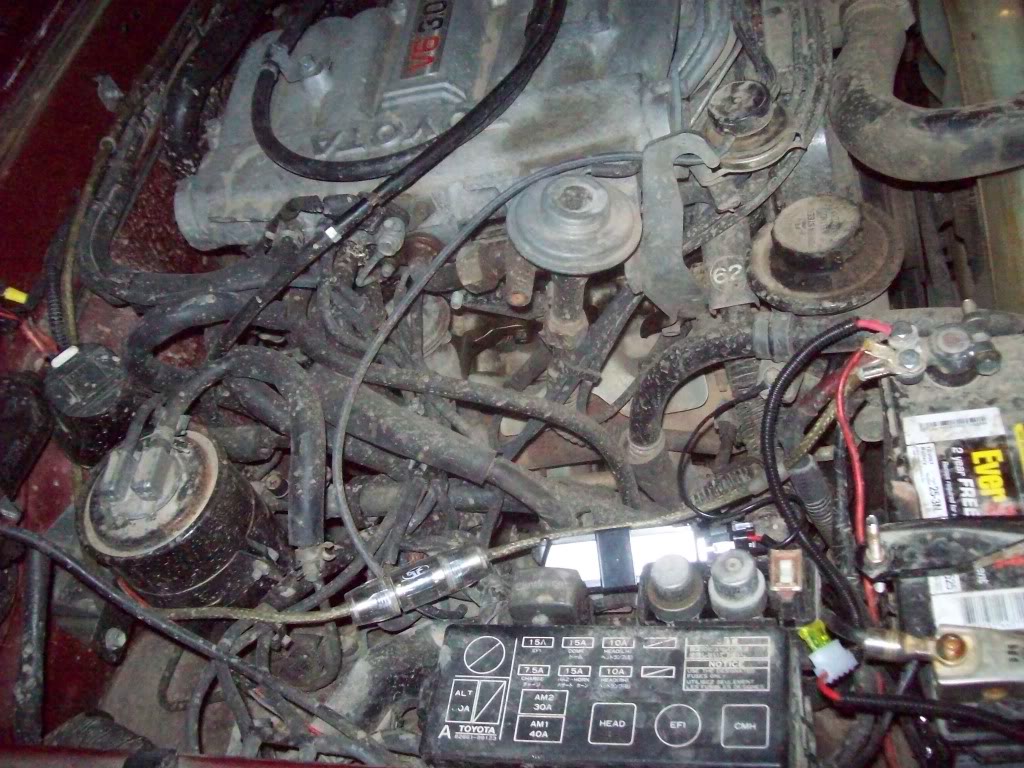
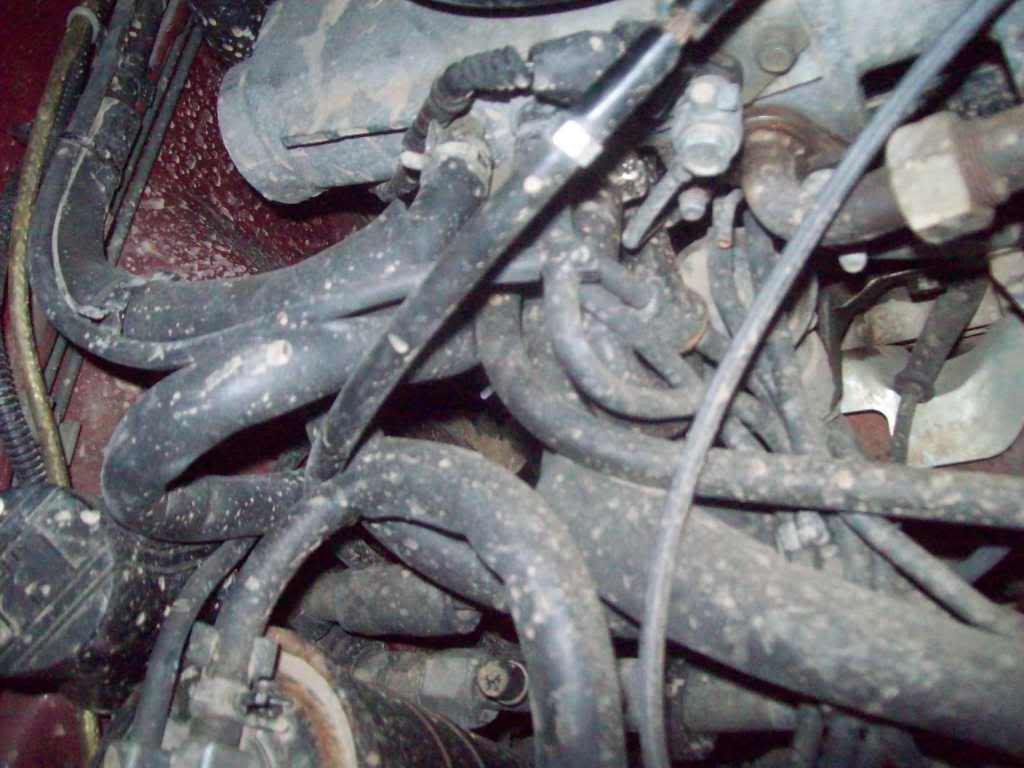
i know one goes to the pcv valve...the rest im not sure, and im not happy admitting it...ive looked through some digrams but for some reason those always seem to be left out...i bought this truck about 2 weeks ago and it was idling high...i did the valve cover gaskets, the intake manifold gasket and several hoses...
 lol
lol
 Feb 28, 2011 | 12:22 PM
#3
Thread Starter
Registered User
Joined: Mar 2009
Posts: 15
Likes: 0
From: San Antonio, TX
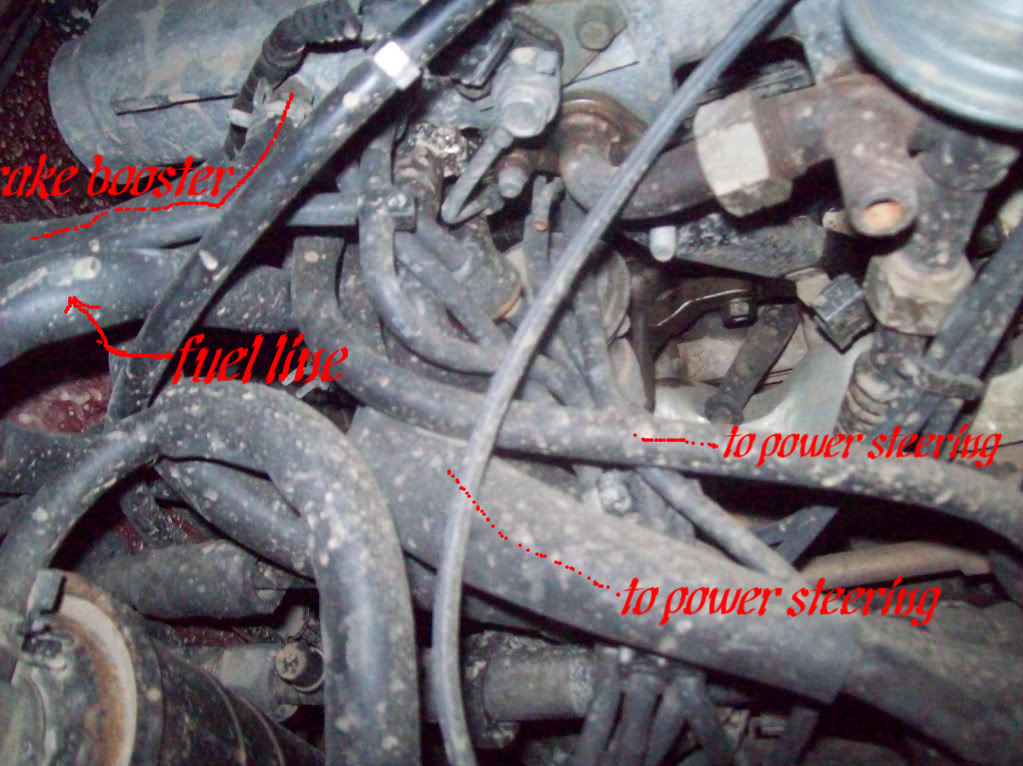
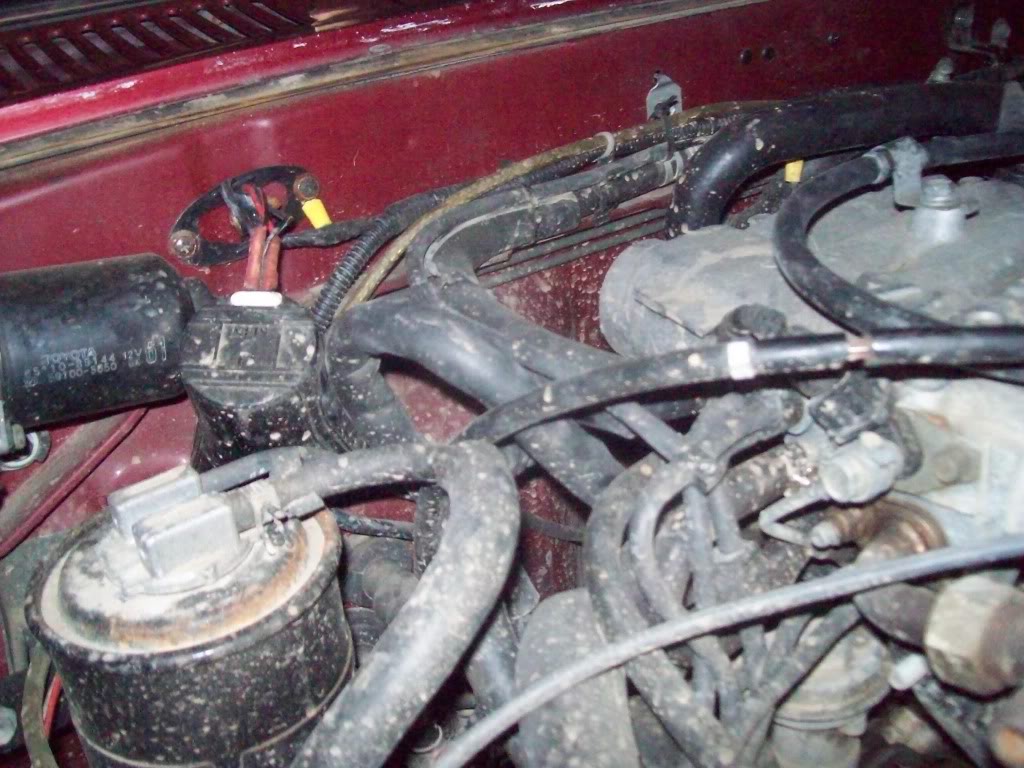
makes perfect sense huh? its a 3.0 on a 93 4runner... i know they're vac hoses, but where do they come from is my question...i had several hoses that were capped off, but didnt notice till after the purchase...somebody was just really lazy...

 Feb 28, 2011 | 01:19 PM
#5

Registered User
Joined: Oct 2009
Posts: 30
Likes: 0
From: SO CAL
Here is my solution
 Mar 1, 2011 | 05:25 AM
#6

Registered User
Joined: Feb 2008
Posts: 2,049
Likes: 4
From: the great Maine wilderness
Make sure you get the 2 that connect to the power steering pump hooked up the same as they came off..... it will work if they are reversed, but will likely shorten the life of the ps pump....
Mar 1, 2011 | 05:30 AM
#7

Contributing Member
Joined: Sep 2003
Posts: 1,241
Likes: 13
From: Winnipeg, MB, Canada
Trending Topics
Mar 1, 2011 | 05:47 AM
#8
Registered User
Joined: Feb 2008
Posts: 2,049
Likes: 4
From: the great Maine wilderness
not 100%.... but I think I got mine backwards last time I was in there, and am noticing some air bubbles in ps fluid, and it seems like the power steering kicks out occasionally.... not sure if its cuz I got those lines backwards, or because its got a lot of miles on it.... but I have been told by more than 1 yota mechanic that its not good....
Mar 1, 2011 | 06:11 AM
#9

Registered User
Joined: Oct 2009
Posts: 318
Likes: 2
From: Knoxville, TN
Mar 1, 2011 | 11:31 AM
#10
Thread Starter
Registered User
Joined: Mar 2009
Posts: 15
Likes: 0
From: San Antonio, TX
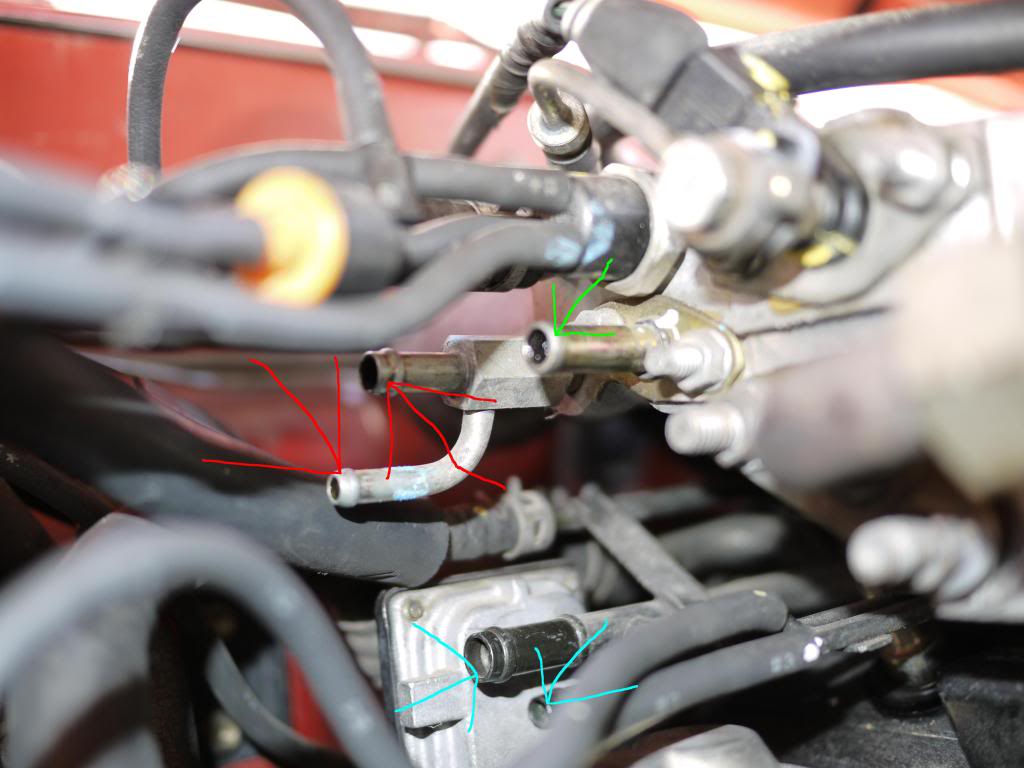
ok so alittle more explaining please...does the pcv valve hose go to the green arrow? and to what color arrows does the power steering pump go to? i guess i still need some baby explination to all this...sorry guys...i dont wanna get it wrong...
 Mar 2, 2011 | 05:55 AM
#12
Registered User
Joined: Oct 2009
Posts: 318
Likes: 2
From: Knoxville, TN
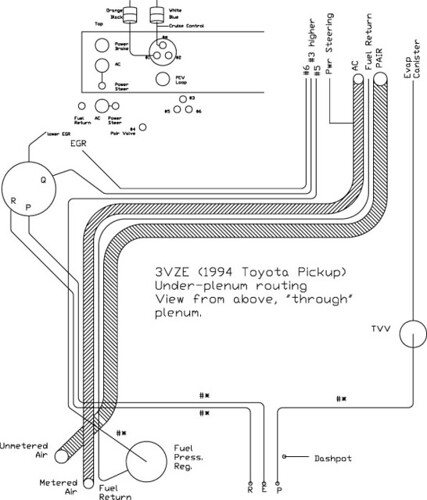
I found this a while back but have not been able to find the link. I think it was posted by Bugs1961, but my apologies if that reference is wrong.
Here are all the hoses on the pass side of the plenum. The item numbers correspond to your picture with the numbers. Toyota numbered the vacuum hoses and it looks like yours are still numbered correctly from your pictures. The vacuum hoses are the small hoses and the larger hoses are air hoses, fuel hoses, brake booster, and PCV hoses. I list the Toyota vacuum hose numbers as printed on the the hose itself as well as where it goes. Front and rear refer to the truck front or rear. There are three VSV's (rear, center, and front) and one AC idle up valve.
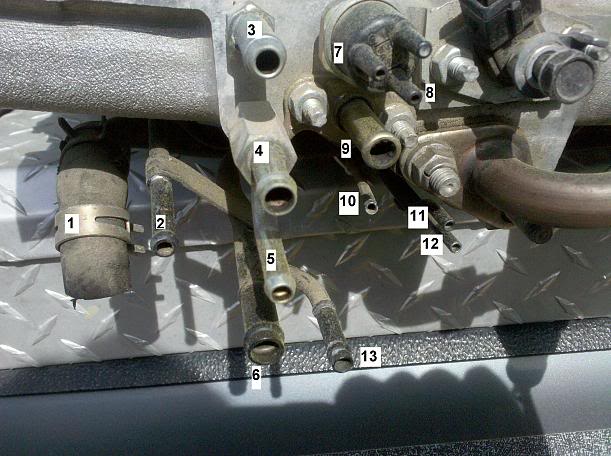
1. Reed valve
2. Fuel return hose
3. Brake booster
4. Rear air hose at the AC idle up
5. PS pump valve
6. Front air hose at the AC idle up
7. Vac hose #1 to pass side of rear VSV
8. Vac hose #2 to pass side of center VSV
9. PCV hose
10. Vac hose #5 to driver side of center VSV
11. Vac hose #3 to pass side of front VSV
12. Vac hose #6 to driver side of front VSV
13. PS pump valve
Vac hose #4 goes from driver side of rear VSV to the reed valve
AC idle up vacuum hoses:
- pass side to diaphragm (very short hose)
- driver side tee's into vacuum hose #2 (item 8 in your picture)
Here are all the hoses on the pass side of the plenum. The item numbers correspond to your picture with the numbers. Toyota numbered the vacuum hoses and it looks like yours are still numbered correctly from your pictures. The vacuum hoses are the small hoses and the larger hoses are air hoses, fuel hoses, brake booster, and PCV hoses. I list the Toyota vacuum hose numbers as printed on the the hose itself as well as where it goes. Front and rear refer to the truck front or rear. There are three VSV's (rear, center, and front) and one AC idle up valve.
1. Reed valve
2. Fuel return hose
3. Brake booster
4. Rear air hose at the AC idle up
5. PS pump valve
6. Front air hose at the AC idle up
7. Vac hose #1 to pass side of rear VSV
8. Vac hose #2 to pass side of center VSV
9. PCV hose
10. Vac hose #5 to driver side of center VSV
11. Vac hose #3 to pass side of front VSV
12. Vac hose #6 to driver side of front VSV
13. PS pump valve
Vac hose #4 goes from driver side of rear VSV to the reed valve
AC idle up vacuum hoses:
- pass side to diaphragm (very short hose)
- driver side tee's into vacuum hose #2 (item 8 in your picture)
Last edited by Wrenchinjoe; Mar 2, 2011 at 06:01 AM.
Mar 2, 2011 | 03:32 PM
#13

Registered User
Joined: Jul 2006
Posts: 479
Likes: 5
From: Anchorage
[QUOTE=Wrenchinjoe;51671883]I found this a while back but have not been able to find the link. I think it was posted by Bugs1961, but my apologies if that reference is wrong.
Here is the link those came from: https://www.yotatech.com/forums/f116...e-help-209069/
I did the identifying but KHIG made the great picture. Post #1 has the photo and post #11 has the IDs. It's a worthwhile thread to go through if you're having vacuum problems. Good luck and have a great day,
Bugs
Here is the link those came from: https://www.yotatech.com/forums/f116...e-help-209069/
I did the identifying but KHIG made the great picture. Post #1 has the photo and post #11 has the IDs. It's a worthwhile thread to go through if you're having vacuum problems. Good luck and have a great day,
Bugs
Jan 12, 2014 | 04:16 AM
#14

Registered User
Joined: Jun 2012
Posts: 59
Likes: 0
The Modulator is an air filter for the egr valve, so it gets clean air/vac.
https://www.yotatech.com/forums/f116...l#post51141054
The VSV are Blue is PAIR, RED (brown) is for Fuel Pressure up and Green is EGR.
The top of the VSV is from the vacuum source and the secondary goes to the item its running.
EGR vacuum comes from 2 vacuum lines to the modulator then from there to the top of the green VSV, From the bottom of the VSV (bleed off filter) goes to the main EGR valve.
EGR only turns on when a cruise or light throttle is happening.
PAIR, From manifold to a one way valve then to of the Blue VSV top, Out to the PAIR valve.
Only turns on during deceleration.
Fuel pressure up, From Manifold to the Red (brown) to the regulator.
Turns on during acceleration dropping vacuum to zero increasing fuel pressure.
Fuel pressure up can be bypassed if the VSV is bad.
https://www.yotatech.com/forums/f116...l#post51141054
The VSV are Blue is PAIR, RED (brown) is for Fuel Pressure up and Green is EGR.
The top of the VSV is from the vacuum source and the secondary goes to the item its running.
EGR vacuum comes from 2 vacuum lines to the modulator then from there to the top of the green VSV, From the bottom of the VSV (bleed off filter) goes to the main EGR valve.
EGR only turns on when a cruise or light throttle is happening.
PAIR, From manifold to a one way valve then to of the Blue VSV top, Out to the PAIR valve.
Only turns on during deceleration.
Fuel pressure up, From Manifold to the Red (brown) to the regulator.
Turns on during acceleration dropping vacuum to zero increasing fuel pressure.
Fuel pressure up can be bypassed if the VSV is bad.
Jul 30, 2020 | 01:36 PM
#15

Registered User
Joined: Jun 2020
Posts: 9
Likes: 0
I found this a while back but have not been able to find the link. I think it was posted by Bugs1961, but my apologies if that reference is wrong.
Here are all the hoses on the pass side of the plenum. The item numbers correspond to your picture with the numbers. Toyota numbered the vacuum hoses and it looks like yours are still numbered correctly from your pictures. The vacuum hoses are the small hoses and the larger hoses are air hoses, fuel hoses, brake booster, and PCV hoses. I list the Toyota vacuum hose numbers as printed on the the hose itself as well as where it goes. Front and rear refer to the truck front or rear. There are three VSV's (rear, center, and front) and one AC idle up valve.
Attachment 188900
1. Reed valve
2. Fuel return hose
3. Brake booster
4. Rear air hose at the AC idle up
5. PS pump valve
6. Front air hose at the AC idle up
7. Vac hose #1 to pass side of rear VSV
8. Vac hose #2 to pass side of center VSV
9. PCV hose
10. Vac hose #5 to driver side of center VSV
11. Vac hose #3 to pass side of front VSV
12. Vac hose #6 to driver side of front VSV
13. PS pump valve
Vac hose #4 goes from driver side of rear VSV to the reed valve
AC idle up vacuum hoses:
- pass side to diaphragm (very short hose)
- driver side tee's into vacuum hose #2 (item 8 in your picture)
Here are all the hoses on the pass side of the plenum. The item numbers correspond to your picture with the numbers. Toyota numbered the vacuum hoses and it looks like yours are still numbered correctly from your pictures. The vacuum hoses are the small hoses and the larger hoses are air hoses, fuel hoses, brake booster, and PCV hoses. I list the Toyota vacuum hose numbers as printed on the the hose itself as well as where it goes. Front and rear refer to the truck front or rear. There are three VSV's (rear, center, and front) and one AC idle up valve.
Attachment 188900
1. Reed valve
2. Fuel return hose
3. Brake booster
4. Rear air hose at the AC idle up
5. PS pump valve
6. Front air hose at the AC idle up
7. Vac hose #1 to pass side of rear VSV
8. Vac hose #2 to pass side of center VSV
9. PCV hose
10. Vac hose #5 to driver side of center VSV
11. Vac hose #3 to pass side of front VSV
12. Vac hose #6 to driver side of front VSV
13. PS pump valve
Vac hose #4 goes from driver side of rear VSV to the reed valve
AC idle up vacuum hoses:
- pass side to diaphragm (very short hose)
- driver side tee's into vacuum hose #2 (item 8 in your picture)
Jul 30, 2020 | 02:12 PM
#16

Registered User

Joined: Sep 2007
Posts: 8,384
Likes: 875
From: San Francisco East Bay
Probably 12255-65010 https://parts.lakelandtoyota.com/sho...rimLevel=18380 . But it's only trying to keep the vacuum in, so unless I was ordering a lot of other stuff, I'd go with RTV.
FIPG? The advantage of FIPG is that it sets REALLY fast. If you're a professional mechanic, need to get this truck out of your bay, and never need to reposition a part, this is pretty good. I'm no professional. Sometimes, after I put a part on, I need to reposition it a little to get it to fit right (think valve cover gaskets). In the grand scheme of things, I'm not in a hurry. So I use RTV. It sets more gracefully, and I can always give it 24 hours before I need to start the engine. Your choice.
FIPG? The advantage of FIPG is that it sets REALLY fast. If you're a professional mechanic, need to get this truck out of your bay, and never need to reposition a part, this is pretty good. I'm no professional. Sometimes, after I put a part on, I need to reposition it a little to get it to fit right (think valve cover gaskets). In the grand scheme of things, I'm not in a hurry. So I use RTV. It sets more gracefully, and I can always give it 24 hours before I need to start the engine. Your choice.
Jul 30, 2020 | 04:11 PM
#17
Registered User
Joined: Jun 2020
Posts: 9
Likes: 0
Probably 12255-65010 https://parts.lakelandtoyota.com/sho...rimLevel=18380 . But it's only trying to keep the vacuum in, so unless I was ordering a lot of other stuff, I'd go with RTV.
FIPG? The advantage of FIPG is that it sets REALLY fast. If you're a professional mechanic, need to get this truck out of your bay, and never need to reposition a part, this is pretty good. I'm no professional. Sometimes, after I put a part on, I need to reposition it a little to get it to fit right (think valve cover gaskets). In the grand scheme of things, I'm not in a hurry. So I use RTV. It sets more gracefully, and I can always give it 24 hours before I need to start the engine. Your choice.
FIPG? The advantage of FIPG is that it sets REALLY fast. If you're a professional mechanic, need to get this truck out of your bay, and never need to reposition a part, this is pretty good. I'm no professional. Sometimes, after I put a part on, I need to reposition it a little to get it to fit right (think valve cover gaskets). In the grand scheme of things, I'm not in a hurry. So I use RTV. It sets more gracefully, and I can always give it 24 hours before I need to start the engine. Your choice.

 Jul 31, 2020 | 04:09 AM
#19
Registered User
Joined: Jun 2020
Posts: 9
Likes: 0
Its actually not the PCV hose but some flange plate that bolts to the manifold with a nipple for the hose. The question is if the flange plate needs a gasket/sealer at surface contact to the manifold. I assume the pressure is low enough that it's not crazy critical

Thread
Thread Starter
Forum
Replies
Last Post
iceman601
95.5-2004 Tacomas & 96-2002 4Runners
50
Jan 8, 2020 11:10 AM
Yota 3.0
86-95 Trucks & 4Runners (Build-Up Section)
243
Oct 8, 2016 10:31 AM
tinigunner11
86-95 Trucks & 4Runners (Build-Up Section)
76
Jan 17, 2014 11:37 AM


