


22R Desmog Tutorial
 Aug 4, 2014 | 05:04 PM
#241

Registered User
Joined: Jul 2011
Posts: 74
Likes: 0
From: mississippi
I have done new plugs, wires, valve cover gasket right before I did desmog/carb. I believe it is strictly carb related. I have read a ton of threads from people with jeeps, Mitsubishis, midget cars all with the same exact problem after the weber install. I'm going to try a rejet in a week or so hopefully. Just trying to decide to buy the kit to richen or lean, I'd hate to drop 50$ + shipping for the wrong kit. I'll let ya know if that fixes it. Also I tried my vac from 0* to 15* BTDC and past 15 once or twice with zero affect on the bog.
Aug 4, 2014 | 05:34 PM
#242

You both need to read and understand this!
http://www.datsun2000.com/tech/weber...ethodology.htm
There is a troubleshooting part where it explains your problem
http://www.datsun2000.com/tech/weber...ethodology.htm
There is a troubleshooting part where it explains your problem
Aug 5, 2014 | 05:59 AM
#243
Thread Starter
Super Moderator
iTrader: (3)
Joined: Jan 2012
Posts: 3,218
Likes: 26
From: Salisbury, MD
For those of you having stalling and/or stumbling issues, (assuming that everything else is adjusted properly and in good working order, IE: fuel pump, FPR, timing, plugs, wires, fuel filters, distributor, vacuum lines, etc) you need to find out if your engine is running lean or rich. You can usually tell your situation by the smell of the exhaust, or better yet, get your self an air/fuel ratio gauge. Your ideal stoichiometric mixtures is in the neighborhood of 14.7:1. Re-jetting is your likely solution. Again, make sure that you have made all the other necessary corrections and adjustments to other fuel delivery and spark components or your efforts may be for not. IF YOU ARE AT HIGH ALTITUDES, you will likely need to lean out your mixture. Webers are tuned from the factory at sea level so you can't just bolt it on and expect to drive around the Rockies right away. LCE has the Weber jet kits at the typically $50 price point. You may be able to find them cheaper elsewhere, but you won't get the tech support that you get when you buy from LCE.
Below are the links to the jet kits from LCE. You'll need to find out if you are rich or lean prior to ordering since one kit adjusts on the lean side and the other adjusts on the rich side.
High altitude/lean kit:
http://www.lceperformance.com/Weber-...-p/1035002.htm
Performance/rich kit:
http://www.lceperformance.com/Weber-...-p/1035003.htm
Below are the links to the jet kits from LCE. You'll need to find out if you are rich or lean prior to ordering since one kit adjusts on the lean side and the other adjusts on the rich side.
High altitude/lean kit:
http://www.lceperformance.com/Weber-...-p/1035002.htm
Performance/rich kit:
http://www.lceperformance.com/Weber-...-p/1035003.htm
Aug 5, 2014 | 12:09 PM
#244
Just to add to Kawa's post, 14.7:1 is the most efficient air/fuel ratio at idle and part throttle/cruising. At wide open throttle you are looking for closer to 13.5:1, an a/f gauge is a great tuning tool.
Aug 10, 2014 | 01:31 PM
#245

Registered User
Joined: May 2013
Posts: 175
Likes: 0
Hola guys did my desmog a couple months ago and now I'm on rebuild two. Didn't have problems before I swapped the motor. But basically I believe I'm getting some oil im through the pcv valve hose. I have the front hose running into the air box and the rear hose is routed into the intake with the lce barb. Any idea. Should I try to run it elsewhere? This is our second rebuild and we are trying to eliminate any possibilities we can. I have a thread going in the 84-85 section about the bad motor.
This is a 22r with a dual plane intake/32/36 weber and a lce header. Full desmog. Truck is burning lots of oil and possibly some coolant as well.
This is a 22r with a dual plane intake/32/36 weber and a lce header. Full desmog. Truck is burning lots of oil and possibly some coolant as well.
Aug 18, 2014 | 08:46 AM
#246
Thread Starter
Super Moderator
iTrader: (3)
Joined: Jan 2012
Posts: 3,218
Likes: 26
From: Salisbury, MD
If you are losing coolant I would suspect a head gasket first. But based on your 22R smoking thread, I would say that you have a poorly rebuilt engine. If it only has 110psi across the board on a fresh rebuild then there is something definitely wrong. Since I haven't finished my truck yet, I did a hand crank compression check on my engine and came up with 122-126psi on all cylinders which is really good for hand cranking. Once I have the starter hooked up I should be back up to the 170psi range but that should give you a good idea of how low your compression really is. Things that could cause poor compression are:
1-bad valve seals
2-improperly cut valve seats
3-improperly lashed valve or valves that need to be re-lashed
4-poor cylinder work causing rings not to seat
5-cheap piston rings
I would start by re-lashing the valves, which can often be a blow-by culprit on rebuilds. Exhaust should be 0.30mm (0.012") and Intake should be 0.20mm (0.008"). You need to do this with the engine warm. Get the engine up to running temp and shut it down. Quickly remove the valve cover and turn the engine to #1 TDC (Rockers on #1 should be loose and #4 should be tight-if not turn 360* and check again). Lash the #1 & #2 intake and #1 & #3 exhaust correctly. Then turn 360* and lash the #3 & #4 intake and #2 & #4 exhaust. You are supposed to re-lash the valve after a rebuilt engine is run in a bit.
Check your compression again after the re-lash to see if anything change - ideally, you should be in the 170psi neighborhood. The FSM says 142 is the low tolerance.
Then double check your timing WITH A LIGHT. For the 84-85 22R engines, the FSM says to set the timing timing to 0* at 950 max RPM with the vacuum advance cut. (Note: pre-84 22R engines are timed at 5* BTDC with vacuum advance cut) With the vacuum advance connected, your timing should advance up around the 12* BTDC mark with the vacuum advance connected.
By the things I read in your other thread, it sounds like the engine builder is likely inferior. Things like the booged up spark plug threads (should have been chased if rebuilt), burning coolant (low quality head gasket), burning oil on load after idle/coast (cheap/old valve seals), low compression (cheap rings/bad bore honing/poorly fitted rings), etc...
1-bad valve seals
2-improperly cut valve seats
3-improperly lashed valve or valves that need to be re-lashed
4-poor cylinder work causing rings not to seat
5-cheap piston rings
I would start by re-lashing the valves, which can often be a blow-by culprit on rebuilds. Exhaust should be 0.30mm (0.012") and Intake should be 0.20mm (0.008"). You need to do this with the engine warm. Get the engine up to running temp and shut it down. Quickly remove the valve cover and turn the engine to #1 TDC (Rockers on #1 should be loose and #4 should be tight-if not turn 360* and check again). Lash the #1 & #2 intake and #1 & #3 exhaust correctly. Then turn 360* and lash the #3 & #4 intake and #2 & #4 exhaust. You are supposed to re-lash the valve after a rebuilt engine is run in a bit.
Check your compression again after the re-lash to see if anything change - ideally, you should be in the 170psi neighborhood. The FSM says 142 is the low tolerance.
Then double check your timing WITH A LIGHT. For the 84-85 22R engines, the FSM says to set the timing timing to 0* at 950 max RPM with the vacuum advance cut. (Note: pre-84 22R engines are timed at 5* BTDC with vacuum advance cut) With the vacuum advance connected, your timing should advance up around the 12* BTDC mark with the vacuum advance connected.
By the things I read in your other thread, it sounds like the engine builder is likely inferior. Things like the booged up spark plug threads (should have been chased if rebuilt), burning coolant (low quality head gasket), burning oil on load after idle/coast (cheap/old valve seals), low compression (cheap rings/bad bore honing/poorly fitted rings), etc...
Sep 2, 2014 | 04:48 AM
#247

Registered User
Joined: Sep 2014
Posts: 2
Likes: 0
From: Sydney, Australia
Thank you for your time and all the details
Ive been reading this thread over and over for a while now and finally took the plunge, slowly, bit by bit, when the cash was available.
I had the Headers and the exhaust installed over the past 12 months. And I made up some home made block off plates from an old alloy bullbar, for the EGR pipes and installed them installed x 2.
And I just recently removed or plugged all the vacuum lines, hard and soft.
This was a big, OMG what am i doing leap of faith kinda moment.. and left 1 charcoal canister for the fuel tank.
I haven't tuned it and it runs ok, but ill get to that this week..
The re-jetted Weber kit just turned up today and im going to install it in a few days when i have some time off work.
Its very hard to find this kind of info in Australia for these engines. And what you have done here has been a great help!
(mines a 1995 22r Hilux 4x4).
I just wanted to say thanks mate for putting this info together.
I had the Headers and the exhaust installed over the past 12 months. And I made up some home made block off plates from an old alloy bullbar, for the EGR pipes and installed them installed x 2.
And I just recently removed or plugged all the vacuum lines, hard and soft.
This was a big, OMG what am i doing leap of faith kinda moment.. and left 1 charcoal canister for the fuel tank.
I haven't tuned it and it runs ok, but ill get to that this week..
The re-jetted Weber kit just turned up today and im going to install it in a few days when i have some time off work.
Its very hard to find this kind of info in Australia for these engines. And what you have done here has been a great help!
(mines a 1995 22r Hilux 4x4).
I just wanted to say thanks mate for putting this info together.
Sep 2, 2014 | 05:13 AM
#248
Thread Starter
Super Moderator
iTrader: (3)
Joined: Jan 2012
Posts: 3,218
Likes: 26
From: Salisbury, MD
otimito, I'm glad this thread helped you out. I understand what you felt when you yanked all the vacuum lines, but that's exactly why I tell people to put on their big boy britches and just start pulling all the vacuum lines. Obviously, those vacuum lines are there for a reason, but that reason is emissions - which is what you are removing anyway.
Sep 6, 2014 | 05:03 AM
#249
Registered User
Joined: Sep 2014
Posts: 2
Likes: 0
From: Sydney, Australia
Webber Installed
Well, i got the Weber installed. I just need to tune it up. bogs down in the lower RMP then takes off like a turbo when the RMP lifts. wow... wish i did this years ago.
I set the timing to about 10 and it idles nice when warm. 700 RPM.
I think the choke needs a fiddle, it idles at about 500 RPM when cold.
Now for some Weber tuning info.
I set the timing to about 10 and it idles nice when warm. 700 RPM.
I think the choke needs a fiddle, it idles at about 500 RPM when cold.
Now for some Weber tuning info.
Oct 2, 2014 | 11:27 PM
#250
Registered User
Joined: Sep 2014
Posts: 55
Likes: 0
20r de smog
I have a 20R in my 1980 Yota and there are a few more differences that I have seen. I don't have a place for the middle block off plate that goes to the block on the passenger side. There are a few less vacuum lines than on the 22r. One of the water choke inlets are on the top of the intake manifold. I am in the middle of pulling all the vacuum lines and accessories off preparing for my weber. If I can upload pics j will show what I mean about the differences.
Oct 3, 2014 | 12:47 PM
#252
Thread Starter
Super Moderator
iTrader: (3)
Joined: Jan 2012
Posts: 3,218
Likes: 26
From: Salisbury, MD
I was reading throught the LCE monthly newsletter and got a little surprise. Look at this, I'm famous! Woot woot!
http://www.lcengineering.com/LCNewsl..._TECHNOTE.html
LCE used my write-up in one of their tech bulletins! I had no clue that they were going to do this, but it's pretty cool feeling that one of the leaders in Toyota performance is using my write-up. I suppose I must have done something right...
http://www.lcengineering.com/LCNewsl..._TECHNOTE.html
LCE used my write-up in one of their tech bulletins! I had no clue that they were going to do this, but it's pretty cool feeling that one of the leaders in Toyota performance is using my write-up. I suppose I must have done something right...
Last edited by kawazx636; Oct 3, 2014 at 01:05 PM.
 Oct 9, 2014 | 10:28 PM
#254

Registered User
Joined: Oct 2014
Posts: 3
Likes: 0
is there any reason why a weber 32/36 dgav wouldn't pull gas through it? my truck runs if i spray carb cleaner in the card but dies when i stop spraying, even with the throttle wide open. it ran good before weber install. i did a complete desmog, except i left in one charcoal canister, ive double checked all vacuum lines and all the block off plates, only have the two vacuum lines to the carb and intake manifold. please help.
Last edited by dutchrunner; Oct 9, 2014 at 10:34 PM.
Oct 9, 2014 | 10:53 PM
#255
Registered User
Joined: Sep 2014
Posts: 55
Likes: 0
things to consider
i couldn't get mine to run until i put a little bit of fuel into the carb to help it prime. My truck has mechanical fuel pump. there is something keeping it from getting fuel and that is where i would start. next, check your fuel pump to make sure it is still good. If you have an electric pump then check your fuse to make sure the fuse didn't blow. These are a few things you can try.. Let me know if it works..
Oct 9, 2014 | 11:37 PM
#256
Registered User
Joined: Oct 2014
Posts: 3
Likes: 0
my fuel pump is mechanical, my truck is an 82 SR5 4x4. ill try pouring gas in, (by that do you mean, open the carb and pour it in the float bowl). Is it possible i might have the wrong jets or forgot an O'ring during rebuild.
Last edited by dutchrunner; Oct 9, 2014 at 11:56 PM.
Oct 10, 2014 | 06:09 AM
#257
Pull the fuel line off the carb and put it into a tall container like a milk jug and let the truck try to start. If you end up with gas in the jug, then your pump is fine. Also you will have to crank the truck for maybe 20 seconds max to get the bowl to fill up in the carb for the first time.
If your pump is good, then you can look in the carb and see if your bowl is dry or not. Kinda sounds like your float/needle is not letting gas in. Did you clean the pathway between the fuel inlet on the carb and where it comes into the bowl by the needle? Those little holes plug easy with old gas being in them.
If your pump is good, then you can look in the carb and see if your bowl is dry or not. Kinda sounds like your float/needle is not letting gas in. Did you clean the pathway between the fuel inlet on the carb and where it comes into the bowl by the needle? Those little holes plug easy with old gas being in them.
Oct 23, 2014 | 11:50 AM
#259

Registered User
Joined: Sep 2011
Posts: 11
Likes: 0
Vacuum advance
You now only need TWO, 2, DOS, DUEX vacuum lines!
1) Main/Port Advance - From the vacuum port on the distributor closest to the radiator to the vacuum port on the Weber.
2) Sub/Idle Advance - From the vacuum port on the distributor closest to the head to the vacuum port on the intake manifold. For the manifold port I installed a 1/4" NPT Male to 3/16" barb fitting on one of the existing holes on the intake manfold (temporarily plugged earlier).
You will only need about 6ft of 5/32" vacuum hose. See below:
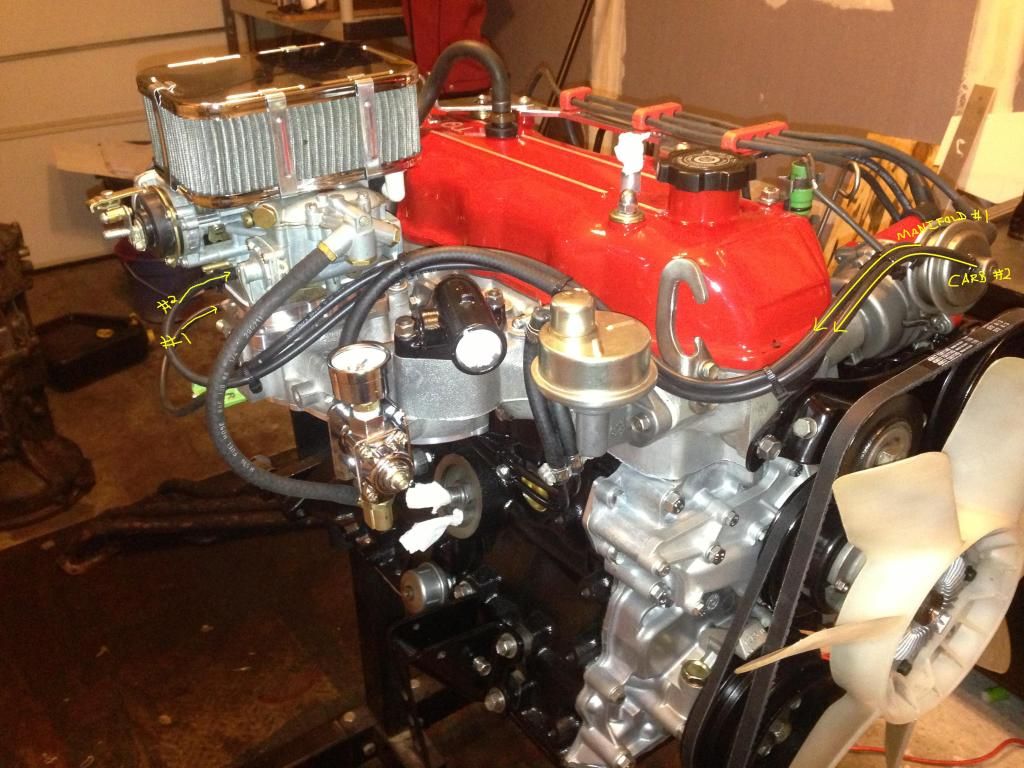
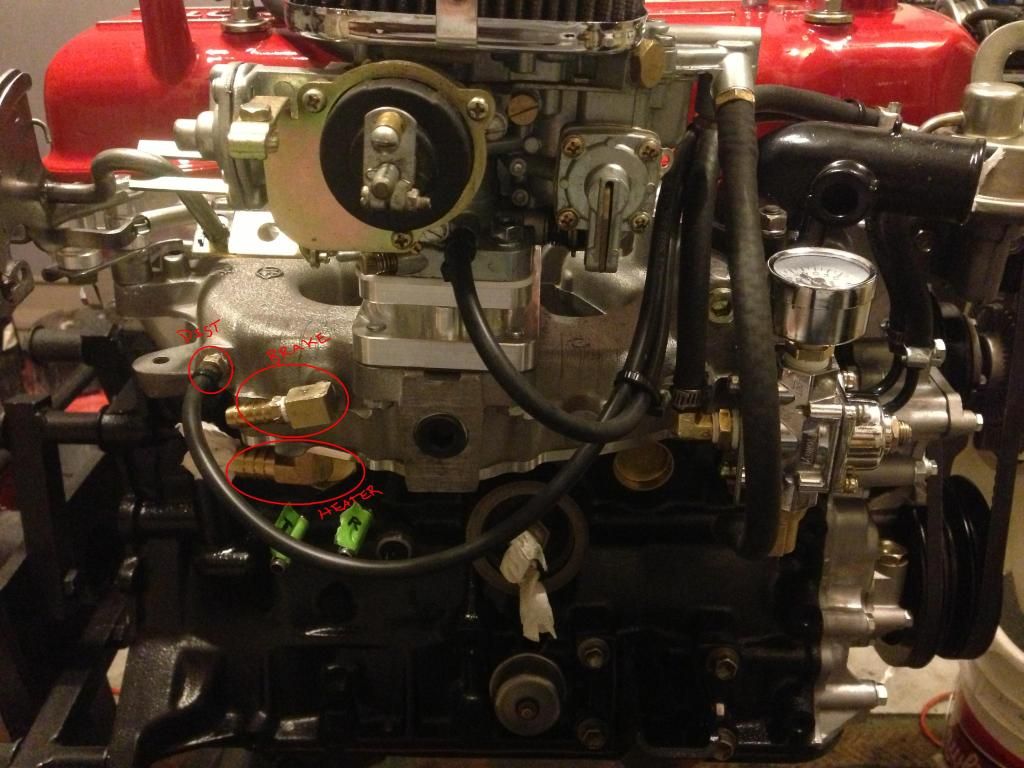
Also in the picture above, you can see the 90* barb I installed for my brake booster (you can use the factory barb, but I wanted the hose to be better routed) and the 90* barb for the heater core that comes with the LCE Under Manifold Water Block Plate Kit.
1) Main/Port Advance - From the vacuum port on the distributor closest to the radiator to the vacuum port on the Weber.
2) Sub/Idle Advance - From the vacuum port on the distributor closest to the head to the vacuum port on the intake manifold. For the manifold port I installed a 1/4" NPT Male to 3/16" barb fitting on one of the existing holes on the intake manfold (temporarily plugged earlier).
You will only need about 6ft of 5/32" vacuum hose. See below:
Also in the picture above, you can see the 90* barb I installed for my brake booster (you can use the factory barb, but I wanted the hose to be better routed) and the 90* barb for the heater core that comes with the LCE Under Manifold Water Block Plate Kit.
I've got mine desmogged with the Aisin, however having a little trouble with running too rich and idles rough. And I've traced it back to the vacuum connections at the HAC and the one right beside the fuel cutoff solenoid. But when I plug the 2 lines coming from the distributor I get no change in idle.
Trying to figure out if I have these vacuum lines plugged into the right ports. At least long enough for me to save up for a weber!
Oct 23, 2014 | 12:17 PM
#260
Registered User
Joined: Sep 2014
Posts: 55
Likes: 0
So you take your vacuum advance into the manifold? Is that just with the Weber, or would you do this with a desmogged Aisin too?
I've got mine desmogged with the Aisin, however having a little trouble with running too rich and idles rough. And I've traced it back to the vacuum connections at the HAC and the one right beside the fuel cutoff solenoid. But when I plug the 2 lines coming from the distributor I get no change in idle.
Trying to figure out if I have these vacuum lines plugged into the right ports. At least long enough for me to save up for a weber!
I've got mine desmogged with the Aisin, however having a little trouble with running too rich and idles rough. And I've traced it back to the vacuum connections at the HAC and the one right beside the fuel cutoff solenoid. But when I plug the 2 lines coming from the distributor I get no change in idle.
Trying to figure out if I have these vacuum lines plugged into the right ports. At least long enough for me to save up for a weber!

On my 20r I don't see that port for the vacuum line to intake manifold. I have mine hooked up to carb so I only have one vacuum line. Am I missing something? This is the only port I see from when I was doing my weber install. Is this where it should be hooked up?
Last edited by Yoda38052; Oct 23, 2014 at 12:22 PM. Reason: Forgot something


