


thrown gauntlet
 Apr 27, 2008 | 02:32 PM
#61
Registered User
Joined: Oct 2007
Posts: 5,377
Likes: 5
True, but the guy isn't going up against a Unimog with a RTI score in the millions. Flex keeps the shiny side up off road, but increases the chances of flipping on road. To keep idiots from scratching up the roof paint, they had to limit flex (not to mention fit huge sway bars, but they disconnect, so not an issue).
Have a look at the pathetic rear flex.

Have a look at the pathetic rear flex.
Apr 27, 2008 | 08:00 PM
#62

Contributing Member
Joined: Nov 2005
Posts: 8,875
Likes: 3
From: Longmont, CO
Apr 27, 2008 | 08:39 PM
#63

Registered User
Joined: Jan 2008
Posts: 278
Likes: 0
From: Birmingham, AL
True, but the guy isn't going up against a Unimog with a RTI score in the millions. Flex keeps the shiny side up off road, but increases the chances of flipping on road. To keep idiots from scratching up the roof paint, they had to limit flex (not to mention fit huge sway bars, but they disconnect, so not an issue).
Have a look at the pathetic rear flex.
Have a look at the pathetic rear flex.
You're absolutely right, though - suspension travel is considered kind of a bad thing in the on-road world. I guess it's a liability issue.
Originally Posted by tc
That's debatable - and applicable to compression travel at best.
Apr 27, 2008 | 11:01 PM
#64
Registered User
Joined: Oct 2007
Posts: 5,377
Likes: 5
That's presumably with the rear swaybar disconnected. You can disconnect the SB from inside the cab on the Rubicon. Very cool if that were a feature in a Toyota. That said this was taken from an car review website and as far as I can tell, all the people who test 4x4s have never seen gravel roads before and complain about wooley steering and big steps into the cab. Perhaps the car tester didn't push the button.
Its a shame Toyota doesn't build the Rubicon. If they did, you might have something special. Leave the Rubicon overnight in the garage with the FJ Cruiser, a little Barry White and maybe in the morning, you'd have a wet-behind-the-ears FJC with a solid front axle, a front locker and better all round visibility.
Its a shame Toyota doesn't build the Rubicon. If they did, you might have something special. Leave the Rubicon overnight in the garage with the FJ Cruiser, a little Barry White and maybe in the morning, you'd have a wet-behind-the-ears FJC with a solid front axle, a front locker and better all round visibility.
Last edited by Matt16; Apr 27, 2008 at 11:07 PM.
 Apr 28, 2008 | 07:03 AM
#66
Contributing Member
Joined: Nov 2005
Posts: 8,875
Likes: 3
From: Longmont, CO
Apr 28, 2008 | 10:21 AM
#67
Registered User
Joined: Jan 2008
Posts: 278
Likes: 0
From: Birmingham, AL
Look, we can argue this all day, say the same thing, and still disagree. I have no problem with IFS, I think that most peoples driving abilities will limit them long before the IFS in their truck will. IFS and SFA both have their places, but there's a reason that 99% of the serious competition-level rockcrawlers out there have solid axle rigs.
Apr 28, 2008 | 10:29 AM
#68
Contributing Member
Joined: Nov 2005
Posts: 8,875
Likes: 3
From: Longmont, CO
You can have all the droop travel in the world - but when you run out of compression, that corner of the truck is going up - PERIOD. When you run out of compression travel on the opposite corner, the truck will lean - PERIOD. As it leans, when the COG gets outside the wheel track, you are going over - PERIOD - whether all four tires are on the ground or not.
So, no, just saying suspension travel results in a more stable vehicle is not in any way correct, especially, if the majority of that travel is droop.
Rock buggies run sick COMPRESSION travel. They run solid axles so the rig is balanced and has the same behavior front and rear. THOSE things are critical to rig performance, not a simple "travel" number.
So, no, just saying suspension travel results in a more stable vehicle is not in any way correct, especially, if the majority of that travel is droop.
Rock buggies run sick COMPRESSION travel. They run solid axles so the rig is balanced and has the same behavior front and rear. THOSE things are critical to rig performance, not a simple "travel" number.
Apr 28, 2008 | 10:41 AM
#69

Registered User
Joined: May 2006
Posts: 2,377
Likes: 2
From: St. Loser, Misery
You can have all the droop travel in the world - but when you run out of compression, that corner of the truck is going up - PERIOD. When you run out of compression travel on the opposite corner, the truck will lean - PERIOD. As it leans, when the COG gets outside the wheel track, you are going over - PERIOD - whether all four tires are on the ground or not.
So, no, just saying suspension travel results in a more stable vehicle is not in any way correct, especially, if the majority of that travel is droop.
Rock buggies run sick COMPRESSION travel. They run solid axles so the rig is balanced and has the same behavior front and rear. THOSE things are critical to rig performance, not a simple "travel" number.
So, no, just saying suspension travel results in a more stable vehicle is not in any way correct, especially, if the majority of that travel is droop.
Rock buggies run sick COMPRESSION travel. They run solid axles so the rig is balanced and has the same behavior front and rear. THOSE things are critical to rig performance, not a simple "travel" number.
It's still IMPOSSIBLE to roll with out lifting a tire......

 Apr 28, 2008 | 01:11 PM
#72

Registered User
Joined: Apr 2005
Posts: 313
Likes: 0
From: Not Denver
Yeah, that's true, a roll over means the greasy side is up. But it's possible that with all 4 wheels are still on the ground when the ingredients for the roll over have already been put into place.
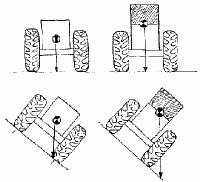
When the center of a vehicles mass gets outside the width of the wheel track, the vehicle will eventually roll. It's called the critical point. Some vehicles have a low enough center of gravity or wide enough track that you have to actually lift a wheel to get go past the critical point and some vehicles are too narrow, tall or have flexible enough suspension that it's possible to have all the wheels still on the ground when you go past the tipping point. Here's a diagram. In the left side, the COG is low enough to avoid a roll over and on the right, the vehicle is going over, even though its tires are still touching.
When the center of a vehicles mass gets outside the width of the wheel track, the vehicle will eventually roll. It's called the critical point. Some vehicles have a low enough center of gravity or wide enough track that you have to actually lift a wheel to get go past the critical point and some vehicles are too narrow, tall or have flexible enough suspension that it's possible to have all the wheels still on the ground when you go past the tipping point. Here's a diagram. In the left side, the COG is low enough to avoid a roll over and on the right, the vehicle is going over, even though its tires are still touching.
 Apr 28, 2008 | 02:54 PM
#74
Registered User
Joined: Apr 2005
Posts: 313
Likes: 0
From: Not Denver
Should add that the diagram shows the vehicle on a sloped hill (it came from a machinery training course), you can see where the vehicle might be leaning over from the suspension being cycled by droop and/or compression. The key is notice how the center of gravity is beyond the track width. IOW, if the axle droops to the point where the outside wheel is inside the COG or the inside wheel runs out of compression and the body leans, both can result in a roll and that's where knowing the limits of your junk is important.
Last edited by DaveInDenver; Apr 28, 2008 at 03:01 PM.
Apr 28, 2008 | 04:04 PM
#75

Contributing Member
Joined: May 2004
Posts: 2,839
Likes: 0
From: marlbank, canada
also called 'pucker factor'. probably where the term 'seat of the pants' comes from. that is demostrated similarly in fork truck driver training. cog is a part of wheeling that doesnt get its fair shake as far as how far is too far.
ive never flopped my truck but its been close and i hope to never experience it.
lee
ive never flopped my truck but its been close and i hope to never experience it.
lee
Apr 28, 2008 | 06:01 PM
#76
Registered User
Joined: Jan 2008
Posts: 278
Likes: 0
From: Birmingham, AL
You can have all the droop travel in the world - but when you run out of compression, that corner of the truck is going up - PERIOD. When you run out of compression travel on the opposite corner, the truck will lean - PERIOD. As it leans, when the COG gets outside the wheel track, you are going over - PERIOD - whether all four tires are on the ground or not.
So, no, just saying suspension travel results in a more stable vehicle is not in any way correct, especially, if the majority of that travel is droop.
Rock buggies run sick COMPRESSION travel. They run solid axles so the rig is balanced and has the same behavior front and rear. THOSE things are critical to rig performance, not a simple "travel" number.
So, no, just saying suspension travel results in a more stable vehicle is not in any way correct, especially, if the majority of that travel is droop.
Rock buggies run sick COMPRESSION travel. They run solid axles so the rig is balanced and has the same behavior front and rear. THOSE things are critical to rig performance, not a simple "travel" number.
I never spoke about "travel numbers".
I also never said that it is impossible to set the stage for a roll when all four tires on the ground. At all. It's very possible, and as soon as the center of gravity shifts too far, you're going over.
Picture a truck lifting one of its front tires up. Suddenly, the entire weight of that truck has shifted, the instant that tire left the ground. If that tire, axle, and part of the truck it was connected to had stayed on the ground, that shift in weight (and COG) would not have been near as extreme or sudden.
I'm not here trying to hash out the IFS or SFA debate, it's been fought on every forum, on every offroad site, by both sides who think one is better than the other. I think both have their uses.
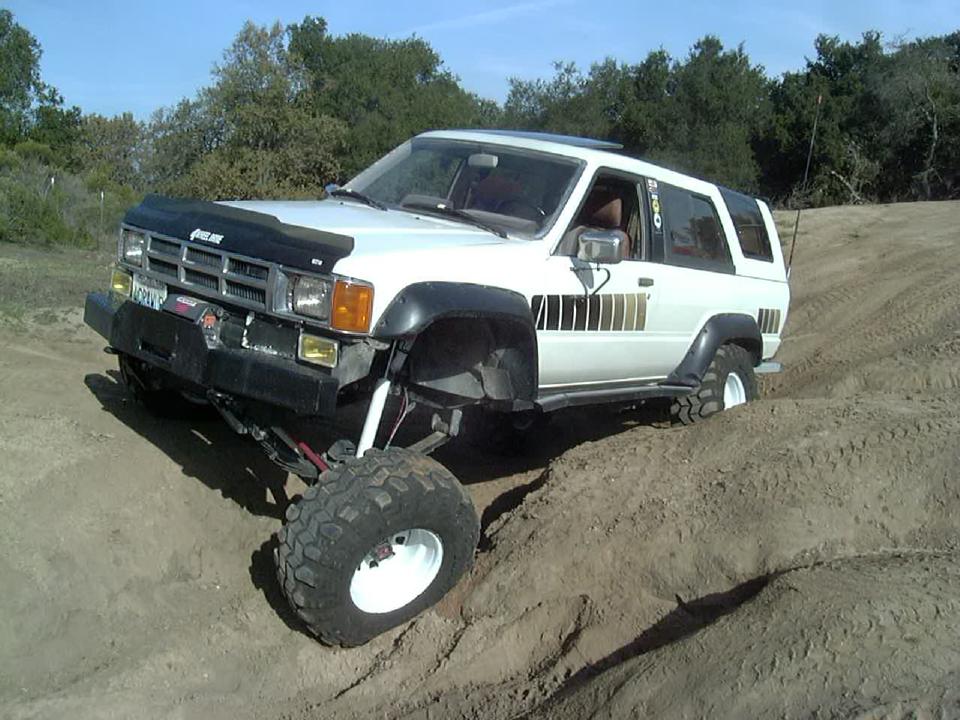
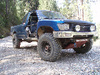
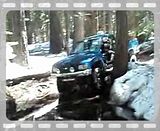
Take this picture of 4crawler's rig. If an IFS truck took the same angle, it would be on its side, or real dang close.
Note that I am NOT saying that an IFS truck could not go over this obstacle. It could, and fairly easily, with a different line.
Apr 28, 2008 | 06:34 PM
#77
Registered User
Joined: Oct 2007
Posts: 5,377
Likes: 5
No, in that case the front DS tire would simply be lifted off the ground. The weight distribution is pretty much the same. The spring isn't pushing up very hard as it is so far extended.
Back the the main point of the thread- 4Runner mods needed to beat a Rubicon over a case of Mountain Dew- the travel of a stock Rubicon isn't that much more that a 4Runner with BJ spacers.
Back the the main point of the thread- 4Runner mods needed to beat a Rubicon over a case of Mountain Dew- the travel of a stock Rubicon isn't that much more that a 4Runner with BJ spacers.
Apr 28, 2008 | 06:47 PM
#78
Registered User
Joined: Jan 2008
Posts: 278
Likes: 0
From: Birmingham, AL
No, in that case the front DS tire would simply be lifted off the ground. The weight distribution is pretty much the same. The spring isn't pushing up very hard as it is so far extended.
Back the the main point of the thread- 4Runner mods needed to beat a Rubicon over a case of Mountain Dew- the travel of a stock Rubicon isn't that much more that a 4Runner with BJ spacers.
Back the the main point of the thread- 4Runner mods needed to beat a Rubicon over a case of Mountain Dew- the travel of a stock Rubicon isn't that much more that a 4Runner with BJ spacers.
Apr 28, 2008 | 07:49 PM
#79
Contributing Member
Joined: Nov 2005
Posts: 8,875
Likes: 3
From: Longmont, CO
x2 - once again, the attitude (levelness) of the truck is defined by the COMPRESSION, not the droop. Two opposite corners with suspension fully compressed, the truck stays level.
Apr 28, 2008 | 08:13 PM
#80
Contributing Member
Joined: Feb 2006
Posts: 458
Likes: 0
From: Loveland, Colorado


