


Post your GAS MILEAGE!!
 Jun 1, 2009 | 08:04 AM
#441
Registered User
Joined: May 2009
Posts: 11
Likes: 0
From: Lewiston MI
Wow ..My wifes 85 2wd short bed 22r 4spd has got up to 34 mpg on long trips. I just assumed all toyotas got good mpg (never owned one before). So I got a 83 4x4 to put her 85 body on (frame rot) thinking she would get around 25+. Now after seeing this thread I think not . I have a 92 ford f150 351w 4spd auto 4x4 long bed(full headers, dual stacks, k&N filter) and I get 19 mpg. Now I am thinking why build a little truck when it gets about the same mpg as a full size truck. Anyone working on high mpg mods for these trucks?
. I have a 92 ford f150 351w 4spd auto 4x4 long bed(full headers, dual stacks, k&N filter) and I get 19 mpg. Now I am thinking why build a little truck when it gets about the same mpg as a full size truck. Anyone working on high mpg mods for these trucks?
Jun 1, 2009 | 08:26 AM
#442

Registered User
Joined: Mar 2003
Posts: 630
Likes: 3
From: Antelope Valley, SoCal
The biggest factor in fuel economy is usually the driver. There are mechanical things you can do, but not many of the "ecomodder" mods are that practical, especially on a tall truck.
All else being equal, 22R-E 4x4s and 3VZ-E 4x4s both get similar economy because the driveline and aero drag is the same, so it takes the same amount of power(and thus fuel) to move them along. The 2wd trucks are lower to the ground, typically have smaller tires, and have less driveline drag, so they get substantially better economy.
All else being equal, 22R-E 4x4s and 3VZ-E 4x4s both get similar economy because the driveline and aero drag is the same, so it takes the same amount of power(and thus fuel) to move them along. The 2wd trucks are lower to the ground, typically have smaller tires, and have less driveline drag, so they get substantially better economy.
Jun 1, 2009 | 03:45 PM
#444
Registered User
Joined: May 2009
Posts: 94
Likes: 0
From: Central Florida
This site claims to offer tips for better MPG. Anyone want to chime in?
http://www.brightgreen.us/lubedev/smartgas/ultra5.htm
^sounds to me like the exact opposite things to do
http://www.brightgreen.us/lubedev/smartgas/ultra5.htm
^sounds to me like the exact opposite things to do
Jun 1, 2009 | 04:46 PM
#445
Registered User
Joined: Mar 2003
Posts: 630
Likes: 3
From: Antelope Valley, SoCal
I will.
1.) First of all, look at the name at the bottom of that page: Lous LaPointe. This guy is widely regarded as the foaming-at-the-mouth crackpot junk scientist behind the acetone myth/phenomenon. Acetone does not work. I don't know exactly why it is recommended so often when it does absolutely nothing for fuel economy. Using ~2oz per tank actually costs about $1 more per fillup. I know, I tried it.
2, 3.) Mixing your own oil cocktails is about as effective as using acetone if you don't know the oil chemistry of what you're mixing.
4.) There is little to no benefit in using gimmicky spark plugs, either. $1.59 plain copper plugs in good condition will do 99.99% of what $13 plugs do.
5.) The only way I see an oil filter improving mileage is if it reduces oil system pumping losses, which is not likely.
6.) I can see the reasoning behind using warm intake air instead of cool, but it will just cause the EFI to compensate and engine will make less power, requiring more throttle, and thus negating any "benefit." It will actually make a carbureted engine run worse and use more fuel.
7.) Using larger tires to reduce engine rpm will incur higher rotating and aerodynamic drag, making economy worse. You guys with the big tires already know that.
8.) The effectiveness of using a hotter thermostat will vary on the engine design. Many(most?) modern engines already have hot t-stats.
9.) Good gas can sometimes improve economy. You just have determine in your situation if the mpg increase offsets the higher price/gallon.
10.) I literally rolled my eyes at using straight antifreeze to make the internal components run hotter. Yeah, keeping heat in the combustion chambers improves power/economy. The problem is that straight antifreeze won't keep the heat from going into the metal of the chamber, it will simply keep it from leaving into the cooling system. It will increase thermal loading on the engine components without improving economy.
11.) This is actually true(!); a worn oxygen sensor will degrade economy and performance.
12.) Backing off on the throttle all the time can actually increase fuel consumption depending on the EFI's fueling strategy. Some use an acceleration(think accelerator pump in a carb) and deceleration(to help with transient response/stalling) enrichment features. Abrupt changes in throttle will activate them and momentarily increase fueling. Generally speaking, gradual changes in throttle are better.
These are just my opinions and personal observations. Your mileage may vary.
1.) First of all, look at the name at the bottom of that page: Lous LaPointe. This guy is widely regarded as the foaming-at-the-mouth crackpot junk scientist behind the acetone myth/phenomenon. Acetone does not work. I don't know exactly why it is recommended so often when it does absolutely nothing for fuel economy. Using ~2oz per tank actually costs about $1 more per fillup. I know, I tried it.
2, 3.) Mixing your own oil cocktails is about as effective as using acetone if you don't know the oil chemistry of what you're mixing.
4.) There is little to no benefit in using gimmicky spark plugs, either. $1.59 plain copper plugs in good condition will do 99.99% of what $13 plugs do.
5.) The only way I see an oil filter improving mileage is if it reduces oil system pumping losses, which is not likely.
6.) I can see the reasoning behind using warm intake air instead of cool, but it will just cause the EFI to compensate and engine will make less power, requiring more throttle, and thus negating any "benefit." It will actually make a carbureted engine run worse and use more fuel.
7.) Using larger tires to reduce engine rpm will incur higher rotating and aerodynamic drag, making economy worse. You guys with the big tires already know that.
8.) The effectiveness of using a hotter thermostat will vary on the engine design. Many(most?) modern engines already have hot t-stats.
9.) Good gas can sometimes improve economy. You just have determine in your situation if the mpg increase offsets the higher price/gallon.
10.) I literally rolled my eyes at using straight antifreeze to make the internal components run hotter. Yeah, keeping heat in the combustion chambers improves power/economy. The problem is that straight antifreeze won't keep the heat from going into the metal of the chamber, it will simply keep it from leaving into the cooling system. It will increase thermal loading on the engine components without improving economy.
11.) This is actually true(!); a worn oxygen sensor will degrade economy and performance.
12.) Backing off on the throttle all the time can actually increase fuel consumption depending on the EFI's fueling strategy. Some use an acceleration(think accelerator pump in a carb) and deceleration(to help with transient response/stalling) enrichment features. Abrupt changes in throttle will activate them and momentarily increase fueling. Generally speaking, gradual changes in throttle are better.
These are just my opinions and personal observations. Your mileage may vary.
Jun 2, 2009 | 06:42 AM
#447
Registered User
Joined: May 2009
Posts: 11
Likes: 0
From: Lewiston MI
I keep my trucks tuned up and in good working order ( no brakes dragging, tire pressure, engine tuned, truck clean, fluids changed, dont carry extra weight when not needed, and such) we also use after market exhaust and intake systems when they work. We are now doing some research on aftermarket overdrives. Read somewhere about a fly wheel that stores unused energy and then re releases it when needed. I dont belive in the snake oils and pills for mpg as all I have found are crap. Anyone have something they have tried that works?
Jun 2, 2009 | 07:25 AM
#449

Registered User
Joined: Dec 2008
Posts: 1,015
Likes: 0
From: DFW, Texas!
What Dirt Driver said is true. I'll add some notes to clarify some things...
Nothing to add here. 
Not only that, but my BS alarms were triggered in this section:
These do not compute. The last one -- smooth shifts mean more slippage, that's how the shifting is smooth.
Also, what percent of gearheads know what to do to check the gaps on the bands?
Typically the iridium/platinum/unobtanium plugs and high-dollar wires last a little longer, but that's it. DD is absolutely correct, no performance or efficiency boost here.
Also, I grew up being taught "always gap your plugs", but after a few years of checking them from the factory, I gave up. I haven't "gapped" plugs in -years-.
I agree! The oil filter isn't the most restrictive component of the oil system. The pressure regulator(s), bearings and other end-points of the oil system are basically what determines how much "work" the pump sees (ignoring the difference between gear oil and sewing machine oil).
Cold air is denser, denser is better -- ever wondered why your MPGs improved at night, even when you draw more power by having your headlights on?
Better yet, if you have a turbo vehicle, remove the intercooler and see if your MPG improves.
Another BS alarm triggered.
This also dorks with the gearing (for example, shift patterns in the automatic transmissions). A lot of modern vehicles have the shift points tuned against specific vehicle speeds. Changing the tire size affects that factory tuning.
Another point they totally miss -- if you don't compensate your speedo for change in tire size, your observed MPGs go down.
Heat destroys things. Saving $20/yr in fuel efficiency won't buy you anything if you're having to throw the car away a year earlier.
This is the one point on the page that is correct (but for reasons other than what they list, haha), 0% ethanol in the fuel is more efficient.
It's a fact that ethanol has less energy density than dino-juice.
See my earlier comment about heat, too.
I will.
1.) First of all, look at the name at the bottom of that page: Lous LaPointe. This guy is widely regarded as the foaming-at-the-mouth crackpot junk scientist behind the acetone myth/phenomenon. Acetone does not work. I don't know exactly why it is recommended so often when it does absolutely nothing for fuel economy. Using ~2oz per tank actually costs about $1 more per fillup. I know, I tried it.
1.) First of all, look at the name at the bottom of that page: Lous LaPointe. This guy is widely regarded as the foaming-at-the-mouth crackpot junk scientist behind the acetone myth/phenomenon. Acetone does not work. I don't know exactly why it is recommended so often when it does absolutely nothing for fuel economy. Using ~2oz per tank actually costs about $1 more per fillup. I know, I tried it.
We avoid highly advertised synthetic engine oils because they do not adhere well to metals, thus preventing proper hydrodynamic lubrication.
Now your tranny will shift smoothly and have less internal slippage during normal operation.
Also, what percent of gearheads know what to do to check the gaps on the bands?
Also, I grew up being taught "always gap your plugs", but after a few years of checking them from the factory, I gave up. I haven't "gapped" plugs in -years-.
6.) I can see the reasoning behind using warm intake air instead of cool, but it will just cause the EFI to compensate and engine will make less power, requiring more throttle, and thus negating any "benefit." It will actually make a carbureted engine run worse and use more fuel.
Better yet, if you have a turbo vehicle, remove the intercooler and see if your MPG improves.
Another BS alarm triggered.
Another point they totally miss -- if you don't compensate your speedo for change in tire size, your observed MPGs go down.
It's a fact that ethanol has less energy density than dino-juice.
10.) I literally rolled my eyes at using straight antifreeze to make the internal components run hotter. Yeah, keeping heat in the combustion chambers improves power/economy. The problem is that straight antifreeze won't keep the heat from going into the metal of the chamber, it will simply keep it from leaving into the cooling system. It will increase thermal loading on the engine components without improving economy.
11.) This is actually true(!); a worn oxygen sensor will degrade economy and performance.
12.) Backing off on the throttle all the time can actually increase fuel consumption depending on the EFI's fueling strategy. Some use an acceleration(think accelerator pump in a carb) and deceleration(to help with transient response/stalling) enrichment features. Abrupt changes in throttle will activate them and momentarily increase fueling. Generally speaking, gradual changes in throttle are better.
These are just my opinions and personal observations. Your mileage may vary.
12.) Backing off on the throttle all the time can actually increase fuel consumption depending on the EFI's fueling strategy. Some use an acceleration(think accelerator pump in a carb) and deceleration(to help with transient response/stalling) enrichment features. Abrupt changes in throttle will activate them and momentarily increase fueling. Generally speaking, gradual changes in throttle are better.
These are just my opinions and personal observations. Your mileage may vary.
Jun 2, 2009 | 09:28 AM
#450
Registered User
Joined: Feb 2006
Posts: 1,485
Likes: 1
From: Austin Texas
I was watching Horsepower TV and they used those E3 whatever plugs and realized a 8 HP gain (yeah on a 400+ HP motor). But it makes me wonder how truthful those guys are. I want to think they are gearheads like us looking for real horsepower?? I use Iridium plugs for logevity--thats it.
Use them in my old jag because they dont fowl out as easily.
Typically the iridium/platinum/unobtanium plugs and high-dollar wires last a little longer, but that's it. DD is absolutely correct, no performance or efficiency boost here.
Also, I grew up being taught "always gap your plugs", but after a few years of checking them from the factory, I gave up. I haven't "gapped" plugs in -years-.
Use them in my old jag because they dont fowl out as easily.
Typically the iridium/platinum/unobtanium plugs and high-dollar wires last a little longer, but that's it. DD is absolutely correct, no performance or efficiency boost here.
Also, I grew up being taught "always gap your plugs", but after a few years of checking them from the factory, I gave up. I haven't "gapped" plugs in -years-.
Jun 3, 2009 | 04:08 PM
#451

Registered User
Joined: Nov 2008
Posts: 100
Likes: 0
From: Seaside Park, NJ
I have a '91 Pickup with 31" All-Terrain tires (aren't very aggressive), 22RE with a K&N filter and performance cat' and cat-back. I get between 20-25 MPG, but I have gotten up to 31 MPG on a road trip down Interstate 81.
 Jun 5, 2009 | 08:15 AM
#453

Registered User
Joined: Apr 2008
Posts: 110
Likes: 0
From: Peoria, IL
I finally got around to calculating my mpg on the freeway and with the new 4.88s I was getting a little over 21 mpg averaging about 70mph. That's a dramatic increase from the 12-13mpg I was getting with stock 4.10s
Jun 5, 2009 | 07:32 PM
#454
Registered User
Joined: Nov 2006
Posts: 287
Likes: 1
From: Land Of The Lollipop Kids (Lancaster,Pa).
Would replacing the O2 sensor help with gas milage? My rig has 227,000 miles on original O2 sensor.
everything seems to run fine,but always wondered if I should change O2 sensor.
If I do change it,how will it effect the engine performance,if at all? (ya know...the whole computer reading thang).
everything seems to run fine,but always wondered if I should change O2 sensor.
If I do change it,how will it effect the engine performance,if at all? (ya know...the whole computer reading thang).
Jun 5, 2009 | 11:29 PM
#455
Registered User
Joined: Apr 2009
Posts: 11
Likes: 0
From: Wenatchee, Washington
227k miles on original O2 sensor? yeah you should get that replaced lol
i bet that would get you at least 3MPG more, maybe even 5.
i imagine that would improve your performance a little bit
i bet that would get you at least 3MPG more, maybe even 5.
i imagine that would improve your performance a little bit
 Jun 6, 2009 | 11:09 AM
#458


Figured mine for the first time with the new set up
35s, 5.29s, 22re, 5 sp, mixed city and hwy driving, no wheeling
Straight figures are 234 miles directly off the odo and 11.818 gal = 19.8mpg
After driving around with the gps I found I'm about 5mph slower than the speedo and logging about 1/10 mile less on the odo per 2 miles travelled or 1 mile per 20. Re figuring the mpg at 245 miles travelled I get 20.7mpg. Yay.
35s, 5.29s, 22re, 5 sp, mixed city and hwy driving, no wheeling
Straight figures are 234 miles directly off the odo and 11.818 gal = 19.8mpg
After driving around with the gps I found I'm about 5mph slower than the speedo and logging about 1/10 mile less on the odo per 2 miles travelled or 1 mile per 20. Re figuring the mpg at 245 miles travelled I get 20.7mpg. Yay.
Jun 6, 2009 | 01:12 PM
#459

Registered User
Joined: Apr 2009
Posts: 5,592
Likes: 24
From: Dixon, Ca
19-20 thats about what i get,, 22re 33/10.5, 3 inch lift, Low end cam, header, borla, KnN, no wheelin, its my daily what can i say, stock gears,,.1988 pickup, just did the head swap, i busted a dang spark plug off, shouldah lubed m
Jun 8, 2009 | 12:46 AM
#460
Registered User
Joined: Jun 2009
Posts: 32
Likes: 0
From: Gilbert, Arizona
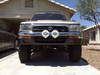
19.9 mpg average on highway, 18.89 mpg mixed driving 3vze 5spd. K&N filter Magnaflow exhaust with highflow cat on 31 1050 BFG Muds. Light footed of course! worst mileage with some wheelin 16 mpg


