


CA. SMOG TEST FAILURE! Help from Smog Techs/other Guru's???I'll post my convo with th
 May 10, 2012 | 09:23 AM
#221
Thread Starter
Registered User
iTrader: (5)
Joined: Jun 2009
Posts: 19,281
Likes: 20
From: Lake Havasu, AZ

Glad to have it, HONEST!


 hehehe.
May 10, 2012 | 12:42 PM
hehehe.
May 10, 2012 | 12:42 PM
#222
Thread Starter
Registered User
iTrader: (5)
Joined: Jun 2009
Posts: 19,281
Likes: 20
From: Lake Havasu, AZ
While I'm happy I passed.... I have to wonder what's going on;
I recalculated my LAMBDA #'s with the new results;
15MPH= 14.96;1(or Lambda=1.018) 25MPH= 14.87;1(or Lambda=1.01)
This has me curious as to whether I 'FIXED' or 'CHANGED' anything by returning to stock exhaust. I know it had to 'effect' things, to a point.. But if 'SOMETHING' within the motor(Vacuum Leaking/Bad or dead spotted AFM/ Same 02 that might, at this point, be not up to par/ECU issues/Wiring issues/WHATEVER) is causing it to constantly revert back to this 'LEANER' mixture... I can't be content with that. I will know more when I see the mileage off this tank...... But the LAMBDA, from what I read, is VERY telling.
Also, this new CAT; It's already GOLD in hew. Not rainbow colored like the last one..But nonetheless, I can't seem to find 'CAT indication/Coloration Pictures'. The last thing I want, however, is to ruin YET ANOTHER brand new CAT via "A/F mixture being 'OFF', etc.
I might just take her in and have a smoke test done(to rule out, once and for all, the air getting in some how)... and will probably swap in the new 02 as well.
As I stated to RW... I DID NOT reset the ECU after moving everything around/cutting the 02 wiring and redoing it.. etc. I was rushing and forgot. Thinking that might not matter much since it's the same 02 sensor(even if it IS reading a LIL faster, etc.) ???
Sorry, don't mean to drag this out, AND TRUST ME, I'd rather not be bothering/having to bother! lol. I just want to get the A/F mixture right and be done with it!
ANY thoughts on what I've posted above? Thanks!
I will stop posting here and pursue this ongoing Process of Elimination on my build thread, if anyone would like to help me figure it out...........
https://www.yotatech.com/forums/f199...l#post51914640
I recalculated my LAMBDA #'s with the new results;
15MPH= 14.96;1(or Lambda=1.018) 25MPH= 14.87;1(or Lambda=1.01)
This has me curious as to whether I 'FIXED' or 'CHANGED' anything by returning to stock exhaust. I know it had to 'effect' things, to a point.. But if 'SOMETHING' within the motor(Vacuum Leaking/Bad or dead spotted AFM/ Same 02 that might, at this point, be not up to par/ECU issues/Wiring issues/WHATEVER) is causing it to constantly revert back to this 'LEANER' mixture... I can't be content with that. I will know more when I see the mileage off this tank...... But the LAMBDA, from what I read, is VERY telling.
Also, this new CAT; It's already GOLD in hew. Not rainbow colored like the last one..But nonetheless, I can't seem to find 'CAT indication/Coloration Pictures'. The last thing I want, however, is to ruin YET ANOTHER brand new CAT via "A/F mixture being 'OFF', etc.
I might just take her in and have a smoke test done(to rule out, once and for all, the air getting in some how)... and will probably swap in the new 02 as well.
As I stated to RW... I DID NOT reset the ECU after moving everything around/cutting the 02 wiring and redoing it.. etc. I was rushing and forgot. Thinking that might not matter much since it's the same 02 sensor(even if it IS reading a LIL faster, etc.) ???
Sorry, don't mean to drag this out, AND TRUST ME, I'd rather not be bothering/having to bother! lol. I just want to get the A/F mixture right and be done with it!
ANY thoughts on what I've posted above? Thanks!
I will stop posting here and pursue this ongoing Process of Elimination on my build thread, if anyone would like to help me figure it out...........
https://www.yotatech.com/forums/f199...l#post51914640
Last edited by ChefYota4x4; May 10, 2012 at 01:00 PM.
May 10, 2012 | 01:19 PM
#223

Exhaust manifold/header and EGR have no impact on A/F ratio. That is the ECU and the AFM and Os sensor that determine that. My guess is the AFM is set a little bit lean like I think mine is. When I smog test mine, I run a brand new Toyota O2 sensor so I know that is good (or at least as good as it can be). And my guess was back in the time this emissions system was designed, it was HC and CO that were the big evils, so running a bit lean was a good thing. Lean makes HC/CO go down, but also makes NOx go up. Back in the '80s, you did not measure NOx on the idle smog tests, just HC and CO.
May 10, 2012 | 01:51 PM
#224

Chef,
Congrats my friend, way to work through this ordeal! I am curious as to your out come with the oem exhaust mani ect.
Kind of a side not, but if you having A/F mixture problems (this is a long shot) have you thought about swapping out the ecu for a know good one? (unless I missed this already) The only reason I ask, awhile back I had a problem running rich and had some sever sputtering, they symptoms were identical to a broken tps and or messed up O2, I replace both of those Items with know good ones and the problem was fixed....for about a week! Did some more trouble shooting, pulled most of my hair out, had a few headaches and after all that I still had the problem, searched High and low and could not find anything to work.
I then decided to sit down and read and trouble shoot anythign from the ecu that may cause those issues. I was led to the O2, tps, ecu, in that order. With having alreay replaced the first two items, I figured I was at my wits end and I would try a new ecu (used but new to me) Low and behold, the lean condition, sputtering ect went away immediatly! I replaced my O2 sensor again and have been running ever since.
Now my point to this is, I had no idea how or why my ecu was having problems, until I opened it up and sand came falling out. YES the sand was somehow arching out my ecu causeing some bad readings one way or another. Guess it is wise to pull the ecu out before having the truck sand blasted...OOOPS
The ecu's dont seem to go bad all that often, but they do, perhaps swap one in and see what you get with your A/f ratio after the new one is installed?
Great Job, And I look forward to seeing your progress!
Congrats my friend, way to work through this ordeal! I am curious as to your out come with the oem exhaust mani ect.
Kind of a side not, but if you having A/F mixture problems (this is a long shot) have you thought about swapping out the ecu for a know good one? (unless I missed this already) The only reason I ask, awhile back I had a problem running rich and had some sever sputtering, they symptoms were identical to a broken tps and or messed up O2, I replace both of those Items with know good ones and the problem was fixed....for about a week! Did some more trouble shooting, pulled most of my hair out, had a few headaches and after all that I still had the problem, searched High and low and could not find anything to work.
I then decided to sit down and read and trouble shoot anythign from the ecu that may cause those issues. I was led to the O2, tps, ecu, in that order. With having alreay replaced the first two items, I figured I was at my wits end and I would try a new ecu (used but new to me) Low and behold, the lean condition, sputtering ect went away immediatly! I replaced my O2 sensor again and have been running ever since.
Now my point to this is, I had no idea how or why my ecu was having problems, until I opened it up and sand came falling out. YES the sand was somehow arching out my ecu causeing some bad readings one way or another. Guess it is wise to pull the ecu out before having the truck sand blasted...OOOPS
The ecu's dont seem to go bad all that often, but they do, perhaps swap one in and see what you get with your A/f ratio after the new one is installed?
Great Job, And I look forward to seeing your progress!
May 10, 2012 | 03:47 PM
#225

Registered User
Joined: Oct 2009
Posts: 231
Likes: 0
From: wonderful central NJ
Congratulations. Nothing wrong in learning how to repair your own vehicle if you're going to beat it. Just don't do it for a living. Now pull that stuff off and put it on the shelf till next inspection. Your CO2 didn't change from 1st test. Mixture spot on. New cat cleans everything. Meow.
Last edited by Thelast83inNJ; May 10, 2012 at 03:53 PM.
May 10, 2012 | 07:33 PM
#226
Thread Starter
Registered User
iTrader: (5)
Joined: Jun 2009
Posts: 19,281
Likes: 20
From: Lake Havasu, AZ
Roger, that's what throws me... If my oxygen is low(Optimal is around 1.5% for non air injected systems?), why is my LAMBDA HIGH? Reading this, below, I believe I'm starting to understand why the smog guy was a lil thrown off. Still trying to absorb it, but it's slowly making sense!  hehehe. Seems the readings are contrary to logic, if I'm understanding the smog guy a lil better. Good part in there about the CAT masking all kinds of stuff, including potentially serious system problems.
OrRunner, that's strange, because I went through all this weird stuff in my build/early on. The Dealership foreman asked if I could look while he looked as well for a spare ECU... I found one that was labeled "87 PU 4WD EFI"... But it ended up throwing 2 codes, over and over. 02 and Knock Sensor.... What he concluded was that the ECU was NOT 87, but rather, 88... It was looking for another 02 sensor and the Knock Sensors are different? IF NOT, ...then MAYBE it was right and mine just isn't reading everything right. It throws codes most often if you unplug something, etc... So I'm not sure, like you said. NO sand in mine.. But then I can't get the screws out, tried before, lol. BUT, I did have a persistently leaking windshield that I THINK is what caused my COR to go bad, while back. FUNNY THING was,.... with that ECU, it seemed to run smoother, without a miss. Unfortunately, on the advice of the foreman, I returned it, through my buddy. I KNOW MANY places I can get one... just don't wanna throw money at it, ya know? Might get JTD to loan me one(Jap Truck Dismantlers), just for S&G's, ya know? Why not?
TheLast83inNJ, .... hahahaha... You crack me up, man! "Meow know you were speeding, right? Meow here's what I want you to do.....".... Maybe I misread that as a super troopers pun... but anyway, still made me laugh. Far as "not doing it for a living"... another pun? lol. Anyhow, thanks, man.... I appreciate the congratz... Just to be clear though.. I don't mind throwing a CAT in there every 2 years, HELL, why not to avoid this headache??? BUT, ... if, like below, I'm dealing with an issue that's constantly running my internal comb. temps up, lean/rich/lean/rich, all schizophrenic! lol.... Then that would explain why i'm eating CAT's, right? lol... Which makes me want to figure out WHAT is eating the CAT's, exactly, ya know?
************************************************** ***********
I thought this was a great read.... Wording, etc. Very easy to read. BUT, maybe I wouldn't have felt so about 2-3 weeks ago? hahahaha>>>>
Link to the page... http://www.916smog.com/smog-help.html
Copy and pasted whole thing here; >>>
So you just came in to get a smog inspection and your car failed. It's not the end of the world. We are here to help. We want to see your car pass the Smog Inspection just as bad as you do. Let start by explaining the 3 different failures.
1. Visual inspection: These items are listed in the middle of the page under "Emmissions control systems". This is just a list of the components that are supposed to be installed on your vehicle. The Pass/Fail/ or N/A result is just a record or the device being present or missing. So just because it say's "Pass", does not mean the item is functioning properly. If all the visual results are "Pass" or "N/A" then you have passed the visual portion of the test. The other items under visual inspection that are labeled "Functional" are part of the Functional Test.
2. Functional inspection: This part of the test is a record of a test procedure done in the Smog Test. So this Pass/Fail N/A result is differentthan the visual result. If they all say "Pass" or "N/A" then your vehicle has passed this portion. These items include Timing, Egr, Evap, Check Engine Light, OBD2, and Gas Cap Test.
a.Timing: If your vehicle failed the Smog inspection for timing you will need to have your timing adjusted. WARNING! After changing the timing, your Emmissions WILL CHANGE. Sometimes they will get better sometimes worse. If you advance the timing N.O.X. & H.C. inharently go up. If you retard the timing they go down. There are variables to this rule, but this is usually how it works.
b. EGR stands for exhaust gas recirculation. This system is usually not tested in the smog inspection. This system does cause alot of cars to fail, but this item will be covered in "Emmisions" portion of this information.
c. Evap is a system. It is a bunch of different components installed that make this a system. These consist of a gas tank, hoses, a charcoal canister and valves or switches. If your vehicle has failed for EVAP, then our test has indicated your system has a leak. This could be a simple hose all the way to a leaky O-ring on top of the tank. It is very difficult to pin point a Evap leak without having a Smoke Machine. These systems are usually a resonably price to repair and should be repaired by a repair facility that has the appropriate equipment (Smog Check Test and Repair Station)
d. Check Engine Light is the light on your dash that usually say's check engine, pcm, engine or has a picture of a motor. There are many different kinds. If this light does not come on it fails the functional portion or the smog inspection. If it comes on but stay's on then it fail's the smog inspection also. This light is an indication there is a problem with your emmisions system. This does NOT mean the computer is bad. In 20yrs as a technition I have replaced less that 20 computers (ECM) in vehicles. They normally do NOT go bad. Usual cause is a sensor out of range, or a disconnected wire or ground from previous repairs. My recomendation to fix this problem is find a licenced Smog Check repair facility. Approx 98% of our 2nd attempt failures are from people taking there cars to "shade tree mechanics". I see people spend more money getting their car fixed at home than at a shop. Most repairs are under $500 at a licensed Smog Check Station.
e. obd2 is only applicable if your vehicle is a 1996 or newer and is done by plugging in our machine to your obd2 data port. After it is plugged in, it reads the Monitors and any fault codes. The vehicle has several different monitors. One for each different system. There is usually not a problem with this test as long as your check engine light is not on, your mechanic has not erased or resest the computer, and you have not changed the vehicle battery recently (approx30 miles).
f. Gas Cap is self explanitory. If the gas cap is bad we will tell you and sell you a new so you can pass the Smog Test. Some stations fail you and then charge you for the gas cap and another Smog Test Inspection.
3.Emissions:
General Background
Concentration of combustion products in the vehicle's exhaust, most of which pollute the air, give important diagnostic clues to the vehicle's engine efficiency. The component gases which contribute the most to air pollution are hydrocarbons (HC), carbon monoxide (CO) and oxides of nitrogen (NOx). This is not N2O (NITROUS). Three of the five gases measured at the tailpipe are regulated pollutants - HC, CO and NOx. The remaining gases, oxygen (O2) And carbon dioxide (CO2), while non-regulated, play a significant role as diagnostic aids. THe 4 gas analyzer measures HC, CO, CO2 and O2 concentrations. The five gas analyzer (BAR 97) adds the measurement of NOx as well.
The exhaust gas analyzer is a highly versatile and accurate test instrument. In addition to testing carbon monoxide (CO), carbon dioxide (CO2), oxygen (O2), hydrocarbons (HC) and oxides of nitrogen (NOx) (5-gas version) for repair requirements or after a tune-up, it can be used to assist in detecting and locating, fuel, exhaust, emission control and engine service problems. Following are a few general facts to keep in mind when using the gas analyzer:
1) High Carbon Monoxide (CO) readings usually indicate a fuel mixture richer than ideal (rich mixture - air fuel ratio below 14.7). In general CO is an indicator of combustion efficiency. The amount of CO in a vehicle’s exhaust is directly related to its air-fuel ratio. High CO levels result from inadequate O2 supply needed for complete combustion. This is caused by a too rich mixture - too much fuel (AFR readings below the optimal 14.7, Lambda below 1.0). If your vehicle failed the Smog Inspection and has a high C.O. level, This should always be fixed first. Circumstances that can lead to high CO emissions:
* Improper float settings in carbureted vehicles
* Dirty or restricted air filters
*Excessively dirty or contaminated oil
*Saturated charcoal canister
*Non-Functioning PCV valve system
*Improper operation of the fuel delivery system
*Improperly functioning thermactor system
*Catalytic converter intervention and CO concentrations
High CO readings at the tailpipe are an clear indication that there is a problem in at least one part of the system, but an CO reading that appears within "normal" ranges or is only modestly elevated is not necessarily a reliable indicator of proper or even acceptable system performance. Low range C.O. readings are possible, and not uncommon, from a malfunctioning engine equipped with a properly functioning catalytic converter. In such circumstances, truly elevated pre-catalytic converter CO levels will be masked by the catalytic converter and the potential for a CO problem must be further evaluated in the context of other readings of abnormal gas concentrations and AFR / Lambda readings.
2) Normal CO readings. If the combustion process is succeeding at or near the stoichiometric point (AFR equals 14.7, Lambda equals 1.0), C.O. levels during an idle test will typically measure less than 1% Pre-Catalytic Converter.
3) Low CO readings. There is, effectively, no reading for CO that can be characterized as too low or "below optimal". CO concentrations will appear "normal" even in a lean burning environment, where AFR is above 14.7 (Lambda is above 1.0).
4) High hydrocarbon (HC) readings usually indicate excessive unburned fuel caused by a lack of ignition or by incomplete combustion. ALWAYS FIX CO BEFORE HC. Concentrations are measured in parts per million (PPM). Common causes include a faulty ignition system, vacuum leaks, and fuel mixture problems. Circumstances that can lead to a high HC emissions are:
* Incomplete combustion due to fouled spark plugs.
* Improper timing or dwell
* Damaged ignition wires
* Low compression
* Vacuum leak
* Ineffective or faulty air management system (ECM control of air/fuel ratios)
* Catalytic converter intervention and HC concentrations
High HC readings at the tailpipe are an clear indication that there is a problem in at least one part of the system, but an HC reading that appears within "normal" ranges or is only modestly elevated is not necessarily a reliable indicator of proper or even acceptable system performance. HC readings at or near "normal" are possible, and not uncommon. From a malfunctioning engine equipped with a properly functioning catalytic converter. In such circumstances, truly elevated pre-catalytic converter HC levels will be masked by the catalytic converter and the potential for an HC problem must be further evaluated in the context of other readings of abnormal gas concentrations and AFR / Lambda readings.
5) Oxygen (O2) readings. Oxygen, measured as a percentage of the exhaust volume, reflects the amount of gas remaining in the exhaust sample after the combustion process has taken place. Ambient O2 readings should be about 20%, reflecting the natural amount oxygen found in the air. The ideal range for vehicles without a secondary air injection system is less than 1.5%. If there is an air injection system, O2 levels will typically fall n the range of 3% to 4%. Pinching off the air hose of a vehicle equipped with air injection should produce O2 levels similar to those found for vehicles without air injection.
6) High oxygen (O2) readings indicate too lean an air-fuel ratio (AFR higher than 14.7, Lambda greater than 1.0). Circumstances that can lead to high O2 emissions are:
* Lean fuel mixture (AFR above 14.7)
* Vacuum leaks
* Ignition related problems causing misfires.
7) Low O2 indicates a rich fuel mixture (AFR below 14.7, Lambda below 1.0).
8) High carbon dioxide (CO2) readings indicate a nearly ideal air-fuel ratio and efficient combustion
9) Low carbon dioxide (CO2) readings indicate a fuel mixture either too rich or too lean, exhaust system leaks, or sample dilution.
10) Oxides of Nitrogen readings. Oxides of nitrogen (NOx), including nitric oxide (NO) and nitrous oxide (NO2), are formed if the combustion temperatures within the combustion chamber exceed some 2,500 degrees F. This can occur when the engine is under load. When excessive temperature conditions exist, the greatest amount of NOx is typically produced at the stoichiometric point (AFR 14.7 or Lambda of 1.0) as the engine is under a light load. If the combustion process within an engine is burning fuel at or near stoichiometric point, NOx levels on acceleration will typically read significantly higher than those measured at cruise and during deceleration. Typically, the NOx readings at idle will be 0 PPM.
11) High NOx Readings. Circumstances that can lead to abnormally high NOx emissions are:
* Malfunctioning EGR valve
* Lean fuel mixture (AFR above 14.7, Lambda above 1.0)
* Improper spark advance
* Thermostatic air heater stuck in the heated air position
* Missing or damaged cold air duct
* Combustion chamber deposits
* Malfunctioning catalytic converter
* Catalytic converter intervention and NOx concentrations
High NOx readings at the tailpipe are an clear indication that there is a problem in at least one part of the system, but an NOx reading that appears within "normal" ranges or is only modestly elevated is not necessarily a reliable indicator of proper or even acceptable system performance. NOx readings at or near "normal" are possible, and not uncommon. From a malfunctioning engine equipped with a properly functioning catalytic converter. In such circumstances, truly elevated pre-catalytic converter NOx levels will be masked by the catalytic converter and the potential for an NOx problem must be further evaluated in the context of other readings of abnormal gas concentrations and AFR / Lambda readings.
12) Low NOx readings. There is, effectively, no reading for NOx that can be characterized as too low or below optimal. NOx is naturally 0 ppm at idle. NOx concentrations may appear normal even in a rich burning environment where the AFR is well below 14.7 (Lambda below 1.0).
TOP
Facts to Remember
The byproducts of combustion are dependent on the air-fuel ratio.
13) O2 combines with HC to form CO2 and H2O.
14) O2 combines with CO to form CO2.
15) CO is an indicator of air-fuel mixture richness.
16) HC is an indicator of fuel mixture leanness (or richness) and misfires.
17) CO and O2 are equal at the stoichiometric air-fuel ratio.
18) O2 and CO2 are indicators of exhaust system integrity, sample hose and probe integrity, or both.
19) CO2 is an indicator of combustion efficiency that peaks at or near the stoichiometric air-fuel ratios, and decreases with lean or rich air-fuel ratio.
20) Air injection systems dilute the exhaust sample with O2.
21) O2 is essential for proper operation of the catalytic converter. Its concentrations are essentially unchanged by the catalytic converter, providing a "window" through the converter to the engine. O2 levels are higher on vehicles with properly operating air injection systems.
22) If CO goes up, O2 goes down (inversely related)
23) If O2 goes up, CO goes down (inversely related)
24) With the air injection system disabled and the CO above 1%, the catalytic converter is oxygen-starved. Without O2, it does not fire, allowing exhaust concentrations to be more like readings taken ahead of the converter.
If readings are within the manufacturer’s or local/state/federal allowable limits, it can generally be assumed that the fuel, ignition, and emission control systems are functioning properly. If they exceed the limits, repairs or adjustments are probably called for.
hehehe. Seems the readings are contrary to logic, if I'm understanding the smog guy a lil better. Good part in there about the CAT masking all kinds of stuff, including potentially serious system problems.OrRunner, that's strange, because I went through all this weird stuff in my build/early on. The Dealership foreman asked if I could look while he looked as well for a spare ECU... I found one that was labeled "87 PU 4WD EFI"... But it ended up throwing 2 codes, over and over. 02 and Knock Sensor.... What he concluded was that the ECU was NOT 87, but rather, 88... It was looking for another 02 sensor and the Knock Sensors are different? IF NOT, ...then MAYBE it was right and mine just isn't reading everything right. It throws codes most often if you unplug something, etc... So I'm not sure, like you said. NO sand in mine.. But then I can't get the screws out, tried before, lol. BUT, I did have a persistently leaking windshield that I THINK is what caused my COR to go bad, while back. FUNNY THING was,.... with that ECU, it seemed to run smoother, without a miss. Unfortunately, on the advice of the foreman, I returned it, through my buddy. I KNOW MANY places I can get one... just don't wanna throw money at it, ya know? Might get JTD to loan me one(Jap Truck Dismantlers), just for S&G's, ya know? Why not?
TheLast83inNJ, .... hahahaha... You crack me up, man! "Meow know you were speeding, right? Meow here's what I want you to do.....".... Maybe I misread that as a super troopers pun... but anyway, still made me laugh. Far as "not doing it for a living"... another pun? lol. Anyhow, thanks, man.... I appreciate the congratz... Just to be clear though.. I don't mind throwing a CAT in there every 2 years, HELL, why not to avoid this headache??? BUT, ... if, like below, I'm dealing with an issue that's constantly running my internal comb. temps up, lean/rich/lean/rich, all schizophrenic! lol.... Then that would explain why i'm eating CAT's, right? lol... Which makes me want to figure out WHAT is eating the CAT's, exactly, ya know?
************************************************** ***********
I thought this was a great read.... Wording, etc. Very easy to read. BUT, maybe I wouldn't have felt so about 2-3 weeks ago? hahahaha>>>>
Link to the page... http://www.916smog.com/smog-help.html
Copy and pasted whole thing here; >>>
So you just came in to get a smog inspection and your car failed. It's not the end of the world. We are here to help. We want to see your car pass the Smog Inspection just as bad as you do. Let start by explaining the 3 different failures.
1. Visual inspection: These items are listed in the middle of the page under "Emmissions control systems". This is just a list of the components that are supposed to be installed on your vehicle. The Pass/Fail/ or N/A result is just a record or the device being present or missing. So just because it say's "Pass", does not mean the item is functioning properly. If all the visual results are "Pass" or "N/A" then you have passed the visual portion of the test. The other items under visual inspection that are labeled "Functional" are part of the Functional Test.
2. Functional inspection: This part of the test is a record of a test procedure done in the Smog Test. So this Pass/Fail N/A result is differentthan the visual result. If they all say "Pass" or "N/A" then your vehicle has passed this portion. These items include Timing, Egr, Evap, Check Engine Light, OBD2, and Gas Cap Test.
a.Timing: If your vehicle failed the Smog inspection for timing you will need to have your timing adjusted. WARNING! After changing the timing, your Emmissions WILL CHANGE. Sometimes they will get better sometimes worse. If you advance the timing N.O.X. & H.C. inharently go up. If you retard the timing they go down. There are variables to this rule, but this is usually how it works.
b. EGR stands for exhaust gas recirculation. This system is usually not tested in the smog inspection. This system does cause alot of cars to fail, but this item will be covered in "Emmisions" portion of this information.
c. Evap is a system. It is a bunch of different components installed that make this a system. These consist of a gas tank, hoses, a charcoal canister and valves or switches. If your vehicle has failed for EVAP, then our test has indicated your system has a leak. This could be a simple hose all the way to a leaky O-ring on top of the tank. It is very difficult to pin point a Evap leak without having a Smoke Machine. These systems are usually a resonably price to repair and should be repaired by a repair facility that has the appropriate equipment (Smog Check Test and Repair Station)
d. Check Engine Light is the light on your dash that usually say's check engine, pcm, engine or has a picture of a motor. There are many different kinds. If this light does not come on it fails the functional portion or the smog inspection. If it comes on but stay's on then it fail's the smog inspection also. This light is an indication there is a problem with your emmisions system. This does NOT mean the computer is bad. In 20yrs as a technition I have replaced less that 20 computers (ECM) in vehicles. They normally do NOT go bad. Usual cause is a sensor out of range, or a disconnected wire or ground from previous repairs. My recomendation to fix this problem is find a licenced Smog Check repair facility. Approx 98% of our 2nd attempt failures are from people taking there cars to "shade tree mechanics". I see people spend more money getting their car fixed at home than at a shop. Most repairs are under $500 at a licensed Smog Check Station.
e. obd2 is only applicable if your vehicle is a 1996 or newer and is done by plugging in our machine to your obd2 data port. After it is plugged in, it reads the Monitors and any fault codes. The vehicle has several different monitors. One for each different system. There is usually not a problem with this test as long as your check engine light is not on, your mechanic has not erased or resest the computer, and you have not changed the vehicle battery recently (approx30 miles).
f. Gas Cap is self explanitory. If the gas cap is bad we will tell you and sell you a new so you can pass the Smog Test. Some stations fail you and then charge you for the gas cap and another Smog Test Inspection.
3.Emissions:
General Background
Concentration of combustion products in the vehicle's exhaust, most of which pollute the air, give important diagnostic clues to the vehicle's engine efficiency. The component gases which contribute the most to air pollution are hydrocarbons (HC), carbon monoxide (CO) and oxides of nitrogen (NOx). This is not N2O (NITROUS). Three of the five gases measured at the tailpipe are regulated pollutants - HC, CO and NOx. The remaining gases, oxygen (O2) And carbon dioxide (CO2), while non-regulated, play a significant role as diagnostic aids. THe 4 gas analyzer measures HC, CO, CO2 and O2 concentrations. The five gas analyzer (BAR 97) adds the measurement of NOx as well.
The exhaust gas analyzer is a highly versatile and accurate test instrument. In addition to testing carbon monoxide (CO), carbon dioxide (CO2), oxygen (O2), hydrocarbons (HC) and oxides of nitrogen (NOx) (5-gas version) for repair requirements or after a tune-up, it can be used to assist in detecting and locating, fuel, exhaust, emission control and engine service problems. Following are a few general facts to keep in mind when using the gas analyzer:
1) High Carbon Monoxide (CO) readings usually indicate a fuel mixture richer than ideal (rich mixture - air fuel ratio below 14.7). In general CO is an indicator of combustion efficiency. The amount of CO in a vehicle’s exhaust is directly related to its air-fuel ratio. High CO levels result from inadequate O2 supply needed for complete combustion. This is caused by a too rich mixture - too much fuel (AFR readings below the optimal 14.7, Lambda below 1.0). If your vehicle failed the Smog Inspection and has a high C.O. level, This should always be fixed first. Circumstances that can lead to high CO emissions:
* Improper float settings in carbureted vehicles
* Dirty or restricted air filters
*Excessively dirty or contaminated oil
*Saturated charcoal canister
*Non-Functioning PCV valve system
*Improper operation of the fuel delivery system
*Improperly functioning thermactor system
*Catalytic converter intervention and CO concentrations
High CO readings at the tailpipe are an clear indication that there is a problem in at least one part of the system, but an CO reading that appears within "normal" ranges or is only modestly elevated is not necessarily a reliable indicator of proper or even acceptable system performance. Low range C.O. readings are possible, and not uncommon, from a malfunctioning engine equipped with a properly functioning catalytic converter. In such circumstances, truly elevated pre-catalytic converter CO levels will be masked by the catalytic converter and the potential for a CO problem must be further evaluated in the context of other readings of abnormal gas concentrations and AFR / Lambda readings.
2) Normal CO readings. If the combustion process is succeeding at or near the stoichiometric point (AFR equals 14.7, Lambda equals 1.0), C.O. levels during an idle test will typically measure less than 1% Pre-Catalytic Converter.
3) Low CO readings. There is, effectively, no reading for CO that can be characterized as too low or "below optimal". CO concentrations will appear "normal" even in a lean burning environment, where AFR is above 14.7 (Lambda is above 1.0).
4) High hydrocarbon (HC) readings usually indicate excessive unburned fuel caused by a lack of ignition or by incomplete combustion. ALWAYS FIX CO BEFORE HC. Concentrations are measured in parts per million (PPM). Common causes include a faulty ignition system, vacuum leaks, and fuel mixture problems. Circumstances that can lead to a high HC emissions are:
* Incomplete combustion due to fouled spark plugs.
* Improper timing or dwell
* Damaged ignition wires
* Low compression
* Vacuum leak
* Ineffective or faulty air management system (ECM control of air/fuel ratios)
* Catalytic converter intervention and HC concentrations
High HC readings at the tailpipe are an clear indication that there is a problem in at least one part of the system, but an HC reading that appears within "normal" ranges or is only modestly elevated is not necessarily a reliable indicator of proper or even acceptable system performance. HC readings at or near "normal" are possible, and not uncommon. From a malfunctioning engine equipped with a properly functioning catalytic converter. In such circumstances, truly elevated pre-catalytic converter HC levels will be masked by the catalytic converter and the potential for an HC problem must be further evaluated in the context of other readings of abnormal gas concentrations and AFR / Lambda readings.
5) Oxygen (O2) readings. Oxygen, measured as a percentage of the exhaust volume, reflects the amount of gas remaining in the exhaust sample after the combustion process has taken place. Ambient O2 readings should be about 20%, reflecting the natural amount oxygen found in the air. The ideal range for vehicles without a secondary air injection system is less than 1.5%. If there is an air injection system, O2 levels will typically fall n the range of 3% to 4%. Pinching off the air hose of a vehicle equipped with air injection should produce O2 levels similar to those found for vehicles without air injection.
6) High oxygen (O2) readings indicate too lean an air-fuel ratio (AFR higher than 14.7, Lambda greater than 1.0). Circumstances that can lead to high O2 emissions are:
* Lean fuel mixture (AFR above 14.7)
* Vacuum leaks
* Ignition related problems causing misfires.
7) Low O2 indicates a rich fuel mixture (AFR below 14.7, Lambda below 1.0).
8) High carbon dioxide (CO2) readings indicate a nearly ideal air-fuel ratio and efficient combustion
9) Low carbon dioxide (CO2) readings indicate a fuel mixture either too rich or too lean, exhaust system leaks, or sample dilution.
10) Oxides of Nitrogen readings. Oxides of nitrogen (NOx), including nitric oxide (NO) and nitrous oxide (NO2), are formed if the combustion temperatures within the combustion chamber exceed some 2,500 degrees F. This can occur when the engine is under load. When excessive temperature conditions exist, the greatest amount of NOx is typically produced at the stoichiometric point (AFR 14.7 or Lambda of 1.0) as the engine is under a light load. If the combustion process within an engine is burning fuel at or near stoichiometric point, NOx levels on acceleration will typically read significantly higher than those measured at cruise and during deceleration. Typically, the NOx readings at idle will be 0 PPM.
11) High NOx Readings. Circumstances that can lead to abnormally high NOx emissions are:
* Malfunctioning EGR valve
* Lean fuel mixture (AFR above 14.7, Lambda above 1.0)
* Improper spark advance
* Thermostatic air heater stuck in the heated air position
* Missing or damaged cold air duct
* Combustion chamber deposits
* Malfunctioning catalytic converter
* Catalytic converter intervention and NOx concentrations
High NOx readings at the tailpipe are an clear indication that there is a problem in at least one part of the system, but an NOx reading that appears within "normal" ranges or is only modestly elevated is not necessarily a reliable indicator of proper or even acceptable system performance. NOx readings at or near "normal" are possible, and not uncommon. From a malfunctioning engine equipped with a properly functioning catalytic converter. In such circumstances, truly elevated pre-catalytic converter NOx levels will be masked by the catalytic converter and the potential for an NOx problem must be further evaluated in the context of other readings of abnormal gas concentrations and AFR / Lambda readings.
12) Low NOx readings. There is, effectively, no reading for NOx that can be characterized as too low or below optimal. NOx is naturally 0 ppm at idle. NOx concentrations may appear normal even in a rich burning environment where the AFR is well below 14.7 (Lambda below 1.0).
TOP
Facts to Remember
The byproducts of combustion are dependent on the air-fuel ratio.
13) O2 combines with HC to form CO2 and H2O.
14) O2 combines with CO to form CO2.
15) CO is an indicator of air-fuel mixture richness.
16) HC is an indicator of fuel mixture leanness (or richness) and misfires.
17) CO and O2 are equal at the stoichiometric air-fuel ratio.
18) O2 and CO2 are indicators of exhaust system integrity, sample hose and probe integrity, or both.
19) CO2 is an indicator of combustion efficiency that peaks at or near the stoichiometric air-fuel ratios, and decreases with lean or rich air-fuel ratio.
20) Air injection systems dilute the exhaust sample with O2.
21) O2 is essential for proper operation of the catalytic converter. Its concentrations are essentially unchanged by the catalytic converter, providing a "window" through the converter to the engine. O2 levels are higher on vehicles with properly operating air injection systems.
22) If CO goes up, O2 goes down (inversely related)
23) If O2 goes up, CO goes down (inversely related)
24) With the air injection system disabled and the CO above 1%, the catalytic converter is oxygen-starved. Without O2, it does not fire, allowing exhaust concentrations to be more like readings taken ahead of the converter.
If readings are within the manufacturer’s or local/state/federal allowable limits, it can generally be assumed that the fuel, ignition, and emission control systems are functioning properly. If they exceed the limits, repairs or adjustments are probably called for.
May 10, 2012 | 09:01 PM
#227

Registered User
Joined: Dec 2011
Posts: 1,388
Likes: 8
From: CA, Until TSHTF!
OK....................... break in the monotony OF THIS CRAP! lol.....
Lately, I've been so used to just doing "the bare minimum" for myself to eat... Portion controlling everything, etc. ... Cuz my clients that I cook for have to have a pretty much fixed menu at this point with my life like it is right now....... SOOOO, today, I said, 'FUUUUUUUUUUUUUUUUUUUUUUUUGGETABOUTIT! lol... Went and Grabbed some Top Quality meat.. RACK O-LAMB! lol.... Did a fat tater and sour cream with some sauted spinach, red onion and garlic in creamery butter and coconut oil, then remembered, "HEY, I just made some Red Jalepeno Pepper Jam last week... AND IT'S ON! lol>>>>
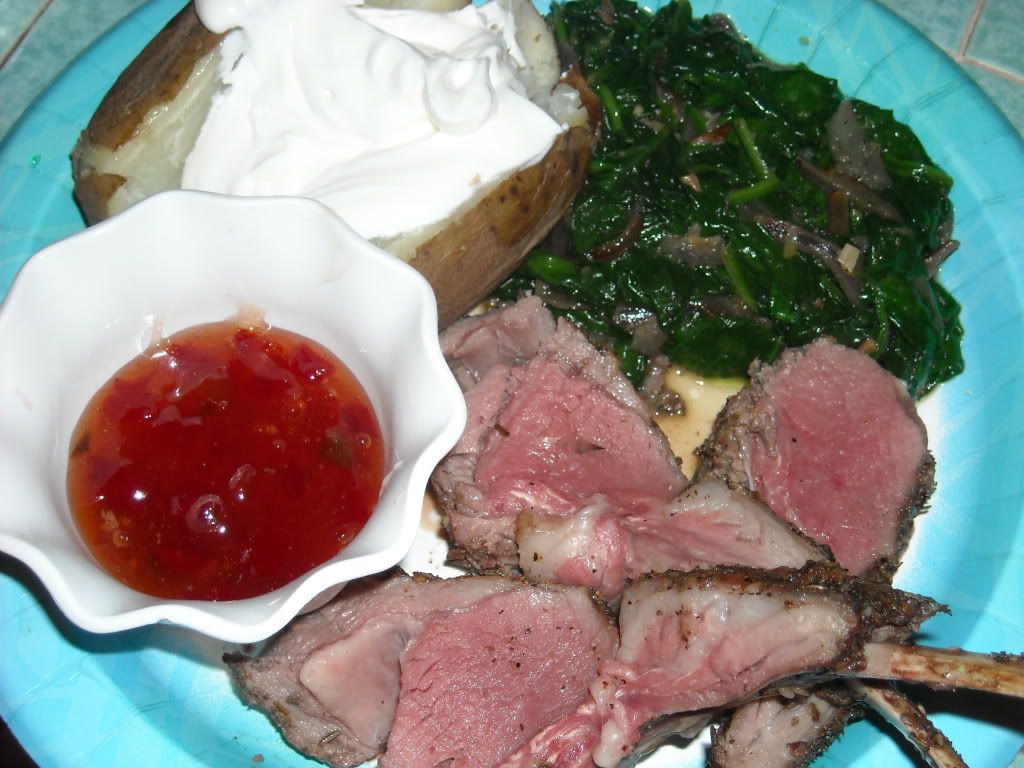
Not sure why the pic is so red... it's PERFECT Medium Rare.... to the Degree, trust me! lol. anyway, MAN that was good... And as the old Mennen Aftershave Commercial used to say, ...........'THANKS, I needed that!', lol...
Thanks again for all the chiming in, guys.. I appreciate it much! And I know, it's hard to figure everything out over the computer, lol. This stuff should be a lil easier to pinpoint.. but I might not have what I need on hand. We'll see, I'll ALWAYS try til I'm out of options/or about to jump off a STEEP cliff! lol.
Lately, I've been so used to just doing "the bare minimum" for myself to eat... Portion controlling everything, etc. ... Cuz my clients that I cook for have to have a pretty much fixed menu at this point with my life like it is right now....... SOOOO, today, I said, 'FUUUUUUUUUUUUUUUUUUUUUUUUGGETABOUTIT! lol... Went and Grabbed some Top Quality meat.. RACK O-LAMB! lol.... Did a fat tater and sour cream with some sauted spinach, red onion and garlic in creamery butter and coconut oil, then remembered, "HEY, I just made some Red Jalepeno Pepper Jam last week... AND IT'S ON! lol>>>>
Not sure why the pic is so red... it's PERFECT Medium Rare.... to the Degree, trust me! lol. anyway, MAN that was good... And as the old Mennen Aftershave Commercial used to say, ...........'THANKS, I needed that!', lol...
Thanks again for all the chiming in, guys.. I appreciate it much! And I know, it's hard to figure everything out over the computer, lol. This stuff should be a lil easier to pinpoint.. but I might not have what I need on hand. We'll see, I'll ALWAYS try til I'm out of options/or about to jump off a STEEP cliff! lol.
This is what I had to eat that day. HaHa! Glad to see you up and running again. No worries now.
 May 10, 2012 | 10:06 PM
#228
Thread Starter
Registered User
iTrader: (5)
Joined: Jun 2009
Posts: 19,281
Likes: 20
From: Lake Havasu, AZ
Hey KSTI! Sup dawg? Glad to see you getting a fully balanced "Meaty Recipe" down yer neck each day! GOOD BOY! hehehehehe. C'monnnnnnn, that means YOU EAT WELL, I'll betcha... GET OUTTA HERE, man! hahaha.
No worries? Yeah, not so sure... It's a relief to pass, NO DOUBT... gives me time, for driving around or to the mountains, etc., due to those pesky mandatory "Mod's" called TAGS! hahaha. RAN down to AAA today and slapped those tags on 20 minutes after parking... GOTTA LOVE THE 'AAA'!!!!!!!! (especially now that they have an "Express Licensing" lane! WOOT! Walked in at 1:30pm.... walked out at 1:41PM, NO KIDDING!)
No worries? Yeah, not so sure... It's a relief to pass, NO DOUBT... gives me time, for driving around or to the mountains, etc., due to those pesky mandatory "Mod's" called TAGS! hahaha. RAN down to AAA today and slapped those tags on 20 minutes after parking... GOTTA LOVE THE 'AAA'!!!!!!!! (especially now that they have an "Express Licensing" lane! WOOT! Walked in at 1:30pm.... walked out at 1:41PM, NO KIDDING!)
May 10, 2012 | 10:47 PM
#229
Thread Starter
Registered User
iTrader: (5)
Joined: Jun 2009
Posts: 19,281
Likes: 20
From: Lake Havasu, AZ
Roger, I just want to thank you, AGAIN, for doing stuff like this>>>>>
http://www.4crawler.com/4x4/CheapTricks/AFM/index.shtml
YES, I already have a basic understanding of how the AFM works/how it relates to the ECU/02 adjusting sending readings thereafter... BUT..... I remember asking you a while back about some stuff I was reading on this swapped in AFM I had to buy.... One being how it read High in a couple spots(1400ohm +) Another being, "why is it 'dropping off' in spots?".....
Well, 10K miles later, I'm still wondering on a couple things... But reading your explanation in "the important part of this testing"... I REEEE-read this;
"2. On test #2, you should see the resistance generally increase as the AFM plate is moved from closed to open, but it may not be in a smooth linear fashion. The resistor track in the AFM is laser trimmed for calibration at the factory and you may see sections where the resistance first increases, the drops down a little before increasing some more. What you want to watch for are places where the resistance drops below 20 or above 1000 ohms (for example if it goes to infinite/open circuit) as that would indicate a problem."
AMAZING, how reading some things a couple more times can inform me that I WAS MISSING SOMETHING HUGE! lol... Primarily, the "you may see sections where the resistance first increases, the drops down a little before increasing some more." part! hahaha. So, instead of being so concerned about the 'dropping back' at points... I just want to know about what to think about hitting that 1400 ohm reading near the 100% Wide Open Vane???
I'll check it again and operate it VERY slowly.... Checking to see if it hits some high numbers along the way, as well. I'll also look more carefully for spots where it drops below 20!
I'll report back.....
http://www.4crawler.com/4x4/CheapTricks/AFM/index.shtml
YES, I already have a basic understanding of how the AFM works/how it relates to the ECU/02 adjusting sending readings thereafter... BUT..... I remember asking you a while back about some stuff I was reading on this swapped in AFM I had to buy.... One being how it read High in a couple spots(1400ohm +) Another being, "why is it 'dropping off' in spots?".....
Well, 10K miles later, I'm still wondering on a couple things... But reading your explanation in "the important part of this testing"... I REEEE-read this;
"2. On test #2, you should see the resistance generally increase as the AFM plate is moved from closed to open, but it may not be in a smooth linear fashion. The resistor track in the AFM is laser trimmed for calibration at the factory and you may see sections where the resistance first increases, the drops down a little before increasing some more. What you want to watch for are places where the resistance drops below 20 or above 1000 ohms (for example if it goes to infinite/open circuit) as that would indicate a problem."
AMAZING, how reading some things a couple more times can inform me that I WAS MISSING SOMETHING HUGE! lol... Primarily, the "you may see sections where the resistance first increases, the drops down a little before increasing some more." part! hahaha. So, instead of being so concerned about the 'dropping back' at points... I just want to know about what to think about hitting that 1400 ohm reading near the 100% Wide Open Vane???
I'll check it again and operate it VERY slowly.... Checking to see if it hits some high numbers along the way, as well. I'll also look more carefully for spots where it drops below 20!
I'll report back.....
 May 11, 2012 | 08:12 AM
#231

Registered User
Joined: Mar 2003
Posts: 630
Likes: 3
From: Antelope Valley, SoCal
I thought this was worth pointing out from that site. I condensed it a bit for readability:
This is immediately what sprang to mind when I first read mention about AFR "calculators" in this thread. Those calculators can only use measurements post-cat and may provide useful information for ideally-functioning engines without any sort of air injection. For vehicles with air injection systems they're not even close to accurate. That is precisely why the ECU only adjusts mixture based on readings from an O2 sensor that is upstream of external influences like that. O2 sensors downstream of cat converters are solely there to make sure the cat is present and working. If exhaust gas oxygen(EGO) readings didn't change after going through the cat, then the second sensor would be completely useless.
The first section in a three-way catalyst is the reducing catalyst that breaks oxides of nitrogen into nitrogen and oxygen. The purpose is to allow the oxidizing catalyst to better oxidize HCs into CO2 and H2O while the harmless N2 continues out the tailpipe in the same form as ingested by the engine. Nitrogen is an inert gas. Nitrogen oxides form nitric acid when combined with (atmospheric) water, which is why such pains are taken to reduce their production.
*Catalytic converter intervention and CO/HC/NOx concentrations:
High CO readings at the tailpipe are an clear indication that there is a problem in at least one part of the system, but an CO/HC/NOx reading that appears within "normal" ranges or is only modestly elevated is not necessarily a reliable indicator of proper or even acceptable system performance. Low range CO/HC/NOx readings are possible, and not uncommon, from a malfunctioning engine equipped with a properly functioning catalytic converter. In such circumstances, truly elevated pre-catalytic converter CO/HC/NOx levels will be masked by the catalytic converter and the potential for a CO/HC/NOx problem must be further evaluated in the context of other readings of abnormal gas concentrations and AFR / Lambda readings.
High CO readings at the tailpipe are an clear indication that there is a problem in at least one part of the system, but an CO/HC/NOx reading that appears within "normal" ranges or is only modestly elevated is not necessarily a reliable indicator of proper or even acceptable system performance. Low range CO/HC/NOx readings are possible, and not uncommon, from a malfunctioning engine equipped with a properly functioning catalytic converter. In such circumstances, truly elevated pre-catalytic converter CO/HC/NOx levels will be masked by the catalytic converter and the potential for a CO/HC/NOx problem must be further evaluated in the context of other readings of abnormal gas concentrations and AFR / Lambda readings.
The first section in a three-way catalyst is the reducing catalyst that breaks oxides of nitrogen into nitrogen and oxygen. The purpose is to allow the oxidizing catalyst to better oxidize HCs into CO2 and H2O while the harmless N2 continues out the tailpipe in the same form as ingested by the engine. Nitrogen is an inert gas. Nitrogen oxides form nitric acid when combined with (atmospheric) water, which is why such pains are taken to reduce their production.
May 11, 2012 | 11:15 AM
#232
Thread Starter
Registered User
iTrader: (5)
Joined: Jun 2009
Posts: 19,281
Likes: 20
From: Lake Havasu, AZ
I thought this was worth pointing out from that site. I condensed it a bit for readability:
This is immediately what sprang to mind when I first read mention about AFR "calculators" in this thread. Those calculators can only use measurements post-cat and may provide useful information for ideally-functioning engines without any sort of air injection. For vehicles with air injection systems they're not even close to accurate. That is precisely why the ECU only adjusts mixture based on readings from an O2 sensor that is upstream of external influences like that. O2 sensors downstream of cat converters are solely there to make sure the cat is present and working. If exhaust gas oxygen(EGO) readings didn't change after going through the cat, then the second sensor would be completely useless.
The first section in a three-way catalyst is the reducing catalyst that breaks oxides of nitrogen into nitrogen and oxygen. The purpose is to allow the oxidizing catalyst to better oxidize HCs into CO2 and H2O while the harmless N2 continues out the tailpipe in the same form as ingested by the engine. Nitrogen is an inert gas. Nitrogen oxides form nitric acid when combined with (atmospheric) water, which is why such pains are taken to reduce their production.
This is immediately what sprang to mind when I first read mention about AFR "calculators" in this thread. Those calculators can only use measurements post-cat and may provide useful information for ideally-functioning engines without any sort of air injection. For vehicles with air injection systems they're not even close to accurate. That is precisely why the ECU only adjusts mixture based on readings from an O2 sensor that is upstream of external influences like that. O2 sensors downstream of cat converters are solely there to make sure the cat is present and working. If exhaust gas oxygen(EGO) readings didn't change after going through the cat, then the second sensor would be completely useless.
The first section in a three-way catalyst is the reducing catalyst that breaks oxides of nitrogen into nitrogen and oxygen. The purpose is to allow the oxidizing catalyst to better oxidize HCs into CO2 and H2O while the harmless N2 continues out the tailpipe in the same form as ingested by the engine. Nitrogen is an inert gas. Nitrogen oxides form nitric acid when combined with (atmospheric) water, which is why such pains are taken to reduce their production.
Hey Dirty, .... yeah, that's EXACTLY what I was highlighting on my build thread. I would have done that here as well but got distracted and then EXHAUSTED! lol.(Just by life-circumstance, not reading that^^^ lol).
And THAT is what has me concerned, Dirty.... I mean, I've had this miss through 3 MOTORS! Along with that, bad mileage(ESPECIALLY BAD before the exhaust swap, we'll see if anything improves, I doubt it), including 10-11mpg last tank(Yes, a lil skinny pedal heavy at times, but NOTHING more that most! lol)... And some intermittent weird stuff ASIDE from the miss.
All in all, this is what I notice;
1. Mileage is low, even for one of these
2. Have a very noticeable miss(which according to the tech didn't appear to be a misfire, as he read the tach)
3. SEEMINGLY, I'm going through CAT's(Seems the CATCO being crapco and HG failure, along with running rich/lean might have helped it along, but I don't know WHICH had HOW MUCH to do with it all.)
4. This brand new CAT is turned GOLD already... is that normal? I don't think so, but asking anyhow. lol.
I want to re-mention some things;
1. I have 2 ECU's. The one in there now? Can't remember if it's the donor or original.
2. Another donor ECU I had(which was labeled as 87 4wd EFI) kept throwing 02 and Knock Sensor Codes. The dealership foreman(really helped me out w/out charging me) kept testing the 02 readings, couldn't find a problem, so he thought it MUST BE an 88+ ECU that is looking for a 'heated' 02 and thus throwing a 'signal code'. Thinking back, the odd thing to me is that the CEL did NOT stay on. It would come and go. Odd part, being, "Wouldn't an 88 ECU be looking for 2 02SENSORS? Thus, wouldn't it ALWAYS have a code up?"... It would help to get an answer to that one. I can't be positive, but it seemed to run smoother with that ECU, just that it was idling higher? ONLY thing I can think of is; If it WAS the wrong ECU for my rig and it's Sensors.... MAYBE it was just going into the pre-set loop and causing it to SEEM smoother, due to more fuel? But NOW, knowing what I've learned... I'm thinking, "WAIT A MINUTE... if it was a n 88 ECU... wouldn't it have been 'missing' a signal from the EGR temp sensor and EGR VSV?" I also seem to remember that 'the foreman' thought it odd that it was reading the codes with flashes similar to an 88+, where they have codes like 52, etc. Mine goes up to what, 15 codes? lol. WISH I had that ECU still. Another thing, wouldn't it throw codes for Injector misreadings? I mean, the 88 Injectors have a different impedance, don't they???? (This one really has me curious... Not sure it would throw EGR Temp Sensor Codes and VSV codes and second 02 Codes or not? It not, WHY not?)
3. The Smog Tech mentioned that "the FPR not doing it's job can wreak havoc on these... It may APPEAR to work when pulling the Vacuum, but if it's not limiting pressure enough at idle, I've seen it cause a miss bcuz it's dumping more fuel than it's supposed to. The 02 would see this as too much fuel, then lean out. If it leans out at higher RPM when you're FPR is actually supposed to be wide open/inactive...then I could see that causing the CAT to get SUPER hot. Also, Lean and Rich both destroy CAT's early. It's one explanation for why you have odd readings of both rich and lean at points in this testing, MAYBE."
************************************************** ****
Sorry guys, I'm just really having trouble figuring out which if any of the 'components' that the ECU relate to might be having issues/If it's just an ECU problem in and of itself. I can try the other ECU I have, which I KNOW is for an 87..... But as I remember, nothing changed/no CEL's, nothing. I'll try it anyhow, but any thoughts on whether any of this sparks something from memory/experience, I'm VERY grateful in advance.
Last edited by ChefYota4x4; May 11, 2012 at 11:24 AM.
May 11, 2012 | 02:17 PM
#233
Thread Starter
Registered User
iTrader: (5)
Joined: Jun 2009
Posts: 19,281
Likes: 20
From: Lake Havasu, AZ
AFM;
1. All preliminary(1st Stage w/out moving vane) testing checks out ok.
2. Secondary Testing for the "Vane- Open/Close/Sweeping" testing(all on "2K Ohm Setting, since 200 is my next lowest and not able to measure above 200ohm)....
...a. closed, ".258" (Which I assume means "258.00", RIGHT? lol)
...b. FULLY opened, "0.989K"
...c. SWEEPING, THIS is what I'm asking, Roger, etc..... "I hit 1200, 1400, even 1600 ohm (1.400, 1.200, 1.600, set at 2k on mm)....
************************************************** ************
02 Sensor;
Swapped in the NEW-Denso from Spark Plugs.com;
NO change in miss/haven't had time to check for mileage difference yet.
************************************************** **************
ECU;
1. I'm fully aware that these are RARELY known to go bad.
2. I've tested most everything at the ECU, both voltage and resistance checks, more than once. NOTHING stood out as odd or 'wiring might be an issue', ya know?
3. I now have removed the Salvage Yard Donor and Re-installed my ORIGINAL ECU.
.....a. I need more time to run it to check and see if it's just relearning stuff's
.....b. BUT, it seems a TINY bit less 'chunky' at idle. Same full power and no hesitation
.....c. Still notice a small miss at the tailpipe but not quite as much
************************************************** ****************
Catalytic Converters #1 and #2;
1. Obviously, I'm running a new CAT. The old one had two very prominent purple stripes in it and obviously, it was not working up to par any longer(since I passed with flying colors, comparatively, after installing a new one)..... But could anyone tell me if it should be turning 'GOLD'??? Any smog guys? I don't notice the 'striped' purple bands, few inches apart, like on the last one I just removed. Rather, this one, the entire thing is turning GOLD. ???
2. I did a Video of the CAT that I removed, to show the coloration, etc. I saw a "Example Poster" on the wall at the exhaust shop... I didn't look further than the one that was similar to mine.... which according to the poster was TOAST or at least running WAY TOO HOT, lol. So I'm just looking for another example of 'how a CAT should appear' in coloration. NO one? lol.
************************************************** ************
Did a few more videos on running, before and after new 02, before and after new 02 AND ECU.... etc. I'll upload them in a few, just have stuff to do first.
Thanks, guys, for anything and everything, lol
1. All preliminary(1st Stage w/out moving vane) testing checks out ok.
2. Secondary Testing for the "Vane- Open/Close/Sweeping" testing(all on "2K Ohm Setting, since 200 is my next lowest and not able to measure above 200ohm)....
...a. closed, ".258" (Which I assume means "258.00", RIGHT? lol)
...b. FULLY opened, "0.989K"
...c. SWEEPING, THIS is what I'm asking, Roger, etc..... "I hit 1200, 1400, even 1600 ohm (1.400, 1.200, 1.600, set at 2k on mm)....
************************************************** ************
02 Sensor;
Swapped in the NEW-Denso from Spark Plugs.com;
NO change in miss/haven't had time to check for mileage difference yet.
************************************************** **************
ECU;
1. I'm fully aware that these are RARELY known to go bad.
2. I've tested most everything at the ECU, both voltage and resistance checks, more than once. NOTHING stood out as odd or 'wiring might be an issue', ya know?
3. I now have removed the Salvage Yard Donor and Re-installed my ORIGINAL ECU.
.....a. I need more time to run it to check and see if it's just relearning stuff's
.....b. BUT, it seems a TINY bit less 'chunky' at idle. Same full power and no hesitation
.....c. Still notice a small miss at the tailpipe but not quite as much
************************************************** ****************
Catalytic Converters #1 and #2;
1. Obviously, I'm running a new CAT. The old one had two very prominent purple stripes in it and obviously, it was not working up to par any longer(since I passed with flying colors, comparatively, after installing a new one)..... But could anyone tell me if it should be turning 'GOLD'??? Any smog guys? I don't notice the 'striped' purple bands, few inches apart, like on the last one I just removed. Rather, this one, the entire thing is turning GOLD. ???
2. I did a Video of the CAT that I removed, to show the coloration, etc. I saw a "Example Poster" on the wall at the exhaust shop... I didn't look further than the one that was similar to mine.... which according to the poster was TOAST or at least running WAY TOO HOT, lol. So I'm just looking for another example of 'how a CAT should appear' in coloration. NO one? lol.
************************************************** ************
Did a few more videos on running, before and after new 02, before and after new 02 AND ECU.... etc. I'll upload them in a few, just have stuff to do first.
Thanks, guys, for anything and everything, lol
May 11, 2012 | 02:22 PM
#234
Registered User
Joined: Mar 2003
Posts: 630
Likes: 3
From: Antelope Valley, SoCal
3. The Smog Tech mentioned that "the FPR not doing it's job can wreak havoc on these... It may APPEAR to work when pulling the Vacuum, but if it's not limiting pressure enough at idle, I've seen it cause a miss bcuz it's dumping more fuel than it's supposed to. The 02 would see this as too much fuel, then lean out. If it leans out at higher RPM when you're FPR is actually supposed to be wide open/inactive...then I could see that causing the CAT to get SUPER hot. Also, Lean and Rich both destroy CAT's early. It's one explanation for why you have odd readings of both rich and lean at points in this testing, MAYBE."
************************************************** ****
************************************************** ****
May 11, 2012 | 02:30 PM
#235
Thread Starter
Registered User
iTrader: (5)
Joined: Jun 2009
Posts: 19,281
Likes: 20
From: Lake Havasu, AZ
So, Dirty Dude, ....
Whatcha think I should be looking into? Couldn't the FPR being iffy cause SOME issue with 'rich' condition? Or you're saying the ECU, through 02 will eventually back off the injectors even if the FPressure is too high?
I see what you're saying about the CAT. I do know for certain that it was GLOWING red hot at times... And now, after the fact, you can see the irredescent discoloration of the CAT in 'Stripes', for lack of a better word at the moment, lol.
But, do you know if my current CAT should be GOLD? It seems to be 'EVENLY' colored the same, all the way across..... ?? Bronze, Gold, ...that kinda hue(Hew? lol).
PS> I WILL speak to him again, as I don't want to misrepresent what he's saying. The guys done those intensive HIGH TECH Auto Training courses for 30 years, ... I'm SURE I'm misquoting him, sorry man. He was just saying, at one point, "the FPR CAN cause problems"... So
Whatcha think I should be looking into? Couldn't the FPR being iffy cause SOME issue with 'rich' condition? Or you're saying the ECU, through 02 will eventually back off the injectors even if the FPressure is too high?
I see what you're saying about the CAT. I do know for certain that it was GLOWING red hot at times... And now, after the fact, you can see the irredescent discoloration of the CAT in 'Stripes', for lack of a better word at the moment, lol.
But, do you know if my current CAT should be GOLD? It seems to be 'EVENLY' colored the same, all the way across..... ?? Bronze, Gold, ...that kinda hue(Hew? lol).
PS> I WILL speak to him again, as I don't want to misrepresent what he's saying. The guys done those intensive HIGH TECH Auto Training courses for 30 years, ... I'm SURE I'm misquoting him, sorry man.
He was just saying, at one point, "the FPR CAN cause problems"... So
Last edited by ChefYota4x4; May 11, 2012 at 04:04 PM.
May 11, 2012 | 05:39 PM
#236
Registered User
Joined: Mar 2003
Posts: 630
Likes: 3
From: Antelope Valley, SoCal
1.) Whatcha think I should be looking into? Couldn't the FPR being iffy cause SOME issue with 'rich' condition? Or you're saying the ECU, through 02 will eventually back off the injectors even if the FPressure is too high?
2.) But, do you know if my current CAT should be GOLD? It seems to be 'EVENLY' colored the same, all the way across..... ?? Bronze, Gold, ...that kinda hue(Hew? lol).
2.) But, do you know if my current CAT should be GOLD? It seems to be 'EVENLY' colored the same, all the way across..... ?? Bronze, Gold, ...that kinda hue(Hew? lol).
2.) Honestly, I don't know how to gauge the health of a cat converter by heat discoloration. Is yours welded on? If not, you could always unbolt the front end and look at the core. Since you got through emissions with it so recently, It's probably still working. Stainless headers just about always turn gold to brown...
May 11, 2012 | 09:00 PM
#237
Thread Starter
Registered User
iTrader: (5)
Joined: Jun 2009
Posts: 19,281
Likes: 20
From: Lake Havasu, AZ
1.) Yeah, that's what I'm saying: the ECU will use O2 feedback to get the mixture back where it should, but only within the authority of the ECU. 20% is a number I hear a lot, although I'm sure it varies. At this point I would be ready to weld in a bung and see what a wideband sensor says is going on. Not sure if that's an option on your end; I have an Innovate LC-1 wideband myself. Yes, a faulty FPR can cause problems. They are referenced to manifold vacuum so that the pressure differential across the injector stays constant all the time. When that fails to happen, the mixture goes hinky. The mechanic you spoke is right; the FPR can cause problems.
2.) Honestly, I don't know how to gauge the health of a cat converter by heat discoloration. Is yours welded on? If not, you could always unbolt the front end and look at the core. Since you got through emissions with it so recently, It's probably still working. Stainless headers just about always turn gold to brown...
2.) Honestly, I don't know how to gauge the health of a cat converter by heat discoloration. Is yours welded on? If not, you could always unbolt the front end and look at the core. Since you got through emissions with it so recently, It's probably still working. Stainless headers just about always turn gold to brown...
Thanks, appreciated.......
Yeah, I'm going to solve the 'CAT-coloration' question by simply heading down there, asap, just asking the dude(or looking on his chart, lol). Either way... it might tell me 'somethings rich', etc., but it wont really point me in any specific direction at this point... As before, which was the same, lol. Next post I'm throwing up some videos of the CAT that was removed and a couple other things. I could see light through it, even though the pipe thereafter was angled.... More light than the original that I lost
lol. SOOOOOO, I might be best off having that Smog Repair place(or another I can trust) slap a scope on it or whatever and just pin down what is causing the "RICH", which I'm guessing is the likely case, considering my mileage, etc.?
Roger/4Crawler might know if those readings from my AFM are really questionable...(hitting 1400 and 1600 ohms at spots), but it sure seems like it from his tutorial. The best way to test them(from what I've read from tech's like yourself, is with it running and through the connector from the backside, with the boot pulled back... NO CLUE how to do that, just yet, ... so I'll have to look into it some.
I also need to test the fuel pressure and get that portion verified/ruled out once and for all. Think the HFreight FP kit would do?
May 12, 2012 | 10:11 AM
#238

Registered User
Joined: Apr 2012
Posts: 2,817
Likes: 2
From: Los Angeles CA
Damn Chef. Looks like your quite the expert now. You went through hell with smog testing. lol
Well if i start having trouble passing my smog test im sure i can come to you with any questions if it doesnt pass. Either that or just pay the guy $200 ha ha ha!
Well if i start having trouble passing my smog test im sure i can come to you with any questions if it doesnt pass. Either that or just pay the guy $200 ha ha ha!
May 12, 2012 | 10:32 AM
#239
Registered User
Joined: Apr 2012
Posts: 2,817
Likes: 2
From: Los Angeles CA
Reading through some of these posts in here makes me wish i had my old truck back sometimes. Although i love the power the 3.0 v6 has on my 4runner; the 22r motor was easier to mess with to get to pass the smog check. That is one of the main reasons i have always loved carburetor motors. When i had problems passing my smog check back in 2006 or so i remember putting in tons of $$$ into the truck just to get the damn thing to pass the smog check. after a while they told me now it is running to lean.
Fusterated and despirate for answers i took it to "Kings Carburetor" on Florence ave near the 110 freeway.(im sure u know where it is) and these guys showed me a trick that i will never forget.
The guy showed me that carburetors have a small little knob that can be turned with a small screwdriver to control how much gas you want to pass through. You can make it run leaner or less lean. And showed me how to adjust it. Told when he made it leaner you could tell the truck was practically turning off due to too running too lean, almost as if the motor felt like it was drowning. Then he showed me the other way and lowered it as much as possible to the point where it was nearly turning off on me but just barely able to run on the street. (I noticed a huge power loss while driving when he did this)And told me. That should fix your problem. Take it back to the A$$Hole who wont pass your truck, and ill be willing to be you bet you that it is gonna pass on the first try. Then he told me once it passes the smog test just turn the knob back to normal and you will have the power you had before you passed the smog test.
Sure Enough, I passed the first time after returning to the smog test guy. This is one of the reasons i learned to love carburetor motors. Although Fuel injection is much better, after learning this little trick i really liked them.
Hopefully i dont run into any problems when i take my truck in for its check up. After all it is pretty much gonna have a brand new engine since im getting it rebuilt, brand new catylic converter and flowmaster muffler. I'll be damned if it wont pass the first time around. lol Be pissed off especially since i dont know any tricks like the carburetor one for my 3.0 motor ha ha
Fusterated and despirate for answers i took it to "Kings Carburetor" on Florence ave near the 110 freeway.(im sure u know where it is) and these guys showed me a trick that i will never forget.
The guy showed me that carburetors have a small little knob that can be turned with a small screwdriver to control how much gas you want to pass through. You can make it run leaner or less lean. And showed me how to adjust it. Told when he made it leaner you could tell the truck was practically turning off due to too running too lean, almost as if the motor felt like it was drowning. Then he showed me the other way and lowered it as much as possible to the point where it was nearly turning off on me but just barely able to run on the street. (I noticed a huge power loss while driving when he did this)And told me. That should fix your problem. Take it back to the A$$Hole who wont pass your truck, and ill be willing to be you bet you that it is gonna pass on the first try. Then he told me once it passes the smog test just turn the knob back to normal and you will have the power you had before you passed the smog test.
Sure Enough, I passed the first time after returning to the smog test guy. This is one of the reasons i learned to love carburetor motors. Although Fuel injection is much better, after learning this little trick i really liked them.
Hopefully i dont run into any problems when i take my truck in for its check up. After all it is pretty much gonna have a brand new engine since im getting it rebuilt, brand new catylic converter and flowmaster muffler. I'll be damned if it wont pass the first time around. lol Be pissed off especially since i dont know any tricks like the carburetor one for my 3.0 motor ha ha
May 12, 2012 | 11:28 AM
#240
Thread Starter
Registered User
iTrader: (5)
Joined: Jun 2009
Posts: 19,281
Likes: 20
From: Lake Havasu, AZ
Hahahahaa.... Sup my Local Yotatechie Brutha? lol....
Wow, yeah... I had an 83 with 38K when I bought it... Guy said he'd never seen one that clean... Then he saw the miles! hahaha. Stock Carb, stock everything... But the key, IMHO, ORIGINAL CAT! The OEM 3way CA Cat's were just FAR superior to the newer ones. Even magnaflow... But alas, even in aftermarket.... BIG differences in quality/amount of product inside, ya know? The exhaust guy told me, "Why do you think they only guarantee NEW OE Cat's for 2 years? Cuz THAT'S ALL THEY LAST, exactly!" lol. He said the Magnaflow should last me longer, but if I don't fix whatever is causing the High NOX/High Internal Combustion Temps/Occasional, Opposite 'RICH' conditions.... I'm doomed to repeat this and go through motors a bit faster........
...... THAT is why I'm still on this. And, NOT much behind that reason?.... CUZ I WANNA HELP ANYONE who might be having a similar strange issue like mine(Bad Mileage in City/CAT's heating up/Rumbling miss that annoys like NOTHING else! lol... You know, that stuff! lol).
Sounds like you found a good guy, bud! GREAT to have those in your book, ya KWImean?
3.0+NEW CAT should equal 'PASS', as long as you pass all the inspection portion. Go through that post I did above, look for the things they'll look at. Some guys grab a new GAS cap and keep it for only tests(box it after, for when theirs finally fails, if it ever fails). Pretty cheap at Toy. Look through the Vacuum stuffs, make sure the timing is right, etc. ya know?
Wow, yeah... I had an 83 with 38K when I bought it... Guy said he'd never seen one that clean... Then he saw the miles! hahaha. Stock Carb, stock everything... But the key, IMHO, ORIGINAL CAT! The OEM 3way CA Cat's were just FAR superior to the newer ones. Even magnaflow... But alas, even in aftermarket.... BIG differences in quality/amount of product inside, ya know? The exhaust guy told me, "Why do you think they only guarantee NEW OE Cat's for 2 years? Cuz THAT'S ALL THEY LAST, exactly!" lol. He said the Magnaflow should last me longer, but if I don't fix whatever is causing the High NOX/High Internal Combustion Temps/Occasional, Opposite 'RICH' conditions.... I'm doomed to repeat this and go through motors a bit faster........
...... THAT is why I'm still on this. And, NOT much behind that reason?.... CUZ I WANNA HELP ANYONE who might be having a similar strange issue like mine(Bad Mileage in City/CAT's heating up/Rumbling miss that annoys like NOTHING else! lol... You know, that stuff! lol).
Sounds like you found a good guy, bud!
GREAT to have those in your book, ya KWImean? 3.0+NEW CAT should equal 'PASS', as long as you pass all the inspection portion. Go through that post I did above, look for the things they'll look at. Some guys grab a new GAS cap and keep it for only tests(box it after, for when theirs finally fails, if it ever fails). Pretty cheap at Toy. Look through the Vacuum stuffs, make sure the timing is right, etc. ya know?


