


sway bar options?
 Oct 8, 2005 | 03:17 PM
#1
Thread Starter
Registered User
Joined: Sep 2003
Posts: 169
Likes: 0
From: Amarillo, Texas
sway bar options?
Lately I've noticed my runner acting a little skittish on small abrupt bumps on the highway. Today I realized that my right hand sway bar link is broken. I figure this is not helping my handeling issue along with worn out shocks. The truck is stock as it sits but I'm about to get some OME springs and shocks all around. Is there a better alternative to the factory sway bar set up that may complemint the OME set up?
Oct 8, 2005 | 04:20 PM
#2

Factory sway bar is fine, or I imagine there are stiffer bars available aftermarket, Sway-A-Way, Addco, etc.
Or, just get some new end-links the proper length for the lift you'll be putting on:
http://www.4crawler.com/4x4/CheapTri...#DisconnectsV2
Or, just get some new end-links the proper length for the lift you'll be putting on:
http://www.4crawler.com/4x4/CheapTri...#DisconnectsV2
Oct 8, 2005 | 06:19 PM
#3
Sponsor
Joined: Jul 2004
Posts: 9,173
Likes: 6
From: Puyallup WA.
the other thing you can do its yank them out completely, i've ran NO sway bars for a while with out a problem, including smashing through mountain curvie roads.... you'll get better flex with out them too.
Oct 8, 2005 | 06:39 PM
#4

Registered User
Joined: Nov 2003
Posts: 536
Likes: 0
From: Blowing Rock, NC
yeah no sway bars isn't too bad if you're off the pavement a good bit. I live in the mountains and it's actually kind of fun driving on the winding mountain roads with them off, but on the highway at 65+ it gets a little tricky. You really need to keep a good hand on the wheel and hope that you dont have to make any emergency maneuvers.
Oct 8, 2005 | 07:04 PM
#5

Contributing Member
Joined: Jul 2005
Posts: 1,963
Likes: 0
From: Socal
Originally Posted by ASU4runner
yeah no sway bars isn't too bad if you're off the pavement a good bit. I live in the mountains and it's actually kind of fun driving on the winding mountain roads with them off, but on the highway at 65+ it gets a little tricky. You really need to keep a good hand on the wheel and hope that you dont have to make any emergency maneuvers.
Oct 8, 2005 | 08:43 PM
#6
Thread Starter
Registered User
Joined: Sep 2003
Posts: 169
Likes: 0
From: Amarillo, Texas
I didn't even think about needing more length on the sway bar link with the added spring height. Am I correct in thinking that the sway bar end should be level with the lower control arm?
Oct 8, 2005 | 09:03 PM
#7
You bet, generally you want the ends of the sway bar to be sitting horizontal at rest. Why? Drive hard around a turn and one side of the bar is pushed up, one side pulls up on the opposite side of the suspension. If you start out horizontal on the end, the up and down angles are the same, so you get equal forces on the bar and suspension. If, for example you lifted the suspension and left the bar hanging down at some angle and went around the same corner, the one side would push the end of the bar up, closer to horizontal. The other side would be pulled down farther by the opposing suspension arm. With the near horizontal end, it would have the full leverage effect on the sway bar since the cosine of 90 degrees is 1.0. However the end of the bar that is down at some angle, would have a lesser amount of leverage, reduced by the cosine of it's angle. So this imbalance would result in the bar needing to be twisted farther to resist the cornering force, more twist = more lean in the vehicle or a less efficient sway bar. For example, assume the bar was down at 15 degrees due to the lift and in a turn it was twisted 15 up and down. That would leave the up side at 0 degrees (i.e. horizontal) and the down side down at 30 degrees. At a 30 degree angle the efective length of the end of the bar is now only 86.6% what is was when level (i.e. cos(30)=0.866). So that side can only provide 86% of the roll resistance as it could when level.
A good lift kit should have available a properly sized end-link replacement for the sway bars. Same thing with an LSPV bracket for the rear axle.
A good lift kit should have available a properly sized end-link replacement for the sway bars. Same thing with an LSPV bracket for the rear axle.
Last edited by 4Crawler; Oct 8, 2005 at 09:18 PM.
Trending Topics
Oct 9, 2005 | 05:22 AM
#9

Originally Posted by 4Crawler
You bet, generally you want the ends of the sway bar to be sitting horizontal at rest. Why? Drive hard around a turn and one side of the bar is pushed up, one side pulls up on the opposite side of the suspension. If you start out horizontal on the end, the up and down angles are the same, so you get equal forces on the bar and suspension. If, for example you lifted the suspension and left the bar hanging down at some angle and went around the same corner, the one side would push the end of the bar up, closer to horizontal. The other side would be pulled down farther by the opposing suspension arm. With the near horizontal end, it would have the full leverage effect on the sway bar since the cosine of 90 degrees is 1.0. However the end of the bar that is down at some angle, would have a lesser amount of leverage, reduced by the cosine of it's angle. So this imbalance would result in the bar needing to be twisted farther to resist the cornering force, more twist = more lean in the vehicle or a less efficient sway bar. For example, assume the bar was down at 15 degrees due to the lift and in a turn it was twisted 15 up and down. That would leave the up side at 0 degrees (i.e. horizontal) and the down side down at 30 degrees. At a 30 degree angle the efective length of the end of the bar is now only 86.6% what is was when level (i.e. cos(30)=0.866). So that side can only provide 86% of the roll resistance as it could when level.
A good lift kit should have available a properly sized end-link replacement for the sway bars. Same thing with an LSPV bracket for the rear axle.
A good lift kit should have available a properly sized end-link replacement for the sway bars. Same thing with an LSPV bracket for the rear axle.

 Oct 9, 2005 | 09:59 AM
#10
Contributing Member
Joined: Jul 2005
Posts: 1,963
Likes: 0
From: Socal
Originally Posted by 4Crawler
You bet, generally you want the ends of the sway bar to be sitting horizontal at rest. Why? Drive hard around a turn and one side of the bar is pushed up, one side pulls up on the opposite side of the suspension. If you start out horizontal on the end, the up and down angles are the same, so you get equal forces on the bar and suspension. If, for example you lifted the suspension and left the bar hanging down at some angle and went around the same corner, the one side would push the end of the bar up, closer to horizontal. The other side would be pulled down farther by the opposing suspension arm. With the near horizontal end, it would have the full leverage effect on the sway bar since the cosine of 90 degrees is 1.0. However the end of the bar that is down at some angle, would have a lesser amount of leverage, reduced by the cosine of it's angle. So this imbalance would result in the bar needing to be twisted farther to resist the cornering force, more twist = more lean in the vehicle or a less efficient sway bar. For example, assume the bar was down at 15 degrees due to the lift and in a turn it was twisted 15 up and down. That would leave the up side at 0 degrees (i.e. horizontal) and the down side down at 30 degrees. At a 30 degree angle the efective length of the end of the bar is now only 86.6% what is was when level (i.e. cos(30)=0.866). So that side can only provide 86% of the roll resistance as it could when level.
A good lift kit should have available a properly sized end-link replacement for the sway bars. Same thing with an LSPV bracket for the rear axle.
A good lift kit should have available a properly sized end-link replacement for the sway bars. Same thing with an LSPV bracket for the rear axle.
Oct 9, 2005 | 10:49 AM
#11
I added a sketch:
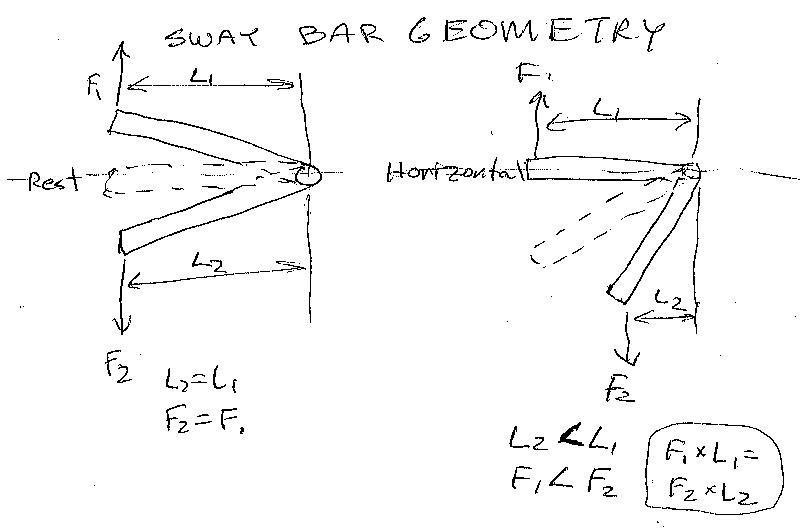
and a description on the web page:
http://www.4crawler.com/4x4/CheapTri...#DisconnectsV2
and a description on the web page:
http://www.4crawler.com/4x4/CheapTri...#DisconnectsV2
Oct 9, 2005 | 11:30 AM
#13
Contributing Member
Joined: Jul 2003
Posts: 8,807
Likes: 3
From: Montreal, QC Canada
Originally Posted by ToferUOP
thanks for reminding why i hated statics so much.... lol jk, it wasnt that bad of a class


Thread
Thread Starter
Forum
Replies
Last Post
JookUpVandetti
86-95 Trucks & 4Runners
10
Sep 30, 2015 08:58 AM


