


Looking for wiring info
 Dec 27, 2015 | 09:10 AM
#1
Thread Starter
Registered User
Joined: Dec 2015
Posts: 212
Likes: 39
From: Peralta, NM
Looking for wiring info
I have a 1983 pickup and I just installed a rear fog light and some hi-lites on the front, but right now I do not know which wires to connect it to. Both are wired into the fuse box but I am very sure that this is not the correct way of doing this and I feel that this puts strain on existing circuits. The rear fog light is at the moment hooked up to the output of the headlight relay and only works when the headlights are on but I would like it to be hooked up to the running light/tail light output line so it can only receive power when the running lights are on but can still be toggled on and off independently. The Hi-Lites do the same thing, and are actually getting positive power from the same circuit. The Hi-Lites are installed with their own relay, and I feel as though the relays have their own lower-amperage circuit and do not get their power directly from the battery.
I can not find where the correct lines are
I would like to know the location of the main wire that the relays get their activation power from, and also the location of the output wire of the running lights.
I can not find where the correct lines are
I would like to know the location of the main wire that the relays get their activation power from, and also the location of the output wire of the running lights.
Dec 27, 2015 | 11:13 AM
#2

Registered User


Joined: Mar 2012
Posts: 7,137
Likes: 685
I would like it to be hooked up to the running light/tail light output line so it can only receive power when the running lights are on but can still be toggled on and off independently.
I would like to know the location of the main wire that the relays get their activation power from, and also the location of the output wire of the running lights.
I would like to know the location of the main wire that the relays get their activation power from, and also the location of the output wire of the running lights.
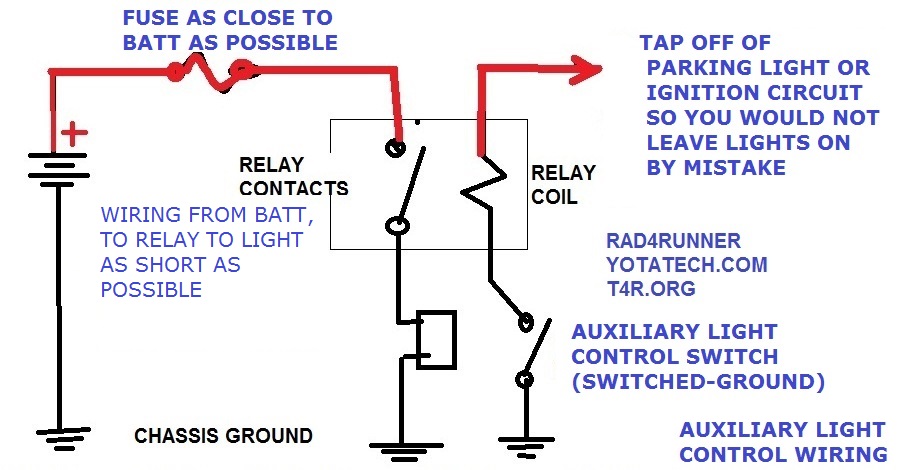
Find front marker wiring closest to BATTERY (earlier I had a typo and typed relay) and find the wire that gets 12Volts when tail lights are on, and zero volt when tail lights are off. Tap off of that to provide 12V to positive coil of your control relay when tail lights are on.
Install switch between negative side of relay coil and ground.
Putting control relay as close as possible to battery and using switched-ground control (like in schematic below) minimizes amount of wires carrying 12V when circuit is off, and you only need to run ONE wire into the cab to the swithc. The other side of the switch can go to a good ground inside the cab. Therefore, less chance of shorting to ground.
Pin-outs:
30 = Load Source
85 = Coil Negative
86 = Coil positive
87 = Output to Load
85 = Coil Negative
86 = Coil positive
87 = Output to Load
Happy New Year!
Last edited by RAD4Runner; Dec 29, 2015 at 08:39 AM.
Dec 27, 2015 | 11:55 PM
#5
Registered User
iTrader: (1)
Joined: Apr 2009
Posts: 13,381
Likes: 100
From: I live in New Tripoli Pa out in the woods

Just curious what are you calling Rear Fog lights ??
Where do you live that you can have a white light on the rear of your vehicle that is not a back up light??
Unless this is off Road Only ??
The best thing if your doing electrical work is get a Copy of Toyota`s Electrical Wiring Diagrams for your vehicle.
3 different Radios should each have there own circuit that way if one fails it does not take them all out.
If you can`t figure things out from RADs Schematic your in over your head.
Where do you live that you can have a white light on the rear of your vehicle that is not a back up light??
Unless this is off Road Only ??
The best thing if your doing electrical work is get a Copy of Toyota`s Electrical Wiring Diagrams for your vehicle.
3 different Radios should each have there own circuit that way if one fails it does not take them all out.
If you can`t figure things out from RADs Schematic your in over your head.
Dec 28, 2015 | 02:13 AM
#6
Thread Starter
Registered User
Joined: Dec 2015
Posts: 212
Likes: 39
From: Peralta, NM
A rear fog light is a single red light on the driver's side that is the same brightness as a brake light.
The purpose of this light is to make your car visible to other vehicles in the fog.
There is only one light and it is always on the driver's side as two lights would obstruct your brake lights.
http://dastern.torque.net/Rearfogs/Rearfogs.html
The purpose of this light is to make your car visible to other vehicles in the fog.
There is only one light and it is always on the driver's side as two lights would obstruct your brake lights.
http://dastern.torque.net/Rearfogs/Rearfogs.html
Dec 28, 2015 | 02:19 AM
#7
Thread Starter
Registered User
Joined: Dec 2015
Posts: 212
Likes: 39
From: Peralta, NM

Here's a pic of the one I have
Also if anyone has a stock rear pipe bumper and/or a rear Japanese tailgate and bed and lives near the Albuquerque area, I would like to hear from you.
Last edited by Johnsoline; Dec 28, 2015 at 02:29 AM.
Trending Topics
Dec 28, 2015 | 08:01 AM
#9
How you wire the fog lights in depends on how you want to use them. In most factory fog light applications, the fog lights are wired to the low beams headlights; HOWEVER, you do not want to power the fog lights with the power to the low beams - it will likely draw too much current and blow your headlight fuses. If you want to wire your fog lights like this, you will need to:
1-Tap into the the low beam wire (+) AFTER the relay\
2-Run that wire that you tapped into the low beam (+) to a relay for your fog lights. 3-Run a (+) wire from a constant power source (IE: Battery) with a in-line fuse close to the power source to the relay.
4-Run a (+) wire from the fog light relay to the fog lights
5-Run a ground wire for the fog lights
6-If you want a switch for your fog lights then simply install a switch within the (+) wire going from the low beam (+) to the for light relay.
In this scenario, you can only turn on your fog lights when the low beams are on and the switch interrupts the power to the the fog light relay to it to connect the circuit. You will not have fog lights with the high beams on or without the low beams on.
Personally, I like to wire my fog lights in their own constant power circuit. I haven't wired mine yet, but when I do I have already installed a constant power fuse block directly off of the battery to which I will run the fog lights to so that I can use the fog lights independently of the headlight and ignition power.
1-Tap into the the low beam wire (+) AFTER the relay\
2-Run that wire that you tapped into the low beam (+) to a relay for your fog lights. 3-Run a (+) wire from a constant power source (IE: Battery) with a in-line fuse close to the power source to the relay.
4-Run a (+) wire from the fog light relay to the fog lights
5-Run a ground wire for the fog lights
6-If you want a switch for your fog lights then simply install a switch within the (+) wire going from the low beam (+) to the for light relay.
In this scenario, you can only turn on your fog lights when the low beams are on and the switch interrupts the power to the the fog light relay to it to connect the circuit. You will not have fog lights with the high beams on or without the low beams on.
Personally, I like to wire my fog lights in their own constant power circuit. I haven't wired mine yet, but when I do I have already installed a constant power fuse block directly off of the battery to which I will run the fog lights to so that I can use the fog lights independently of the headlight and ignition power.
Dec 28, 2015 | 10:21 AM
#10
Registered User
iTrader: (1)
Joined: Apr 2009
Posts: 13,381
Likes: 100
From: I live in New Tripoli Pa out in the woods
This is the first I ever heard of this I think it is a great idea .
Learned something new !!!
Although no one in this part of the country for the most even puts on their lights in the rain or fog.
My luck I would get a ticket for a brake light on all the time.
Learned something new !!!
Although no one in this part of the country for the most even puts on their lights in the rain or fog.
My luck I would get a ticket for a brake light on all the time.

 Dec 28, 2015 | 04:52 PM
#13
Thread Starter
Registered User
Joined: Dec 2015
Posts: 212
Likes: 39
From: Peralta, NM
They may not know what it is but it is completely legal. I have found that when cops ask about it I just tell them that it's a fog light and a safety feature ant they're always just chill with it.
Don't know how it goes outside of my small town though.
Don't know how it goes outside of my small town though.
 Dec 28, 2015 | 11:51 PM
#16
Registered User
iTrader: (1)
Joined: Apr 2009
Posts: 13,381
Likes: 100
From: I live in New Tripoli Pa out in the woods
Simple matter to wire a light any way you want to do it.
If you want a independent circuit just figure what the current draw is for your load (light) is. To size the wire and circuit protection.
You can use a relay or just a switch just using a switch the switch must be rated to carry the load.
Perhaps a refresher on basic DC circuits ??
Some people run direct off the battery others install a second fuse block .
Solder and heat shrink connections .
I am not sure where you having problems but then after a few decades I have yet to learn how to drive a automatic transmission.
If you want a independent circuit just figure what the current draw is for your load (light) is. To size the wire and circuit protection.
You can use a relay or just a switch just using a switch the switch must be rated to carry the load.
Perhaps a refresher on basic DC circuits ??
Some people run direct off the battery others install a second fuse block .
Solder and heat shrink connections .
I am not sure where you having problems but then after a few decades I have yet to learn how to drive a automatic transmission.
Dec 29, 2015 | 04:57 AM
#17
Thread Starter
Registered User
Joined: Dec 2015
Posts: 212
Likes: 39
From: Peralta, NM
I have never heard of a blue fog lamp. The idea was that a lower frequency such as yellow or amber would pierce the fog better than white due to Raleigh Scattering. I assumed since blue was a higher frequency than white that it would have been considered even worse than white and not used.
Also I have come to discover that blue and white light tends to focus in front of the retina, instead of upon it. Because of this, blue and white light tends to appear blurry or glared, and therefore; selective yellow or amber fogs do increase visibility in the fog or other low visibility weather conditions, but not due to Raleigh Scattering as previously thought.
Thanks for the info.
They say that the color frequency idea is false and doesn't really make a difference but I have seen otherwise and quite frankly don't believe them.
I think I probably will go on to create a thread on this very topic.
Also I have come to discover that blue and white light tends to focus in front of the retina, instead of upon it. Because of this, blue and white light tends to appear blurry or glared, and therefore; selective yellow or amber fogs do increase visibility in the fog or other low visibility weather conditions, but not due to Raleigh Scattering as previously thought.
Thanks for the info.
They say that the color frequency idea is false and doesn't really make a difference but I have seen otherwise and quite frankly don't believe them.
I think I probably will go on to create a thread on this very topic.
Last edited by Johnsoline; Dec 30, 2015 at 01:56 AM.
Dec 29, 2015 | 05:07 AM
#18
Thread Starter
Registered User
Joined: Dec 2015
Posts: 212
Likes: 39
From: Peralta, NM
I have always heard that the purpose of a relay is to allow a low-powered circuit to control the power flow in a high-powered circuit in order to allow lighter duty or more compact controls to be used and/or to protect against heat in the line. If I am correct in my information; I am looking for the low-current line that powers the control side of the relays.
If I am incorrect in this information; then what is the purpose of the relay in the first place?
Also I don't know how to drive an automatic either, and I don't really care too much to learn.
If I am incorrect in this information; then what is the purpose of the relay in the first place?
Also I don't know how to drive an automatic either, and I don't really care too much to learn.
Dec 29, 2015 | 08:33 AM
#19
Registered User
Joined: Mar 2012
Posts: 7,137
Likes: 685
I am looking for the low-current line that powers the control side of the relays.
"Find front marker wiring closest to battery (sorry, typo - was relay earlier) and find the wire that gets 12Volts when tail lights are on, and zero volt when tail lights are off. Tap off of that to provide 12V to positive coil of your control relay when tail lights are on."
Sorry, but if you could not do that, this project is beyond your level of expertise.
Last edited by RAD4Runner; Dec 29, 2015 at 08:40 AM.
Dec 29, 2015 | 09:03 AM
#20
I have always heard that the purpose of a relay is to allow a low-powered circuit to control the power flow in a high-powered circuit in order to allow lighter duty or more compact controls to be used and/or to protect against heat in the line. If I am correct in my information; I am looking for the low-current line that powers the control side of the relays.
If I am incorrect in this information; then what is the purpose of the relay in the first place?
If I am incorrect in this information; then what is the purpose of the relay in the first place?
- Run a constant power wire to the fog light relay (most quality fog light kits will have the relay included). You could use an existing wire with constant power; however, you could potentially overload that circuit so I would recommend drawing your constant power directly from the battery. You'll need a fuse between your power source and the relay - preferably as close as practical to the power source. Again, I installed a constant power fuse block off of my battery for several auxiliary power sources - it makes wiring future accessories that need constant power much easier and cleaner.
- To wire your dash mounted switch, you are also going to need a constant power source. You can tap into the power to your headlights, hazards, radio memory wire or anything else that can be powered with the ignition off. You will have to tap into that power source BEFORE the switch or you won't have power to your fog light switch unless the switch powering the circuit you are using is turned on. You'll run that wire to one side of the dash mounted switch and another wire from the other side of the dash mounted switch to the relay. It is not pertinent to have a fuse in the wiring of this switch since you are essentially just "Stealing" 12v to send a signal to the relay to "turn on" the fog lights - thus controlling a higher current circuit (the fog lights wired to the battery) using a lower current as the signal or switch (the power tapped into from a constant source described above) to activate it. If your switch is lighted then you will need to run a ground to the switch for the light to work.
- Wire your fog lights to the switched power source on the relay and run your ground wires to the frame or body. A lot of people like to run one (+) wire from the relay to one fog light and then wire the second fog light to the first - mainly because it is easier. But this can potentially over load the wire going to the first fog light from the relay so I like to run two independent (+) wires from the relay to each fog light.
- Don't forget to run a ground wire for your relay - your relay can't "Switch" without being grounded.
On your relay you will have four numbered poles: 30, 85, 86 & 87. Here's how they wire up:
- 30 --> Fuse --> Battery (+)
- 85 --> Ground
- 86 --> Dash Switch --> Constant power source under the dash
- 87 --> Fog Lights
Clear as mud??


