


Radiator hose clamps?
 Oct 5, 2015 | 08:05 AM
#21

Registered User
Joined: Jul 2012
Posts: 1,776
Likes: 110
From: Northern Colorado
I've never had any problem using worm-drive clamps. Keep in mind that they heat up and expand at fairly close to the same rate as the pipe underneath the hose, so the change in clamping pressure isn't as great as all that.
Generally, for manufacturing, the criteria is (1) adequate for the job, meaning that it will last as long as the hose (or the vehicle warranty), (2) really quick and easy to install, preferably in an automated way, and (3) cheap.
So, just because Toyota doesn't use worm-drive clamps doesn't mean they're worse than the spring clamps, and it doesn't mean they're better. It means the spring clamps are adequate, they install quicker than the worm clamps, and they're cheap. That's really all you can say without reading the engineers' lab notebooks.
Generally, for manufacturing, the criteria is (1) adequate for the job, meaning that it will last as long as the hose (or the vehicle warranty), (2) really quick and easy to install, preferably in an automated way, and (3) cheap.
So, just because Toyota doesn't use worm-drive clamps doesn't mean they're worse than the spring clamps, and it doesn't mean they're better. It means the spring clamps are adequate, they install quicker than the worm clamps, and they're cheap. That's really all you can say without reading the engineers' lab notebooks.
Oct 5, 2015 | 09:09 AM
#22

Registered User

Joined: Sep 2007
Posts: 8,381
Likes: 873
From: San Francisco East Bay
I have noticed that with some older hoses held with worm-drive clamps, the hose "oozes" through the "gear teeth" in the clamp. I'm not sure that's any different than the permanent mark left in the hose by a spring clamp. But if the hose looks (to me) like it's starting to age, I generally assume that it HAS aged and I replace it. With the same (worm-drive or spring) clamp.
Oct 5, 2015 | 10:24 AM
#24
Registered User
Joined: Sep 2007
Posts: 8,381
Likes: 873
From: San Francisco East Bay
Personally, I would be afraid that if I tried to "line" the hose clamp I would end up with the clamp slipping. There are clamps that seem to have this as a design feature (I'm thinking of Oetiker clamps, which are pretty rare in automotive), but if it was a real improvement some genius would start selling lined worm-gear clamps for $1 extra.
Oct 12, 2015 | 04:34 PM
#25
Thread Starter
Registered User
Joined: Jun 2014
Posts: 228
Likes: 1
From: North Alabama
I ended up reusing two of the spring-type hose clamps on the radiator necks (the truck had two on it to begin with) and buying new worm drive clamps for the remaining 4 joints. So far, over 2 complete heating and cooling cycles, no signs of a leak yet. I reused my coolant, and was surprised at just how little has to be added before the level fills up to the neck, maybe a third of what was drained. There must be a heck of an air lock in there! Of course, I just pump the upper hose and eventually it drains into the block.
 Oct 13, 2015 | 11:08 AM
#27

A roll of Teflon tape isn't very much at home depot. Wrap it around the part the screw will work its way onto, and it would probably work. Either that or some 243 loctite. Let it cure. I'm a cheap man myself. Good luck.
Oct 13, 2015 | 03:00 PM
#28
Thread Starter
Registered User
Joined: Jun 2014
Posts: 228
Likes: 1
From: North Alabama
I even added an engine block heater (don't laugh) and so far that's not leaking either.


 Oct 14, 2015 | 03:24 AM
#30
I just remembered an old mechanic telling me that any time he did radiator hoses, he would put a thin layer of good old fashioned grease on the mating surfaces, I guess after it dries its kinda like a glue, and its water/coolant resistant. I dunno. Never tried it myself.
Nov 29, 2015 | 12:49 AM
#31

Registered User


Joined: Mar 2012
Posts: 7,125
Likes: 681
Had to Adjust Worm-Drive Hose Clamp After I saw Drip
Hi guys,
I hope you all had a fine Thanksgiving weekend.
Glad to find this page. Since my engine was rebuilt and all cooking components were replaced (in 2013), I never saw any leaks - even after 8-hour long drives.
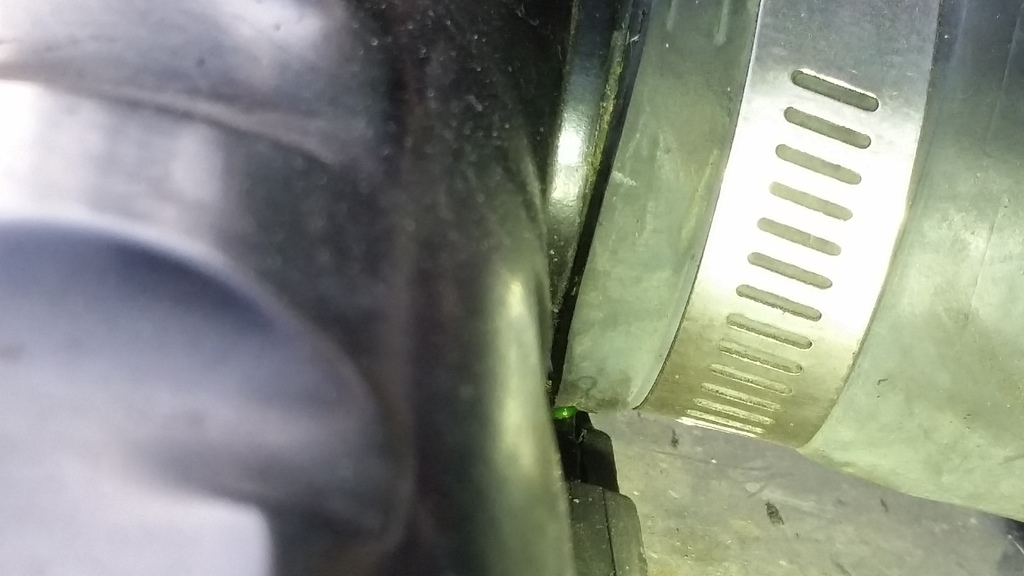
However, the morning after Thanksgiving, I saw coolant dripping under upper radiator hose where it is clamped at radiator neck (see below). I re- tightened and checked when we got back to San Diego tonight. So far, no leaks
This could have been because of combination of:
(1) After-market constant-tension worm-drive hose clamp,
(2) Almost freezing temp in Las Vegas these past few days, making materials shrink when they cooled after a 6-hour drive, AND
(3) Hose looking like under tension (I may have to replace with something that would have more slack.)
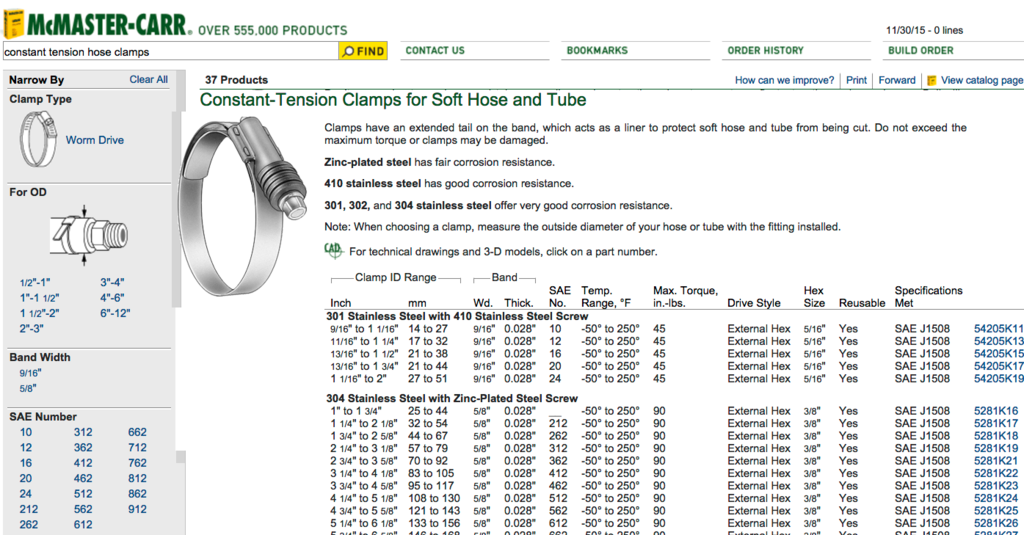
So now I'm leaning toward replacing the worm-drive clamp (where hose material starts to squeeze through the slots/threads) with either OEM or Spring-Loaded ones like this from McMaster-Carr
Have you guys had any experience with the McMaster one?
I hope you all had a fine Thanksgiving weekend.
Glad to find this page. Since my engine was rebuilt and all cooking components were replaced (in 2013), I never saw any leaks - even after 8-hour long drives.
However, the morning after Thanksgiving, I saw coolant dripping under upper radiator hose where it is clamped at radiator neck (see below). I re- tightened and checked when we got back to San Diego tonight. So far, no leaks
This could have been because of combination of:
(1) After-market constant-tension worm-drive hose clamp,
(2) Almost freezing temp in Las Vegas these past few days, making materials shrink when they cooled after a 6-hour drive, AND
(3) Hose looking like under tension (I may have to replace with something that would have more slack.)
So now I'm leaning toward replacing the worm-drive clamp (where hose material starts to squeeze through the slots/threads) with either OEM or Spring-Loaded ones like this from McMaster-Carr
Have you guys had any experience with the McMaster one?
Nov 30, 2015 | 05:24 AM
#32

I have not seen a McMaster clamp. It does seem like when I replace a hose at some time later I do need to go back and retighten it.
Last edited by Terrys87; Nov 30, 2015 at 04:27 PM.
Nov 30, 2015 | 01:51 PM
#33
Registered User
Joined: Mar 2012
Posts: 7,125
Likes: 681
Thanks, Terry.
I think, like many people say, retightening is a necessary maintenance item for worm-drive clamps. That's fine with metal radiator fittings but I would be wary with plastic ones. I would just use a "lined" one where the un-threaded/un-slotted part of the metal strip extends under the slotted part (like on the McMaster one pictured below). This way, hose rubber would not get extruded through the slots.
McMaster Clamp looks like below.
McMaster Clamp looks like below.
Last edited by RAD4Runner; Feb 12, 2019 at 12:01 PM.
Nov 30, 2015 | 02:20 PM
#34
Thread Starter
Registered User
Joined: Jun 2014
Posts: 228
Likes: 1
From: North Alabama
Not that it helps, but I reused two of my OEM spring clamps on the plastic necks, and bought new, basic worm drive clamps for the other 4. No issues aside from having to retighten one of the worm drive clamps.
Nov 30, 2015 | 07:10 PM
#35
Registered User
Joined: Mar 2012
Posts: 7,125
Likes: 681
Clamps with give like OEM good for plastic connectors, and rigid worm-drive OK for steel connections but need to be retightened as the hose material compresses.
Feb 10, 2019 | 06:55 PM
#36
Registered User
Joined: Mar 2012
Posts: 7,125
Likes: 681
Above post shows how my radiator end of my upper radiator hose had to be re-tightened. It happened after we drove to Las Vegas when it was significantly colder than San Diego.
Last weekend, I parked my truck at trailhead where it went below freezing. When I checked today, I saw coolant drips and found a pool of it below where upper radiator hose connects to thermostat housing "elbow". Yes, that end of the hose is wet. I'l retighten and monitor.
Could it be possible that extreme (by west coast standards) cooling and heating of these parts cause rubber to shrink or make it lose its ability to bounce back?

Last weekend, I parked my truck at trailhead where it went below freezing. When I checked today, I saw coolant drips and found a pool of it below where upper radiator hose connects to thermostat housing "elbow". Yes, that end of the hose is wet. I'l retighten and monitor.
Could it be possible that extreme (by west coast standards) cooling and heating of these parts cause rubber to shrink or make it lose its ability to bounce back?
Feb 10, 2019 | 07:25 PM
#37
Registered User
Joined: Sep 2007
Posts: 8,381
Likes: 873
From: San Francisco East Bay
I know i expressed the opinion (in this thread!) that worm-drive clamps might be better than spring clamps. But since then, I came across a source that clearly disagreed (I know, I know .. without the cite my recollection is suspect). The argument was that spring clamps hold a (relatively) constant pressure, whereas worm drive clamps hold a constant diameter and will change pressure with temperature changes.
You can get a set of 100 OEM-style clamps (in different sizes) for $12 delivered. https://www.aliexpress.com/item/100p...833084012.html You might measure your radiator input; if it's 22mm or less this could be an option.
You can get a set of 100 OEM-style clamps (in different sizes) for $12 delivered. https://www.aliexpress.com/item/100p...833084012.html You might measure your radiator input; if it's 22mm or less this could be an option.
 Feb 11, 2019 | 12:02 AM
#38

Registered User
Joined: Mar 2012
Posts: 1,139
Likes: 414
From: Oklahoma
Above post shows how my radiator end of my upper radiator hose had to be re-tightened. It happened after we drove to Las Vegas when it was significantly colder than San Diego.
Last weekend, I parked my truck at trailhead where it went below freezing. When I checked today, I saw coolant drips and found a pool of it below where upper radiator hose connects to thermostat housing "elbow". Yes, that end of the hose is wet. I'l retighten and monitor.
Could it be possible that extreme (by west coast standards) cooling and heating of these parts cause rubber to shrink or make it lose its ability to bounce back?
Last weekend, I parked my truck at trailhead where it went below freezing. When I checked today, I saw coolant drips and found a pool of it below where upper radiator hose connects to thermostat housing "elbow". Yes, that end of the hose is wet. I'l retighten and monitor.
Could it be possible that extreme (by west coast standards) cooling and heating of these parts cause rubber to shrink or make it lose its ability to bounce back?
I'm sure O'Reilly gets wore out from me digging thru the hoses to find one with the right bends, od, id, that i can modify... regardless of application.
Last edited by 87-4runner; Feb 11, 2019 at 12:05 AM.
Feb 11, 2019 | 02:34 AM
#39

Registered User
Joined: Aug 2018
Posts: 605
Likes: 140
My local NAPA stocks Ideal Tridon Flex-Gear 47 behind the counter. These clamps solved all of my radiator hoses cold leak problems on my 22RE
It's a Belleville spring design that maintains constant tension, and they are all stainless. Cost round about $5.50 each.
http://idealtridon.com/aftermarket/f.../flex-gear-47/
It's a Belleville spring design that maintains constant tension, and they are all stainless. Cost round about $5.50 each.
http://idealtridon.com/aftermarket/f.../flex-gear-47/
Feb 11, 2019 | 01:32 PM
#40
Registered User
Joined: Mar 2012
Posts: 7,125
Likes: 681
(The hose with OEM clamp (like the aliexpress above ) to power steering fluid reservoir - which is a low pressure line - of a friend's Camry. Worm-drive clamp fixed it.)
However, I understand that worm-drives need to be adjusted occasionally.
Therefore, I think the Tridon Flex-Gear 47 has the spring load and adjustability at the same time. $6 is a fair price so use on a high-pressure, high-temp line. Will check it out next time I'm near Napa.


