When you click on links to various merchants on this site and make a purchase, this can result in this site earning a commission. Affiliate programs and affiliations include, but are not limited to, the eBay Partner Network.
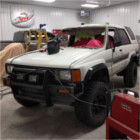
Borrowing my dads project jeep for a few weeks, so I finally have a chance to pull the leaky windshield out and get it taken care of.
Popped right out!
Previous owner used bathtub caulk. If I ever see him again....
Looks like most of it is actually in pretty good shape. Need to wire brush down to bare metal, but all the metal is still there.
The worst part is a small section on the bottom. I think it's from where the water ran down the inside of the windshield whenever it rained, and rolled right onto the metal there. Hopefully, fingers crossed, there is enough meat there to paint and reuse.
Does it look like I need to do body work?
Also, is there anything else I can be doing while I have the windshield out that is a pain with it in?
Yea, I may attempt the fiberglass reinforcement technique to rebuild that, while being skeptical and giving it a thorough testing. Worst case, I cut it out anyway, nothing to lose.
If that doesn't work, hopefully I can trailer it to my father in laws and borrow his welder. And learn to weld. This is going to be a learning experience.
i'd like to know what gauge sheet metal it is as well, because i have similar issues with my windshield channel... the glass is still in, but i was able to push a screwdriver thru the top channel :/
i think that this sheet metal welding should be done with solid core wire and gas?
I think, from cursory searching, that the sheet metal most places is 22ga, MIG/TIG territory
Saving grace may be that the channel is twice? as thick (making it 16 gauge), so if only the doubled up part needs replaced it might be doable with flux core
My brother in law welds for a living, has experience with body panels, may be getting in touch
I'm no welding expert, but the American Welding Society says:
Note: Do not attempt to weld thin metal with flux cored wires. These wires use more heat because they require globular transfer. Unlike short circuiting transfer, where the weld pool cools every time the wire touches the base metal, the arc remains "on" constantly with globular transfer.
More work tonight. If you call everything that happens after 5:30 night. I hate winter.
Digressing - masked off the dash with plastic sheet. Everything bagged and tagged. Need a new A pillar cover (if I'm calling that the right thing)
Pulled the headliner back and removed the lip it was attached to.
1. What is that thing called? The lip the headliner wraps around at the front?
2. What kind of glue will I need to put the headliner back on?
It was in perfect shape, pained me to pull it off. If I have to replace this headliner after this I'm gonna be very sad.
A rust remover wheel on the drill helped make quick work of the rust and remaining adhesive that I couldn't get off. Also killed the drill batteries pretty quick, but better than trying to use a putty knife.
Bad news, about an inch of the top disentegrated.
Good news, the sides are in great shape.
<no pic, my bad>
Picture of the corner Ray and others are having trouble with. FWIW, mine was not leaking there (visibly, anyway), and there is sealant down inside that gap.
Another potential trouble spot if I'm not careful
All tucked in for the night
Originally Posted by scope103
I'm no welding expert, but the American Welding Society says:
Note: Do not attempt to weld thin metal with flux cored wires. These wires use more heat because they require globular transfer. Unlike short circuiting transfer, where the weld pool cools every time the wire touches the base metal, the arc remains "on" constantly with globular transfer. https://app.aws.org/wj/2002/03/feature/
I'll bet you if you were REALLY good at welding thin metal with flux core, you might be able to get away with welding 18ga, but it would not be fun.
Note that AWS recommends 0.023 wire with MIG, rather than the 0.035 we usually use.
Pulled the headliner back and removed the lip it was attached to.
1. What is that thing called? The lip the headliner wraps around at the front?
2. What kind of glue will I need to put the headliner back on?
!
I just put 3M double-sided tape on the strip before screwing it back on.
I want to lean duraglas, but they recommending topcoating the duraglas with all-metal to waterproof, in which case why not just go straight for all-metal
Do you still have any of those gaskets by chance?
If not, where did you get them?
They don't require any glue at all, just a roped in gasket?
What is the average speed of an unladen swallow?
What gauge metal did you use?
And what type?
Right now I have 16 and 22ga, just the "weldable" stuff from Lowes, not sure if I need something better.
You're in territory I thankfully did not enter. I did have to reglue the headliner as one of the first things I did to my truck. I used 3m headliner adhesive and a roller and used duct tape to hold the whole thing up until it dried. This all happened six years ago and the headliner is still there. I paid about $6 for the roller from Amazon. Then you can use it for Peel n' Seal later.
Nice welding work!
Yes, urethane is the way to go now.
I think it works really well directly on my POR-15 base - surface sanded and primed of course. (My leak is not at the windshield interface after all - It's coming from worn-out gutter seal)
Adventure Copan on T4R.ORG also did same. Windshield urethane directly on POR-15.
Originally Posted by magnet18
Last weekend, and a couple evenings this week, Got the lower patch welded in!
Originally Posted by magnet18
Dang, looks like I'm gluing it in after all
thanks



 Nov 25, 2016 | 08:24 PM












 , the proper way to work on a truck, especially in the winter