When you click on links to various merchants on this site and make a purchase, this can result in this site earning a commission. Affiliate programs and affiliations include, but are not limited to, the eBay Partner Network.
Hi, Does anyone know the difference between the 85/86 1 ton pickup/4 runner front bumpers and the std pickup/4 runner bumpers? The dealership and aftermarket suppliers all state the 1 ton truck is different. Will one of the standard pickup/4 runner bumpers work?
I have 2 1 ton pickup trucks. An 85 pickup I bought new and an 86. Both have the 3 piece front bumper. My 85 is a manual trans and the 86 is an automatic. Both 22rec engines. I need a new front bumper and other parts for the 86 due to hitting a deer. The problem I have is that there is supposedly something different about the 1 ton verses the standard 4 runner bumpers that I am not familiar with. The only bumper Toyota currently provides part numbers for supersedes to a 1 piece bumper that was discontinued. I tried getting more information from 3 different dealerships but with no success.
I have not been able to find either of the 3 piece nor the 1 piece bumpers and associated components offered as an aftermarket item for the 1 ton. What I do find is stated that the bumpers do not fit the 1 ton. I do not understand why they do not fit the 1 ton. The 1 ton uses one of the standard grills found on the lighter duty trucks.
I also have not found anyone offering the tubular backing (bumper stay?) for the front bumper for any of the 85/86 trucks. Just the mounting brackets that are welded to the steel tubes. My tubular portion is salvageable but rusted thin and the mounting brackets are crushed. I don't know if the aftermarket replacement standard mounting brackets will work for the 1 ton. There were apparently 2 different versions of the bumper stay. One with simply curved tubes and a version with 2 bends in the middle area. Mine are the type with the 2 bends in the middle portion. My 85 had the optional rubber bumper guards on the front face bar mounting bolts.
What I do know is that the 85/86 one ton pickup was built entirely in Japan to meet the USA regulations. It is IFS front. 2 wheel drive. They have a Japanese 7ft box. The VIN numbers for the 1 ton pickup start out a JT4RN55xxxxxxxx.
Toyota says the 3 piece bumper face bar for either of my trucks is a 52111-39585 or 52111-89134. These were replaced by 52111-89152 which is a 1 piece bumper. It is stated that this only fits the 1 ton.
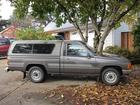
Here is a photo of the 1986 1 ton followed by the style bumper stay that is used. 1986 1 ton fitted with Hella E code H4 headlights. style of bumper stay/reinforcement used
Fenders and core support were the same between 1-Ton and half.
Depending on the production date there was a short time period where the bumper brackets on the 1-Ton were different. How much I don't know, but can't be much.
The bumper filler wasn't the same either. But it looks like you don't have one right now, anyway.
So you can put a non 1-Ton bumper on your vehicle, and odds are everything should be ok. Worst case is you might have to get brackets, too.
TBH, it looks like you have a regular half-ton bumper on there right now. The 1-ton that had a center face bar with black end caps also had black rubber pads on either side of the license plate recess. That chrome bumper is missing the holes for the pads to be bolted on. Might also explain why there's no filler.
The 3 piece bumper generally appears the same between all of my trucks. I currently have the 2 1 ton trucks, a couple motorhomes, an 87 and 88 1/2 ton with 1 piece bumper and a 92 1/2 ton. Only the 1 ton pickup trucks have the tubular bumper filler/reinforcement.
According to the dealership the 1 ton was completely built in Japan to meet USA DOT regulations. This is evidenced by the VIN beginning with J. Thus I wonder if the tubular filler/reinforcement was needed to have the bumper meet the low speed impact requirements while loaded with the added GVWR of the 1 ton.
The rubber pads you mention are on my 85 1 ton and were on one of the motorhome chassis I sold last year. The rubber pad is simply overmolded on the bolts used on each side of the license plate to mount the bumper face bar to the filler/reinforcement. Conceivably they could be used on any bumper with a matching profile - if the bolts are at the same location in the face bar. I've taken a photo of my wrecked 87 1/2 ton for a comparison of the face bar.
I am not sure what filler you mention is missing other than the very light tin strip that closes the gap between the face bar and the plastic grill. That is missing from the 86 1 ton and presumably indicates that the bumper face bar may have been replaced at some point. That filler strip is found on every truck I have with a 3 piece bumper including the 87 1/2 ton truck. 1987 1/2 ton with 3 piece bumper. No tubular filler/reinforcement used.
I took some more photos for you of the 85 1 ton so you can see the tubular filler an rubber pads. 1985 1 ton bumper with rubber pads. Known OEM. 1985 1 ton with tubular filler/reinforcement. Known OEM.
Ok, agreed. While the 1-Tons I saw had the bumper pads, I do see where it had bumpers without them.
Toyota didn’t make trucks in the USA till the first gen Tacoma, so yes, the 1-Tons were all built in Japan, and complied with the safety and emissions requirements of whatever country they were being shipped to. The trucks were all classified as commercial vehicles, so they were commonly shipped without a rear bumper. Sometimes one got added at the US port or at the dealer, but it wasn’t a requirement for sale. But regarding the front bumper reinforcement being included to meet DOT or NHTSA requirements I have no idea. Commercial standards always seemed to be a lower bar, not higher, than a regular vehicle.
yes, the filler is is that strip between the bumper and grille
I still think pretty much any bumper intended for that series truck would work on a 1 Ton.
Hi,
Yea - I bought the 85 new off the dealer showroom floor. I know that truck quite well. Still has the original Bridgestone tires on the front. The rear bumper was optional as were side mirrors. The dealership had installed the drivers side plastic mirror. I wanted the matching passenger side mirror but did not want a wide angle one that is nearly useless with a trailer. They said that they could get that but had to order it - $65 installed. I also wanted rust proofing and a chrome step bumper. So had to bring the truck back to have the final details done. I was peeved when the passenger side mirror turned out to be a wide angle one even though they said it wasn't. It was already installed with holes drilled in my new truck's door so I was rather stuck with it. I ended up buying a stack of mirror tiles at a garage sale and broke a number of them before I got one cut with the requisite radius corners and installed into the snap fit housing without cracking or breaking.
Only a couple weeks later my new bride and I were in Florida on our honeymoon. It was interesting to see so many of the cab and chassis trucks at the dealerships. I saw a couple self dumping flat bed trucks and possibly 2 or 3 of the very rare drop side flat bed trucks. I was rather disappointed that we'd not known they were available. I've never seen one since.
I don't know the exact time line on the variations of import configurations of the trucks. I know the 1985 and on short box 1/2 ton trucks were typically shipped to the USA without a box and an American made 6ft box was installed when it arrived State side. Doing this allowed the cab and chassis trucks to be piggy backed on each other to get more of them inside the ship - saving some money on shipping. The American box lacks the outer cargo hook lip so it looks like it came off a ford ranger or chevy s-10. Interesting part is that the Japanese and American made tailgates are interchangeable even though they are shaped quite differently.
The way to know if a truck was fully made in Japan or not is by the VIN. If the first letter is a - J - it is a fully Japanese truck. I don't know it this applies to pre 84 trucks but was told that is the case with the 1 ton's and an easy way to know if a truck is a one ton or not.
All Toyotas shipped to the USA were built in Japan until the Calif. NuMMI plant started building corollas in 1988. I said earlier that Tacomas were the first USA-built truck, but I think actually HiLuxes were starting to be built in 1991 or 1992 at NUMMI
original tires? I do like Bridgestone, but maybe not THAT much😃
All Toyotas shipped to the USA were built in Japan until the Calif. NuMMI plant started building corollas in 1988. I said earlier that Tacomas were the first USA-built truck, but I think actually HiLuxes were starting to be built in 1991 or 1992 at NUMMI
original tires? I do like Bridgestone, but maybe not THAT much😃
As I said - the trucks were made there but the smooth side American box was added when they got State side. I was told it saved them about $500 a truck to do it that way.
My 85 was the first vehicle my folks or I bought new. It was for our business so - we registered it to the business. By mid-summer 1986 the box side seams had cracked through the paint and started rust staining the white paint so I bought it back to the dealership. They handed me a repair estimate for $1,200. I said here's the rust proofing documentation. They then claimed that there was a mistake. I wasn't supposed to have that warranty as it was a commercial owned vehicle and there was no warranty on a commercial owned vehicle. They had even placed a sticker in the back window for the Quaker State "Lifetime" rustproofing. That sticker is still there. Of note - I wasn't satisfied with the initial rust proofing work product so had required they do the job a second time. The dealership refused to honor the paint warranty. A couple years later I had a body shop lead the seam and repaint.
In 1996 I was fitting a custom painted utility box to the truck and pulled myself under the truck on a piece of cardboard to disconnect the fuel filler hose. The finger tips on both hands crushed the frame. I was stunned. The frame looked fine with glossy black paint but had rusted internally so much I could crush the frame with my bare fingers on both sides. I set the pickup box back down and bolted in place. I took it to the dealership. Same story Commercial owned truck - no warranty. We transferred the ownership to me as we knew it wasn't safe to use for our business. I parked the truck in 97 - unsafe to drive as it twisted and turned tighter in turns on curves in the road. I was advised that selling the truck could be a business liability since I knew of the issue with the frame - so it sat on a concrete pad at the shop. The frame recall happened. I took it back to the stealership. I was told the 85 is not part of the recall. Just the next later years...... So - there the truck has been. Not driven since 1997. 62K actual miles. The original tires still on the front. I'd burned off the tires on the rear pulling boats on algea covered ramps and racing V-6 Ford Rangers that couldn't keep up with a 4 cyl due to the rear axle ratio and a 5 speed. The Bridgestones held air all these years.



 Mar 16, 2023 | 02:01 PM