


77 help charging issue
 Dec 5, 2019 | 06:47 PM
#1

Thread Starter
Registered User
Joined: Sep 2019
Posts: 42
Likes: 0
77 help charging issue
I've got a 77 pickup stock except for weber, gm ignition, fuel pump. I was driving this morning and my CHG light came on, moments later the oil light came on. Then the truck died as if it was running out of gas, battery was at good charge. with the key on I usually hear the fuel pump. But I didn't hear it so I re routed the fuel line and plugged in my stock fuel pump relay. The power wire to the aftermarket pump is plugged into the 2-wire female spade type plug on the passenger side that went to some emissions thing, or the old carb. Anyway, when I touched the aftermarket pump wire to the battery it worked, so the pump had just lost power. So I continued driving with the stock pump for about 75 miles with the charge and oil light on. On the was home, the lights got dim and the truck died. Dead battery. I got a jump and it idled good for 3 minutes then died.
Sounds like a bad alternator. But it also sounds like a bad ground? I could read the voltage from the white alternator wire to the head but not from the white to the black. Isn't the black alternator wire a ground?
Sounds like a bad alternator. But it also sounds like a bad ground? I could read the voltage from the white alternator wire to the head but not from the white to the black. Isn't the black alternator wire a ground?
Dec 6, 2019 | 05:28 AM
#2

Registered User


Joined: Jun 2016
Posts: 717
Likes: 189
From: Florida
I do not know of a Black wire coming off of the Alternator. There are 4 wires, colors - White with Black Stripe, Green, Blue and White. See diagram, this is for a '78 but the '77 is the same:
http://www.globalsoftware-inc.com/co..._LC_Pickup.pdf
It is possible that the ground cable on your battery doesn't have good connection, or that it's original (or just old) and has a lot of resistance in it. Only way to tell is a Voltage Drop Test or Resistance Test. Use your Ohm Meter to check the resistance in the cable by touching a probe to each end of the cable. It should have 0.1 Ohm resistance or less; anything higher than this & it needs to be replaced. My original '78 battery ground cable had 0.4 Ohms; new one measures 0 Ohms. Check your connections on each end as well for dirt, corrosion, damage or looseness.
The problem could be a bad diode in the alternator, or the Voltage Regulator. Alternators produce AC current; the diodes in them change the current to DC. If one of the diodes goes out it could cause the Alternator to stop producing electricity. If your Volatge Regulator is bad it could also cause the Alternator to stop making electricity. You Voltage Regulator is separate from the Alternator, and is mounted to the inside of the driver's side fender. It looks like this : https://www.rockauto.com/en/moreinfo...277096&jsn=952
Inside the Voltage Regulator are electromagnetic coils and contact points. Over time the contacts can wear out, or get corroded or pitted from arcing. Here's what it looks like inside:
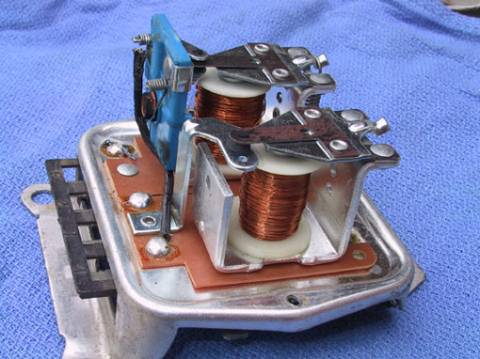
The contacts are not repairable/replaceable so if they are pitted or corroded, you need to replace the whole unit.
If it were me I'd just remove both items and have them tested at a parts store to verify which item (if either) was causing the problem. Given your description of what happened and the fact that the Voltage Regulator is likely original, I'd be leaning in it's direction as the problem, but you never know for sure until you test these things. If your battery ground cable was also original (originals are usually are Black with a Yellow Stripe) I'd just go ahead & get a new one in there while I was at it. Nearly every electrical system in the truck depends on that ground cable.
http://www.globalsoftware-inc.com/co..._LC_Pickup.pdf
It is possible that the ground cable on your battery doesn't have good connection, or that it's original (or just old) and has a lot of resistance in it. Only way to tell is a Voltage Drop Test or Resistance Test. Use your Ohm Meter to check the resistance in the cable by touching a probe to each end of the cable. It should have 0.1 Ohm resistance or less; anything higher than this & it needs to be replaced. My original '78 battery ground cable had 0.4 Ohms; new one measures 0 Ohms. Check your connections on each end as well for dirt, corrosion, damage or looseness.
The problem could be a bad diode in the alternator, or the Voltage Regulator. Alternators produce AC current; the diodes in them change the current to DC. If one of the diodes goes out it could cause the Alternator to stop producing electricity. If your Volatge Regulator is bad it could also cause the Alternator to stop making electricity. You Voltage Regulator is separate from the Alternator, and is mounted to the inside of the driver's side fender. It looks like this : https://www.rockauto.com/en/moreinfo...277096&jsn=952
Inside the Voltage Regulator are electromagnetic coils and contact points. Over time the contacts can wear out, or get corroded or pitted from arcing. Here's what it looks like inside:
The contacts are not repairable/replaceable so if they are pitted or corroded, you need to replace the whole unit.
If it were me I'd just remove both items and have them tested at a parts store to verify which item (if either) was causing the problem. Given your description of what happened and the fact that the Voltage Regulator is likely original, I'd be leaning in it's direction as the problem, but you never know for sure until you test these things. If your battery ground cable was also original (originals are usually are Black with a Yellow Stripe) I'd just go ahead & get a new one in there while I was at it. Nearly every electrical system in the truck depends on that ground cable.
Dec 14, 2019 | 09:54 AM
#3
Thread Starter
Registered User
Joined: Sep 2019
Posts: 42
Likes: 0
Update
After replacing main ground cables and cable to starter. I got a jump this morning, as I turned the key I the on position, the chg light and oil light came on as normal, the oil light was very low (barely lit). the truck started and ran, both oil light and chg light were off as normal. Truck was in neutral, so I let the clutch out, as soon as it grabbed the chg light came on. Then I took my foot off the break. The charge light popped on as soon as the break pedal switch was activated. I took my foot on/off the brake pedal a dozen times and the charge light was controlled by the brake pedal!!! Then I disconnected the jumper cables and the truck died seconds later. What is going on. I need some help.
Last edited by CMiller; Dec 14, 2019 at 09:57 AM.
Dec 15, 2019 | 07:50 AM
#4
Registered User
Joined: Jun 2016
Posts: 717
Likes: 189
From: Florida
After replacing main ground cables and cable to starter. I got a jump this morning, as I turned the key I the on position, the chg light and oil light came on as normal, the oil light was very low (barely lit). the truck started and ran, both oil light and chg light were off as normal. Truck was in neutral, so I let the clutch out, as soon as it grabbed the chg light came on. Then I took my foot off the break. The charge light popped on as soon as the break pedal switch was activated. I took my foot on/off the brake pedal a dozen times and the charge light was controlled by the brake pedal!!! Then I disconnected the jumper cables and the truck died seconds later. What is going on. I need some help.
lSince you jump started the truck I am assuming that the battery you have in the truck is dead or very low? Or do you even have a battery in the truck and are jumping to bare cables/terminals? You need to have a verified functional battery in the truck in order to check if the charging system is working or not. The battery is basically a really big capacitor that works with the rest of the electric/charging system and if it's missing or something is wrong with it, the system will not work correctly, even if you do have jumper cables hooked up to a good "jump" battery or jump pack. If you do have a battery in it get it load tested at a parts store for free, to make sure it does not have any internal problems like shorted plates. If the battery tests good make sure it has a full charge of at least 12.6 volts. If the battery tests bad OR is over 5 years old get a new one.
Once you get a KNOWN good fully charged battery in it & get it started again, forget the Charge light for a minute and use a volt meter to check that the alternator is putting out decent charging voltage, which should be a MINIMUM of 13.8 volts, with 14.2 to 14.5 volts being more common. With the engine running this is measured with the volt meter at the battery posts. With the engine off, a good battery should read at least 12.6 volts.
Unless you check these things with a volt meter we really can't be too sure what's going on with the charging system. There is no substitute for good data/info when diagnosing. The Charge light being on, off or "low" really won't give you that.
Once you get all of the above sorted out & correct & get the truck running again,AND IF you still have the charge light going on and off with the use of the brake pedal, you have another problem to track down. Why does this happen? Most likely you have a bad ground at one or both of the tail light housings, or you have a bad bulb or bulbs, or a wire problem. To check if this is the case there are a few simple tests, and the truck does not need to be running. But there does need to be decent battery power, and you'll need another person to work the brake pedal. Have someone press the brake pedal & hold it while you look at the brake lights. Both should light up normally (bright). Release brake pedal. Turn on the running lights (headlight switch). Verify that both taillight running lights come on. Have your assistant press & hold the brake pedal while you watch the lights. Both should switch from running lights to bright brake lights. If anything is different from this, like one side doesn't light, one side lights but not bright, or with running lights on - one turns off while other goes bright, only one goes bright & other stays dim (running light). one goes bright other goes OFF - you PROBABLY have a bad ground at one or both of the tail lights.
Inside the bed there are metal covers over the back of the tail light assemblies, held on by screws. Take the covers off & look for the bolts that mount the assemblies to the bed metal. These bolts are what grounds the assemblies to the body, and usually there is some dirt, rust or other corrosion at these points that is causing the bad ground problem. Take off the mounting nuts & wire brush or sandpaper the bolts & surrounding areas clean to bare metal. Clean the nuts as well. Re-install the nuts & tighten then retest the brake lights as above. This will solve 80% of problems here. The other possible 20% are bad/blown/shorted bulbs, shorted, broken or just plain dirty bulb sockets in the light assembly, or a problem with the wires from the assembly (very common if they have been cut before for trailer light hookups).
Dec 17, 2019 | 04:27 PM
#5
Thread Starter
Registered User
Joined: Sep 2019
Posts: 42
Likes: 0
Another update
I replaced all grounds, from head to firewall, to frame, body, battery. I later got a jump it would not start, no spark. They are all fresh new grounds with pre crimped cables, I took my alternater and my GM ignition in to get tested. The alternator is fine. They said the ignition module was bad. I got a new one
I jumped my truck with a fancy computer controlled car, this was the first time it wouldnt fire up. When I turned the key my starter was turning very fast. I wonder if this newer car could have fried my ignition module? Anyway. I got a new one today. And soldered all my connections so im sure the ignition system is solid. I also swapped the battery for a good charged one. Still wont start, no spark. How can i be 100%sure that my engine grounds are solid. I sprayed the area with brake cleaner, and sanded it.
I jumped my truck with a fancy computer controlled car, this was the first time it wouldnt fire up. When I turned the key my starter was turning very fast. I wonder if this newer car could have fried my ignition module? Anyway. I got a new one today. And soldered all my connections so im sure the ignition system is solid. I also swapped the battery for a good charged one. Still wont start, no spark. How can i be 100%sure that my engine grounds are solid. I sprayed the area with brake cleaner, and sanded it.
Dec 18, 2019 | 12:14 AM
#6
Thread Starter
Registered User
Joined: Sep 2019
Posts: 42
Likes: 0
Also, my ignition system is getting 12v through a toggle switch and directly to the battery, and the modules ground goes directly to the battery. So it is completely independent of the rest of the wireing in the car.
When i mentioned the black wire on my alternator, there's a second stud on the back of the alternator, with a short black wire that goes down to a small metal cylinder that's mounted on the alternator housing. Seems like maybe the charge sensor?
Is it possible to swap in a different alternator (w/ internal regulator) and create a charging system that is completely independent of the rest of the vehicle?
Is there a large fuse somewhere in this truck? I thought I saw one somewhere once. Like a 100A fuse? Or any other fuses besides the main fuse box and a couple inline fuses under the hood.
When i mentioned the black wire on my alternator, there's a second stud on the back of the alternator, with a short black wire that goes down to a small metal cylinder that's mounted on the alternator housing. Seems like maybe the charge sensor?
Is it possible to swap in a different alternator (w/ internal regulator) and create a charging system that is completely independent of the rest of the vehicle?
Is there a large fuse somewhere in this truck? I thought I saw one somewhere once. Like a 100A fuse? Or any other fuses besides the main fuse box and a couple inline fuses under the hood.
Dec 18, 2019 | 09:07 AM
#7
Registered User
Joined: Jun 2016
Posts: 717
Likes: 189
From: Florida
You've done some good work here & provided some good info about what's going on, but a few questions come up in my mind, especially concerning what you are actually working with parts wise. I'll get to these first then address you other questions in order.
Every part of a charging system or ignition system needs to be checked & verified as working or not. You never said whether or not you got the Voltage Regulator tested, or not. Again, given the age of the vehicle and the mechanical nature of the regulator, it could be worn out or simply malfunctioning. If any of the internal parts go bad (coils, contacts, etc.) it will affect the charging system and the electric system. I have seen cases where the contact points have "welded" themselves together, basically causing a dead short, and knocking out power to a system or several systems. Your Voltage Regulator should be mounted to the inside of the Driver's side fender and looks like this:

Here's a link to the part on Rock Auto for reference: https://www.rockauto.com/en/catalog/...regulator,4884
Also, here is a link to the correct stock alternators on Rock Auto for reference: https://www.rockauto.com/en/catalog/...generator,2412 (more on this below)
Another thought. If you do not have a detailed history of the vehicle, it can be hard to know what some previous owners have done to it, like modifications. Do you even have this Voltage Regulator on your truck? Do you have a stock Toyota/Denso alternator or no? I ask this because one of the more popular modifications that used to be done to these trucks was to replace the stock Regulator & Alternator with a GM unit, that has an internal voltage regulator. This is commonly referred to by some as a "1 wire alternator". I'm asking this because your description of your alternator doesn't match a stock one. Check out the pics in the second link & compare to what you actually have installed. Stock Toyota/Denso alternators do not have the "metal cylinder", which to me sounds like a damping capacitor (usually used to eliminate electrical noise interference for the radio). Also maybe check the body of the alternator for a part number or markings cast into the metal or stamped on. In any case, we need to know exactly what parts you are dealing with.
GM Ignition Control Module - These modules are pretty well designed & made, however the 1 thing that usually makes them fail is a bad or failing ignition coil. 2nd reason is bad connections to the module, but you say you have that taken care of. Have you tested the Ignition Coil? As Ignition Coils age they can develop higher resistance than spec. This extra resistance can and will burn out an Ignition Module. I've been through this myself, going through 3 modules until I found the bad coil, which I should have tested and/or replaced with new in the first place. Do you have a stock coil or no? Having the correct coil with the right resistance specs is critical to having the HEI Module work. The '77 stock Toyota coil has the right specs. Those specs, as tested with an OHM Meter, are Primary Resistance: 1.3 to 1.7 Ohms, Secondary Resistance: 6500 to 10,500 Ohms. These specs are "cold". Any heat applied to an ignition coil can make these reading rise, especially if the coil is malfunctioning or otherwise defective. Resistance can get high enough that the coil will not put out enough electrical energy, and you would get no spark. More on testing ignition coils below.
Again, we need to know exactly what coil you have. Again, here's a parts reference: https://www.rockauto.com/en/catalog/...tion+coil,7060 I use and recommend the Standard UC12X. Quality here is the main point, as I have found cheaper Chinese made coils to not last & go out of spec in less than a year, and blow out ignition modules, starting the problems all over again. Avoid Spectra Premium Brand. And BTW, there should NOT be any external ignition coil resistor used with the GM HEI Module System. The module is designed to get full battery voltage (12 volts). Which leads me to another question....
Distributor - Do you have a points distributor or do you have one with the pickup coil inside? I ask because some 77's got the older style points distributor & some got the later "electronic": distributor. Again we need to know exactly what you have. The GM Module will work with a points distributor, but you still have to adjust the points to the proper spec, and the points wear over time which can effect things, and while it will run, it won't run as well as a distributor with the pickup coil. The pickup coil replaces the contact points in the system & is more reliable than contact points, as there is no wear on the coil like on the points. Here's some pics for comparison of the 2 different distributors:

1977 Points Style Distributor
https://www.cardone.com/catalog/elec...14-distributor

1978 Pickup Coil Style Distributor
https://www.cardone.com/catalog/elec...25-distributor
If you do have the pickup coil style of distributor, check the air gap between the "star wheel" on the shaft & the coils face. If this is out of adjustment it could give you start or run problems. The gap spec is 2mm to 4 mm, or .008" to .016". You need some feeler gauges to check this, and you can adjust the gap by loosening the hold-down screw on the coils base plate. You should set the gap so the feeler can slide between the 2 parts with a little "drag". I have mine set at .012" and it works fine.
All of the above items need to be checked, as any one of them out of adjustment, defective or malfunctioning could lead to your "no spark" condition.
VERY good work on the grounds, it all sounds good. Using the "newer car" to jump start the truck shouldn't make any difference. It is only providing battery power & I cannot think of any way it could have affected your ignition module.
How to be sure your new grounds are solid? Test them with an Ohm Meter for resistance. You just put 1 probe on 1 end of a ground cable terminal and the other probe at the other end & measure the resistance. It should be at or near zero. Anything above 0.3 Ohms & you have an issue. You can get a "good enough" Volt/Ohm Meter at any Harbor Freight for $6 to $7, sometimes less if you have a coupon (check website). You can also use the "Ohm" part of the meter to test your ignition coil. PLEASE NOTE: a cheap Ohm Meter like the Harbor Freight one will NOT be "self zeroing". There is resistance in the test lead wires. You have to touch the probes together first to find out what the lead wire resistance is, and subtract that from any reading you get while testing a component. Especially when measuring very low readings, like ground cables (near zero) or like Primary Resistance in an ignition coil (like your spec of 1.3 to 1.7 Ohms).
How to test an Ignition Coil: https://www.autoblog.com/2016/08/01/...ignition-coil/
Why is there a toggle switch for the ignition system? Why is it there? The stock system never had this and you really don't need it for the system to work correctly. What is the toggle switch rated for? It should be marked with an AMP Rating. It might be a good idea to use the meter to test the switch to make sure it's not a problem. Have you tested for power at the ignition module to be sure it's getting power? Again you need the Volt Meter for that to be sure. What size/gauge wire did you use for the module ground to the battery? Did you use stranded wire or solid? All of this matters.
Black wire on Alt - like I said, that's probably a capacitor for electrical noise reduction. The "charge sensor" is within the Voltage Regulator, whether it's totally electronic or mechanical like the stock regulator.
Yes, as previously discussed, it is possible to swap in a different alternator with internal regulator. My question would be why? The stock alt works fine. Also be aware that an internal regulator type of alt does NOT make it completely independent of the rest of the vehicle. It's still a part of the electrical system no matter what type it is.
To the absolute best of my knowledge, there is no "big 100 Amp fuse" on these trucks as stock, but your asking this is twigging my brain a bit. Was this truck formerly or still an RV/Camper? Does it have "dualies" on the back (2 wheels & tires per side on rear axle instead of 1 wheel & tire per side)? If it has the "dualies" it is/was an RV model, and there might be some extra electrical components that the "regular" stock truck would not have. Let me know about this, as I do have some info concerning the RV models of the trucks.
Also to the best of my knowledge, there are no stock inline fuses under the hood or anywhere else. If there are, these may have been added later by a previous owner for some reason (electrical accessory additions?) All fuses should be located in the stock fuse block under the dash to the left of the steering column. Which reminds me, have you checked all your fuses in the block & are they good? The only other thing that you might call a "fuse" is the Fusible Link wire near the battery, but if that had "popped" you wouldn't have any power to the starter, dash, ignition or anything else, it would be VERY obvious.
Any follow up on the tail light grounds?
The only other thing I can tell you at this point is to remember that this is a 41 year old truck and is likely needing to be completely gone through, component by component, system by system; there is no other way. IMO it's worth doing because once you get all the systems working right, it's going to run like a champ. Just keep at it, consider it all as a learning experience & don't get discouraged. I will continue to try to help you out with what info I have.
Every part of a charging system or ignition system needs to be checked & verified as working or not. You never said whether or not you got the Voltage Regulator tested, or not. Again, given the age of the vehicle and the mechanical nature of the regulator, it could be worn out or simply malfunctioning. If any of the internal parts go bad (coils, contacts, etc.) it will affect the charging system and the electric system. I have seen cases where the contact points have "welded" themselves together, basically causing a dead short, and knocking out power to a system or several systems. Your Voltage Regulator should be mounted to the inside of the Driver's side fender and looks like this:
Here's a link to the part on Rock Auto for reference: https://www.rockauto.com/en/catalog/...regulator,4884
Also, here is a link to the correct stock alternators on Rock Auto for reference: https://www.rockauto.com/en/catalog/...generator,2412 (more on this below)
Another thought. If you do not have a detailed history of the vehicle, it can be hard to know what some previous owners have done to it, like modifications. Do you even have this Voltage Regulator on your truck? Do you have a stock Toyota/Denso alternator or no? I ask this because one of the more popular modifications that used to be done to these trucks was to replace the stock Regulator & Alternator with a GM unit, that has an internal voltage regulator. This is commonly referred to by some as a "1 wire alternator". I'm asking this because your description of your alternator doesn't match a stock one. Check out the pics in the second link & compare to what you actually have installed. Stock Toyota/Denso alternators do not have the "metal cylinder", which to me sounds like a damping capacitor (usually used to eliminate electrical noise interference for the radio). Also maybe check the body of the alternator for a part number or markings cast into the metal or stamped on. In any case, we need to know exactly what parts you are dealing with.
GM Ignition Control Module - These modules are pretty well designed & made, however the 1 thing that usually makes them fail is a bad or failing ignition coil. 2nd reason is bad connections to the module, but you say you have that taken care of. Have you tested the Ignition Coil? As Ignition Coils age they can develop higher resistance than spec. This extra resistance can and will burn out an Ignition Module. I've been through this myself, going through 3 modules until I found the bad coil, which I should have tested and/or replaced with new in the first place. Do you have a stock coil or no? Having the correct coil with the right resistance specs is critical to having the HEI Module work. The '77 stock Toyota coil has the right specs. Those specs, as tested with an OHM Meter, are Primary Resistance: 1.3 to 1.7 Ohms, Secondary Resistance: 6500 to 10,500 Ohms. These specs are "cold". Any heat applied to an ignition coil can make these reading rise, especially if the coil is malfunctioning or otherwise defective. Resistance can get high enough that the coil will not put out enough electrical energy, and you would get no spark. More on testing ignition coils below.
Again, we need to know exactly what coil you have. Again, here's a parts reference: https://www.rockauto.com/en/catalog/...tion+coil,7060 I use and recommend the Standard UC12X. Quality here is the main point, as I have found cheaper Chinese made coils to not last & go out of spec in less than a year, and blow out ignition modules, starting the problems all over again. Avoid Spectra Premium Brand. And BTW, there should NOT be any external ignition coil resistor used with the GM HEI Module System. The module is designed to get full battery voltage (12 volts). Which leads me to another question....
Distributor - Do you have a points distributor or do you have one with the pickup coil inside? I ask because some 77's got the older style points distributor & some got the later "electronic": distributor. Again we need to know exactly what you have. The GM Module will work with a points distributor, but you still have to adjust the points to the proper spec, and the points wear over time which can effect things, and while it will run, it won't run as well as a distributor with the pickup coil. The pickup coil replaces the contact points in the system & is more reliable than contact points, as there is no wear on the coil like on the points. Here's some pics for comparison of the 2 different distributors:
1977 Points Style Distributor
https://www.cardone.com/catalog/elec...14-distributor
1978 Pickup Coil Style Distributor
https://www.cardone.com/catalog/elec...25-distributor
If you do have the pickup coil style of distributor, check the air gap between the "star wheel" on the shaft & the coils face. If this is out of adjustment it could give you start or run problems. The gap spec is 2mm to 4 mm, or .008" to .016". You need some feeler gauges to check this, and you can adjust the gap by loosening the hold-down screw on the coils base plate. You should set the gap so the feeler can slide between the 2 parts with a little "drag". I have mine set at .012" and it works fine.
All of the above items need to be checked, as any one of them out of adjustment, defective or malfunctioning could lead to your "no spark" condition.
VERY good work on the grounds, it all sounds good. Using the "newer car" to jump start the truck shouldn't make any difference. It is only providing battery power & I cannot think of any way it could have affected your ignition module.
How to be sure your new grounds are solid? Test them with an Ohm Meter for resistance. You just put 1 probe on 1 end of a ground cable terminal and the other probe at the other end & measure the resistance. It should be at or near zero. Anything above 0.3 Ohms & you have an issue. You can get a "good enough" Volt/Ohm Meter at any Harbor Freight for $6 to $7, sometimes less if you have a coupon (check website). You can also use the "Ohm" part of the meter to test your ignition coil. PLEASE NOTE: a cheap Ohm Meter like the Harbor Freight one will NOT be "self zeroing". There is resistance in the test lead wires. You have to touch the probes together first to find out what the lead wire resistance is, and subtract that from any reading you get while testing a component. Especially when measuring very low readings, like ground cables (near zero) or like Primary Resistance in an ignition coil (like your spec of 1.3 to 1.7 Ohms).
How to test an Ignition Coil: https://www.autoblog.com/2016/08/01/...ignition-coil/
Why is there a toggle switch for the ignition system? Why is it there? The stock system never had this and you really don't need it for the system to work correctly. What is the toggle switch rated for? It should be marked with an AMP Rating. It might be a good idea to use the meter to test the switch to make sure it's not a problem. Have you tested for power at the ignition module to be sure it's getting power? Again you need the Volt Meter for that to be sure. What size/gauge wire did you use for the module ground to the battery? Did you use stranded wire or solid? All of this matters.
Black wire on Alt - like I said, that's probably a capacitor for electrical noise reduction. The "charge sensor" is within the Voltage Regulator, whether it's totally electronic or mechanical like the stock regulator.
Yes, as previously discussed, it is possible to swap in a different alternator with internal regulator. My question would be why? The stock alt works fine. Also be aware that an internal regulator type of alt does NOT make it completely independent of the rest of the vehicle. It's still a part of the electrical system no matter what type it is.
To the absolute best of my knowledge, there is no "big 100 Amp fuse" on these trucks as stock, but your asking this is twigging my brain a bit. Was this truck formerly or still an RV/Camper? Does it have "dualies" on the back (2 wheels & tires per side on rear axle instead of 1 wheel & tire per side)? If it has the "dualies" it is/was an RV model, and there might be some extra electrical components that the "regular" stock truck would not have. Let me know about this, as I do have some info concerning the RV models of the trucks.
Also to the best of my knowledge, there are no stock inline fuses under the hood or anywhere else. If there are, these may have been added later by a previous owner for some reason (electrical accessory additions?) All fuses should be located in the stock fuse block under the dash to the left of the steering column. Which reminds me, have you checked all your fuses in the block & are they good? The only other thing that you might call a "fuse" is the Fusible Link wire near the battery, but if that had "popped" you wouldn't have any power to the starter, dash, ignition or anything else, it would be VERY obvious.
Any follow up on the tail light grounds?
The only other thing I can tell you at this point is to remember that this is a 41 year old truck and is likely needing to be completely gone through, component by component, system by system; there is no other way. IMO it's worth doing because once you get all the systems working right, it's going to run like a champ. Just keep at it, consider it all as a learning experience & don't get discouraged. I will continue to try to help you out with what info I have.
Trending Topics
Dec 18, 2019 | 01:47 PM
#8
Thread Starter
Registered User
Joined: Sep 2019
Posts: 42
Likes: 0
I've got a new regulator, same one in your photo from napa. Btw, what's the short blue wire on these regs? I think I've got the stock alternator, it does have the black wire but it looks just as old as the truck. I want to do the gm swap and just because once i wire it up I'll know exactly how it works for later trouble shooting, same reason why i did the ignition module completely independednt from the rest of the car because I know how it works I guess. It has a toggle switch because its not connected through the ignition switch. When I start the car i just turn it on, i have one for an aftermarket fuel pump too. They are 20A switches, but ill also add a fuse in the systems.
I dont have a wire diagram and this wire harness is just too complicated. If i were to rip out the entire harness today, ive got my separate ignition system, fuel pump. And if i added an independent alternator and wiring, so that all I have is fuel, air and spark, it should run right. Nothing else would work but it would run.
If yes, then why do I have no spark now? My ignition module doesnt tie into anything else. Ive tested the ignition coil, primary resistance is + to -? Secondary is + to center? What about - to center? Its the stock coil. I've got an electronic distributor fairly new rebuilt one from oriley, and tested the pulse from the pickup coil, Looks good. The only thing I can think of is that the head is not grounded. But then lots of stuff wouldnt work right?
Ive replaced all the fuses in the brick.
Ive got 12v to the ignition module, but only 9v when cranking. Would this be an issue with the alternator? Could it cause no spark.
I found 1 rusty brake light ground. Cleaned it up. Could there be an issue having the emissions control computer unplugged? Or the fuel pump relay unplugged? Ive had them unplugged for a long time, never been a problem.
Do you have a wire diagram for this? It would help ALOT!
I dont have a wire diagram and this wire harness is just too complicated. If i were to rip out the entire harness today, ive got my separate ignition system, fuel pump. And if i added an independent alternator and wiring, so that all I have is fuel, air and spark, it should run right. Nothing else would work but it would run.
If yes, then why do I have no spark now? My ignition module doesnt tie into anything else. Ive tested the ignition coil, primary resistance is + to -? Secondary is + to center? What about - to center? Its the stock coil. I've got an electronic distributor fairly new rebuilt one from oriley, and tested the pulse from the pickup coil, Looks good. The only thing I can think of is that the head is not grounded. But then lots of stuff wouldnt work right?
Ive replaced all the fuses in the brick.
Ive got 12v to the ignition module, but only 9v when cranking. Would this be an issue with the alternator? Could it cause no spark.
I found 1 rusty brake light ground. Cleaned it up. Could there be an issue having the emissions control computer unplugged? Or the fuel pump relay unplugged? Ive had them unplugged for a long time, never been a problem.
Do you have a wire diagram for this? It would help ALOT!
Last edited by CMiller; Dec 18, 2019 at 01:55 PM.
Dec 19, 2019 | 06:21 AM
#9
Registered User
Joined: Jun 2016
Posts: 717
Likes: 189
From: Florida
The Blue wire on the Regulator, I really don't know what it's for, as it has never been hooked up to anything underhood since I've owned the truck. I would suspect that it's there for a later model that had some sort of added "feature", as this is quite common in the parts aftermarket. Later models may make use of the Blue wire but the earlier models do not. All the connections you should need are a part of the big green plug on it, which should have 6 pins or terminals in it.
If you have the stock Alternator, it should have a green plug in it that should look like this:
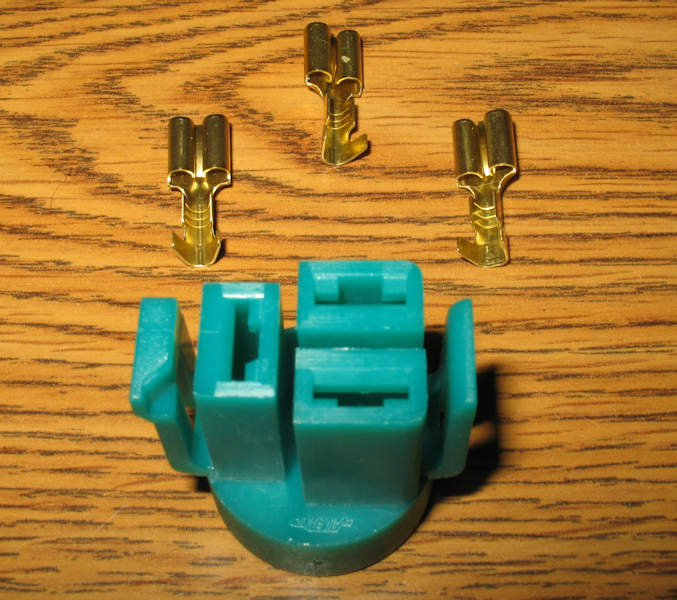
If it's the GM style plug for the GM Alt, it should be rectangular & usualy with 2 terminal sockets.
The toggle switch is because it's not connected through the ignition switch? Why? The ignition switch actually controls 4 different wire circuits; do you have all 4 of these wired to the toggle switch, or some other arrangement? The ignition switch is wired to the starter, voltage regulator and 2 wires go to the fuse block. If it's because the ignition switch is bad, why not just get a new one & replace it? They are readily available and it's not too difficult to do. My concern here is that the further away from stock you get, the more likely certain things aren't going to work, or will not work correctly as designed. Toyota engineers designed these things to work well so I personally do not see the need to change all that. Just IMO. The 20 AMP toggle switch should be strong enough to handle the current. I had just assumed that you were using the toggle switch like a "battery cutoff" but apparently I'm wrong. If you're dealing with a wire harness that was previously pretty hacked up by previous owners I get it. Is this an RV model or not? That makes a big difference in the electrical system, as there are additional circuits added. Let me know about this, I'm working blind here.
Sure, you could custom wire up the fuel pump,ignition system and charging system and it would run & charge the battery, but you'd have nothing else. That's fine for an off-road vehicle but otherwise not very useful.
Ignition coil - Yes,Primary is the + & - terminals. Secondary is + to center post terminal OR - to center post terminal. You can measure Secondary resistance either way, it doesn't matter. How did you test the pulse from the pickup coil? Just measuring if it has pulse may not be enough, the pulse has to be strong enough to trigger the module, & if the air gap is too big you may get pulse, but not enough voltage to actually trigger off the module. Did you check the Air Gap on the Pickup Coil as I suggested? Is the hold-down screw on it tight? As the distributor is a fairly new rebuild I wouldn't suspect that the Pickup Coil has a problem, but you can check it's resistance. The spec on it is 130 to 190 Ohms cold. What kind of condition is the wire/cable from the Pickup Coil? Is it original? That cable is shielded to prevent interference with the Pickup Coil signal. Again, due to age & heat exposure underhood it might have a problem and be a "weak link: in the ignition system. My 40 year old original had seen better days, so I replaced it. I fabbed up a new one using shielded alarm system cable that has two conductors in it. Works perfectly. Here's what I used:
https://www.homedepot.com/p/Southwir...-204725140-_-N
Head not grounded? You said you replaced all the ground wires, and I did previously mention the one that goes from the engine head to the firewall; did you do that one? Even without that ground cable things might still work, but may not work correctly.
Good on replacing all the fuses in the fuse block, but did you check to see if they are still good? Double check.
12 volts to the module but only 9 volts when cranking? Definitely a problem here, that's too big of a voltage drop. Some ideas. Did you replace the Red Cable that goes to the starter or no? Are the connections to the starter, especially for the big red cable from the battery, clean and tight? This could also indicate that your battery has a bad cell (or more). Did you ever get the battery tested to see if it's OK? Also you never did answer the question about the battery to frame ground cable; what gauge is it? it should be no smaller than 4 Gauge. Undersized cables can cause a voltage drop like that, as well as bad connections or a bad battery. The Alternator shouldn't have anything to do with voltage drop when cranking.
Good work on cleaning up the brake light ground. Having the emissions control computer unplugged is no big deal in these earlier trucks. I "de-smogged" my truck and have the computer unplugged and have no problems at all.
What do you mean, you have the fuel pump relay "unplugged"? Did you disconnect the relay from it's socket on the wire harness? Are you sure it's the fuel pump relay? It should be located under the dash about in the center area. The originals look like this:
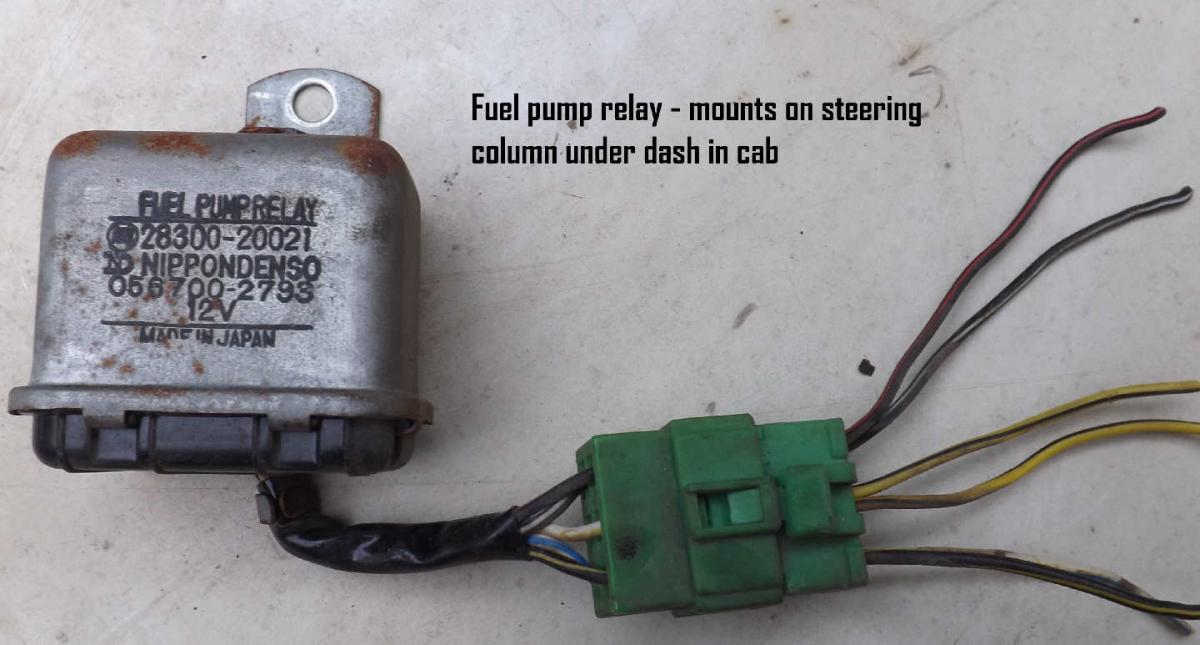
Having that relay unplugged could be an issue, but not for spark. It is wired to your Start & Run circuits via the ignition switch. Also the Oil Sender switch goes through it but shouldn't affect the functioning of the Oil Light. My relay went bad on me & there are no direct factory replacements. I just wired up a "Bosch Style" 5 pin 30/40 Amp relay with socket & pigtail, put male spade connectors on the ends of the pigtail wires & plugged them in individually into the stock relay socket. Works great.
What's with the aftermarket electric fuel pump? What is it? What brand/part number? Where is it mounted? Are you running a stock carb or a Weber? Also, dumb question time - How are you checking for spark? How do you know you don't have spark? If you could describe what you are doing to test this it would help me to understand whats going on. Hard to diagnose things without actually being there to see it.
Wiring Diagram - I only have one on file. It's not a Toyota factory original diagram but I have reviewed it and it appears to be MOSTLY accurate, and I will post it below. I would advise you to look for a factory service manual on Ebay, or get the Haynes manual from a parts store or online.
https://haynes.com/en-us/toyota/pickup/1969-1978
Wiring Diagram: http://www.offroadforum.cz/toyota/aa...8/85786148.pdf
If you have the stock Alternator, it should have a green plug in it that should look like this:
If it's the GM style plug for the GM Alt, it should be rectangular & usualy with 2 terminal sockets.
The toggle switch is because it's not connected through the ignition switch? Why? The ignition switch actually controls 4 different wire circuits; do you have all 4 of these wired to the toggle switch, or some other arrangement? The ignition switch is wired to the starter, voltage regulator and 2 wires go to the fuse block. If it's because the ignition switch is bad, why not just get a new one & replace it? They are readily available and it's not too difficult to do. My concern here is that the further away from stock you get, the more likely certain things aren't going to work, or will not work correctly as designed. Toyota engineers designed these things to work well so I personally do not see the need to change all that. Just IMO. The 20 AMP toggle switch should be strong enough to handle the current. I had just assumed that you were using the toggle switch like a "battery cutoff" but apparently I'm wrong. If you're dealing with a wire harness that was previously pretty hacked up by previous owners I get it. Is this an RV model or not? That makes a big difference in the electrical system, as there are additional circuits added. Let me know about this, I'm working blind here.
Sure, you could custom wire up the fuel pump,ignition system and charging system and it would run & charge the battery, but you'd have nothing else. That's fine for an off-road vehicle but otherwise not very useful.
Ignition coil - Yes,Primary is the + & - terminals. Secondary is + to center post terminal OR - to center post terminal. You can measure Secondary resistance either way, it doesn't matter. How did you test the pulse from the pickup coil? Just measuring if it has pulse may not be enough, the pulse has to be strong enough to trigger the module, & if the air gap is too big you may get pulse, but not enough voltage to actually trigger off the module. Did you check the Air Gap on the Pickup Coil as I suggested? Is the hold-down screw on it tight? As the distributor is a fairly new rebuild I wouldn't suspect that the Pickup Coil has a problem, but you can check it's resistance. The spec on it is 130 to 190 Ohms cold. What kind of condition is the wire/cable from the Pickup Coil? Is it original? That cable is shielded to prevent interference with the Pickup Coil signal. Again, due to age & heat exposure underhood it might have a problem and be a "weak link: in the ignition system. My 40 year old original had seen better days, so I replaced it. I fabbed up a new one using shielded alarm system cable that has two conductors in it. Works perfectly. Here's what I used:
https://www.homedepot.com/p/Southwir...-204725140-_-N
Head not grounded? You said you replaced all the ground wires, and I did previously mention the one that goes from the engine head to the firewall; did you do that one? Even without that ground cable things might still work, but may not work correctly.
Good on replacing all the fuses in the fuse block, but did you check to see if they are still good? Double check.
12 volts to the module but only 9 volts when cranking? Definitely a problem here, that's too big of a voltage drop. Some ideas. Did you replace the Red Cable that goes to the starter or no? Are the connections to the starter, especially for the big red cable from the battery, clean and tight? This could also indicate that your battery has a bad cell (or more). Did you ever get the battery tested to see if it's OK? Also you never did answer the question about the battery to frame ground cable; what gauge is it? it should be no smaller than 4 Gauge. Undersized cables can cause a voltage drop like that, as well as bad connections or a bad battery. The Alternator shouldn't have anything to do with voltage drop when cranking.
Good work on cleaning up the brake light ground. Having the emissions control computer unplugged is no big deal in these earlier trucks. I "de-smogged" my truck and have the computer unplugged and have no problems at all.
What do you mean, you have the fuel pump relay "unplugged"? Did you disconnect the relay from it's socket on the wire harness? Are you sure it's the fuel pump relay? It should be located under the dash about in the center area. The originals look like this:
Having that relay unplugged could be an issue, but not for spark. It is wired to your Start & Run circuits via the ignition switch. Also the Oil Sender switch goes through it but shouldn't affect the functioning of the Oil Light. My relay went bad on me & there are no direct factory replacements. I just wired up a "Bosch Style" 5 pin 30/40 Amp relay with socket & pigtail, put male spade connectors on the ends of the pigtail wires & plugged them in individually into the stock relay socket. Works great.
What's with the aftermarket electric fuel pump? What is it? What brand/part number? Where is it mounted? Are you running a stock carb or a Weber? Also, dumb question time - How are you checking for spark? How do you know you don't have spark? If you could describe what you are doing to test this it would help me to understand whats going on. Hard to diagnose things without actually being there to see it.
Wiring Diagram - I only have one on file. It's not a Toyota factory original diagram but I have reviewed it and it appears to be MOSTLY accurate, and I will post it below. I would advise you to look for a factory service manual on Ebay, or get the Haynes manual from a parts store or online.
https://haynes.com/en-us/toyota/pickup/1969-1978
Wiring Diagram: http://www.offroadforum.cz/toyota/aa...8/85786148.pdf
Dec 19, 2019 | 04:53 PM
#10
Thread Starter
Registered User
Joined: Sep 2019
Posts: 42
Likes: 0
I do have type of alternator plug, but it might be black. I'll check later.
For my ignition system, ive got a wire from the battery that goes to a toggle switch in my cab then straight to B on the module and + on the coil. My module is grounded directly to the battery. To me it just seems more simple and id rather not route it through the old harness and ignition switch because then I've got alot of other points of failure to check. But im thinking now that may be a bad idea because while the truck is running, the ignition module would be getting the juice straight from the alternator 14.6 ish volts right? Because before I had it hooked up to the black/yellow wire coming out of the harness which im not sure if that is current that has gone through the regulator? Could that blow out a module?
the ignition coil tested good. I checked my air gap. Its a rebuilt destributor but the red and white wires from the pickup look like their from the 70s. The resistance checks out and tested the pickup by measuring the voltage between the 2 wires while cranking.
I replaced all the ground cables including the one from firewall to head, but im gonna run another from the head right to the battery. All the cables are 4 guage and I replaces the starter cable and it is clean.
ive got the pump relay unplugged because the tank pump is bad and I've got an aftermarket one from autozone. Not sure of the part number. Just a Mr gasket 12v inline pump its mounted on the passenger side fender where some emissions crap was. Ive got the relay unplugged at the green connecter in the picture. My old tank pump makes a fizzing sound, like a soda pop.
The truck is not a RV like the dolphin. Its got a camper shell that is a foot taller than the cab, with a window, double doors in the back, no tailgate, its got a light mounted in it but the shell is not wired up not sure if its original on this truck. Some wires hanging off the shell.
By the way, youve been very helpful. I appriciate that you care about my truck running. Thanks
For my ignition system, ive got a wire from the battery that goes to a toggle switch in my cab then straight to B on the module and + on the coil. My module is grounded directly to the battery. To me it just seems more simple and id rather not route it through the old harness and ignition switch because then I've got alot of other points of failure to check. But im thinking now that may be a bad idea because while the truck is running, the ignition module would be getting the juice straight from the alternator 14.6 ish volts right? Because before I had it hooked up to the black/yellow wire coming out of the harness which im not sure if that is current that has gone through the regulator? Could that blow out a module?
the ignition coil tested good. I checked my air gap. Its a rebuilt destributor but the red and white wires from the pickup look like their from the 70s. The resistance checks out and tested the pickup by measuring the voltage between the 2 wires while cranking.
I replaced all the ground cables including the one from firewall to head, but im gonna run another from the head right to the battery. All the cables are 4 guage and I replaces the starter cable and it is clean.
ive got the pump relay unplugged because the tank pump is bad and I've got an aftermarket one from autozone. Not sure of the part number. Just a Mr gasket 12v inline pump its mounted on the passenger side fender where some emissions crap was. Ive got the relay unplugged at the green connecter in the picture. My old tank pump makes a fizzing sound, like a soda pop.
The truck is not a RV like the dolphin. Its got a camper shell that is a foot taller than the cab, with a window, double doors in the back, no tailgate, its got a light mounted in it but the shell is not wired up not sure if its original on this truck. Some wires hanging off the shell.
By the way, youve been very helpful. I appriciate that you care about my truck running. Thanks
Dec 31, 2019 | 06:51 AM
#11
Registered User
Joined: Jun 2016
Posts: 717
Likes: 189
From: Florida
The toggle switch setup isn't stock. Did you do that or was it there when you got the truck (done by previous owner?) If so I'm curious about what wire gauge & type was used to create this system, and it would also be a "direct wire" system that does not even use the fuse for the ignition system, as it is bypassed this way. Is there an inline fuse in this system or no? Many possibilities. IF I were to do something like this I wouldn't use anything lighter than 14 gauge wire, & probably go with 12 gauge just to be on the safe side. This has to do with current handling capacity & resistance. If the wire gauge is too light to handle the amps going thru it, it will heat up & cause excess resistance, dropping what power is going thru it, and maybe "starving" the coil & module for power. I understand the "many points of failure" but wire harnesses are fairly simple things, unless some previous owner hacked it up to death. I am also at a loss to explain why someone would do what they have done in making that "system". Only 2 thoughts that come to mind is that they had some problem with the power feed to the coil/ignitior/module, or it's a basic "anti-theft" device. If the toggle switch is not in an obvious spot (mounted) or isn't labeled/tagged as to what it's for, I'd think the latter reason. Lastly, if the wire used for this setup is solid core and not multi-strand that could also be a problem. If the wire is old and solid core, that might be a problem, as soild core doesn't stand up to vibration as well as multi-strand over time.
I wouldn't be too worried about the module getting more than 12 volts, as it would routinely get more than 12 volts as the system is designed to work. The Voltage Regulator's job is to limit the alternators output to 14.5 volts or less to protect the vehicles electric system, and to make sure the battery never receives more than 14.5 volts. Charging a battery with more voltage than that can damage it. From your question I am assuming that your perception is that the voltage regulator maintains vehicle system voltage at 12 volts; this is not in fact what happens. Your battery is basically a big capacitor that stores energy. It also acts as a "voltage buffer" or "voltage smoother". Because of how it is constructed & designed, it will only allow a certain amount of voltage to flow at any given time. This helps prevent any large & fast voltage spikes in the system. As long as your battery is in good condition and has a full charge at rest (engine not running, not being charged by alternator, should read at least 12.5 volts) it should function the way I described. Even IF your module & coil were getting straight alternator voltage, those 2 components were designed to handle that. The number 1 biggest reason modules "blow up" or nor work correctly is excess resistance in the ignition circuit, usually from a defective coil, but it could come from other sources too. This is why I am concerned about the voltage supply, wire gauge, etc. of your current setup.
"Its a rebuilt destributor but the red and white wires from the pickup look like their from the 70s." Can you be more specific here? If you mean the red & white wires between the plug on the distributor for the pickup coil, going TO the module, they should be replaced to assure that part of the "circuit" is good. My old connector wire from the distributor to the module was original, to the point where the ends of my red wire were color faded to pink. That cable takes a lot of heat underhood and over time, the wires inside can get fatigued and not conduct as intended. That cable is now over 40 years old & is probably due to be replaced. Also, you can't just use any old wire to replace it, as that cable is shielded inside to prevent any external interference to the pickup coils "signal" voltage to the module, which could also cause run issues. What I used was #18 AWG Gauge, 2 Conductor, Stranded, Shielded Security/Alarm System Cable. Example: https://www.homedepot.com/p/Southwir...-204725192-_-N
I just cut the old cable off at the distributor connector end, leaving enough wire so that I could strip the ends to solder to the new wire, a bit of electrical tape over each solder joint for insulation, a little aluminum foil around that for shielding, then heatshrink-tubed the whole area. Adding the foil for shielding in that small area probably doesn't matter that much but I did it anyway; you could likely get away with just soldering the wires & putting the tape & heatshrink tube over it. I soldered on some terminals on the other ends of the wires for attachment to my module, and also shrink-tubed over those joints. As you can see the wire is available at Home Depot by the foot, & possibly at Lowes. If you end up not being able to find any let me know, I have some extra laying around here I could mail to you.
What did you air gap onthe pickup coil turn out to be? Just curious. Good work on the ground cables & starter cable.
I get that the original tank pump is bad. Have you ever tested fuel flow on the new pump for volume? Is there is a broken part inside the old tank pump you might have a fuel flow restriction. The "fizzing sound" sounds like the impeller broke and is keeping the motor from turning; that could be leading to a fuel restriction in the old pump. Decent flow rate should be about a quart of gas every 15 seconds or so. Are you running the stock carburetor or a Weber? This makes a big difference. Mr. Gasket makes quite a few 12 volt inline fuel pumps, all with different specs. Depending on exactly which one you are using and what carb you have, there could be a problem there (incorrect fuel flow rate, incorrect fuel pressure rate). Webers don't like anything above 3 PSI fuel pressure, and most aftermarket fuel pumps are higher than that, so it could cause a flooding condition. A pressure regulator would be needed Let me know exactly what you have on these things so we can eliminate them as possible problems or find some solutions.
Also sorry to have to say this, but you mounted the fuel pump in the wrong place. Electric fuel pumps work best when mounted as near to the gas tank as possible. The way you have it mounted on the passenger side fender well, it has to "draw" gas from the tank all the way up the fuel line. It's always better to mount the pump near the tank, so it doesn't have to work as hard to "draw", and instead use most of the pumps power to "push" the gas up the line. There could be a couple of PSI difference in this which matters a bunch. Stock carbs are designed to work on 5 to 8 PSI, Webers usually no more than 3 PSI.
The camper shell is not original, as Toyota never sold them as original equipment. If you have a camper shell sitting in the original bed, that is an aftermarket add-on item.
You're most welcome to what help I can offer. Sorry about the delay in response but you know, holidays & all. Hope yours have gone well.
I wouldn't be too worried about the module getting more than 12 volts, as it would routinely get more than 12 volts as the system is designed to work. The Voltage Regulator's job is to limit the alternators output to 14.5 volts or less to protect the vehicles electric system, and to make sure the battery never receives more than 14.5 volts. Charging a battery with more voltage than that can damage it. From your question I am assuming that your perception is that the voltage regulator maintains vehicle system voltage at 12 volts; this is not in fact what happens. Your battery is basically a big capacitor that stores energy. It also acts as a "voltage buffer" or "voltage smoother". Because of how it is constructed & designed, it will only allow a certain amount of voltage to flow at any given time. This helps prevent any large & fast voltage spikes in the system. As long as your battery is in good condition and has a full charge at rest (engine not running, not being charged by alternator, should read at least 12.5 volts) it should function the way I described. Even IF your module & coil were getting straight alternator voltage, those 2 components were designed to handle that. The number 1 biggest reason modules "blow up" or nor work correctly is excess resistance in the ignition circuit, usually from a defective coil, but it could come from other sources too. This is why I am concerned about the voltage supply, wire gauge, etc. of your current setup.
"Its a rebuilt destributor but the red and white wires from the pickup look like their from the 70s." Can you be more specific here? If you mean the red & white wires between the plug on the distributor for the pickup coil, going TO the module, they should be replaced to assure that part of the "circuit" is good. My old connector wire from the distributor to the module was original, to the point where the ends of my red wire were color faded to pink. That cable takes a lot of heat underhood and over time, the wires inside can get fatigued and not conduct as intended. That cable is now over 40 years old & is probably due to be replaced. Also, you can't just use any old wire to replace it, as that cable is shielded inside to prevent any external interference to the pickup coils "signal" voltage to the module, which could also cause run issues. What I used was #18 AWG Gauge, 2 Conductor, Stranded, Shielded Security/Alarm System Cable. Example: https://www.homedepot.com/p/Southwir...-204725192-_-N
I just cut the old cable off at the distributor connector end, leaving enough wire so that I could strip the ends to solder to the new wire, a bit of electrical tape over each solder joint for insulation, a little aluminum foil around that for shielding, then heatshrink-tubed the whole area. Adding the foil for shielding in that small area probably doesn't matter that much but I did it anyway; you could likely get away with just soldering the wires & putting the tape & heatshrink tube over it. I soldered on some terminals on the other ends of the wires for attachment to my module, and also shrink-tubed over those joints. As you can see the wire is available at Home Depot by the foot, & possibly at Lowes. If you end up not being able to find any let me know, I have some extra laying around here I could mail to you.
What did you air gap onthe pickup coil turn out to be? Just curious. Good work on the ground cables & starter cable.
I get that the original tank pump is bad. Have you ever tested fuel flow on the new pump for volume? Is there is a broken part inside the old tank pump you might have a fuel flow restriction. The "fizzing sound" sounds like the impeller broke and is keeping the motor from turning; that could be leading to a fuel restriction in the old pump. Decent flow rate should be about a quart of gas every 15 seconds or so. Are you running the stock carburetor or a Weber? This makes a big difference. Mr. Gasket makes quite a few 12 volt inline fuel pumps, all with different specs. Depending on exactly which one you are using and what carb you have, there could be a problem there (incorrect fuel flow rate, incorrect fuel pressure rate). Webers don't like anything above 3 PSI fuel pressure, and most aftermarket fuel pumps are higher than that, so it could cause a flooding condition. A pressure regulator would be needed Let me know exactly what you have on these things so we can eliminate them as possible problems or find some solutions.
Also sorry to have to say this, but you mounted the fuel pump in the wrong place. Electric fuel pumps work best when mounted as near to the gas tank as possible. The way you have it mounted on the passenger side fender well, it has to "draw" gas from the tank all the way up the fuel line. It's always better to mount the pump near the tank, so it doesn't have to work as hard to "draw", and instead use most of the pumps power to "push" the gas up the line. There could be a couple of PSI difference in this which matters a bunch. Stock carbs are designed to work on 5 to 8 PSI, Webers usually no more than 3 PSI.
The camper shell is not original, as Toyota never sold them as original equipment. If you have a camper shell sitting in the original bed, that is an aftermarket add-on item.
You're most welcome to what help I can offer. Sorry about the delay in response but you know, holidays & all. Hope yours have gone well.
Jan 4, 2020 | 10:51 PM
#12
Thread Starter
Registered User
Joined: Sep 2019
Posts: 42
Likes: 0
I added the toggle switches. The previous owner had butchered the harness just a little. I bought the truck stock, it had no spark, I installed the GM system. Ive sorted all that out now and going to put it all back together tomorrow. All lights are in one harness, fan in one harness, wipers in one harness starter solenoid in one harness and ignition wires in another. Everythings wire loomed and taped up. Looks great.
I think that was the issue, too much resistance. I think i was using 14 ga or maybe 16, but it was going from the module all the way accross the fire wall to the battery, and the ground for the module was doing the same. Probably a good 8-9 ft of wire and another 8-9ft for the ground. It is stranded automotive wire. I'll wire it back into the ignition switch this time. But I would like to add some sort of a security feature. I think I'll keep the toggle for the fuel pump. I do have a weber and this is the model of fuel pump that gives 3psi. What other sort of security system could i add.
If I remember correctly, my air gap was .08 I think, whatever the middle of the range is. The wires out of the distributor are old looking, faded and just old looking. It looks like they put a old pickup coil in a rebuilt distributor but that would defeat the purpose.
I'll mount the pump closer to the tank if i ever get around to removing the old one, ive been worried about it pulling thru the old one but its been fine so far.
I think that was the issue, too much resistance. I think i was using 14 ga or maybe 16, but it was going from the module all the way accross the fire wall to the battery, and the ground for the module was doing the same. Probably a good 8-9 ft of wire and another 8-9ft for the ground. It is stranded automotive wire. I'll wire it back into the ignition switch this time. But I would like to add some sort of a security feature. I think I'll keep the toggle for the fuel pump. I do have a weber and this is the model of fuel pump that gives 3psi. What other sort of security system could i add.
If I remember correctly, my air gap was .08 I think, whatever the middle of the range is. The wires out of the distributor are old looking, faded and just old looking. It looks like they put a old pickup coil in a rebuilt distributor but that would defeat the purpose.
I'll mount the pump closer to the tank if i ever get around to removing the old one, ive been worried about it pulling thru the old one but its been fine so far.
Jan 5, 2020 | 09:09 AM
#13
Registered User
Joined: Jun 2016
Posts: 717
Likes: 189
From: Florida
Sounds like you're moving along well. Did you add some inline fuses to those new circuits? It would be wise to protect your equipment & for fire safety. Just use the old fuse block for reference as to fuse size/ratings. A toggle switch mounted somewhere in the cab, in an not-so-easy to see or find place can make a simple but effective "security system". You can wire it to cut power to the ignition system, fuel pump, starter, almost any single or combination of items you want. Again just make sure the switch is rated for enough amps to handle whatever circuit you run through it.
The Distributor Pickup Coil Air Gap Spec is .008" to .016" (0.2 mm to 0.4 mm), so the "middle spec is .012" I have mine set at .012", which is the "middle setting" and the engine runs very well. By the way for anyone else reading, if you only have steel feeler gauges instead of the "non-ferrous" brass or aluminum ones called for to set this gap (magnet in the pickup coil could interfere with getting the gap right), you can use a dollar bill folded to triple thickness, or a "standard" business card to set the gap. A dollar bill is .004" thick so a triple fold yields .012"; a standard business card is usually .014" thick (14 point card stock). Either one would be within spec.
The Pickup Coil might look old but that doesn't mean it's bad. Verify that it's good so you know for sure. Use your Ohm Meter to check the resistance of the pickup coil, cold & hot (hot meaning engine completely warmed up & run for at least 5 minutes after cooling system thermostat opens). Cold spec is 130 - 190 Ohms. Hot specs should not exceed 20% of those values, or 155 - 225 Ohms. Anything out of spec either way & the pickup coil should be replaced.
Fuel Pump - Again, test it to be sure If it were me I'd test for flow to make sure there isn't any restriction thru the old pump. Again, you should get about a quart every 15 seconds or so.
The Distributor Pickup Coil Air Gap Spec is .008" to .016" (0.2 mm to 0.4 mm), so the "middle spec is .012" I have mine set at .012", which is the "middle setting" and the engine runs very well. By the way for anyone else reading, if you only have steel feeler gauges instead of the "non-ferrous" brass or aluminum ones called for to set this gap (magnet in the pickup coil could interfere with getting the gap right), you can use a dollar bill folded to triple thickness, or a "standard" business card to set the gap. A dollar bill is .004" thick so a triple fold yields .012"; a standard business card is usually .014" thick (14 point card stock). Either one would be within spec.
The Pickup Coil might look old but that doesn't mean it's bad. Verify that it's good so you know for sure. Use your Ohm Meter to check the resistance of the pickup coil, cold & hot (hot meaning engine completely warmed up & run for at least 5 minutes after cooling system thermostat opens). Cold spec is 130 - 190 Ohms. Hot specs should not exceed 20% of those values, or 155 - 225 Ohms. Anything out of spec either way & the pickup coil should be replaced.
Fuel Pump - Again, test it to be sure If it were me I'd test for flow to make sure there isn't any restriction thru the old pump. Again, you should get about a quart every 15 seconds or so.

Thread
Thread Starter
Forum
Replies
Last Post
Pri$erulz
General Electrical & Lighting Related Topics
3
Dec 18, 2014 10:18 AM
trktwo
86-95 Trucks & 4Runners
5
Mar 13, 2013 12:00 PM
B4Runner
General Electrical & Lighting Related Topics
3
May 4, 2010 02:12 PM


