


Help! oil pressure gauge
 Apr 23, 2021 | 09:07 AM
#1

Thread Starter
Registered User
Joined: Jan 2013
Posts: 52
Likes: 7
Help! oil pressure gauge
Shouldnt have messed with it, but here we are... Anyone know if the oil pressure gauge on these trucks is repairable or replaceable without having to swap the whole cluster? Any sources for one, or am i relegated to junk yards?
I replaced my sending unit, because my reading was low ish and it was annoying to have the needle at zero once the oil was hot (not that useful). New sending unit seemed to work for about 4 minutes, then it pegged the gauge to max. Was thinking water may have got up under the cover and shorted the unit... Driving around a bit more and it dropped to zero at lights, then all the way to max if rpms went up at all. Got home and went through some diagnostics.
Test light goes on between sensor hot and ground. Test light was measured at ~10ohms. Gauge stays at zero. Gauge is now always at zero even when driving around... Any tips?
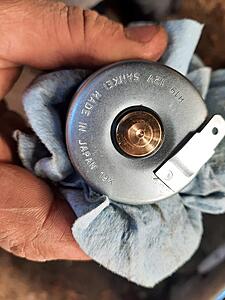
I replaced my sending unit, because my reading was low ish and it was annoying to have the needle at zero once the oil was hot (not that useful). New sending unit seemed to work for about 4 minutes, then it pegged the gauge to max. Was thinking water may have got up under the cover and shorted the unit... Driving around a bit more and it dropped to zero at lights, then all the way to max if rpms went up at all. Got home and went through some diagnostics.
Test light goes on between sensor hot and ground. Test light was measured at ~10ohms. Gauge stays at zero. Gauge is now always at zero even when driving around... Any tips?
 Apr 23, 2021 | 10:46 AM
#2

Registered User

Joined: Apr 2021
Posts: 60
Likes: 15
I got a generic sender from ebay, gauge is still dead. If I ground the sender wire the gauge works. Also If I leave the ignition on but dont start the engine, after a few seconds the gauge starts to move all over at random speeds. Doest work at all when motors running. Do I need a toyota specific sender?
Sorry for the thread hijack but its kinda related
shem
Sorry for the thread hijack but its kinda related
shem
Apr 23, 2021 | 11:16 AM
#3
Thread Starter
Registered User
Joined: Jan 2013
Posts: 52
Likes: 7
You dont need a toyota specific one, but any old pressure sender probably wont work the way you want. The way it works is the gauge grounds through the sender, which has some large resistance. Gauges may have a different "excitation" current. The sender has to match the gauge in terms of resistance curve with pressure.
BECK/ARNLEY 2011130 cross refs with the following:
Alternate/OEM Part Number(s): 8352014020, 8352014021, 8352014022, 8352014023, 8352055011
I might recommend just getting the OEM toyota one.
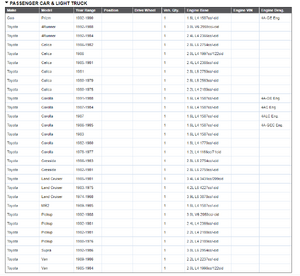
I
BECK/ARNLEY 2011130 cross refs with the following:
Alternate/OEM Part Number(s): 8352014020, 8352014021, 8352014022, 8352014023, 8352055011
I might recommend just getting the OEM toyota one.
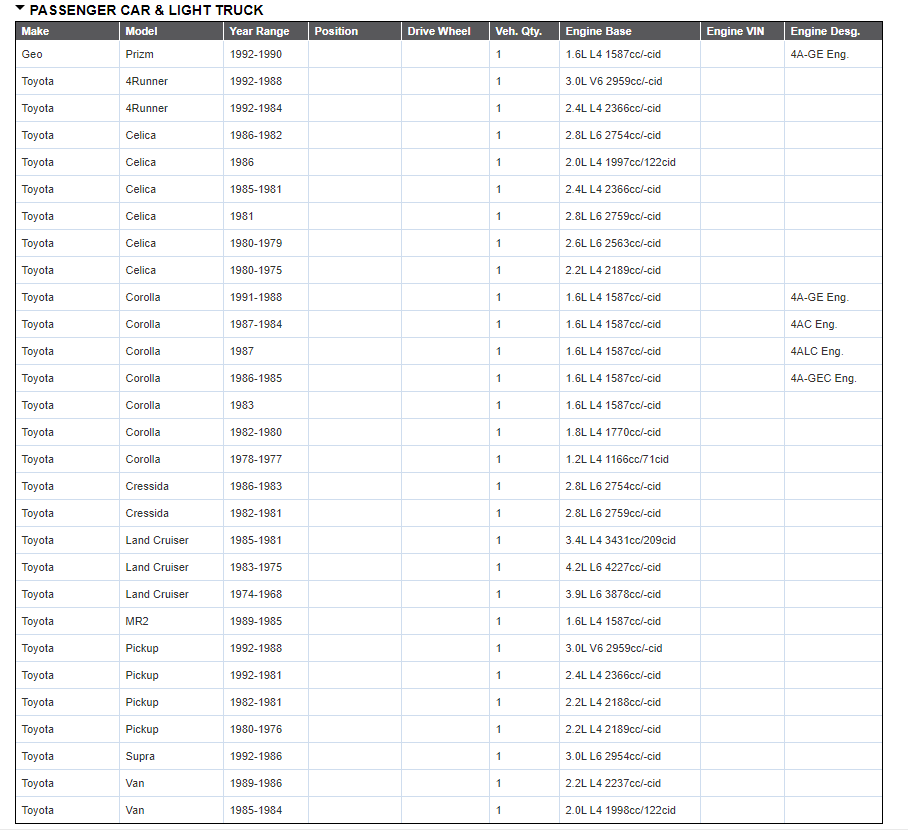
I

Trending Topics
Apr 24, 2021 | 06:47 AM
#8

YT Community Team


Joined: Jan 2020
Posts: 2,253
Likes: 1,003
I must have pulled my gauge a dozen times (not hard on a first gen 4R)) till I figured out what was wrong. Once I saw what failed the fix was simple. Might be worth pulling the cluster and looking. If it needs replacement, finding a used gauge in a wrecking yard shouldn't be hard. At least here in So Cal.
Apr 24, 2021 | 06:37 PM
#9
Registered User
Joined: Jun 2018
Posts: 257
Likes: 22
From: Texas
I will jump in here also. Mine does the same thing. When oil is on start up it shoots to the right where it should. As it warms up it drops to the L.
My sender is pretty new. Autozone.
does the sender do anything more than report the current oil level ? Does it say dictate what the pump is doing ? If not I ain’t worried about it.
My sender is pretty new. Autozone.
does the sender do anything more than report the current oil level ? Does it say dictate what the pump is doing ? If not I ain’t worried about it.
Apr 25, 2021 | 12:06 PM
#10

Registered User

Joined: Jul 2005
Posts: 2,345
Likes: 656
From: Chiloquin, OR
Nope. All it does is supply information to the gauge, nothing else. Actually, it varies the resistance to ground the gauge sees with the pressure applied to it. The oil pressure is controlled by the relief valve on the oil pump.
Bear in mind, the oil pressure drops as the oil hots up. At least at idle. It'll come up when the engine speeds up, but with the oil hot, even the higher rpm oil pressure is going to a bit lower than when it's cold.
Also, the gauge isn't designed to be excessively accurate. If you want an actual, accurate, reading, an after market gauge is about your only choice, as far as I know.
Good luck!
Pat☺
Bear in mind, the oil pressure drops as the oil hots up. At least at idle. It'll come up when the engine speeds up, but with the oil hot, even the higher rpm oil pressure is going to a bit lower than when it's cold.
Also, the gauge isn't designed to be excessively accurate. If you want an actual, accurate, reading, an after market gauge is about your only choice, as far as I know.
Good luck!
Pat☺
Apr 25, 2021 | 03:42 PM
#11
Registered User
Joined: Apr 2021
Posts: 60
Likes: 15
Anybody know the ohm range for the oil gauge? The generic ones for chevys is 0-90 ohm which is probably what this ebay one I got is. Even then it should still register something on the gauge. My gauge pegs when grounded so wire n gauge are good. Me thinks it needs a toyo specific sender.
shem
shem
Apr 26, 2021 | 08:18 AM
#12
Thread Starter
Registered User
Joined: Jan 2013
Posts: 52
Likes: 7
Anybody know the ohm range for the oil gauge? The generic ones for chevys is 0-90 ohm which is probably what this ebay one I got is. Even then it should still register something on the gauge. My gauge pegs when grounded so wire n gauge are good. Me thinks it needs a toyo specific sender.
shem
shem
Proper sender should be open circuit (infinity ohms) with no pressure and I don't know what at operating pressure... Enough to make a 3w test light flash but not enough to make it stay illuminated.
Apr 26, 2021 | 12:26 PM
#13
Registered User
Joined: Jul 2005
Posts: 2,345
Likes: 656
From: Chiloquin, OR
Well, I looked, and I can't find anything in the FSM specifying the ohm range of the sender. Only the minimum pressure at idle, and normal oil pressure at 3000 rpm. Warmed up, nothing about cold. The low end, at idle, warmed up, is only 4.3 PSI, so it probably would be pretty close to the L on the gauge. Warmed up, at 3000 rpm, it specifies 38-75 PSI.
If I were you, and I'm not, obviously, I would get an OEM, Toyota sender. If you have to, from the dealership. I wouldn't think it'd be all that expensive, even from the stealership.
Good luck!
Pat☺
If I were you, and I'm not, obviously, I would get an OEM, Toyota sender. If you have to, from the dealership. I wouldn't think it'd be all that expensive, even from the stealership.
Good luck!
Pat☺
Apr 26, 2021 | 12:48 PM
#14

Registered User

Joined: Sep 2007
Posts: 8,380
Likes: 871
From: San Francisco East Bay
If you grounded the gauge you probably destroyed it. This is a common issue with those who swap their combination meter (instrument panel) with idiot light for one with a gauge. If they don't replace the oil pressure warning switch with a sender, as soon as power is applied the switch grounds the meter and destroys it.
Last edited by scope103; Apr 27, 2021 at 07:40 AM.
Apr 26, 2021 | 01:07 PM
#15
Thread Starter
Registered User
Joined: Jan 2013
Posts: 52
Likes: 7
To go back to original problem, I suspect my new sender grounded out when splashed, as the rubber protective cover didnt sit tight on the sender body and I drove through some snow and water. Thus destroying the gauge.
But HOW does it destroy the gauge, is it possible to repair, and can you replace just the gauge instead of the whole cluster are my three questions.
Jimkola's post seems to suggest its possible to swap jus the one gauge, but on a 1st gen.
But HOW does it destroy the gauge, is it possible to repair, and can you replace just the gauge instead of the whole cluster are my three questions.
Jimkola's post seems to suggest its possible to swap jus the one gauge, but on a 1st gen.
Apr 26, 2021 | 01:36 PM
#16
Registered User
Joined: Sep 2007
Posts: 8,380
Likes: 871
From: San Francisco East Bay
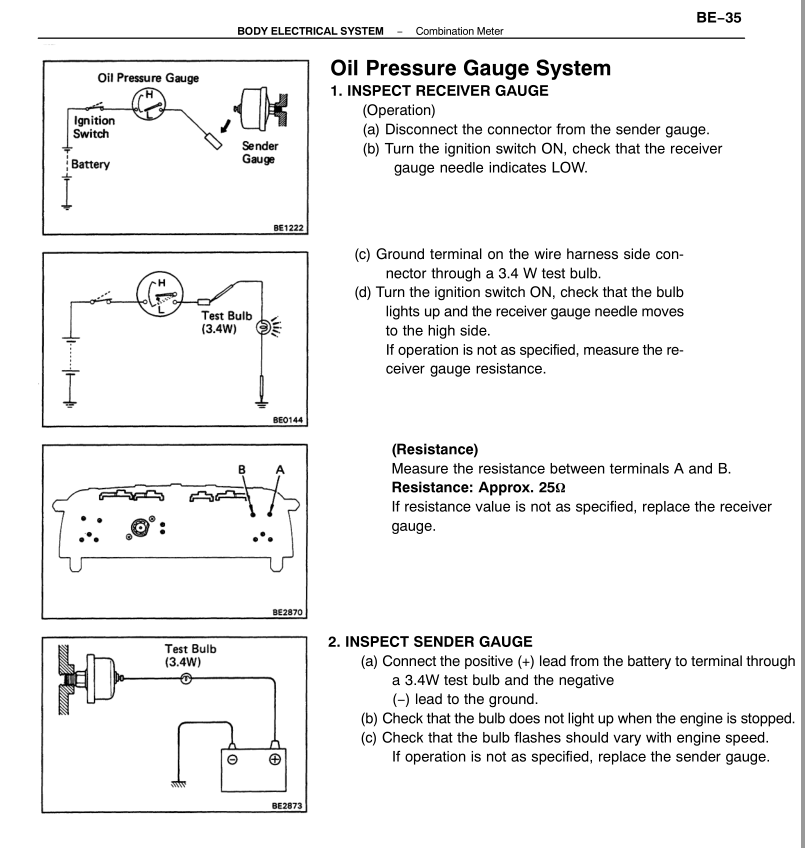
Just in case I'm completely wrong about the result, use the test method described in the manual section I linked to test the gauge.
I haven't looked, but lots on this forum have found complete SR-5 combination meters in salvage yards. I think that would be easier than doing printed circuit surgery on your meter, but as I said, I've never tried it.
If you want to go that route, start by determining if you have the cable driven speedometer or the electronic. You can tell by looking at the connection at the back of the transfer case.
I haven't looked, but lots on this forum have found complete SR-5 combination meters in salvage yards. I think that would be easier than doing printed circuit surgery on your meter, but as I said, I've never tried it.
If you want to go that route, start by determining if you have the cable driven speedometer or the electronic. You can tell by looking at the connection at the back of the transfer case.
Apr 27, 2021 | 05:21 AM
#17

Registered User
Joined: Apr 2007
Posts: 89
Likes: 21
From: Winston Salem, NC
I'm having the same issue with my son's '86 22re. The gauge reads on the low side all the time. The engine is new but when I rebuilt it I got the oil pump for an '86 and it appears the engine itself is an '84 ish. The oil pumps (and a bunch of other stuff) is different. So I put the old oil pump back on and figured it was just kinda worn out. 1700 miles later the oil pressure was so low I decided it was time to try something else. I changed the oil and went with a heavier weight oil and added Lucas oil stabilizer to thicken it up a bit more. The pressure didn't really change a whole lot. Was a bit higher but still below the lower line on the gauge. So fast forward to this weekend and we put a new oil pump on it. (I'm guessing the other was original with who knows how many miles) Initially the pressure was better but still on the low side of the gauge and once it got hot it was back down at the lower line or a little lower. Guess I hadn't thought about the sender being faulty since it moved up and down. I'd bought an aftermarket gauge but haven't installed it. Guess it's time to do that.
Apr 27, 2021 | 07:39 AM
#18
Thread Starter
Registered User
Joined: Jan 2013
Posts: 52
Likes: 7
Check the sender and the gauge using the described procedure in FSM. If both check out, PERSONALLY i would just buy a new toyota OEM sender and install it, as they can get off enough to read low (what was happening to me).
The other thing to do is just check oil pressure using an actually accurate gauge. I would first always assume the factory gauge is lying.

The other thing to do is just check oil pressure using an actually accurate gauge. I would first always assume the factory gauge is lying.
 Apr 29, 2021 | 11:58 AM
#20
Registered User
Joined: Jul 2005
Posts: 2,345
Likes: 656
From: Chiloquin, OR
Just remember to pull the negative battery lead off, and let it sit for a few minutes to discharge any caps, BEFORE you measure any ohms anywhere. Preferably both battery leads, just to be safe. It only takes a very small voltage across the meter leads to blow the ohms circuit in the meter. Most nowadays have a fuse in there for it, but still, it would kinda suck to break your new meter first time you go to use it.
Good luck!
Pat☺
Good luck!
Pat☺


