


fitting 33's......
 Feb 27, 2008 | 03:35 AM
#1
Thread Starter
Registered User
Joined: Jan 2008
Posts: 9
Likes: 0
From: michigan
fitting 33's......
i have a 87 4runner with stock ifs suspension. what do i need to do to fit 33's under it is it possible? i have 31's on it now and they don't rub at all. i thought about a 2 inch body lift ,turn torshion bars up and make longer shackles for the rear. has any one done this......
 Feb 27, 2008 | 03:51 AM
#3
X2 on searching, there is a ton of info on it and this question gets asked all the time...And yes, tons of people have gone your proposed route before.
I cranked my Torsion Bars on my old '86 4Runner, IMO it rode like crap.
I cranked my Torsion Bars on my old '86 4Runner, IMO it rode like crap.
Feb 27, 2008 | 05:58 AM
#5
Contributing Member
Joined: Apr 2004
Posts: 5,464
Likes: 6
From: Arvada, Colorado
Okay.
First of all, Body Lifts are a GREAT way to lift a truck, in fact, on early IFS, they are the BEST way. They give you clearance for bigger tires, and clearance to lift the drive train, giving you better approach, breakover, and departure angles.
BJ spacers and torsion bar cranks DO NOT GIVE YOU ROOM TO FIT BIGGER TIRES, unless you move your lower bumpstops downward by shimming them with washers, which restricts your up travel.
Back to the OT, yes, you can fit 33x9.50, or 33x10.50 tires without lift ON STOCK BACKSPACED RIMS. you will likely have to pound the pinchweld flat, which has zero cosmetic impact, as you cannot see the pinch weld normally.
for 33x12.50's, you will have to either cut out the fenders, get a body lift, or a bracket lift.
Here is a thread you can browse through for more lift ideas.
https://www.yotatech.com/forums/f31/...trucks-124467/
Good luck.
First of all, Body Lifts are a GREAT way to lift a truck, in fact, on early IFS, they are the BEST way. They give you clearance for bigger tires, and clearance to lift the drive train, giving you better approach, breakover, and departure angles.
BJ spacers and torsion bar cranks DO NOT GIVE YOU ROOM TO FIT BIGGER TIRES, unless you move your lower bumpstops downward by shimming them with washers, which restricts your up travel.
Back to the OT, yes, you can fit 33x9.50, or 33x10.50 tires without lift ON STOCK BACKSPACED RIMS. you will likely have to pound the pinchweld flat, which has zero cosmetic impact, as you cannot see the pinch weld normally.
for 33x12.50's, you will have to either cut out the fenders, get a body lift, or a bracket lift.
Here is a thread you can browse through for more lift ideas.
https://www.yotatech.com/forums/f31/...trucks-124467/
Good luck.
Last edited by AxleIke; Feb 27, 2008 at 06:02 AM.
Feb 27, 2008 | 06:28 AM
#6

Contributing Member
Joined: Nov 2005
Posts: 8,875
Likes: 3
From: Longmont, CO
http://www.4crawler.com/4x4/ForSale/...it.shtml#FAQ10
Sum it - stay narrow and you can fit a taller tire.
Sum it - stay narrow and you can fit a taller tire.
Trending Topics
Feb 27, 2008 | 09:24 AM
#8
 Feb 28, 2008 | 10:12 AM
#10

Registered User
Joined: Feb 2008
Posts: 64
Likes: 1
Actually the BJ spacers push your lower suspension compnents (the lower a-arm etc.) down by adding the spacer bewteen the upper a-arm and upper BJ. This pushes the knuckle and lower a-arm down raising the front end. This in turn gives you a lift equal to the height of the spacer increasing room for tires. Its not much room but it allows you to run 33x10.5 tires without punding the pinch weld and also gives you a slight amount of travel. The downside is with the travel comes over extension of the stock CV's.
The torsion bar does basically the same thing, forces all the suspension downward increasing the room in the upper wheel well, but it stiffens the ride and is pointless unless its for looks.
It also depends on what tires since some 33's run at 32", some at 33" some at 31.5" and some at 34".
My friend ran 33x12.5 TSl's and they run at around 33.6" while my 33x10.5 TSL radials ran about a little over 32". BFG's run very close to 33" and they will rub in the rear with a 2" shackle lift. My friend ran 1.5" BJ spacers, 2" shackles, and a 1" BL to clear his 33x10.5 BFG's with no body mods.
Feb 28, 2008 | 10:27 AM
#11
Registered User
Joined: Oct 2007
Posts: 2,747
Likes: 3
From: NC
4runners are said to hold 33x10.50's stock but it is a tight fit and you have a 2in bod lift on it so it think they will fit. It might look werid but fit.
_________________________________________________
95 Toyota 4runner SR5 V6 3.0 Automatic 149,900 Miles
_________________________________________________
95 Toyota 4runner SR5 V6 3.0 Automatic 149,900 Miles
Feb 28, 2008 | 10:32 AM
#12
Contributing Member
Joined: Apr 2004
Posts: 5,464
Likes: 6
From: Arvada, Colorado
Actually the BJ spacers push your lower suspension compnents (the lower a-arm etc.) down by adding the spacer bewteen the upper a-arm and upper BJ. This pushes the knuckle and lower a-arm down raising the front end. This in turn gives you a lift equal to the height of the spacer increasing room for tires. Its not much room but it allows you to run 33x10.5 tires without punding the pinch weld and also gives you a slight amount of travel. The downside is with the travel comes over extension of the stock CV's.
The torsion bar does basically the same thing, forces all the suspension downward increasing the room in the upper wheel well, but it stiffens the ride and is pointless unless its for looks.
It also depends on what tires since some 33's run at 32", some at 33" some at 31.5" and some at 34".
My friend ran 33x12.5 TSl's and they run at around 33.6" while my 33x10.5 TSL radials ran about a little over 32". BFG's run very close to 33" and they will rub in the rear with a 2" shackle lift. My friend ran 1.5" BJ spacers, 2" shackles, and a 1" BL to clear his 33x10.5 BFG's with no body mods.
The torsion bar does basically the same thing, forces all the suspension downward increasing the room in the upper wheel well, but it stiffens the ride and is pointless unless its for looks.
It also depends on what tires since some 33's run at 32", some at 33" some at 31.5" and some at 34".
My friend ran 33x12.5 TSl's and they run at around 33.6" while my 33x10.5 TSL radials ran about a little over 32". BFG's run very close to 33" and they will rub in the rear with a 2" shackle lift. My friend ran 1.5" BJ spacers, 2" shackles, and a 1" BL to clear his 33x10.5 BFG's with no body mods.
Nope.
Only on the street does that logic hold true. Off road, where you can flex out what little suspension travel these things have, you can flex that lower a-arm right back to the stock location.
Second, with stock bumpstops, the CV angles are just fine, with manual hubs. Those with ADD and driveflanges will experience increased boot wear.
Bottom line is, you can fit the same sized tire with or without bj spacers and or torsion crank.
I've done it all, BJ spacers, new torsions, stock height with and without BJ spacers, lifted from spacers, 1" lift from spacers, blah blah blah.
The ticket is to put in the BJ spacers for added travel, and relax the torsion bars back down so the lower a-arms sit at the stock geometry, and the uppers are up higher. This will keep you from blowing steering components out of the truck every run, and give a fairly decent ride.
Your buddy cleared the tires because of the body lift, not any of the suspension mods.
Last edited by AxleIke; Feb 28, 2008 at 10:34 AM.
Feb 28, 2008 | 12:10 PM
#13
Registered User
Joined: Feb 2008
Posts: 64
Likes: 1
Nope.
Only on the street does that logic hold true. Off road, where you can flex out what little suspension travel these things have, you can flex that lower a-arm right back to the stock location.
Second, with stock bumpstops, the CV angles are just fine, with manual hubs. Those with ADD and driveflanges will experience increased boot wear.
Bottom line is, you can fit the same sized tire with or without bj spacers and or torsion crank.
I've done it all, BJ spacers, new torsions, stock height with and without BJ spacers, lifted from spacers, 1" lift from spacers, blah blah blah.
The ticket is to put in the BJ spacers for added travel, and relax the torsion bars back down so the lower a-arms sit at the stock geometry, and the uppers are up higher. This will keep you from blowing steering components out of the truck every run, and give a fairly decent ride.
Your buddy cleared the tires because of the body lift, not any of the suspension mods.
Only on the street does that logic hold true. Off road, where you can flex out what little suspension travel these things have, you can flex that lower a-arm right back to the stock location.
Second, with stock bumpstops, the CV angles are just fine, with manual hubs. Those with ADD and driveflanges will experience increased boot wear.
Bottom line is, you can fit the same sized tire with or without bj spacers and or torsion crank.
I've done it all, BJ spacers, new torsions, stock height with and without BJ spacers, lifted from spacers, 1" lift from spacers, blah blah blah.
The ticket is to put in the BJ spacers for added travel, and relax the torsion bars back down so the lower a-arms sit at the stock geometry, and the uppers are up higher. This will keep you from blowing steering components out of the truck every run, and give a fairly decent ride.
Your buddy cleared the tires because of the body lift, not any of the suspension mods.
How does lowering the knuckle on the front end not increase the ride height? Simple logic says when you put the knuckle lower to the ground the tire is lower therefore raising the truck and adding increased space above the tire.
And i fail to see where bumpstops affect ride height. Bumpstops are just that, a pad that stops over travel of the suspension and harsh bottoming so components are not damaged. According to 4crawlers site and my personal experience you need to shim the bumpstops or else your CV can hyper extend and in my case, your idler arm will destroy itself. The CV problem occurs with the droop of the suspension as does all the steering problems.
Im pretty sure my friend and I both cleared our 33's due to the BJ spacer LIFT.
"Whether or not you prefer enhanced compression travel for high speed trips through desert washes or a balance between compression and extension travel more suited for rocky trails, these spacers will increase your functionality and ability to custom tailor your suspension characteristics while increasing clearance between the fenders and front wheels. If 1.5" is too tall for your needs, 1" and 0.5" spacers are available on special order. "
Taken from the 4crawler site. Im pretty sure it provides a lift, otherwise 4crawler is putting out false advertisements.

Bottom line is you can fit the same size tires with and without BJ spacers, BUT with BJ spacers the need for a body mod is greatly reduced.
Last edited by alpine4x4; Feb 28, 2008 at 12:13 PM.
Feb 28, 2008 | 12:32 PM
#14
Both statements are true. Ball joint spacers can contribute to lift if you adjust the torsion bars to ride higher than they were before the lift. And they can simply provide added travel with no additional lift, if you adjust the torsion bars back down after installing the spacers. All depends where you adjust the front end after installing the spacers.
- http://www.4crawler.com/4x4/ForSale/...cer.shtml#FAQ2
And yes, you can basically do the same thing without spacers, but the higher up you go, the harsher the ride will be. With the spacers installed, the ride will be smoother at a given height as compared to cranked torsion bars only.
- http://www.4crawler.com/4x4/ForSale/...cer.shtml#FAQ2
And yes, you can basically do the same thing without spacers, but the higher up you go, the harsher the ride will be. With the spacers installed, the ride will be smoother at a given height as compared to cranked torsion bars only.
Feb 28, 2008 | 03:13 PM
#15
Contributing Member
Joined: Apr 2004
Posts: 5,464
Likes: 6
From: Arvada, Colorado
How does lowering the knuckle on the front end not increase the ride height? Simple logic says when you put the knuckle lower to the ground the tire is lower therefore raising the truck and adding increased space above the tire.
And i fail to see where bumpstops affect ride height. Bumpstops are just that, a pad that stops over travel of the suspension and harsh bottoming so components are not damaged. According to 4crawlers site and my personal experience you need to shim the bumpstops or else your CV can hyper extend and in my case, your idler arm will destroy itself. The CV problem occurs with the droop of the suspension as does all the steering problems.
Im pretty sure my friend and I both cleared our 33's due to the BJ spacer LIFT.
"Whether or not you prefer enhanced compression travel for high speed trips through desert washes or a balance between compression and extension travel more suited for rocky trails, these spacers will increase your functionality and ability to custom tailor your suspension characteristics while increasing clearance between the fenders and front wheels. If 1.5" is too tall for your needs, 1" and 0.5" spacers are available on special order. "
Taken from the 4crawler site. Im pretty sure it provides a lift, otherwise 4crawler is putting out false advertisements.
Bottom line is you can fit the same size tires with and without BJ spacers, BUT with BJ spacers the need for a body mod is greatly reduced.
And i fail to see where bumpstops affect ride height. Bumpstops are just that, a pad that stops over travel of the suspension and harsh bottoming so components are not damaged. According to 4crawlers site and my personal experience you need to shim the bumpstops or else your CV can hyper extend and in my case, your idler arm will destroy itself. The CV problem occurs with the droop of the suspension as does all the steering problems.
Im pretty sure my friend and I both cleared our 33's due to the BJ spacer LIFT.
"Whether or not you prefer enhanced compression travel for high speed trips through desert washes or a balance between compression and extension travel more suited for rocky trails, these spacers will increase your functionality and ability to custom tailor your suspension characteristics while increasing clearance between the fenders and front wheels. If 1.5" is too tall for your needs, 1" and 0.5" spacers are available on special order. "
Taken from the 4crawler site. Im pretty sure it provides a lift, otherwise 4crawler is putting out false advertisements.
Bottom line is you can fit the same size tires with and without BJ spacers, BUT with BJ spacers the need for a body mod is greatly reduced.
Height is controlled by the torsion bars alone. As 4crawler said, you can adjust to any height you want. If you leave the torsion bars where they were, put on BJ spacers, you get 1.5" of lift. You can raise or lower from there.
As I said, you are correct ON THE ROAD. Where you don't flex very much at all.
Just look at your front suspension. You have pushed the knuckle down, BUT, you can flex the lower A-Arm to the bumpstop. That bumpstop, unless you changed it, is the same as it was stock. So, regardless, at FULL COMPRESSION, your tires are in the EXACT same place, BJ spacers or no.
When you add BJ spacers, without adjusting Torsion bars, you gain clearance between the fender. But, when off road, you will still rub, because your tires can compress to the same location they could stock. You won't rub as much, because you won't be as close to the fender as often.
As for the steering, you are breaking it because you have the torsion bars cranked too far up. I am on Idler arm 13, centerlink #3, and i have no idea how many tie rod ends.
I cut down significanlty on broken steering parts when I went back to stock geometry for the lower A-arms. The steering likes to be in its stock location. Cranking tbars or leaving the tbars stock with BJ spacers puts too much force on the steering components.
For the upper bumpstops, i dunno. I have stock uppers, and have had no CV issues. I had one boot go out, but I think that was from a stick, not from increased wear. I have manual hubs, which helps a lot.
 Feb 29, 2008 | 02:38 PM
#17
Registered User
Joined: Feb 2008
Posts: 64
Likes: 1
Nope.
Height is controlled by the torsion bars alone. As 4crawler said, you can adjust to any height you want. If you leave the torsion bars where they were, put on BJ spacers, you get 1.5" of lift. You can raise or lower from there.
As I said, you are correct ON THE ROAD. Where you don't flex very much at all.
Just look at your front suspension. You have pushed the knuckle down, BUT, you can flex the lower A-Arm to the bumpstop. That bumpstop, unless you changed it, is the same as it was stock. So, regardless, at FULL COMPRESSION, your tires are in the EXACT same place, BJ spacers or no.
When you add BJ spacers, without adjusting Torsion bars, you gain clearance between the fender. But, when off road, you will still rub, because your tires can compress to the same location they could stock. You won't rub as much, because you won't be as close to the fender as often.
As for the steering, you are breaking it because you have the torsion bars cranked too far up. I am on Idler arm 13, centerlink #3, and i have no idea how many tie rod ends.
I cut down significanlty on broken steering parts when I went back to stock geometry for the lower A-arms. The steering likes to be in its stock location. Cranking tbars or leaving the tbars stock with BJ spacers puts too much force on the steering components.
For the upper bumpstops, i dunno. I have stock uppers, and have had no CV issues. I had one boot go out, but I think that was from a stick, not from increased wear. I have manual hubs, which helps a lot.
Height is controlled by the torsion bars alone. As 4crawler said, you can adjust to any height you want. If you leave the torsion bars where they were, put on BJ spacers, you get 1.5" of lift. You can raise or lower from there.
As I said, you are correct ON THE ROAD. Where you don't flex very much at all.
Just look at your front suspension. You have pushed the knuckle down, BUT, you can flex the lower A-Arm to the bumpstop. That bumpstop, unless you changed it, is the same as it was stock. So, regardless, at FULL COMPRESSION, your tires are in the EXACT same place, BJ spacers or no.
When you add BJ spacers, without adjusting Torsion bars, you gain clearance between the fender. But, when off road, you will still rub, because your tires can compress to the same location they could stock. You won't rub as much, because you won't be as close to the fender as often.
As for the steering, you are breaking it because you have the torsion bars cranked too far up. I am on Idler arm 13, centerlink #3, and i have no idea how many tie rod ends.
I cut down significanlty on broken steering parts when I went back to stock geometry for the lower A-arms. The steering likes to be in its stock location. Cranking tbars or leaving the tbars stock with BJ spacers puts too much force on the steering components.
For the upper bumpstops, i dunno. I have stock uppers, and have had no CV issues. I had one boot go out, but I think that was from a stick, not from increased wear. I have manual hubs, which helps a lot.
I had no problems fitting my 33's in the front.
As for the CV's 4crawler reccomends checking for CV binding after installation because it is possible and reccomends shimming the bumpstops if bindage occurs.
In my front end the shock might have been the limiting factor because i never shimmed it and it was a stock shock. It might have limited suspension travel enough to keep the suspension from drooping too far.
Feb 29, 2008 | 04:41 PM
#18
Contributing Member
Joined: Apr 2004
Posts: 5,464
Likes: 6
From: Arvada, Colorado
My experience is that ANY lift in the front is what fatigues steering components. The steering geometry gets set out of whack due to aligning the truck at the increased angles, and thus, under compression, as you say, the idler and other parts fail.
I have had not issues fitting the 33's either. But, I could have fit them stock as well.
I have had not issues fitting the 33's either. But, I could have fit them stock as well.
Feb 29, 2008 | 05:03 PM
#19
Contributing Member
Joined: Nov 2005
Posts: 606
Likes: 4
From: Tucson, AZ
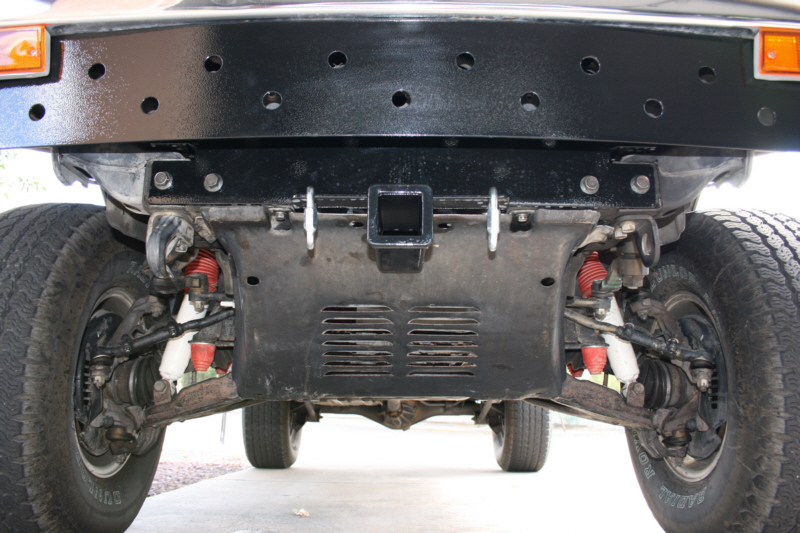
True putting in BJ spacers does throw off the control arm geometry a little, but they do push down the spidles the same height as the spacer. Therefore lift. If you leave the TB in the stock position you have the same amount of drop out as before and more compression room. I had to change the 4 lower stops with longer stops. I'm going to build my own diff drop by recreating the center cross bar and spacing the rear mounts, so as to drop it evenly and not mess up the pinion angle (like just putting spacers in the rear does).
Feb 29, 2008 | 05:41 PM
#20
Contributing Member
Joined: Dec 2006
Posts: 3,607
Likes: 2
From: maryland
Well fellas here is what frank at S.D.O.R.I. has posted at his site for the theory of bj spacers hope this helps
Often questions arise as to how ball joint spacers will affect vehicle performance when contrasted to simply cranking the torsion bars or installing new torsion bars. This page will explain.
What do torsion bars do? While it seems obvious, it's not always. Torsion bars simply resist the twisting force, or torque of your truck's upper control arms. You can adjust them such that the truck sits higher, or lower, but in the end, all they do is resist that torque. Adjusting them up does not increase the preload (actually it decreases it). After all, the load is a result of the truck's weight which did not increase when you cranked up the bars. There is an interaction where the the force of the truck's wheels results in a lower torque when the upper a-arm is not parallel with the ground. This is why the preload drops (and ride gets stiffer) when the bars are cranked.
So, do I need new bars if I want to lift my truck via the torsion bar? NO. You can adjust your stock torsion bars for what ever lift you want just as you can adjust an aftermarket bar similarly. You will sacrifice down travel for up travel with no gain in over all travel. Lifting a truck by adjusting the torsion bars will make it ride stiffer and the lack of down travel can adversely affect drive quality and trail flex. However, this lift is free and that is its benefit.
So what does an aftermarket bar really do fo me? This is simple, a larger diameter bar makes the suspension more stiff. Typically, we want our suspension to flex more not less, therefore stiff bars are not what we want. However, there are cases for them. One is when a vehicle has a heavy winch/bumper bolted to the front end. This can cause the truck to bottom out (run out of suspension travel) often. Here, a stiffer torsion bar can help. The other is the case of those who like to jump their trucks. Ultimately, that type of driving requires an expensive long travel kit due to the extremely high stresses on the vehicle's chassis. However, for those who want to try this on a budget, stiffer bars will help with the bottoming out and hopfully put off the inevitable damage for a while that can occur when a vehicle runs out of suspension travel repeatedly.
How do ball joint spacers work into all of this? Ball joint spacers do two things, increase the window of travel and increase the flexibility of the suspension. By design, they are intended to lift the truck 1.5" over stock. The user has the option to further adjust the torsion bars to set the suspension to their liking. The suspension can be set for only 1" of lift which means the truck now has 1" more compression travel and .5" more downtravel than it had stock. At 1.5" of lift, the truck has 1.5" more compression travel and equal downtravel as stock. The result is that the truck can absorb a larger bump than it could stock and do so without sacrificing the downtravel necessary for good trail flex and on road drive quality. Since the spacer helps to lift the truck while keeping the a-arm more parallel with the ground, the flex characteristics are improved as well.
Can I set my suspension for more than 1.5" of lift? Yes but there are trade offs since the steeper a-arm angles mean steeper drive axle and steering angles. The CV boots can wear faster and idler arm stress increases. It can make the the CV more prone to failure, but typically that failure requires a front locker, open front differentials do not apply enough stress to break CV axles. One can mitigate the CV boot wear by installing manual hubs. If manual hubs are present, then the CV boot wear is not really an issue. The idler arm is more prone to fail when the a-arm angles are steep. This can be addressed with an idler arm brace like that from Downey.
Can I fit 33X12.5's with just spacers? The truth is no, not without rubbing. The spacers permit the suspension to travel upwards until the lower control arm hits its bumpstops. While there is more clearance than stock when the truck is at rest, there is similar clearance when a wheel is stuffed. As a result, a 33X12.5 tire that clears under normal street driving conditions might rub on the trail when the suspenion is compressed and front wheels turned. There are numerous ways to address the rubbing ranging from pounding/trimming fenders to adding a body lift. Since 33X12.5" tires are not all the same size and width, how much clearancing you will have to do will vary depending on the tire you chose. Typically, the spacer lift combined with a 2" body lift will clear most 33X12.5" tires. It should be noted, 33X10.5" tires will fit with no lift and work well with ball joint spacers.
Are ball joint spacers compatible with my 4" bracket type lift kit? Yes! Ball joint spacers interact with the suspension differently than the 4" kit and can actually augment the performance of such kits in the ways described above.
Hopefully this helps to explain how one's truck can benefit from ball joint spacers. The addition of this lift not only improves the truck's capability but actually improves the ride quality. That is not someing one can do by simply cranking up the torsion bars or purchasing a more expensive bracket style lift kit.
Often questions arise as to how ball joint spacers will affect vehicle performance when contrasted to simply cranking the torsion bars or installing new torsion bars. This page will explain.
What do torsion bars do? While it seems obvious, it's not always. Torsion bars simply resist the twisting force, or torque of your truck's upper control arms. You can adjust them such that the truck sits higher, or lower, but in the end, all they do is resist that torque. Adjusting them up does not increase the preload (actually it decreases it). After all, the load is a result of the truck's weight which did not increase when you cranked up the bars. There is an interaction where the the force of the truck's wheels results in a lower torque when the upper a-arm is not parallel with the ground. This is why the preload drops (and ride gets stiffer) when the bars are cranked.
So, do I need new bars if I want to lift my truck via the torsion bar? NO. You can adjust your stock torsion bars for what ever lift you want just as you can adjust an aftermarket bar similarly. You will sacrifice down travel for up travel with no gain in over all travel. Lifting a truck by adjusting the torsion bars will make it ride stiffer and the lack of down travel can adversely affect drive quality and trail flex. However, this lift is free and that is its benefit.
So what does an aftermarket bar really do fo me? This is simple, a larger diameter bar makes the suspension more stiff. Typically, we want our suspension to flex more not less, therefore stiff bars are not what we want. However, there are cases for them. One is when a vehicle has a heavy winch/bumper bolted to the front end. This can cause the truck to bottom out (run out of suspension travel) often. Here, a stiffer torsion bar can help. The other is the case of those who like to jump their trucks. Ultimately, that type of driving requires an expensive long travel kit due to the extremely high stresses on the vehicle's chassis. However, for those who want to try this on a budget, stiffer bars will help with the bottoming out and hopfully put off the inevitable damage for a while that can occur when a vehicle runs out of suspension travel repeatedly.
How do ball joint spacers work into all of this? Ball joint spacers do two things, increase the window of travel and increase the flexibility of the suspension. By design, they are intended to lift the truck 1.5" over stock. The user has the option to further adjust the torsion bars to set the suspension to their liking. The suspension can be set for only 1" of lift which means the truck now has 1" more compression travel and .5" more downtravel than it had stock. At 1.5" of lift, the truck has 1.5" more compression travel and equal downtravel as stock. The result is that the truck can absorb a larger bump than it could stock and do so without sacrificing the downtravel necessary for good trail flex and on road drive quality. Since the spacer helps to lift the truck while keeping the a-arm more parallel with the ground, the flex characteristics are improved as well.
Can I set my suspension for more than 1.5" of lift? Yes but there are trade offs since the steeper a-arm angles mean steeper drive axle and steering angles. The CV boots can wear faster and idler arm stress increases. It can make the the CV more prone to failure, but typically that failure requires a front locker, open front differentials do not apply enough stress to break CV axles. One can mitigate the CV boot wear by installing manual hubs. If manual hubs are present, then the CV boot wear is not really an issue. The idler arm is more prone to fail when the a-arm angles are steep. This can be addressed with an idler arm brace like that from Downey.
Can I fit 33X12.5's with just spacers? The truth is no, not without rubbing. The spacers permit the suspension to travel upwards until the lower control arm hits its bumpstops. While there is more clearance than stock when the truck is at rest, there is similar clearance when a wheel is stuffed. As a result, a 33X12.5 tire that clears under normal street driving conditions might rub on the trail when the suspenion is compressed and front wheels turned. There are numerous ways to address the rubbing ranging from pounding/trimming fenders to adding a body lift. Since 33X12.5" tires are not all the same size and width, how much clearancing you will have to do will vary depending on the tire you chose. Typically, the spacer lift combined with a 2" body lift will clear most 33X12.5" tires. It should be noted, 33X10.5" tires will fit with no lift and work well with ball joint spacers.
Are ball joint spacers compatible with my 4" bracket type lift kit? Yes! Ball joint spacers interact with the suspension differently than the 4" kit and can actually augment the performance of such kits in the ways described above.
Hopefully this helps to explain how one's truck can benefit from ball joint spacers. The addition of this lift not only improves the truck's capability but actually improves the ride quality. That is not someing one can do by simply cranking up the torsion bars or purchasing a more expensive bracket style lift kit.


