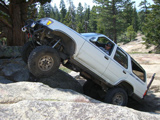
Why are J**p rock sliders mounted to the body??
 Dec 2, 2005 | 07:20 PM
#1
Thread Starter
Registered User
Joined: Apr 2004
Posts: 2,685
Likes: 1
From: Ashburnham, MA
Why are J**p rock sliders mounted to the body??
My brother owns a jeep, otherwise, this would never have come to my attention. I was looking on this site to see about getting his christmas present and I noticed this:
http://www.jeepinoutfitters.com/scri...?idCategory=91
They have sliders that mount to the body. I realize that they are probably thick and strong but I personally wouldn't want to come down on a slider attached to the body of my truck, seems like it would tweak something. Can someone explain why this works on a jeep? Am I missing something?
http://www.jeepinoutfitters.com/scri...?idCategory=91
They have sliders that mount to the body. I realize that they are probably thick and strong but I personally wouldn't want to come down on a slider attached to the body of my truck, seems like it would tweak something. Can someone explain why this works on a jeep? Am I missing something?

 Dec 2, 2005 | 07:30 PM
#5

Registered User
Joined: Aug 2003
Posts: 990
Likes: 0
From: Columbia, MO
well, they are cheap and easy to mount that way. also, it offers improved clearance. wheras my sliders stick about 2" below the rocker panel, body mounted ones would offer me 2" more clearance.
i have seen body mounted ones on toyotas as well.
i have seen body mounted ones on toyotas as well.
Dec 2, 2005 | 07:48 PM
#6
Contributing Member
Joined: Sep 2002
Posts: 4,749
Likes: 0
From: Santa Clarita, California
but what good is the clearance if it messes up the body? is that a reasonable trade off? aye, at least not for me as i'm running a dd.
either these jeepers just don't care about the body damage or think the extra clearance is worth it or there's just something we're not geting here?
either these jeepers just don't care about the body damage or think the extra clearance is worth it or there's just something we're not geting here?
Trending Topics
 Dec 2, 2005 | 08:11 PM
#9

Contributing Member
Joined: Mar 2005
Posts: 1,871
Likes: 0
From: WA ,monroe
Originally Posted by WATRD
It depends upon which Heep model. Some Heeps are "unibody", so there is no "frame" as you and I think of it, to attach sliders to.
Dec 2, 2005 | 08:16 PM
#11

Registered User
Joined: Sep 2002
Posts: 1,520
Likes: 1
From: woodstock, ga
Originally Posted by rockota
I have a friend who build his own that bolted to the body. They are usually some form of angle and actually pretty strong.
Dec 2, 2005 | 10:02 PM
#12
Registered User
Joined: Aug 2004
Posts: 1,385
Likes: 0
From: Sammamish, WA
I've only seen those ones that mount sort of to the body, on TJ/YJ/CJ's (wranglers). The sliders on my zj were welded to the "frame rails", and then bolted to the seam right under the rockers, too.
Dec 3, 2005 | 05:50 AM
#13
Thread Starter
Registered User
Joined: Apr 2004
Posts: 2,685
Likes: 1
From: Ashburnham, MA
I understand that they are thicker and stronger than the body, but either way, the forces are being sent through the body rather than to the frame. It just seems counter productive. I would be concerned about body mount bolts pulling through the floor from repeated slider use. or the bdy tweaking a bit and making it hard to open or close a door, ya know.
Dec 3, 2005 | 06:11 AM
#14

Registered User
Joined: Dec 2003
Posts: 792
Likes: 0
From: Minnesota
Originally Posted by Intrepid
I understand that they are thicker and stronger than the body, but either way, the forces are being sent through the body rather than to the frame. It just seems counter productive. I would be concerned about body mount bolts pulling through the floor from repeated slider use. or the bdy tweaking a bit and making it hard to open or close a door, ya know.
The CJ/YJ/TJ frames are MUCH more narrow than the Toy frames, forcing any fame mounted slider to have very long mounting legs = lots of leverage.
People like Roger Brown and Scott Ellinger have been making sliders that take advantage of the body seem for a very long time. Yes, they are bolted/welded to the frame, but they sill use the body seem to spread the load.
Third - it ain't broke, so don't fix it.

 Dec 3, 2005 | 07:30 AM
#17
Contributing Member
Joined: Jun 2005
Posts: 1,725
Likes: 0
From: San Jose, CA
Originally Posted by WATRD
It depends upon which Heep model. Some Heeps are "unibody", so there is no "frame" as you and I think of it, to attach sliders to.
Doesn't that mean that unibodies can still have a frame?
Thank You,
Marko
Dec 3, 2005 | 08:10 AM
#18

Contributing Member
Joined: Oct 2002
Posts: 5,089
Likes: 0
From: Duvall, WA
Originally Posted by marko3xl3
Can someone explain to me the "unibody" thing? I thought unibody meant that a vehicle's body is made of one pice, cast, instead of more than one either screwed together or welded together.
Doesn't that mean that unibodies can still have a frame?
Thank You,
Marko
Doesn't that mean that unibodies can still have a frame?
Thank You,
Marko
The first automotive application of the monocoque technique was 1923's Lancia Lambda. Citroën built the first mass-produced monocoque vehicle in 1934, the innovative Traction Avant. The popular Volkswagen Beetle also used a semi-monocoque body (its frame required the body for support) in 1938.
In the post-war period the technique became more widely used. The Ford Consul introduced an evolution called unit body or unibody. In this system, separate body panels are still used but are bolted to a monocoque body-shell. Spot welded unibody construction is now the dominant technique in automobiles, though some vehicles (particularly trucks) still use the older body-on-frame technique.
In automobiles, it is common to see true monocoque frames, where the structural members around the window and door frames are built by folding the skin material several times. In these situations the main concerns are spreading the load evenly, having no holes for corrosion to start, and reducing the overall workload. Compared to older techniques, in which a body is bolted to a frame, monocoque cars are less expensive and stronger.
Dec 3, 2005 | 08:36 AM
#19

Actually in the Jeep line, they call it "uni-frame" not uni-body, for example on the Cherokees. They use a regular one piece body and a traditional steel ladder frame. Only difference is that instead of using compliant body mount bushings:
- http://www.4crawler.com/4x4/ForSale/...Kit.shtml#Body
They just weld the body to the frame, making it all one unit.
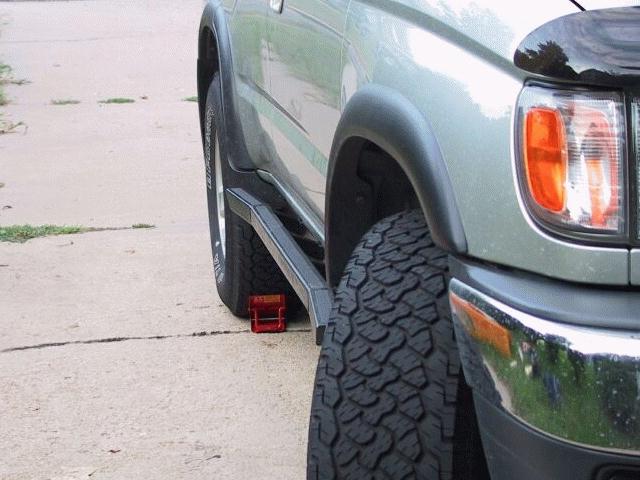
Quite common for the SWB Jeeps and FJ40 Landcruisers to use the rocker panel reinforcements instead of sliders. Seems to work fine, never seen anyone have trouble with that on the trail. With the vertical body side, I guess it is easy and more economical to do. On the 4Runners and pickups, it would be a lot harder to form heavy steel to match the body contours and figure out a way to attach and support it, so separate sliders seem to be the better answer. Also look at the side profile of a Jeep, straight up and down, so protecting the bottom corner is sufficient. Look at the profile on the 4Runner. The door panel sticks out ~6" or so beyond the rocker panel. I prefer to have a slider that is as wide as the door panel to help protect that sheet metal on the trail:
http://www.4crawler.com/4x4/ForSale/...tml]More info.
- http://www.4crawler.com/4x4/ForSale/...Kit.shtml#Body
They just weld the body to the frame, making it all one unit.
Quite common for the SWB Jeeps and FJ40 Landcruisers to use the rocker panel reinforcements instead of sliders. Seems to work fine, never seen anyone have trouble with that on the trail. With the vertical body side, I guess it is easy and more economical to do. On the 4Runners and pickups, it would be a lot harder to form heavy steel to match the body contours and figure out a way to attach and support it, so separate sliders seem to be the better answer. Also look at the side profile of a Jeep, straight up and down, so protecting the bottom corner is sufficient. Look at the profile on the 4Runner. The door panel sticks out ~6" or so beyond the rocker panel. I prefer to have a slider that is as wide as the door panel to help protect that sheet metal on the trail:
http://www.4crawler.com/4x4/ForSale/...tml]More info.