


!!Speedy's Supercharger Thread!!
 Oct 5, 2013 | 02:56 PM
#1201
Thread Starter
Registered User

Joined: Aug 2006
Posts: 945
Likes: 0
From: Nashville, TN
I know, I've been so buy messing with these calipers I haven't had time to upload them to my site. I'll work on that tomorrow in between coats of paint on the calipers.
Finally got them all smoothed out. They're gonna look great painted, but if I had it to do over I'd have just left them be. These Toyota calipers had to be the roughest I've ever seen with the dimpled finish they had on them. That's all polished smooth but it took way longer than I'd have liked.
Finally got them all smoothed out. They're gonna look great painted, but if I had it to do over I'd have just left them be. These Toyota calipers had to be the roughest I've ever seen with the dimpled finish they had on them. That's all polished smooth but it took way longer than I'd have liked.
Oct 9, 2013 | 05:06 PM
#1202
Thread Starter
Registered User
Joined: Aug 2006
Posts: 945
Likes: 0
From: Nashville, TN
OK, finally had time to get a couple of pics posted.
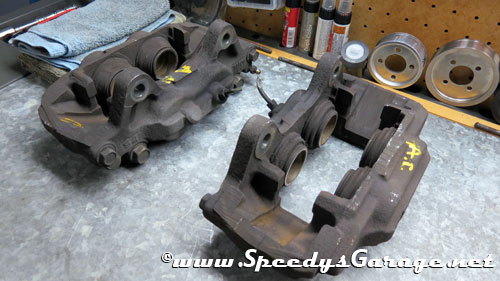
Junk yard $35 calipers before:
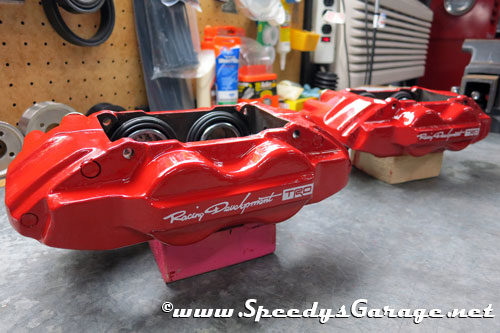
After:
Ordered my lift parts today. Got Tundra TRD springs and 5100s for the front and 906s for the rear with 5100s. I'll post up pics of the complete setup once installed.
Junk yard $35 calipers before:
After:
Ordered my lift parts today. Got Tundra TRD springs and 5100s for the front and 906s for the rear with 5100s. I'll post up pics of the complete setup once installed.
 Oct 11, 2013 | 08:53 AM
#1204
Thread Starter
Registered User
Joined: Aug 2006
Posts: 945
Likes: 0
From: Nashville, TN
That is BRUSH ON G2 caliper paint. It is a self leveling two part product that I've used on other projects with great success. I love the stuff. Flows out smooth as it dries and is good to 950°. Once it dries, acetone won't even touch it.
Color is their standard red.
Color is their standard red.
Oct 12, 2013 | 04:24 PM
#1205
Thread Starter
Registered User
Joined: Aug 2006
Posts: 945
Likes: 0
From: Nashville, TN
Posted up my videos on rebuilding and painting the calipers. Rotors and all that are on order, but I'll be doing the lift kit first. Planning the lift install for next weekend.
Here's the caliper thread:
https://www.yotatech.com/forums/f2/s...pgrade-273995/
Here's the caliper thread:
https://www.yotatech.com/forums/f2/s...pgrade-273995/
Nov 3, 2013 | 08:24 PM
#1206
Registered User
Joined: Sep 2010
Posts: 82
Likes: 0
From: Mid West
From the looks of those dust boots, it appears you rebuilt your calipers. Do you have a part number for the rebuild kit? I know on t4r a member used the 199mm rebuild kit to rebuild his 231mm calipers and it worked. Just wondering if you did something different.
Edit: Just watched your video, and of course, my rebuild kit is a different part number than yours. However a member over at T4R claims he rebuilt his 231mm calipers with 04479-0C020 and the boots fit. I'm curious if there is any difference in the diameter of the pistons between the two caliper sizes.
Here's the thread:
http://www.toyota-4runner.org/3rd-ge...ld-thread.html
Edit: Just watched your video, and of course, my rebuild kit is a different part number than yours. However a member over at T4R claims he rebuilt his 231mm calipers with 04479-0C020 and the boots fit. I'm curious if there is any difference in the diameter of the pistons between the two caliper sizes.
Here's the thread:
http://www.toyota-4runner.org/3rd-ge...ld-thread.html
Last edited by madbomber08; Nov 3, 2013 at 08:51 PM.
Nov 4, 2013 | 10:26 AM
#1207
Thread Starter
Registered User
Joined: Aug 2006
Posts: 945
Likes: 0
From: Nashville, TN
Hmm, I can't answer that one.
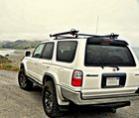
Well, here's a few more pics. I went with new tires and wheels and a 2" lift using Tundra TRD coils, 5100 shocks, and 906 springs in the rear with 5100s.
Here's a few pics. I'll start a new thread since this one kind of meandered a bit and link to it from here with the install and parts info/pics/video.
Before new tires and wheels. Stock suspension IS TRD wheels and stock tires.
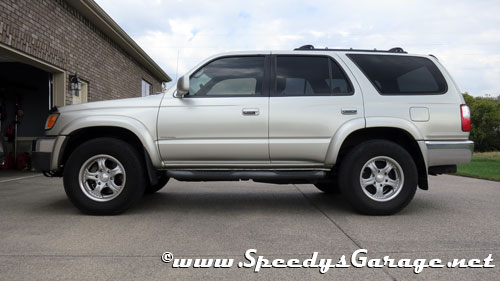
After 265/75R15 Bridgestone Dueller A/T Revo 2 tires and Level 8 MK6 wheels. To me, the larger tires upset the lines of the vehicle at stock height.
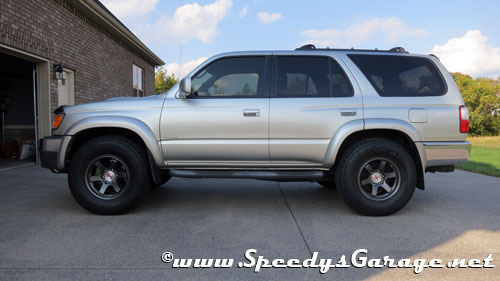
After 2" lift. For me this is perfect. Not too high and gives nice body lines and proportions for the tire/wheel combo.
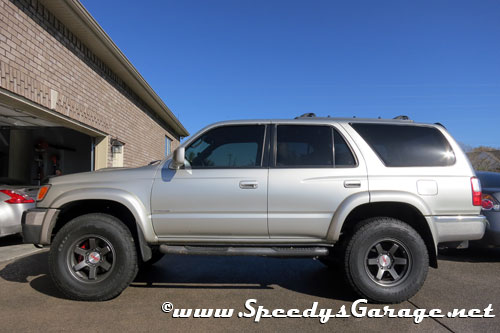
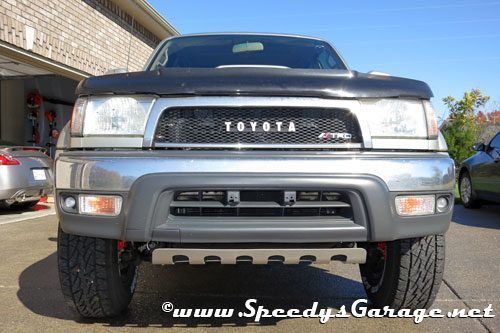
Well, here's a few more pics. I went with new tires and wheels and a 2" lift using Tundra TRD coils, 5100 shocks, and 906 springs in the rear with 5100s.
Here's a few pics. I'll start a new thread since this one kind of meandered a bit and link to it from here with the install and parts info/pics/video.
Before new tires and wheels. Stock suspension IS TRD wheels and stock tires.
After 265/75R15 Bridgestone Dueller A/T Revo 2 tires and Level 8 MK6 wheels. To me, the larger tires upset the lines of the vehicle at stock height.
After 2" lift. For me this is perfect. Not too high and gives nice body lines and proportions for the tire/wheel combo.
Nov 4, 2013 | 12:40 PM
#1208

Contributing Member
Joined: Apr 2007
Posts: 4,932
Likes: 1
From: DFW TEXAS BABY!
Looks good, personally I liked the look with the new wheels before the lift better but what you like is what matters. I have always had a soft spot for the setup like those ice trucks with massive tires with mild lifts.
 Nov 6, 2013 | 03:45 PM
#1213
Thread Starter
Registered User
Joined: Aug 2006
Posts: 945
Likes: 0
From: Nashville, TN
I made a thread with all the install information, but figured I'd post this up here as well for those that actually go through all 50 or whatever pages.
Lift Install How To Video I put together:
[YOUTUBE]m9-0hMzv_RU[/YOUTUBE]
Caliper How To Videos
[YOUTUBE]qoQlAW4DPnA[/YOUTUBE]
[YOUTUBE]xF0skQC8WyE[/YOUTUBE]
[YOUTUBE]dRaYaytYkIY[/YOUTUBE]
Lift Install How To Video I put together:
[YOUTUBE]m9-0hMzv_RU[/YOUTUBE]
Caliper How To Videos
[YOUTUBE]qoQlAW4DPnA[/YOUTUBE]
[YOUTUBE]xF0skQC8WyE[/YOUTUBE]
[YOUTUBE]dRaYaytYkIY[/YOUTUBE]
Last edited by Speedy; Nov 6, 2013 at 03:47 PM.
Nov 25, 2013 | 09:49 AM
#1214
Registered User
Joined: Nov 2013
Posts: 48
Likes: 0
From: Arizona
Which ngk wires: Te66 or 4412? For 5vzfe 2001 4r 3.4l v6 sr5 4x4 supercharged
Hi guys,
I've stayed up reading almost the whole thread of Speedy's on T4N.org, and I've read TA's entire thread here. I'm new to modding and wrenching but I'm learning. This is my first post here at yotatech.
I'm looking to replace my OEM spark plug wires. I'm not concerned about getting OEM because I'm supercharged and interested in performance. I've looked on the web to no avail about the difference or compatibility of the NGK TR66 and NGK 4412 wires, especially for my specific application. I've read of gen 3ers using both, but nowhere can I find information about the difference between the two. Any input would be groovy.
Also, I just ordered some new plugs, after getting the NGK plug code manual, and the printout of the entire part number to stock number of the NGK catalog, here:
NGK Spark Plug Codes
http://www.ngksparkplugs.com/pdf/StocktoPart11x17.pdf
Question 2. For my supercharged application, I chose the NGK BKR6EKPB-11, part 3453. This is an international standard, resistor, one step colder, 19mm, 2 grounded electrode for certain Toyota's, platinum tipped, special construction plug with spark gap of 1.1mm/.044". It is also a fine wire core plug which is a performance plug, which will not last as long as an iridium plug (...EIX stock #).
When I went to advanceautoparts.com and other places to buy the plugs, they said that the plugs didn't fit my application. I bought them anyway. My question is will these plugs fit, and does anyone have any experience with these plugs with their supercharger?
Just for the sake of adding to the community's education, I will list the other NGK plug stock numbers which are relevant to this.
NKR6EIX-11 part 3764 Iridium, performance fine wire, rad plug but cannot be used because it is not double or more grounded which is required in 3rd gen Yotas.
BKR5EKB-11 probably best plug for stock app / non SC'd, but not Iridium
BKUR7ET performance fine wire, 3 ground, dbl. plat
BKR7EQUP part 4285, 4 ground, platinum, performance fine wire
I haven't seen this topic addressed so fire away.
I've stayed up reading almost the whole thread of Speedy's on T4N.org, and I've read TA's entire thread here. I'm new to modding and wrenching but I'm learning. This is my first post here at yotatech.
I'm looking to replace my OEM spark plug wires. I'm not concerned about getting OEM because I'm supercharged and interested in performance. I've looked on the web to no avail about the difference or compatibility of the NGK TR66 and NGK 4412 wires, especially for my specific application. I've read of gen 3ers using both, but nowhere can I find information about the difference between the two. Any input would be groovy.
Also, I just ordered some new plugs, after getting the NGK plug code manual, and the printout of the entire part number to stock number of the NGK catalog, here:
NGK Spark Plug Codes
http://www.ngksparkplugs.com/pdf/StocktoPart11x17.pdf
Question 2. For my supercharged application, I chose the NGK BKR6EKPB-11, part 3453. This is an international standard, resistor, one step colder, 19mm, 2 grounded electrode for certain Toyota's, platinum tipped, special construction plug with spark gap of 1.1mm/.044". It is also a fine wire core plug which is a performance plug, which will not last as long as an iridium plug (...EIX stock #).
When I went to advanceautoparts.com and other places to buy the plugs, they said that the plugs didn't fit my application. I bought them anyway. My question is will these plugs fit, and does anyone have any experience with these plugs with their supercharger?
Just for the sake of adding to the community's education, I will list the other NGK plug stock numbers which are relevant to this.
NKR6EIX-11 part 3764 Iridium, performance fine wire, rad plug but cannot be used because it is not double or more grounded which is required in 3rd gen Yotas.
BKR5EKB-11 probably best plug for stock app / non SC'd, but not Iridium
BKUR7ET performance fine wire, 3 ground, dbl. plat
BKR7EQUP part 4285, 4 ground, platinum, performance fine wire
I haven't seen this topic addressed so fire away.
Nov 25, 2013 | 01:21 PM
#1215
Contributing Member
Joined: Apr 2007
Posts: 4,932
Likes: 1
From: DFW TEXAS BABY!
I ran the plugs from my MR2 in the 4runner at one point due to lack of options at the time. They were BKR7E, 2 steps colder .032 gapped single electrode plugs, they ran fine. I later got the same plugs in 1 step colder and ran the truck on those for some time while getting the tune sorted (always use cheap plugs during tuning).
So yeah, those you picked should work.
So yeah, those you picked should work.
Nov 25, 2013 | 02:18 PM
#1216
Registered User
Joined: Nov 2013
Posts: 48
Likes: 0
From: Arizona
Are you guys using gadget's free fuel management unit (fmu) mod?
I'm wondering if any of you guys are using Gadget's free Fuel Management Unit (FMU) mod in which he disconnects the Fuel Pressure Regulator (FPR) hose from the stock main air induction tube and connects it to the boost port on the back of the SC?
The following quote is copied from http://www.gadgetonline.com/Fuel.htm#Free%20FMU:
Free FMU:
The following quote is copied from http://www.gadgetonline.com/Fuel.htm#Free%20FMU:
Free FMU:
While testing the Cartech FMU and the TRD Fuel pressure regulator I decided to see if I could run my 305cc injectors without an FMU stumbled across something. I removed the Cartech FMU and went for a test drive. I was surprised to see that my fuel pressure was increasing when I was in boost at a ratio of 1:1. How can this be?
I checked out my connections and found that I had the stock fuel pressure regulator (FPR) hooked to the boost port. The stock connection is to the main air induction tube which is really nothing more then a vent and gives a constant 43 PSI all the time.
With the FPR hooked to the boost port it will react to boost pressure and increase the fuel pressure under boost at a perfect 1:1 ratio. This offsets the boost pressure differential that I discussed earlier and really does a good job of stabilizing the fuel pressure in relation to manifold or boost pressure. The funny thing is that all the other fuel injected engines I have toyed with has the FPR connected to a port that allows it to read and adjust the fuel pressure in relation to engine load (manifold pressure).
Here is the benefit with the TRD supercharger. Like I explained earlier, as the manifold pressure increases in boost it will restrict fuel flow from the injectors. By reconnecting the FPR to the boost port you prevent this problem and it will give you 6-7 PSI of extra fuel pressure at max boost that you did not have before. Many people with the dreaded pining problem have tried this and it has in some cases eliminated the high gear, low RPM ping. All have reported an improvement.
I do not think for a second that this will be enough to prevent the fuel system from leaning out at max boost, but it will not be as bad.
Give it a try. It is FREE and you can easily switch it back. I have been told that TRD has heard about my little trick and is now recommending it as their own discovery.
I currently have my stock FPR connected to the boost port and I am using the 305 cc injectors.
I checked out my connections and found that I had the stock fuel pressure regulator (FPR) hooked to the boost port. The stock connection is to the main air induction tube which is really nothing more then a vent and gives a constant 43 PSI all the time.
With the FPR hooked to the boost port it will react to boost pressure and increase the fuel pressure under boost at a perfect 1:1 ratio. This offsets the boost pressure differential that I discussed earlier and really does a good job of stabilizing the fuel pressure in relation to manifold or boost pressure. The funny thing is that all the other fuel injected engines I have toyed with has the FPR connected to a port that allows it to read and adjust the fuel pressure in relation to engine load (manifold pressure).
Here is the benefit with the TRD supercharger. Like I explained earlier, as the manifold pressure increases in boost it will restrict fuel flow from the injectors. By reconnecting the FPR to the boost port you prevent this problem and it will give you 6-7 PSI of extra fuel pressure at max boost that you did not have before. Many people with the dreaded pining problem have tried this and it has in some cases eliminated the high gear, low RPM ping. All have reported an improvement.
I do not think for a second that this will be enough to prevent the fuel system from leaning out at max boost, but it will not be as bad.
Give it a try. It is FREE and you can easily switch it back. I have been told that TRD has heard about my little trick and is now recommending it as their own discovery.
I currently have my stock FPR connected to the boost port and I am using the 305 cc injectors.
Nov 25, 2013 | 02:41 PM
#1217
Contributing Member
Joined: Apr 2007
Posts: 4,932
Likes: 1
From: DFW TEXAS BABY!
Honestly I thought everyone did that, never really gave it much thought.
It will cause the ECU some trouble till it relearns the cruise areas but other then that it gives you more fuel under boost which is good.
It will cause the ECU some trouble till it relearns the cruise areas but other then that it gives you more fuel under boost which is good.
Dec 1, 2013 | 03:34 AM
#1218
Registered User
Joined: Nov 2013
Posts: 48
Likes: 0
From: Arizona
Hey Speedy, Hey guys,
My supercharger does not run well. It loses power a lot of the time during acceleration and surges. It wants to go but something holds it back and it struggles to accelerate firmly and smoothly. Its my daily driver, and it still runs good, and accelerates just not smoothly and not without struggling like it's lean or something. It is the worst through 1st and 2nd, 3rd gear is better. It's stock 2001 4Runner 3.4L V6 auto SC with a factory pulley. I'm getting 7-7.5 lbs of boost in 1st and 2nd, and 7.5 to 9 lbs of boost in 3rd. Is this typical on the stock ones without the 7th injector? Or what could it be? Thanks.
My supercharger does not run well. It loses power a lot of the time during acceleration and surges. It wants to go but something holds it back and it struggles to accelerate firmly and smoothly. Its my daily driver, and it still runs good, and accelerates just not smoothly and not without struggling like it's lean or something. It is the worst through 1st and 2nd, 3rd gear is better. It's stock 2001 4Runner 3.4L V6 auto SC with a factory pulley. I'm getting 7-7.5 lbs of boost in 1st and 2nd, and 7.5 to 9 lbs of boost in 3rd. Is this typical on the stock ones without the 7th injector? Or what could it be? Thanks.
Dec 8, 2013 | 11:07 AM
#1220
Thread Starter
Registered User
Joined: Aug 2006
Posts: 945
Likes: 0
From: Nashville, TN
What TA said. The blower was sold as a bolt on from Toyota so I doubt you'll hurt the motor since all the timing will be pulled when it goes lean, but it'll run like crap. There is no intercooler on these so the heat and lean condition causes detonation and the knock sensors pull all your timing which is where the power is. You need to hit my website and follow the mods I made to complete the system and have a nice running truck.


