When you click on links to various merchants on this site and make a purchase, this can result in this site earning a commission. Affiliate programs and affiliations include, but are not limited to, the eBay Partner Network.
Help me figure out how to save her! (+/- head gasket)
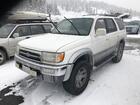
I have come seeking some advice. This is my 2nd 3rd gen 4runner, a 98 5 speed with 260k. She was a california car until we moved back east a few years ago. I got her for a steal with 175k (dealer maintained) for $2000 because of a small amount of rocker rust (repaired) and clear coat failure.I supercharged with fuel and eventually wmi shortly after purchase and she has been fantastic since until last week. I'm pretty sure the head gasket let go and I pressurized the cooling system on the highway. I didn't drop much coolant, caught the temp gauge 3/4 of the way up and had her towed home. I'm getting ready to check leakdown and compression this weekend but am assuming a gasket is leaking. I'm pretty sure my fan clutch is shot also but I can't imagine that would cause me to get hot going 65 on a cool day...What do I do? I am fairly confident I could replace the gaskets myself. I have the tools (I think) and have done one on a 4cyl bmw m10 before. I just don't know if it makes sense to spend the money to do it right on a 260k engine. My other option would be to buy a jdm low mileage, swap the us parts over and hopefully be good for another 150-200k miles. Alternately I could buy a yotashop rebuilt long block and hopefully be good for a long time. I don't really know the long term potential of a fully rebuilt 5vz and I really haven't been able to read many experiences with them. I would enjoy the challenge of rebuilding myself but I could see my head gasket job creeping and turning out to be more expensive than a jdm drop in.I think I'm leaning towards getting a used jdm and possibly rebuilding mine over time to have as a spare but I then wonder if a fully refurbished engine makes the most sense. What would you do?
There's no one right answer. A rebuilt will never be as good as the original. IF the truck has been treated well and maintained, your engine still has plenty of life left. It's a big IF, but it's truth. At these higher mileages, it makes all the difference. I've only owned my truck since it had 189,000 miles, but I'm friends with both previous owners, and remember in college when my friend first bought it. It's been treated well. At 290,000 miles, it's had zero major issues. The farthest I or anyone has been inside the engine is timing belts/water pump and valve cover gaskets. Still runs very strong. Original clutch.
As whether you can take on the head gasket, it just depends. Sure you can. I've found it's more a matter of time vs money for me these days. I do enjoy working on my truck, but if I made twice as much money? I'd probably contract out quite a few more jobs that I currently do myself. Certainly you could screw it up. I've screwed up. Youtube makes this stuff so much easier than back in the days of just repair manuals or photo tutorials.
There's no one right answer. A rebuilt will never be as good as the original. IF the truck has been treated well and maintained, your engine still has plenty of life left. It's a big IF, but it's truth. At these higher mileages, it makes all the difference. I've only owned my truck since it had 189,000 miles, but I'm friends with both previous owners, and remember in college when my friend first bought it. It's been treated well. At 290,000 miles, it's had zero major issues. The farthest I or anyone has been inside the engine is timing belts/water pump and valve cover gaskets. Still runs very strong. Original clutch.
As whether you can take on the head gasket, it just depends. Sure you can. I've found it's more a matter of time vs money for me these days. I do enjoy working on my truck, but if I made twice as much money? I'd probably contract out quite a few more jobs that I currently do myself. Certainly you could screw it up. I've screwed up. Youtube makes this stuff so much easier than back in the days of just repair manuals or photo tutorials.
Same the farthest ill go is timing belt water pump. I personally would go the JDM engine route and while its on a engine stand do fresh OEM bolt-on parts and maintenance for peace of mind. Keep the old engine for spare parts
She is otherwise in great shape besides the paint. I have all the previous owners maintenance paperwork. They seemed to take great care, we are still on the original clutch@270k.
I have done extensive work, rebuilding suspension ,new steering rack, water pump, timing, power steering, vcg along with routine maint.
I'd really like to keep it forever unless I can work out a trade for an fj80 so the little ones will fit better...
She is otherwise in great shape besides the paint. I have all the previous owners maintenance paperwork. They seemed to take great care, we are still on the original clutch@270k.
I have done extensive work, rebuilding suspension ,new steering rack, water pump, timing, power steering, vcg along with routine maint.
I'd really like to keep it forever unless I can work out a trade for an fj80 so the little ones will fit better...
Sounds like after a motor should last you another 200k+ more miles. I plan on keeping mine till gas is no longer a thing
My point was that in 290,000 miles no one has had to go farther into the engine than timing belt/water pump and valve cover gasket. I'd absolutely keep a well-maintained high mileage engine going until the crank bearings are worn and cylinder walls can't take it anymore. Or whatever else. A head gasket is worth repairing on a 3.4 with almost 300,000, if it's been treated well. A rebuild will never be the same.
Even still, a new engine isn't a bad idea. It's one option. My thoughts are that yes, the original engine is worth putting more work into. It should keep going. Doesn't mean a new engine is a dumb idea. Just not necessary.
Because I'd never done head gaskets before and wanted to give it a shot I went for it. I had the necessary tools.
My personal take, you gotta do you.
I did both head gaskets after testing to make sure that was the problem (though it was really obvious). It failed on #3, #6 was looking eminent so I'm glad I did both. A little over 300,000 miles at the time. Cylinder walls was the determining factor- they looked terrific. My heads were not warped.
Dunno how long it'll last, but so far so good. It's my daily driver.
Note: The valve cover bolt grommets from Yotashop are crap. So far the rest of the kit has been good, but that particular part was junk. They aren't oem, the metal is too cupped so the rubber can't do its job and the rubber falls apart cheap-style. They didn't even last 2 years. I did end up buying some from Toyota to replace the junk ones, definitely different.
Last edited by habanero; Mar 26, 2021 at 07:21 PM.
I haven’t done a HG on the 5VZ, but I have done them on the 22RE and several other motors GM 2.8, 3.1, 3.4.
The internet is an amazing thing now. You can watch a video of someone doing it. You can ask questions on forums with pictures and get nearly real-time answers. If you’ve rounded the corner to “major services” like timing belts, then a HG is no different. Sure more bolts and parts to disassemble, but you’ve already established good practice of keeping your parts organized as they come off, cleaning and inspecting as you go, and (hopefully) reassembling using appropriate torque specs. Take the heads off and get them tanked and inspected so they are nice and clean when they go back together. Since you’re on the original clutch, it may not be a bad idea just to pull the motor and do a whole refresh.
personally I like to do these myself, aside from a hot tank, because I’m curious to see the wear after thousands of miles.
What I'd do:
- do a compression test - partially to confirm the HG diagnosis, but also to check the compression in the good cylinders and get a check on the health of the rings
- take the heads off the engine. It's not a huge task - although messing with the exhaust manifolds can be a royal PITA - since everything is usually rusted into place.
- eyeball the bores to get an idea on the wear on the motor. There's more to the amount of wear on a motor than merely the miles. The frequency of oil changes, air filter, short trips vs long, etc.
If at that point the healthy cylinders had good compression - the bores look good (lots of crosshatching still visible, not very much smooth shiny metal), then slap some new HG's on, and put it back together with a new TB/WP kit, new belts, new hoses, and drive on for another 200K miles.
JDM engines aren't magical - they're almost always advertised as being barely used, low miles, etc, but that's not really the case. Usually the sellers don't have any data linking motors back to the cars they came out of, and it's not terribly uncommon for cars in Japan to get driven a lot. So they're all sold as low mileage, but they might have a ton of miles. If you get one, have a cold compression test done on it before accepting it, and even then, it might be as worn as the one you have. And it might need headgaskets at some point too.
Toyota went through multiple revisions on the 5VZ headgaskets. An aluminum head on an iron block is just problematic over time. They expand at different rates as the motor warms up, so every cold start introduces a bit of wear as the gasket gets rubbed between the head and block. The original style was conventional, the intervening styles were' modified' conventional - with some expanded metal sections on the head side. And the final version was a complete metal (MLS style) gasket. I think most of the first revisions were replaced in a recall early on, the middle revisions will probably eventually need to be replaced (with enough cold starts) - the final MLS version will probably last the life of the engine. If you replace the HG's - certainly use the latest revision - buy the HG set for a 2002 4Runner.
Rotate so each piston is down in the bore, then looks at the cylinder walls. That will tell you what the wear state is like. Smooth and shiny is not good in this situation.
This is one of the cheapest inspection cameras available. The 45 degree mirror is junk.
I was able to easily identify cross-hatch in each cylinder.
On to compression and leakdown.
Cylinders look good. Pressures are all close enough. Does your 4Runner have dual zone front and back heat? Check the armrest console from the backseat, is there a switch to adjust hot to cold and fan speed near the rear cup holders?
if so, I’d bet dollars to donuts you blew the heater pipes under the passenger side causing a coolant loss rather than a motor issue.
I'll take a look but I replaced the rear heater lines a few years ago. There was definitely coolant sprayed under the hood and the overflow cap was (pushed) off.
Things will have to continue tomorrow. Cylinder leak detector I got (amazon cheapo) doesn't seem to work properly. Open to air it won't read above 25%...
I'm just going back to reading your original post. What exactly happened? What do you mean by you "pressurized the coolant"? I know you overheated a bit. What else happened?



 Mar 25, 2021 | 08:50 PM