


DIRTCO's 1986 4Runner Build-Up Thread

 Apr 9, 2009 | 07:19 PM
#582

Thread Starter
Registered User
Joined: May 2007
Posts: 1,441
Likes: 0
From: Summit County, Colorado
 Apr 9, 2009 | 07:33 PM
#583
Thread Starter
Registered User
Joined: May 2007
Posts: 1,441
Likes: 0
From: Summit County, Colorado
Quote:
A while back there was a thread about whether or not it's normal for a turbo to glow red at night; we pretty much decided this is normal to a certain extent, but it did worry me.
Dirtco,
Just a comment on this. I did my Mechanical Engineering internship with Allied Signal Automotive, Turbocharger division (formerly Garrett Turbo).
It is perfectly normal for the turbo to glow red after it has been driven, especially if it has been driven hard. The turbo creates an enormous amount of back pressure on the motor, by design, and is placed as close to the exhaust valves as possible to ensure that the highest temp, highest energy exhaust flow is getting to the turbine.
There are two things that spell an early death for a turbo. Old, dirty oil will kill the bearings very quickly and heat soak-back will cook the oil in the bearings.
The RPM's that turbo's spin is a little mind boggling. While these engines are lucky to see 5k RPM every once in a while, turbo's spin at 50, 60, 70, 80k, RPM, even higher for some models. I working on their GT15 turbo for 1.2 L turbodiesels. 180k RPM max for that little semifloating, one piece journal turbo. You must keep the oil clean and change it frequently, the journals in the average turbo rely on oil to be at it's peak performance. (Ball bearing turbos have their own set of requirements.)
The other thing that kills a turbo over time is heat soak-back. When you turn the engine off the turbine housing is very hot, as you have noticed. The center section of the turbo, where the bearings are, is cooled by the oil flow and coolant flow, if it is a water cooled center (some are air cooled, even worse). When you turn the engine off, all forced flow ceases. The oil quickly drains out of the center section. The coolant stagnates and only moves by natural convection. The heat from the turbine housing soaks into the center section. Without any flow, the residual oil in the housing sees very high temps for a period of time, as the system air cools (tick, tick, tick).
With conventional oil, if it is a little past it's prime, it will cook into crystals in there. Those crystals (coaking) will restrict the passages and damage the bearings.
The best thing you can do is run a full synthetic for your turbo and change it every 3k. You can get away with longer oil changes on a non-turbo motor with synthetic, but not with a turbo. The synthetic is highly resistant to coaking in the center section
Mike
A while back there was a thread about whether or not it's normal for a turbo to glow red at night; we pretty much decided this is normal to a certain extent, but it did worry me.
Dirtco,
Just a comment on this. I did my Mechanical Engineering internship with Allied Signal Automotive, Turbocharger division (formerly Garrett Turbo).
It is perfectly normal for the turbo to glow red after it has been driven, especially if it has been driven hard. The turbo creates an enormous amount of back pressure on the motor, by design, and is placed as close to the exhaust valves as possible to ensure that the highest temp, highest energy exhaust flow is getting to the turbine.
There are two things that spell an early death for a turbo. Old, dirty oil will kill the bearings very quickly and heat soak-back will cook the oil in the bearings.
The RPM's that turbo's spin is a little mind boggling. While these engines are lucky to see 5k RPM every once in a while, turbo's spin at 50, 60, 70, 80k, RPM, even higher for some models. I working on their GT15 turbo for 1.2 L turbodiesels. 180k RPM max for that little semifloating, one piece journal turbo. You must keep the oil clean and change it frequently, the journals in the average turbo rely on oil to be at it's peak performance. (Ball bearing turbos have their own set of requirements.)
The other thing that kills a turbo over time is heat soak-back. When you turn the engine off the turbine housing is very hot, as you have noticed. The center section of the turbo, where the bearings are, is cooled by the oil flow and coolant flow, if it is a water cooled center (some are air cooled, even worse). When you turn the engine off, all forced flow ceases. The oil quickly drains out of the center section. The coolant stagnates and only moves by natural convection. The heat from the turbine housing soaks into the center section. Without any flow, the residual oil in the housing sees very high temps for a period of time, as the system air cools (tick, tick, tick).
With conventional oil, if it is a little past it's prime, it will cook into crystals in there. Those crystals (coaking) will restrict the passages and damage the bearings.
The best thing you can do is run a full synthetic for your turbo and change it every 3k. You can get away with longer oil changes on a non-turbo motor with synthetic, but not with a turbo. The synthetic is highly resistant to coaking in the center section
Mike
I use Mobil 1 synthetic and change it every 3k, sometimes even sooner. I also have a turbo timer to let the turbo cool down a bit before shuting down the engine (between 3-6 minutes). Whenever possible (95% of the time), I get the engine up to full operating temp before driving it. Even if I don't have time, I still will let it warm up for at least a few minutes before taking off. Thanks again for the infomation!
Apr 9, 2009 | 07:43 PM
#584
Thread Starter
Registered User
Joined: May 2007
Posts: 1,441
Likes: 0
From: Summit County, Colorado
Subscribed.. Let me say I just spent 3 hours going through all this and your build is amazing. I wish I had the mad skills to take on something like this. I won't be using my runner for crazy crawling like that but it is sure inspiring to see you guys go at it. I do enjoy learning stuff here and there.
Thank you
Thank you
 Apr 9, 2009 | 07:50 PM
#585
Thread Starter
Registered User
Joined: May 2007
Posts: 1,441
Likes: 0
From: Summit County, Colorado
Apr 10, 2009 | 10:17 AM
#586
Registered User
Joined: Dec 2007
Posts: 710
Likes: 2
From: Santa Rosa, CA
Quote:
I use Mobil 1 synthetic and change it every 3k, sometimes even sooner. I also have a turbo timer to let the turbo cool down a bit before shuting down the engine (between 3-6 minutes). Whenever possible (95% of the time), I get the engine up to full operating temp before driving it. Even if I don't have time, I still will let it warm up for at least a few minutes before taking off. Thanks again for the infomation!
Dirtco, as with everything else on this project, you are on it!! You are doing everything you can do to keep that turbo operating properly.
Below is a picture of a turbo cross section I keep on my desk, a going away present from Garrett when I finished my internship. This is their GT15 turbo. It has a single, semi-floating journal bearing and a thrust bearing. The thrust bearing is on the compressor side. The high pressure oil is fed in from the top through the threaded fitting. It feeds sideways to the thrust bearing on the left, down to the compressor side journal lands, and sideways to the right to the turbine side journal lands. The oil then exits into the oil jacket and drains out the bottom. This is an air cooled unit, so, no water jackets in this casting. The problems with oil coaking start on the turbine side in the oil jacket around the oil slinger. As that cavity fills with crystalized oil, oil drain flow is restricted and eventually the oil in the journal cannot drain fast enough, heat develops, and you spin the bearing.
[IMG] [/IMG]
Good luck with the rest of the project, not that you need it. You do good work.
Mike
I use Mobil 1 synthetic and change it every 3k, sometimes even sooner. I also have a turbo timer to let the turbo cool down a bit before shuting down the engine (between 3-6 minutes). Whenever possible (95% of the time), I get the engine up to full operating temp before driving it. Even if I don't have time, I still will let it warm up for at least a few minutes before taking off. Thanks again for the infomation!
Dirtco, as with everything else on this project, you are on it!! You are doing everything you can do to keep that turbo operating properly.
Below is a picture of a turbo cross section I keep on my desk, a going away present from Garrett when I finished my internship. This is their GT15 turbo. It has a single, semi-floating journal bearing and a thrust bearing. The thrust bearing is on the compressor side. The high pressure oil is fed in from the top through the threaded fitting. It feeds sideways to the thrust bearing on the left, down to the compressor side journal lands, and sideways to the right to the turbine side journal lands. The oil then exits into the oil jacket and drains out the bottom. This is an air cooled unit, so, no water jackets in this casting. The problems with oil coaking start on the turbine side in the oil jacket around the oil slinger. As that cavity fills with crystalized oil, oil drain flow is restricted and eventually the oil in the journal cannot drain fast enough, heat develops, and you spin the bearing.
[IMG]
[/IMG]Good luck with the rest of the project, not that you need it. You do good work.
Mike
Apr 10, 2009 | 11:54 AM
#587

Registered User
Joined: Mar 2003
Posts: 630
Likes: 3
From: Antelope Valley, SoCal
I have one of them little GT15s too, but the ends are still on and it doesn't have a big hole in the center housing. Twins would probably work pretty well on a 22R-E....
Nice build DIRTCO. I look forward to more.
Twins would probably work pretty well on a 22R-E....Nice build DIRTCO. I look forward to more.
Apr 10, 2009 | 01:56 PM
#588
Registered User
Joined: Aug 2004
Posts: 1,209
Likes: 0
From: Pueblo, CO
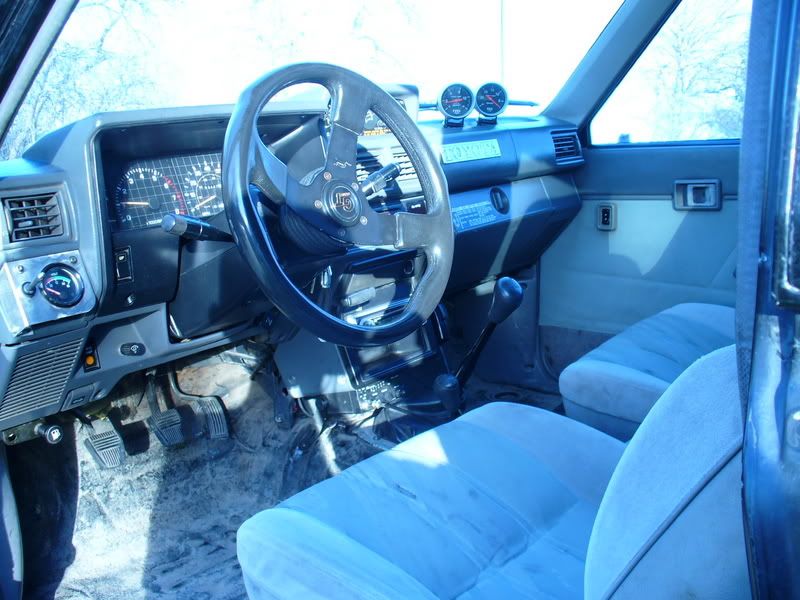
I've got 3 small gauges to mount also (oil pressure, water temp, and volt meter) and think they would go perfect where you have mounted yours. Do you think I could drill the holes in the dash pad without removing it from the dash? I know it's only a couple of screws that hold it down but I'm pretty lazy and hate messing with the dash 


 Apr 10, 2009 | 07:19 PM
#589
Thread Starter
Registered User
Joined: May 2007
Posts: 1,441
Likes: 0
From: Summit County, Colorado
I've got 3 small gauges to mount also (oil pressure, water temp, and volt meter) and think they would go perfect where you have mounted yours. Do you think I could drill the holes in the dash pad without removing it from the dash? I know it's only a couple of screws that hold it down but I'm pretty lazy and hate messing with the dash
If you do pull the dash, don't forget the nut behind the far passenger side vent. And the nut in about the middle/back of the dash (you can reach it with a long extension behind the glove box openning).
Apr 10, 2009 | 07:29 PM
#590
Thread Starter
Registered User
Joined: May 2007
Posts: 1,441
Likes: 0
From: Summit County, Colorado
Quote:
I use Mobil 1 synthetic and change it every 3k, sometimes even sooner. I also have a turbo timer to let the turbo cool down a bit before shuting down the engine (between 3-6 minutes). Whenever possible (95% of the time), I get the engine up to full operating temp before driving it. Even if I don't have time, I still will let it warm up for at least a few minutes before taking off. Thanks again for the infomation!
Dirtco, as with everything else on this project, you are on it!! You are doing everything you can do to keep that turbo operating properly.
Below is a picture of a turbo cross section I keep on my desk, a going away present from Garrett when I finished my internship. This is their GT15 turbo. It has a single, semi-floating journal bearing and a thrust bearing. The thrust bearing is on the compressor side. The high pressure oil is fed in from the top through the threaded fitting. It feeds sideways to the thrust bearing on the left, down to the compressor side journal lands, and sideways to the right to the turbine side journal lands. The oil then exits into the oil jacket and drains out the bottom. This is an air cooled unit, so, no water jackets in this casting. The problems with oil coaking start on the turbine side in the oil jacket around the oil slinger. As that cavity fills with crystalized oil, oil drain flow is restricted and eventually the oil in the journal cannot drain fast enough, heat develops, and you spin the bearing.
[IMG][/IMG]
Good luck with the rest of the project, not that you need it. You do good work.
Mike
I use Mobil 1 synthetic and change it every 3k, sometimes even sooner. I also have a turbo timer to let the turbo cool down a bit before shuting down the engine (between 3-6 minutes). Whenever possible (95% of the time), I get the engine up to full operating temp before driving it. Even if I don't have time, I still will let it warm up for at least a few minutes before taking off. Thanks again for the infomation!
Dirtco, as with everything else on this project, you are on it!! You are doing everything you can do to keep that turbo operating properly.
Below is a picture of a turbo cross section I keep on my desk, a going away present from Garrett when I finished my internship. This is their GT15 turbo. It has a single, semi-floating journal bearing and a thrust bearing. The thrust bearing is on the compressor side. The high pressure oil is fed in from the top through the threaded fitting. It feeds sideways to the thrust bearing on the left, down to the compressor side journal lands, and sideways to the right to the turbine side journal lands. The oil then exits into the oil jacket and drains out the bottom. This is an air cooled unit, so, no water jackets in this casting. The problems with oil coaking start on the turbine side in the oil jacket around the oil slinger. As that cavity fills with crystalized oil, oil drain flow is restricted and eventually the oil in the journal cannot drain fast enough, heat develops, and you spin the bearing.
[IMG]
[/IMG]Good luck with the rest of the project, not that you need it. You do good work.
Mike
Apr 11, 2009 | 04:21 AM
#591

Registered User
Joined: Jan 2008
Posts: 2
Likes: 0
From: Portland OR
Love the fact you have a place to do all of that, and the tools. Im doing a SAS swap to my runner here soon. In the mean time i have been looking for a turbo setup for my 22re. Harder to come by then i first expected. I know LC makes one, just a little too expensive for me. But anyways nice truck dude.
"Wheel till the rims fall off"
"Wheel till the rims fall off"
Apr 16, 2009 | 06:54 PM
#592
Thread Starter
Registered User
Joined: May 2007
Posts: 1,441
Likes: 0
From: Summit County, Colorado
I got a few more details wrapped up .
First, I got my rear CV driveshaft installed. It is a stock front shaft that I had re-tubed for the rear. It really helped to get rid of the drivetrain vibration that I was having. (Thanks again Hayes for bringing the driveshaft up to the county for me)


The transfer case rear output seal developed a small leak, (I'm guessing from the slight driveshaft vibration) So I replaced that too.
I also pulled the transmission pan and installed the bung for the temp sender. I really wish I would have installed it when the transmission was all tore apart, but oh well.

. First, I got my rear CV driveshaft installed. It is a stock front shaft that I had re-tubed for the rear. It really helped to get rid of the drivetrain vibration that I was having. (Thanks again Hayes for bringing the driveshaft up to the county for me)
The transfer case rear output seal developed a small leak, (I'm guessing from the slight driveshaft vibration) So I replaced that too.
I also pulled the transmission pan and installed the bung for the temp sender. I really wish I would have installed it when the transmission was all tore apart, but oh well.
Apr 16, 2009 | 07:31 PM
#593
Thread Starter
Registered User
Joined: May 2007
Posts: 1,441
Likes: 0
From: Summit County, Colorado
I took the 4Runner for a test drive and I realized that I was going to have to balance the tires. I never really pushed the speed limit with the old driveshaft, but with the new one I wanted to cruise at a decent speed.
So I went back to the shop and balanced the tires. Let me tell you that 35's with 2" of backspacing and rockrings suck to balance. It was not the process of doing it, but getting the tire on the machine, etc. The large wing nut/lever assembly only cleared the rock ring by about 1/2" and had to go about 6" inside the wheel. With the extreme offset of the wheel, it would not stay on the cone that lines everything up on the machine. I had to hold the entire weight of the tire and wheel, while threading everything through the rock ring and into postion. I did get all of them balanced, it just took some smashed hands, a sore back and tire tracks all over my body to finish the job.
Each tire and wheel took about 6-7 oz on each side of the wheel. I used hammer on weights on the inside and stick on weights on the outside, behind the rock rings. I was able to get all of the tires/wheels within 1oz of zero, I could have zero'ed them but it was really not worth the effort.
Anyway's, it was time to take the 4Runner out again and see if I fixed most of the small stuff that I ran into the first time out. The GF and I met up with Cory and ran Chinaman's again on Easter. The weather sucked on the drive down, but once we got on the trail it was not that bad. There was nobody on the trail so we had the whole thing to ourselves.
Like last time, I didn't get many pictures. The truck worked awesome and I didn't run into any issues. I drove the whole way out there at about 70mph, I could have gone faster but didn't see the need. Also, the fan didn't rub any more when flexed out. When SUPER flexed out, the rear tire just barely touches the trim on the back of the rear wheel well. Once I get my bumpstops installed it should take care of that issue.
Here's the only pictures I got


So I went back to the shop and balanced the tires. Let me tell you that 35's with 2" of backspacing and rockrings suck to balance.
It was not the process of doing it, but getting the tire on the machine, etc. The large wing nut/lever assembly only cleared the rock ring by about 1/2" and had to go about 6" inside the wheel. With the extreme offset of the wheel, it would not stay on the cone that lines everything up on the machine. I had to hold the entire weight of the tire and wheel, while threading everything through the rock ring and into postion. I did get all of them balanced, it just took some smashed hands, a sore back and tire tracks all over my body to finish the job. Each tire and wheel took about 6-7 oz on each side of the wheel. I used hammer on weights on the inside and stick on weights on the outside, behind the rock rings. I was able to get all of the tires/wheels within 1oz of zero, I could have zero'ed them but it was really not worth the effort.
Anyway's, it was time to take the 4Runner out again and see if I fixed most of the small stuff that I ran into the first time out. The GF and I met up with Cory and ran Chinaman's again on Easter. The weather sucked on the drive down, but once we got on the trail it was not that bad. There was nobody on the trail so we had the whole thing to ourselves.
Like last time, I didn't get many pictures. The truck worked awesome and I didn't run into any issues. I drove the whole way out there at about 70mph, I could have gone faster but didn't see the need. Also, the fan didn't rub any more when flexed out. When SUPER flexed out, the rear tire just barely touches the trim on the back of the rear wheel well. Once I get my bumpstops installed it should take care of that issue.
Here's the only pictures I got
Last edited by DIRTCO; Apr 16, 2009 at 07:34 PM.
 (yeah, I'm a smartarse)
Apr 16, 2009 | 08:37 PM
(yeah, I'm a smartarse)
Apr 16, 2009 | 08:37 PM
#595
Registered User
Joined: Aug 2004
Posts: 1,209
Likes: 0
From: Pueblo, CO
What?? You hit up Chinamans again and didn't take but 2 pics 
Did you make the left line on Whale Rock? I made it up without slipping a tire while on 33's and haven't tried it yet on 40's. Kinda scared I won't make it since the COG is now higher
Glad your rig is finally drivable closer to the speed limit. I bought some cheap 35's and plan on mounting them on some spare wheels in preperation of having to drive it rather than trailer it this summer. I also will have to pull a small utilty trailer with the big tires / wheels in it and swap them at the trailhead and back again at the end of the run. No fun but that's the only way I'm going to make it to the trails in less than 10 hours
Did you make the left line on Whale Rock? I made it up without slipping a tire while on 33's and haven't tried it yet on 40's. Kinda scared I won't make it since the COG is now higher
Glad your rig is finally drivable closer to the speed limit. I bought some cheap 35's and plan on mounting them on some spare wheels in preperation of having to drive it rather than trailer it this summer. I also will have to pull a small utilty trailer with the big tires / wheels in it and swap them at the trailhead and back again at the end of the run. No fun but that's the only way I'm going to make it to the trails in less than 10 hours
Apr 16, 2009 | 08:47 PM
#596
Registered User
Joined: Dec 2008
Posts: 92
Likes: 0
From: Corvallis, OR
wow, Dirtco. i do believe this is the sweetest yota i've ever seen. the attention to detail, the 22re-t, the digital dash, its all awesome. congrats on gettin her in shape to wheel, i'm uber jelous!
Apr 16, 2009 | 09:33 PM
#597
Thread Starter
Registered User
Joined: May 2007
Posts: 1,441
Likes: 0
From: Summit County, Colorado
What?? You hit up Chinamans again and didn't take but 2 pics
Did you make the left line on Whale Rock? I made it up without slipping a tire while on 33's and haven't tried it yet on 40's. Kinda scared I won't make it since the COG is now higher
Glad your rig is finally drivable closer to the speed limit. I bought some cheap 35's and plan on mounting them on some spare wheels in preperation of having to drive it rather than trailer it this summer. I also will have to pull a small utilty trailer with the big tires / wheels in it and swap them at the trailhead and back again at the end of the run. No fun but that's the only way I'm going to make it to the trails in less than 10 hours
Did you make the left line on Whale Rock? I made it up without slipping a tire while on 33's and haven't tried it yet on 40's. Kinda scared I won't make it since the COG is now higher
Glad your rig is finally drivable closer to the speed limit. I bought some cheap 35's and plan on mounting them on some spare wheels in preperation of having to drive it rather than trailer it this summer. I also will have to pull a small utilty trailer with the big tires / wheels in it and swap them at the trailhead and back again at the end of the run. No fun but that's the only way I'm going to make it to the trails in less than 10 hours
She said it just drove through the obsticle and didn't do anything cool, ... I guess that means it works pretty freaking good 
I took the middle line up Whale Rock. In the last 4Runner I used to take the left line, but I'm a little scared to in this one. I have a lot more overhang in the rear and I'm a little concerned about the transmission starving for fluid and getting stuck. There's also the the super hard roll if you mess up. I would love to try it once I get more used to the vehicle and have some more people to give a hand if things go South.
I have one question on trailering your 40's to the trail. I know this will save wear on the tires, but how much time do you think it will save? I've thought about the same thing in the past and came to the conclusion that the only advantage is less tire wear. Between the time it takes to pull the tires off, mount the new ones, switch at the trail head, run the trail, switch again and drive home (with over a 1000lb's of trailer behind you), I bet that 45 mph on the 40's would overall be faster. I do think it would save some tire wear on the 40's but it's something to think about. I'm not trying to be negative, just just something to think about.
Let me know when you are ready to go wheeling, with all this new snow we keep getting I want to do some snowbashing bad. The time frame you talked about should work out great!
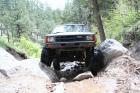
Speaking of Whale Rock here's a couple old pictures

K5 Blazer on 42's getting denied

The old green 4Runner back in the day, walking up it with no spot


 Apr 17, 2009 | 01:38 PM
#599
Registered User
Joined: Aug 2004
Posts: 1,209
Likes: 0
From: Pueblo, CO
It's hard to take pictures and drive at the same time! I gave the camera to Laura to take some pictures, but she is so used to the green 4Runner that she does not take a picture until at least two tires are off the ground. She said it just drove through the obsticle and didn't do anything cool, ... I guess that means it works pretty freaking good
I took the middle line up Whale Rock. In the last 4Runner I used to take the left line, but I'm a little scared to in this one. I have a lot more overhang in the rear and I'm a little concerned about the transmission starving for fluid and getting stuck. There's also the the super hard roll if you mess up. I would love to try it once I get more used to the vehicle and have some more people to give a hand if things go South.
She said it just drove through the obsticle and didn't do anything cool, ... I guess that means it works pretty freaking good I took the middle line up Whale Rock. In the last 4Runner I used to take the left line, but I'm a little scared to in this one. I have a lot more overhang in the rear and I'm a little concerned about the transmission starving for fluid and getting stuck. There's also the the super hard roll if you mess up. I would love to try it once I get more used to the vehicle and have some more people to give a hand if things go South.
Do the autos starving for fluid that easy? How do they take getting overfilled a couple of oz's to try and prevent that?
I have one question on trailering your 40's to the trail. I know this will save wear on the tires, but how much time do you think it will save? I've thought about the same thing in the past and came to the conclusion that the only advantage is less tire wear. Between the time it takes to pull the tires off, mount the new ones, switch at the trail head, run the trail, switch again and drive home (with over a 1000lb's of trailer behind you), I bet that 45 miles per hour on the 40's would overall be faster. I do think it would save some tire wear on the 40's but it's something to think about. I'm not trying to be negative, just just something to think about.
I think I would probably swap out the 35's for the 40's in twenty minutes. But the drive on 35's (balanced ) and closer to the correct gearing will probably be more enjoyable and like you said, save on some tire wear. We'll see how well a 22RE on 35's pulls a trailer loaded with 500 pounds of tires and a couple hundred pounds of camping gear does.
Apr 19, 2009 | 07:20 AM
#600
Thread Starter
Registered User
Joined: May 2007
Posts: 1,441
Likes: 0
From: Summit County, Colorado
Have you worked on your transmission yet? Good to hear that the new 4Runner works out that good! I'm just giving you a hard time about no pictures. I also understand about the left line and no forgiveness! It's a long fall down if you mess up. The time I went up on 33's and my current 4" lift, I didn't drag my gate (no bumper on mine). Looking at the video, I might have barely touched a rear bumper if I had one.
The left line is one of my favorite lines ever, but like you said it can be unforgiving. I would hate to total the truck on it's second time out, or ever for that matter. Part of wheeling your only vehicle is knowing where and when to take the smart line. I would love to take the left line one day, when I get more used to the vehicle.I'm sure you would make it up, no problem! Cory doesn't even stop for the thing anymore, just goes right up it.
Believe me, I'm not looking forward to swapping tires at the trailhead I think I would probably swap out the 35's for the 40's in twenty minutes. But the drive on 35's (balanced ) and closer to the correct gearing will probably be more enjoyable and like you said, save on some tire wear. We'll see how well a 22RE on 35's pulls a trailer loaded with 500 pounds of tires and a couple hundred pounds of camping gear does.
I think I would probably swap out the 35's for the 40's in twenty minutes. But the drive on 35's (balanced ) and closer to the correct gearing will probably be more enjoyable and like you said, save on some tire wear. We'll see how well a 22RE on 35's pulls a trailer loaded with 500 pounds of tires and a couple hundred pounds of camping gear does. 
I started on my front bumper, too! I'm really excited with the progress so far, but there's still alot that needs to be done to it. I figured it would be nice to have a good front bumper and winch (if it works
 ) for the early season snow wheeling. We'll see if I'll have it done in time , I'll post pictures of the progress later in the week.


