


Jacking Placed Under Rr Diff
 May 1, 2007 | 08:29 PM
#1

Thread Starter
Registered User
Joined: Jan 2007
Posts: 243
Likes: 0
From: Minot, ND
Jacking Under Rr Diff
The other day at the tire shop, the guys put a floor jack under the middle of the rear axle and lifted the truck supported by the axle housing (right under the drain plug).
Is this safe?? Does everyone but me feel comfortable lifting the whole rear-end of the truck with a jack under your ring gear? or is the housing really up to the job?
It made me feel a bit un-easy. As stated in the owners manual, I always raise the rear axle at each end, near the u-bolts.
Is this safe?? Does everyone but me feel comfortable lifting the whole rear-end of the truck with a jack under your ring gear? or is the housing really up to the job?
It made me feel a bit un-easy. As stated in the owners manual, I always raise the rear axle at each end, near the u-bolts.
Last edited by hodgepodge79; May 1, 2007 at 08:32 PM.
May 1, 2007 | 08:52 PM
#2

Contributing Member
Joined: Jun 2005
Posts: 3,415
Likes: 10
From: Phx, AZ
I've lifted my 4Runner countless times from that point. 
Plus slammed countless rocks there as well. I wouldn't worry about the support capability of the housing. Always make sure the jack you choose is up to the task however.
Maybe loading the very end of the pinion could be a problem... but no one would suggest placing a jack there.
Even that would probably hold up.
Plus slammed countless rocks there as well. I wouldn't worry about the support capability of the housing. Always make sure the jack you choose is up to the task however.
Maybe loading the very end of the pinion could be a problem... but no one would suggest placing a jack there.
Even that would probably hold up.
May 1, 2007 | 09:05 PM
#4
Thread Starter
Registered User
Joined: Jan 2007
Posts: 243
Likes: 0
From: Minot, ND
Good to know!!
Now that I have dedicated trail and DD tires sets, I will be changing tires a lot. Placing the jack in only one spot front (under ifs cross member) and then one spot rear (under center of housing) will save a bunch of time.
I have been driving around town on my "new-to-me" 34x9.50's, and it totally kills my top-speed and fuel economy, so, I will continue to use my 30"ers on the pavement.
thanks!
Now that I have dedicated trail and DD tires sets, I will be changing tires a lot. Placing the jack in only one spot front (under ifs cross member) and then one spot rear (under center of housing) will save a bunch of time.
I have been driving around town on my "new-to-me" 34x9.50's, and it totally kills my top-speed and fuel economy, so, I will continue to use my 30"ers on the pavement.
thanks!
Last edited by hodgepodge79; May 1, 2007 at 09:06 PM.

 May 2, 2007 | 11:31 AM
#7
Contributing Member
Joined: Mar 2005
Posts: 901
Likes: 0
From: The Republic Texas
I'm with you dude, it makes me nervous too!! The entire weight of the vehicle in that point, and a long lever out to the point of weight. I have seen axles bent at that point before (not from lifting).
It's probably fine, but I avoid it.
It's probably fine, but I avoid it.
Trending Topics
 May 2, 2007 | 12:24 PM
#9

Registered User
Joined: Aug 2005
Posts: 1,731
Likes: 3
From: Philly PA

Whatever. Its all I use. On any car that has a "solid" rear axle.. safest place IMHO.
Note that I jack under the AXLE HOUSING and not by the THRID MEMBER (added stress to the diff seal). Not that wacking it off roading seems to have harmed it any

Toyota TRUCK... remember.. these things are tuff
 May 2, 2007 | 01:48 PM
#11
Thread Starter
Registered User
Joined: Jan 2007
Posts: 243
Likes: 0
From: Minot, ND
That's the point, it is supposed to be one tire at a time, but hey, apparently, it can't hurt.
No service/owners manual I have ever seen suggests jacking up BOTH tires at the same time.
No service/owners manual I have ever seen suggests jacking up BOTH tires at the same time.
Last edited by hodgepodge79; May 2, 2007 at 01:50 PM.
May 2, 2007 | 01:56 PM
#13
Contributing Member
Joined: Dec 2005
Posts: 2,226
Likes: 0
From: Houston (home), Atlanta (school), Cincinnati (work)
i lift mine there every time i lift the rear end, if i need to do axle/suspension work, i lift it up high from the rear diff, jack stand the frame, and let the axle come back down.
May 2, 2007 | 02:12 PM
#14

Contributing Member
Joined: Nov 2005
Posts: 8,875
Likes: 3
From: Longmont, CO
x100000 or whatever we're up to. I DO try and align the "tabs" on the pad of the jack so one of the low points goes across the diff drain. I REALLY need to get an allen type drain plug before a rock grinds down the standard one enough that I can't get a socket on it...
May 2, 2007 | 02:18 PM
#15

Contributing Member
Joined: Apr 2004
Posts: 5,464
Likes: 6
From: Arvada, Colorado
Been there...It sucks.
May 2, 2007 | 02:23 PM
#17

Registered User
Joined: Aug 2003
Posts: 513
Likes: 0
From: Glenville, NY
As long as it's a solid axle, I don't see the problem. I've done it for more years than I care to admit. But, I always put a set of jack stands under each end of the axle, once I have it to the height I need, to keep it stable. The center housing is cast iron, and shouldn't have any effect on the ring gear or pinion as long as the center housing is cradled in the jack cup. I also make sure I am using a jack rated to lift that weight by at least a factor of 3.
May 2, 2007 | 02:37 PM
#18
Contributing Member
Joined: Jun 2005
Posts: 3,415
Likes: 10
From: Phx, AZ
1. The factory scissor or even bottle type jacks are generally unstable and probably not up to the task of raising one end of vehicle at once. It would be spooky and unstable if they did.
2. Manuals are directing you how to change a single flat, so there would be no reason to try and raise both sides at once.
3. It's ultimately safer to raise one side at a time and for liability reasons, manuals are almost always going to err on the side of caution.
Regardless of the manual, I am sure you are wise enough to support the vehicle with correctly rated jack stands once it gets off the ground before you go under or start your project... what ever it may be.
May 2, 2007 | 02:56 PM
#19
Registered User
Joined: Aug 2006
Posts: 4,940
Likes: 2
From: Central NJ
Ive raised front axles with jacks and used the jack to hold them up. The factory jack is junk and only for lifting one side of a vehicle at once. What you need is a real jack, like a 3 ton jack, thats what i always used 3 ton or better rated stuff.
May 2, 2007 | 03:17 PM
#20
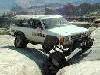

Yep, lift mine like that all the time. Picked up a long arm HF floor jack for just that purpose. It is long enough to reach under the axle and have the handle out back of the truck. If I am going to work on more than tires, I'll lift it high enough to slide jack stands under the frame, then pull the wheels off and lower it down:


