When you click on links to various merchants on this site and make a purchase, this can result in this site earning a commission. Affiliate programs and affiliations include, but are not limited to, the eBay Partner Network.
I've got some free play in my rear differential where the driveshaft enters. Driveshafts wobbles around a bit at that spot and fluid i leaking around the seal. Driveshaft U joints are fine.
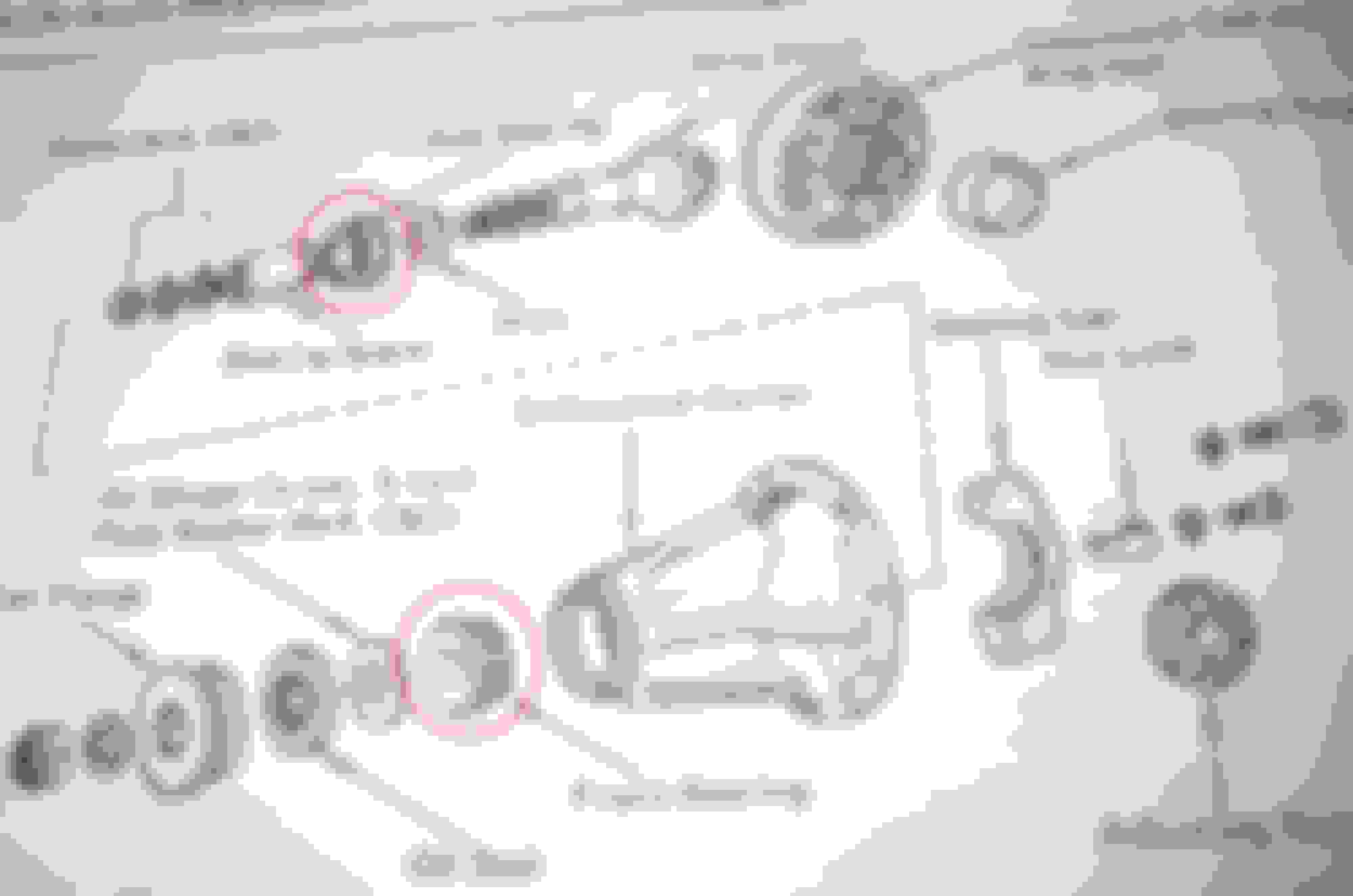
I have bought two new bearings. The ones circled in red in this diagram.
It looks like the "front bearing" will come right out when I remove the driveshaft, flange and seal.
The "rear bearing" looks like the third member may need to be removed to get to it. Or can this bearing also be removed in the same way that the "front bearing" is removed by simply removing the driveshaft, flange and seal? Can both of these bearings be removed and replaced without opening up the third member?
They cannot be replaced without removing the 3rd member.
You need a couple different torque wrenches, a dial indicator, it is likely that you will need a bearing separator plate and a hydraulic press.
Are you sure that your application doesn't use a crush sleeve, instead of pinion shims?? What year and model you got??
Have you tried retightening the pinion nut to get rid of your play?? You can torque it to 120-130fp and restake the nut. Remove the yoke and replace the seal before you retighten it.
You have nothing to lose by trying this simpler fix. If it fails, you have to remove the 3rd for overhaul anyway.
They cannot be replaced without removing the 3rd member.
You need a couple different torque wrenches, a dial indicator, it is likely that you will need a bearing separator plate and a hydraulic press.
Are you sure that your application doesn't use a crush sleeve, instead of pinion shims?? What year and model you got??
Have you tried retightening the pinion nut to get rid of your play?? You can torque it to 120-130fp and restake the nut. Remove the yoke and replace the seal before you retighten it.
You have nothing to lose by trying this simpler fix. If it fails, you have to remove the 3rd for overhaul anyway.
No I haven't tried re tightening the pinion nut. That seems unlikely to me. Have you ever seen a pinion nut just randomly come loose and having a problem like this solved just be tightening it? It would have to be very very loose. There is a good deal of slop back there and fluid drips consistently. There is a bit of vibration while driving as you would imagine but other than that it functions properly and I don't notice any noises. My truck is a 1986 4x4 xtracab.
No I haven't tried re tightening the pinion nut. That seems unlikely to me. Have you ever seen a pinion nut just randomly come loose and having a problem like this solved just be tightening it? It would have to be very very loose. There is a good deal of slop back there and fluid drips consistently. There is a bit of vibration while driving as you would imagine but other than that it functions properly and I don't notice any noises. My truck is a 1986 4x4 xtracab.
I have seen a dozen or more of them fixed and run tens of thousands of miles afterwards.
Occasionally though, the looseness is caused by a bearing that is already too far gone, and failure will follow shortly.
As I said before, you have nothing to lose by trying.
Given your description of wobbling I would want to remove to 3rd to see what effect it is having on the gears wear/alignment.
Well it's shaking in the same way that your truck will shake when you have a bad u joint. Because the effects of this loose driveshaft are very very similar to a worn u joint.
I have seen a dozen or more of them fixed and run tens of thousands of miles afterwards.
Occasionally though, the looseness is caused by a bearing that is already too far gone, and failure will follow shortly.
As I said before, you have nothing to lose by trying.
Well I guess I don't need to try it. I will simply see if the pinion nut is loose when I remove the driveshaft and flange. If it's tightened down to spec just as it should be then it will be clear that the bearings are at fault.
I literally just had this problem bout a month ago. It was a loose pinion nut. Tightened it up, restaked the same nut and it's been going since. That's only been a few hundred miles though.
I literally just had this problem bout a month ago. It was a loose pinion nut. Tightened it up, restaked the same nut and it's been going since. That's only been a few hundred miles though.
That's good to hear. That will be excellent if that's all that's wrong with mine too. Strange that the pinion nut would just come loose.
With age the crush sleeve crushes more, thus creating a slight wobble/vibration, the pinion nut will still be staked but flange will slide back and forth slightly, I personally have seen this on many vehicles other than yota, now if you have a pre 82, it would be possible that you have a pinion bushing with shims. I would try to retorque the pinion nut to 110 lbs, restake the nut in the groove area and give that a try. If replacing the inner bearing, the 3rd member comes out then remove the diff caps, noting shim count and threads exposed on bearing sides then pinion shaft comes out. Hope this helps...
With age the crush sleeve crushes more, thus creating a slight wobble/vibration, the pinion nut will still be staked but flange will slide back and forth slightly, I personally have seen this on many vehicles other than yota, now if you have a pre 82, it would be possible that you have a pinion bushing with shims. I would try to retorque the pinion nut to 110 lbs, restake the nut in the groove area and give that a try. If replacing the inner bearing, the 3rd member comes out then remove the diff caps, noting shim count and threads exposed on bearing sides then pinion shaft comes out. Hope this helps...
So the outer bearing (the one directly behind the flange and oil seal) can be replaced without removing the third member?
No, not really. You can remove the nut, washer, flange, seal, and oil slinger then the inner portion of the small pinion bearing is visible. Usually the inner portion of the small pinion bearing will slide off the pinion shaft but on occasion you'll have to press the pinion shaft out through the small pinion bearing. The outer race of the small pinion bearing is pressed into the differential housing and needs to be tapped out/pounded out from the inside. You could leave it but I wouldn't recommend it. Inner and outer portions should be kept as a matched set.
With age the crush sleeve crushes more, thus creating a slight wobble/vibration, the pinion nut will still be staked but flange will slide back and forth slightly, I personally have seen this on many vehicles other than yota, now if you have a pre 82, it would be possible that you have a pinion bushing with shims. I would try to retorque the pinion nut to 110 lbs, restake the nut in the groove area and give that a try. If replacing the inner bearing, the 3rd member comes out then remove the diff caps, noting shim count and threads exposed on bearing sides then pinion shaft comes out. Hope this helps...
My Haynes manual says 145 to 253 foot pounds torque for the 8.0 inch ring gear drive pinion nut. That is a massive range.
They cannot be replaced without removing the 3rd member.
You need a couple different torque wrenches, a dial indicator, it is likely that you will need a bearing separator plate and a hydraulic press.
Are you sure that your application doesn't use a crush sleeve, instead of pinion shims?? What year and model you got??
Have you tried retightening the pinion nut to get rid of your play?? You can torque it to 120-130fp and restake the nut. Remove the yoke and replace the seal before you retighten it.
You have nothing to lose by trying this simpler fix. If it fails, you have to remove the 3rd for overhaul anyway.
I'm sorry I ever doubted you sir! I removed the driveshaft and sure enough the pinion nut was very loose. I removed the flange, removed the seal, installed a Marlin Crawler heavy duty seal, reinstalled the flange, tightened the pinion nut to 160 foot pounds and restaked it. ALl vibrations are now gone and it's going great.
That torque isn't really the driving factor. When the differential is properly assembled, the pinion nut is tightened to crush the new crush sleeve which will put a preload on the pinion bearings. You tighten the pinion nut until there is a pinion running torque of about 12-15 INCH-pounds for new bearings or 5-6 INCH-pounds for used. The actual tightening torque on the pinion nut is pretty much useless and not related to proper assembly.
160fp is a smidge tighter than I usually re- torque them, but likely not enough force to crush the sleeve any further.
90-95fp is probably enough to keep the pinion nut sufficiently tight. That is the torque spec for the transfer case output flanges.
I have re-torqued 3 different of my own 3rds to eliminate flange wobble and all are still doing well after 10-20 thousand miles. Those thirds all had 200,000+ miles run up on them. I torqued them to 130-140fp.
I have another 3rd of unknown history that I have had to tighten with enough force to add additional crush to get the pinion to tighten up. I'm really not too optimistic about that ones future, but I haven't run it yet.
I didn't want to remove it from its axle if not needed. The pinion still rotates smoothly, with some pre-load. We'll just have to wait and see.
160fp is a smidge tighter than I usually re- torque them, but likely not enough force to crush the sleeve any further.
90-95fp is probably enough to keep the pinion nut sufficiently tight. That is the torque spec for the transfer case output flanges.
I have re-torqued 3 different of my own 3rds to eliminate flange wobble and all are still doing well after 10-20 thousand miles. Those thirds all had 200,000+ miles run up on them. I torqued them to 130-140fp.
I have another 3rd of unknown history that I have had to tighten with enough force to add additional crush to get the pinion to tighten up. I'm really not too optimistic about that ones future, but I haven't run it yet.
I didn't want to remove it from its axle if not needed. The pinion still rotates smoothly, with some pre-load. We'll just have to wait and see.
Yeah I was amazed that the pinion nut could just come loose like that. Especially when it was staked. It seemed unlikely to me but clearly I didn't know what I was talking about. I took my take and made sure I really staked it well after I re-torqued it.



 Jun 21, 2017 | 11:06 AM