


Need advice on possible short.
 Jun 22, 2014 | 05:08 PM
#1

Thread Starter
Registered User
Joined: Dec 2009
Posts: 112
Likes: 0
From: Walland, TN
Need advice on possible short.
'88 4Runner 4cylinder with 367,000 miles. Alternator started to go out. Replaced with re manufactured Denso. Car ran great, but following day battery died. Replaced with new battery. Car ran great, but next day dead battery. Car jump starts, runs fine and voltmeter registers in normal range. I believe I've got a short. I pulled the connections on the alternator and stripped off all the covering on the wiring harness. Wires look good, no breaks in insulation. Any thoughts would be greatly appreciated
Jun 22, 2014 | 05:32 PM
#2

Registered User


Joined: Mar 2012
Posts: 7,125
Likes: 681
What made you think alternator was starting to go out?
Did the discharging overnight problem occur before you replaced alternator?
Could it be that your original problem was battery, you replaced alternator thinking it was the issue, and now you still have a bad battery?
Check the charging circuit? Made some voltage measurements? Chargin system explained on my sig.
Also, disconnect "B" wire, make sure there is nothing connected to "B" post (bolt) of alternator, measure resistance from "B" post of alternator to ground. Red probe on "B" post, black probe to ground. You should have mega-ohms of resistance. If lower (Like K-ohms) your alt probably has bad rectifier.
Did the discharging overnight problem occur before you replaced alternator?
Could it be that your original problem was battery, you replaced alternator thinking it was the issue, and now you still have a bad battery?
Check the charging circuit? Made some voltage measurements? Chargin system explained on my sig.
Also, disconnect "B" wire, make sure there is nothing connected to "B" post (bolt) of alternator, measure resistance from "B" post of alternator to ground. Red probe on "B" post, black probe to ground. You should have mega-ohms of resistance. If lower (Like K-ohms) your alt probably has bad rectifier.
Last edited by RAD4Runner; Jun 23, 2014 at 07:11 PM. Reason: edited with more edetails
Jun 23, 2014 | 12:16 AM
#3
Registered User
iTrader: (1)
Joined: Apr 2009
Posts: 13,381
Likes: 100
From: I live in New Tripoli Pa out in the woods

Just what failed on the Alternator that it needed replaced ??
The charge light on??
Have you ever replaced the Wire off the B terminal of the alternator after that many miles it has to be cooked to the point of no longer conducting
The charge light on??
Have you ever replaced the Wire off the B terminal of the alternator after that many miles it has to be cooked to the point of no longer conducting
Jun 23, 2014 | 01:15 AM
#4

A lot of the times the key will come out in the Accessories position in stead of the Off position. Make sure you are pushing the black button on the steering column and going to the Off position before removing your key. Seen that several times.
Jun 24, 2014 | 06:02 AM
#5
Thread Starter
Registered User
Joined: Dec 2009
Posts: 112
Likes: 0
From: Walland, TN
I sincerely appreciate all of the input. Here is the entire story to see if it adds anything regarding cause of the current problem.
Over 367,000 miles I've replaced 4 alternators on my 4Runner. One failed due to a faulty regulator, the other 3, including most recent alternator, failed in the following fashion. The dash voltmeter reads low at higher rpms. At lower rpms the voltmeter drops below 50% and the dash warning lights illuminate. What follows is a chronological explanation of recent events.
On Saturday my voltmeter was reading at 50% during normal driving speeds, but descended well below that level when driving a lower speeds (rpms), and the dash warning lights illuminated unless I raised rpms. As soon as I noticed the problem I drove 15 miles home, parked the car and ordered a newly re-manufactured Denso alternator from Rock Auto.
Five days later, on Thursday, the new alternator arrived and was installed. (Also installed new OEM distributor cap and rotor, new NGK plugs and plug wires, and newly rodded out radiator.) The car slowly cranked, but started and at idle the dash voltmeter was immediately in the normal range, ~75-80% of full range. A 30 mile trip with a 30 minute stop was without incident. The voltmeter was always in the normal range.
The following day, Friday, the car started and ran fine, and was driven 40 miles with 3 stops of varying intervals (5 minutes to 1 hour). Dash voltmeter was always in normal range.
On Saturday the car started and ran fine. I drove 5 miles, stopped for 2.5 hours, drove 25 miles, stopped for 10 minutes, and drove 5 miles and stopped for what should have been 5 minutes. When I returned to the car the battery was dead. Voltmeter barely rose when the ignition was turned. I had enough juice to roll down the rear window to get the jumper cables. Car jump started immediately, ran fine and the voltmeter was in the normal range. I drove 25 miles, parked in front of an AutoZone store, stopped car, waited 2 minutes and tried to restart the car. The battery was dead, voltmeter barely moved. I purchased and installed a new battery. Car started fine, voltmeter was in normal range. I drove 5 miles, stopped for 30 minutes then drove 15 miles home and parked the car overnight.
On Sunday morning the battery was dead. I jump started the car, drove 15 miles stopped for 30 minutes and the battery was (still) dead. I jump started car and drove 15 miles home. Since replacing the alternator anytime the car was running the dash voltmeter was in the normal range. Once home I attached a digital voltmeter to the battery. At rest it registered 13.5V and when the ignition was turned it dropped to 1.5V. Convinced there was a short circuit I hooked the battery up to a charger and detached the alternator's wiring harness. I removed the harness wrapping and inspected all the wires very closely. With the exception of the black ground wire that exits the harness about mid-way to the alternator, the wires were amazingly pristine. The black ground wire had a crack in the insulation, but was not broken. I wrapped the cracked area of the ground wire with electrical tape and re-wrapped the rest of wiring harness. Once the battery was charged the car started and ran normally. When I parked it I detached the lead to the positive battery terminal.
I am certain of the following:
1. The old alternator was bad
2. The old battery was probably good
3. The new alternator either despite generating normal voltage is not charging the battery or I have a short circuit.
My current primary suspicion is there may be a short in the new Denso alternator.
Any suggestions on how to clarify this issue will be greatly appreciated.
Thanks
Dave
Over 367,000 miles I've replaced 4 alternators on my 4Runner. One failed due to a faulty regulator, the other 3, including most recent alternator, failed in the following fashion. The dash voltmeter reads low at higher rpms. At lower rpms the voltmeter drops below 50% and the dash warning lights illuminate. What follows is a chronological explanation of recent events.
On Saturday my voltmeter was reading at 50% during normal driving speeds, but descended well below that level when driving a lower speeds (rpms), and the dash warning lights illuminated unless I raised rpms. As soon as I noticed the problem I drove 15 miles home, parked the car and ordered a newly re-manufactured Denso alternator from Rock Auto.
Five days later, on Thursday, the new alternator arrived and was installed. (Also installed new OEM distributor cap and rotor, new NGK plugs and plug wires, and newly rodded out radiator.) The car slowly cranked, but started and at idle the dash voltmeter was immediately in the normal range, ~75-80% of full range. A 30 mile trip with a 30 minute stop was without incident. The voltmeter was always in the normal range.
The following day, Friday, the car started and ran fine, and was driven 40 miles with 3 stops of varying intervals (5 minutes to 1 hour). Dash voltmeter was always in normal range.
On Saturday the car started and ran fine. I drove 5 miles, stopped for 2.5 hours, drove 25 miles, stopped for 10 minutes, and drove 5 miles and stopped for what should have been 5 minutes. When I returned to the car the battery was dead. Voltmeter barely rose when the ignition was turned. I had enough juice to roll down the rear window to get the jumper cables. Car jump started immediately, ran fine and the voltmeter was in the normal range. I drove 25 miles, parked in front of an AutoZone store, stopped car, waited 2 minutes and tried to restart the car. The battery was dead, voltmeter barely moved. I purchased and installed a new battery. Car started fine, voltmeter was in normal range. I drove 5 miles, stopped for 30 minutes then drove 15 miles home and parked the car overnight.
On Sunday morning the battery was dead. I jump started the car, drove 15 miles stopped for 30 minutes and the battery was (still) dead. I jump started car and drove 15 miles home. Since replacing the alternator anytime the car was running the dash voltmeter was in the normal range. Once home I attached a digital voltmeter to the battery. At rest it registered 13.5V and when the ignition was turned it dropped to 1.5V. Convinced there was a short circuit I hooked the battery up to a charger and detached the alternator's wiring harness. I removed the harness wrapping and inspected all the wires very closely. With the exception of the black ground wire that exits the harness about mid-way to the alternator, the wires were amazingly pristine. The black ground wire had a crack in the insulation, but was not broken. I wrapped the cracked area of the ground wire with electrical tape and re-wrapped the rest of wiring harness. Once the battery was charged the car started and ran normally. When I parked it I detached the lead to the positive battery terminal.
I am certain of the following:
1. The old alternator was bad
2. The old battery was probably good
3. The new alternator either despite generating normal voltage is not charging the battery or I have a short circuit.
My current primary suspicion is there may be a short in the new Denso alternator.
Any suggestions on how to clarify this issue will be greatly appreciated.
Thanks
Dave
Last edited by rworegon; Jun 24, 2014 at 02:51 PM. Reason: Added a few paragraphs for ease of reading.
Jun 24, 2014 | 08:54 AM
#6
Registered User
Joined: Mar 2012
Posts: 7,125
Likes: 681
All those alternators could not have been all bad. Probably something wrong in your charging system wiring. Were you getting charge AND brake error lights while driving? Would be that system was not charging, but your charge fuse is blown so you do not get the fault indication.
Tired of guessing?
Time to stop throwing parts, alternators, batteries and do a simple but thorough check of your charging system.
https://www.yotatech.com/forums/f199...l#post52094780
Do not trust the dash voltmeter. Use a real multi-meter. To make it easy and safe to monitor voltage while driving, try Pay special attention to "IG" pin and wiring
 this" />
Last edited by RAD4Runner; Jun 24, 2014 at 08:57 AM.
Jun 24, 2014 | 09:40 AM
#7

Registered User

Joined: Sep 2007
Posts: 8,380
Likes: 871
From: San Francisco East Bay
Use an ammeter to check for "parasitic draw." Unfortunately, it sounds like it's intermittent, and big! (If it can run the battery to dead in 5 minutes it is nearly a dead-short.) But with the truck "off" you should only be drawing a handful of milliamps (enough to keep the clock and radio memory alive). If you've got more draw than that, you can look for it by pulling fuses one at a time.
Trending Topics
Jun 24, 2014 | 09:58 AM
#8
Registered User
Joined: Mar 2012
Posts: 7,125
Likes: 681
A dead-short that could run battery down from 13.5V to 1.3V, whatever it is should have melted, IF battery were really fully-charged.
Which leads me to believe that alternator is weakly charging or not charging at all, leaving O.P. a weak battery always. Assuming a good alternator, poor wiring IG (i.e., IG terminal not getting full 12Volts from Engine Fuse) could cause that.
Obviously, throwing parts at the problem is not effective. O.P. Should really break out the multi-meter/ammeter and do systematic, thorough checks.
Also, there was no mention of cleaning battery connector down to bare metal. Grey metal is not bare metal electrically-speaking. Bare metal is shiny silver or copper color- depending on connector material.
Last edited by RAD4Runner; Jun 24, 2014 at 10:01 AM.
Jun 24, 2014 | 11:04 AM
#9

Registered User
Joined: May 2009
Posts: 578
Likes: 11
From: Southern NH
Yeah, here's an example of a dead short I ran into last week when the J bolt rattled loose and I most likely forgot to put the insulating cap back on.
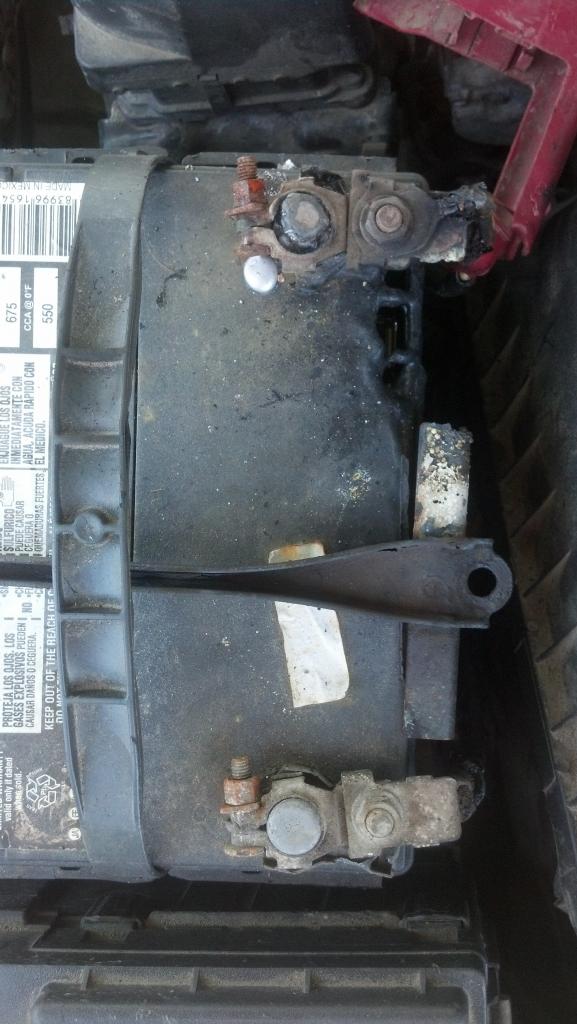
(Seems like that crossmember should be plastic if anything on the vehicle is, with benefit of hindsight.) It welded itself to the terminal, I kicked it free, if this happened to Jane Doe it would've been a fire.
I agree with RAD.

(Seems like that crossmember should be plastic if anything on the vehicle is, with benefit of hindsight.) It welded itself to the terminal, I kicked it free, if this happened to Jane Doe it would've been a fire.
I agree with RAD.
Jun 24, 2014 | 12:26 PM
#10
Registered User
iTrader: (1)
Joined: Apr 2009
Posts: 13,381
Likes: 100
From: I live in New Tripoli Pa out in the woods
Until we have real numbers it is all just a guess.
I have no clue if the Denso Alternators take out the rectifiers when installed with a discharged battery.
With the miles on this vehicle I think a big 3 upgrade is in order just from the age
I know unless it was done The cables will all be brittle and burnt.
Could be just a case of old age.
my one 4 runner would also drop down to near 0 on the factory gauge when turning the key.
the after market volt meter dipped to just below 12vdc
I have no clue if the Denso Alternators take out the rectifiers when installed with a discharged battery.
With the miles on this vehicle I think a big 3 upgrade is in order just from the age
I know unless it was done The cables will all be brittle and burnt.
Could be just a case of old age.
my one 4 runner would also drop down to near 0 on the factory gauge when turning the key.
the after market volt meter dipped to just below 12vdc
Jun 24, 2014 | 02:40 PM
#11
Registered User
Joined: Mar 2012
Posts: 7,125
Likes: 681
Ouch. Been there, Done that - LOL! I bet it did not drain the battery, huh?
A dead short with a 12-AWG wire would have melted away and gone away.
I bet it's parasitic draw, like scope mentioned^^, OR alternator not charging the battery at all that's causing O.P.'s problem.
Yep. Gotta take simple but thorough current-draw measurements in line with fusible link wire to determine parasitic draw. AND simple but thorough voltage measurements in charging system to check its functionality.
Yep. Could be made out of same material as battery housing so it does not rust and is insulative; Re-used or recycled. O'Reilly carries that now.
Should not. Alternators are rated to carry to provide as much current as needed to re-charge a dead battery.
Yes, or at least a thorough cleaning down to bare metal of all contacts and then protecting with di-electric grease.
Yeah, I think dash volt-meters & temp indicators are just "Good or "No-good" indicators, not actual measuring instruments. (One reason I'm researching after-market temp gauge - with overheat contacts for warning light and buzzer).
A dead short with a 12-AWG wire would have melted away and gone away.
I bet it's parasitic draw, like scope mentioned^^, OR alternator not charging the battery at all that's causing O.P.'s problem.
Yep. Gotta take simple but thorough current-draw measurements in line with fusible link wire to determine parasitic draw. AND simple but thorough voltage measurements in charging system to check its functionality.
Seems like that crossmember should be plastic
I have no clue if the Denso Alternators take out the rectifiers when installed with a discharged battery.
With the miles on this vehicle I think a big 3 upgrade is in order just from the age
my one 4 runner would also drop down to near 0 on the factory gauge when turning the key. the after market volt meter dipped to just below 12vdc
Jun 26, 2014 | 04:49 AM
#12
Thread Starter
Registered User
Joined: Dec 2009
Posts: 112
Likes: 0
From: Walland, TN
Thanks for all the advice on researching my problem. I've been out of town, but will try and get some answers this weekend. I'm a fair shade tree mechanic, but electrical issues are a total mystery to me.
I'll add a few comments to address what has been said/asked.
The battery terminal are in excellent condition.
The dash warning lights have only illuminated when I was going at lower rpms with the failing re-manufactured (RM) Denso. When I increased the rpms the dash voltmeter (or is that an ammeter??) would move up to the half way mark and the dash warning lights would go out. As soon as I replaced the old RM-Denso with the new RM-Denso the dash voltmeter/ammeter (?) has run in the normal range at all rpm levels and the dash warning lights have never illuminated.
Regarding the numerous failed alternators over 26 years of ownership, I'm not sure that is an indication of a faulty charging system. The original OEM Denso lasted a very long time. It was replaced with 3 successive Advanced Auto Lifetime warrantee RM alternators. Each lasted approximately 2-3 years. The original alternator and 2 of the AA alternators failed exactly like the most recent RM-Denso, which lasted 20 months. One AA alternator had a bad regulator, i.e., dash voltmeter started moving all over the place and eventually pegged out the top overcharging the battery. Some time ago I was advised by posters on Yotatech forum that the RM-AA alternators were crap and to get a RM-Denso, hence the change.
The voltage drop I reported, i.e., 13.5V to 1.5V was measured with a digital voltmeter and not the the meter on the right side of the dash.
The battery discharge appears to be gradual. After I replaced the failing RM-Denso alternator the understandably weakened old battery was able to start the car. It took 2 attempts and each was associated with very slow cranking before the engine finally fired up. After starting the car I drove it briefly that afternoon, the following day, and until noon on the 3rd day before the battery died. With the new Auto Zone battery I drove about 20 miles with a stop in between and after parking overnite the battery was dead the next morning. I am assuming the new off-the-shelf batteries at Auto Zone are not fully charged and my brief drive of 20 miles was not adequate to charge it. This, of course, assumes the new alternator is charging the battery, which it may not be doing. I'm inclined to believe the new RM-Denso alternator is not charging the battery because the old battery failed after the 3rd day and shortly following a 25 mile drive on an interstate.
I'll add a few comments to address what has been said/asked.
The battery terminal are in excellent condition.
The dash warning lights have only illuminated when I was going at lower rpms with the failing re-manufactured (RM) Denso. When I increased the rpms the dash voltmeter (or is that an ammeter??) would move up to the half way mark and the dash warning lights would go out. As soon as I replaced the old RM-Denso with the new RM-Denso the dash voltmeter/ammeter (?) has run in the normal range at all rpm levels and the dash warning lights have never illuminated.
Regarding the numerous failed alternators over 26 years of ownership, I'm not sure that is an indication of a faulty charging system. The original OEM Denso lasted a very long time. It was replaced with 3 successive Advanced Auto Lifetime warrantee RM alternators. Each lasted approximately 2-3 years. The original alternator and 2 of the AA alternators failed exactly like the most recent RM-Denso, which lasted 20 months. One AA alternator had a bad regulator, i.e., dash voltmeter started moving all over the place and eventually pegged out the top overcharging the battery. Some time ago I was advised by posters on Yotatech forum that the RM-AA alternators were crap and to get a RM-Denso, hence the change.
The voltage drop I reported, i.e., 13.5V to 1.5V was measured with a digital voltmeter and not the the meter on the right side of the dash.
The battery discharge appears to be gradual. After I replaced the failing RM-Denso alternator the understandably weakened old battery was able to start the car. It took 2 attempts and each was associated with very slow cranking before the engine finally fired up. After starting the car I drove it briefly that afternoon, the following day, and until noon on the 3rd day before the battery died. With the new Auto Zone battery I drove about 20 miles with a stop in between and after parking overnite the battery was dead the next morning. I am assuming the new off-the-shelf batteries at Auto Zone are not fully charged and my brief drive of 20 miles was not adequate to charge it. This, of course, assumes the new alternator is charging the battery, which it may not be doing. I'm inclined to believe the new RM-Denso alternator is not charging the battery because the old battery failed after the 3rd day and shortly following a 25 mile drive on an interstate.
Last edited by rworegon; Jun 27, 2014 at 02:27 PM. Reason: Added paragraphs for ease of reading
Jun 27, 2014 | 12:44 PM
#13
Thread Starter
Registered User
Joined: Dec 2009
Posts: 112
Likes: 0
From: Walland, TN
There appears to be a sort circuit on one of the items controlled by fuse #6, which serves the cigarette lighter, digital clock, power side view windows, radio/cassette/tape player and power antenna.
Now to identify the culprit.
Now to identify the culprit.
Jun 27, 2014 | 01:52 PM
#14
Registered User
Joined: May 2009
Posts: 103
Likes: 1
From: Seattle, WA
Since it's your accessory circuit (fuse #6), it could just as easily be some legitimate power draw that isn't quitting when the ignition is off. That should be a 10 amp fuse, so a serious short should pop it long before it kills the battery. A slow drain like a dome light, however, would do the job.
That said, I've seen wiring harnesses with loose pins cause havoc from constant arcing when they should have a solid connection. In one case this melted the plastic enough to cause a neighboring wire to fail. (in my case, it meant my headlights would randomly go out). Check any connection plugs for discoloration or distortion. In hindsight it was obvious by looking at it that something was really wrong.
If you want to make life easier, get a volt-meter that plugs into the cig lighter. This will give you a lot better feedback while driving (or not) to see what the charging system is doing. Amazon has several for around $10., Basic rule of thumb is that if it goes under 13.5 while the engine is running, you've got problems. With the key off, the battery should output 12.5 or higher. Even 11.5 is a seriously discharged battery.
Jun 28, 2014 | 02:03 PM
#16
Thread Starter
Registered User
Joined: Dec 2009
Posts: 112
Likes: 0
From: Walland, TN
I got home Wed. night. 4Runner sat for 3.5 days with positive battery lead disconnected. When reconnected Thursday AM car started fine. I asked a guy at a local alternator/starter shop if he could localize the cause of the power drain. He had me leave car Friday for about an hour and told me it was fuse #6, which he pulled. I drove car around all day Friday and never disconnected battery.
Sat. AM started just fine. After stopping the car I checked the battery voltage (19.7V), then I hooked the multimeter up in series with the ground side of the battery (i.e., black lead to battery terminal and red lead to detached negative battery cable). I turned the multimeter dial to 10 Ah DC and got the following readings:
With fuse #6 out 0.32 with dome light on and 0.01 with dome light off. I inserted fuse #6 expecting to see a large rise in the current. Absolutely no change in readings. I then put the lighter igniter in the lighter- no change, and subsequently depressed the igniter- no change. I then proceeded to pull and replace every fuse in the driver side fuse panel. Each fuse, in or out, was associated with a reading of 0.01 Ah if I kept the button depressed for the dome light and 0.32 Ah if I let the dome light button out.
I have no idea if 0.01 Ah is an abnormally large current?? If it is I obviously have not found the source of the drain. If it isn't I'm inclined to replace fuse #6 and see if battery goes dead. To be on the safe side I pulled fuse #6, started the car and parked it back in front of my house.
I'm at a total loss and plan to go back to guy at alternator/starter shop and ask him exactly what he saw that lead him to conclude it was fuse #6. Actually he said it was the lighter, but I suspect he saw the 'CIG' written on the cover of the fuse panel and didn't realize it also served the radio, antenna, clock and power mirrors.
Any thoughts are appreciated.
Sat. AM started just fine. After stopping the car I checked the battery voltage (19.7V), then I hooked the multimeter up in series with the ground side of the battery (i.e., black lead to battery terminal and red lead to detached negative battery cable). I turned the multimeter dial to 10 Ah DC and got the following readings:
With fuse #6 out 0.32 with dome light on and 0.01 with dome light off. I inserted fuse #6 expecting to see a large rise in the current. Absolutely no change in readings. I then put the lighter igniter in the lighter- no change, and subsequently depressed the igniter- no change. I then proceeded to pull and replace every fuse in the driver side fuse panel. Each fuse, in or out, was associated with a reading of 0.01 Ah if I kept the button depressed for the dome light and 0.32 Ah if I let the dome light button out.
I have no idea if 0.01 Ah is an abnormally large current?? If it is I obviously have not found the source of the drain. If it isn't I'm inclined to replace fuse #6 and see if battery goes dead. To be on the safe side I pulled fuse #6, started the car and parked it back in front of my house.
I'm at a total loss and plan to go back to guy at alternator/starter shop and ask him exactly what he saw that lead him to conclude it was fuse #6. Actually he said it was the lighter, but I suspect he saw the 'CIG' written on the cover of the fuse panel and didn't realize it also served the radio, antenna, clock and power mirrors.
Any thoughts are appreciated.
Last edited by PETDOC; Jun 28, 2014 at 02:09 PM.
Jun 28, 2014 | 02:44 PM
#17

Contributing Member
Joined: Nov 2010
Posts: 5,125
Likes: 4
From: Columbia River Gorge, Oregon...east side
19.7v at the battery with the engine off (or on) is crazy high...well above spec, IIRC. Are you sure you read and/or typed that value correctly?
Last edited by rworegon; Jun 28, 2014 at 02:55 PM.
Jun 28, 2014 | 03:05 PM
#18
Thread Starter
Registered User
Joined: Dec 2009
Posts: 112
Likes: 0
From: Walland, TN
I thought the same thing, but the voltmeter read 19.7V . The reading was taken with the engine off. After I had done all the testing of the current readings and reattached the negative cable to the battery I rechecked the voltage and it read 12.6V. That seems more reasonable to me.
Jun 28, 2014 | 11:15 PM
#19
Registered User
Joined: Mar 2012
Posts: 7,125
Likes: 681
I think 0.01 ampere is normal.
May I reiterate... Did you...
?
Also Open and inspect this.
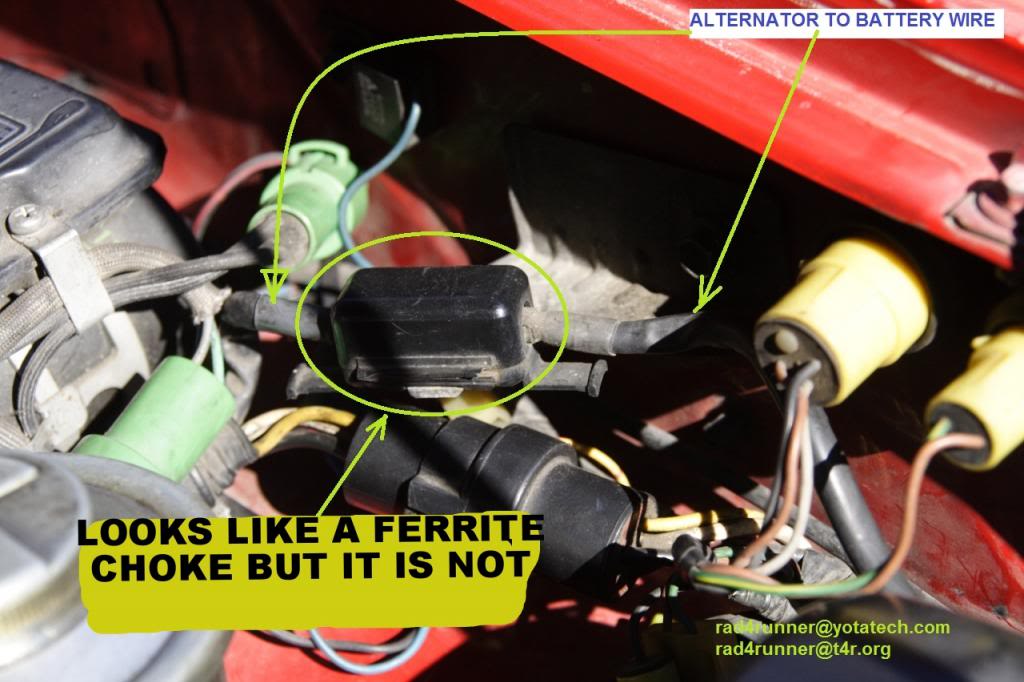
This looks like a ferrite choke but it is not. This is the equivalent of the appendix in human terms. I am not aware of any 4Runner owner on T4R.org or Yotatech who had put this to any use in the past 30 years.
If there is poor connection here, your regulator will see good output from alternator, so you will not get the "Charge" error light. So you would think your charging system is working properly. However, the truth is that alternator output is never reaching your battery.
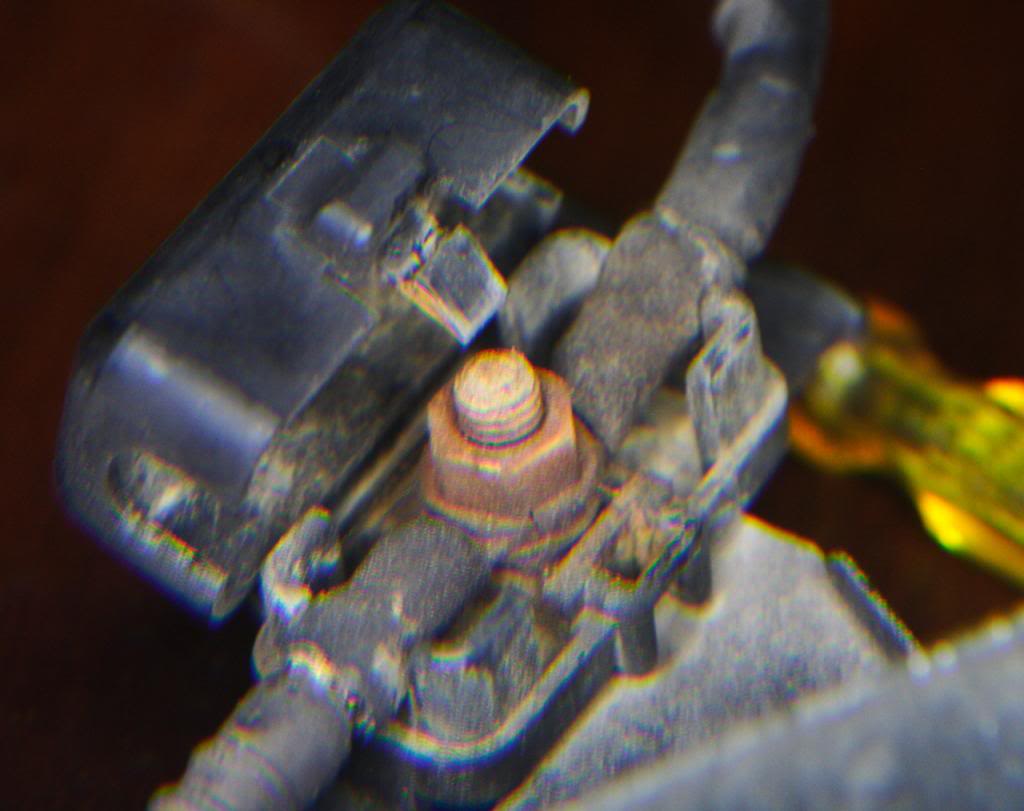
Take it apart, clean everything thoroughly down to shiny bare metal, re-assemble. Better yet, replace the whole battery to alternator wire with one continuous piece of thicker brand-new wire, and scrap this useless part.
May I reiterate... Did you...
do a simple but thorough check of your charging system.
https://www.yotatech.com/forums/f199...l#post52094780
https://www.yotatech.com/forums/f199...l#post52094780
Also Open and inspect this.
This looks like a ferrite choke but it is not. This is the equivalent of the appendix in human terms. I am not aware of any 4Runner owner on T4R.org or Yotatech who had put this to any use in the past 30 years.
If there is poor connection here, your regulator will see good output from alternator, so you will not get the "Charge" error light. So you would think your charging system is working properly. However, the truth is that alternator output is never reaching your battery.
Take it apart, clean everything thoroughly down to shiny bare metal, re-assemble. Better yet, replace the whole battery to alternator wire with one continuous piece of thicker brand-new wire, and scrap this useless part.
Last edited by RAD4Runner; Jun 28, 2014 at 11:18 PM.
Jun 30, 2014 | 06:49 AM
#20
Thread Starter
Registered User
Joined: Dec 2009
Posts: 112
Likes: 0
From: Walland, TN
I went back to my multimeter and here are the results:
....................................Ignition off..............Engine running
Battery poles.....................12.71V.................. ....14.55V
Alt cable to battery*...........12.71V......................14. 68V
*Voltmeter attached at alternator cable as it exits the "appendix" on the battery side. I have yet to clean the attachment site in the appendix but it looks pretty good.
With door button pressed in (i.e., dome light off) and fuse #6 out.........9.7 mAh
With dome light on and fuse #6 out............................................... ...320 mAh
With door button in, fuse #6 in, and lighter with or without igniter
inserted.......................................... ...............................................9.7 mAh
My 4Runner has now had the battery hooked up and fuse #6 removed for 5 days and has started fine every day.
My conclusions are:
The alternator is definitely charging the battery
At this time there is no parasitic draw of electricity
My plan:
Go talk with the starter/alternator guy and ask him what he saw that lead to his conclusion.
Put fuse #6 back in and wait.
....................................Ignition off..............Engine running
Battery poles.....................12.71V.................. ....14.55V
Alt cable to battery*...........12.71V......................14. 68V
*Voltmeter attached at alternator cable as it exits the "appendix" on the battery side. I have yet to clean the attachment site in the appendix but it looks pretty good.
With door button pressed in (i.e., dome light off) and fuse #6 out.........9.7 mAh
With dome light on and fuse #6 out............................................... ...320 mAh
With door button in, fuse #6 in, and lighter with or without igniter
inserted.......................................... ...............................................9.7 mAh
My 4Runner has now had the battery hooked up and fuse #6 removed for 5 days and has started fine every day.
My conclusions are:
The alternator is definitely charging the battery
At this time there is no parasitic draw of electricity
My plan:
Go talk with the starter/alternator guy and ask him what he saw that lead to his conclusion.
Put fuse #6 back in and wait.
Last edited by PETDOC; Jun 30, 2014 at 06:50 AM.


