


Help With Homework
 Sep 11, 2008 | 04:35 PM
#1

Thread Starter
Registered User
Joined: Oct 2007
Posts: 1,521
Likes: 0
From: Hopkins, MN
3VZ-E vs 22R-E (Behind the Numbers)
I was hoping some wise toyotian could help me out.
1. How much does the 3vze and the 22re weigh?
2. What is their fuel consumption (lbs/hphr or kg/kWhr)
I know this is probably a stretch, but I figured asking would hurt.
See Post #15
1. How much does the 3vze and the 22re weigh?
2. What is their fuel consumption (lbs/hphr or kg/kWhr)
I know this is probably a stretch, but I figured asking would hurt.
See Post #15
Last edited by jason191918; Sep 13, 2008 at 06:36 PM.

 Sep 11, 2008 | 05:07 PM
#3
Thread Starter
Registered User
Joined: Oct 2007
Posts: 1,521
Likes: 0
From: Hopkins, MN
After some research I found the 22re is about 340lbs, 400lbs, or 315lbs. I found the 340 and 400 on one site each, and the 315 on several sites.
The 3vze I found to be 360lbs, 325lbs, or 350lbs (once each).
Thanks for the reply.
Last edited by jason191918; Sep 13, 2008 at 11:23 AM.
Sep 11, 2008 | 05:45 PM
#4

Registered User
Joined: Jun 2007
Posts: 182
Likes: 1
From: Marietta, Georgia
I think you are being asked to compute pounds of fuel per horsepower hour, or per kilowatt hour. I would do it on horsepower, because you can get engine performance data in horsepower. Things you need to know:
1. Horsepower at RPM. ( Usually a horsepower/RPM curve for your engine will give you this data)
2. Since this is per hour, the easy way to do the calculations is to use RPM at 60 MPH.
3. Your milage at 60 MPH, using your highway mileage is probably close enough.
4. The weight of a gallon of gas
An example-
2800 RPM at 60 miles an hour
Horsepower at 2800 = 120
Mileage 18 MPG
Weight of 1 gallon of gas = about 6 pounds
6 pounds per gallon*(60 miles in one hour/18 mpg = 4.1 gallons per hour) = (24.6 pounds per hour at 120 horsepower 24.6/120 = .205 pounds of fuel per horsepower hour.
To do the problem in watts, convert horsepower to watts.
A calculation of this type is somewhat theoretical, as while speed is a direct function of engine RPM, fuel consumption is a function of RPM and load. If you are driving uphill, your fuel consumption to maintain RPM/speed will be higher than if you were going downhill.
I hope this helps.
1. Horsepower at RPM. ( Usually a horsepower/RPM curve for your engine will give you this data)
2. Since this is per hour, the easy way to do the calculations is to use RPM at 60 MPH.
3. Your milage at 60 MPH, using your highway mileage is probably close enough.
4. The weight of a gallon of gas
An example-
2800 RPM at 60 miles an hour
Horsepower at 2800 = 120
Mileage 18 MPG
Weight of 1 gallon of gas = about 6 pounds
6 pounds per gallon*(60 miles in one hour/18 mpg = 4.1 gallons per hour) = (24.6 pounds per hour at 120 horsepower 24.6/120 = .205 pounds of fuel per horsepower hour.
To do the problem in watts, convert horsepower to watts.
A calculation of this type is somewhat theoretical, as while speed is a direct function of engine RPM, fuel consumption is a function of RPM and load. If you are driving uphill, your fuel consumption to maintain RPM/speed will be higher than if you were going downhill.
I hope this helps.
Sep 11, 2008 | 05:55 PM
#5
Thread Starter
Registered User
Joined: Oct 2007
Posts: 1,521
Likes: 0
From: Hopkins, MN
I think you are being asked to compute pounds of fuel per horsepower hour, or per kilowatt hour. I would do it on horsepower, because you can get engine performance data in horsepower. Things you need to know:
1. Horsepower at RPM. ( Usually a horsepower/RPM curve for your engine will give you this data)
2. Since this is per hour, the easy way to do the calculations is to use RPM at 60 miles per hour.
3. Your milage at 60 MPH, using your highway mileage is probably close enough.
4. The weight of a gallon of gas
An example-
2800 RPM at 60 miles an hour
Horsepower at 2800 = 120
Mileage 18 MPG
Weight of 1 gallon of gas = about 6 pounds
6 pounds per gallon*(60 miles in one hour/18 mpg = 4.1 gallons per hour) = (24.6 pounds per hour at 120 horsepower 24.6/120 = .205 pounds of fuel per horsepower hour.
To do the problem in watts, convert horsepower to watts.
A calculation of this type is somewhat theoretical, as while speed is a direct function of engine RPM, fuel consumption is a function of RPM and load. If you are driving uphill, your fuel consumption to maintain RPM/speed will be higher than if you were going downhill.
I hope this helps.
1. Horsepower at RPM. ( Usually a horsepower/RPM curve for your engine will give you this data)
2. Since this is per hour, the easy way to do the calculations is to use RPM at 60 miles per hour.
3. Your milage at 60 MPH, using your highway mileage is probably close enough.
4. The weight of a gallon of gas
An example-
2800 RPM at 60 miles an hour
Horsepower at 2800 = 120
Mileage 18 MPG
Weight of 1 gallon of gas = about 6 pounds
6 pounds per gallon*(60 miles in one hour/18 mpg = 4.1 gallons per hour) = (24.6 pounds per hour at 120 horsepower 24.6/120 = .205 pounds of fuel per horsepower hour.
To do the problem in watts, convert horsepower to watts.
A calculation of this type is somewhat theoretical, as while speed is a direct function of engine RPM, fuel consumption is a function of RPM and load. If you are driving uphill, your fuel consumption to maintain RPM/speed will be higher than if you were going downhill.
I hope this helps.
Sep 11, 2008 | 08:22 PM
#7
Thread Starter
Registered User
Joined: Oct 2007
Posts: 1,521
Likes: 0
From: Hopkins, MN
Because my teacher told me too. 
I was told to calculate power, torque, BMEP, max/operating speed, mean piston speed, fuel consumption, efficiency, and specific power for 2 engines.
I chose the 3vze and the 22re.
I was told to calculate power, torque, BMEP, max/operating speed, mean piston speed, fuel consumption, efficiency, and specific power for 2 engines.
I chose the 3vze and the 22re.
Trending Topics
 Sep 13, 2008 | 11:14 AM
#12
Thread Starter
Registered User
Joined: Oct 2007
Posts: 1,521
Likes: 0
From: Hopkins, MN
 Sep 13, 2008 | 05:45 PM
#15
Thread Starter
Registered User
Joined: Oct 2007
Posts: 1,521
Likes: 0
From: Hopkins, MN
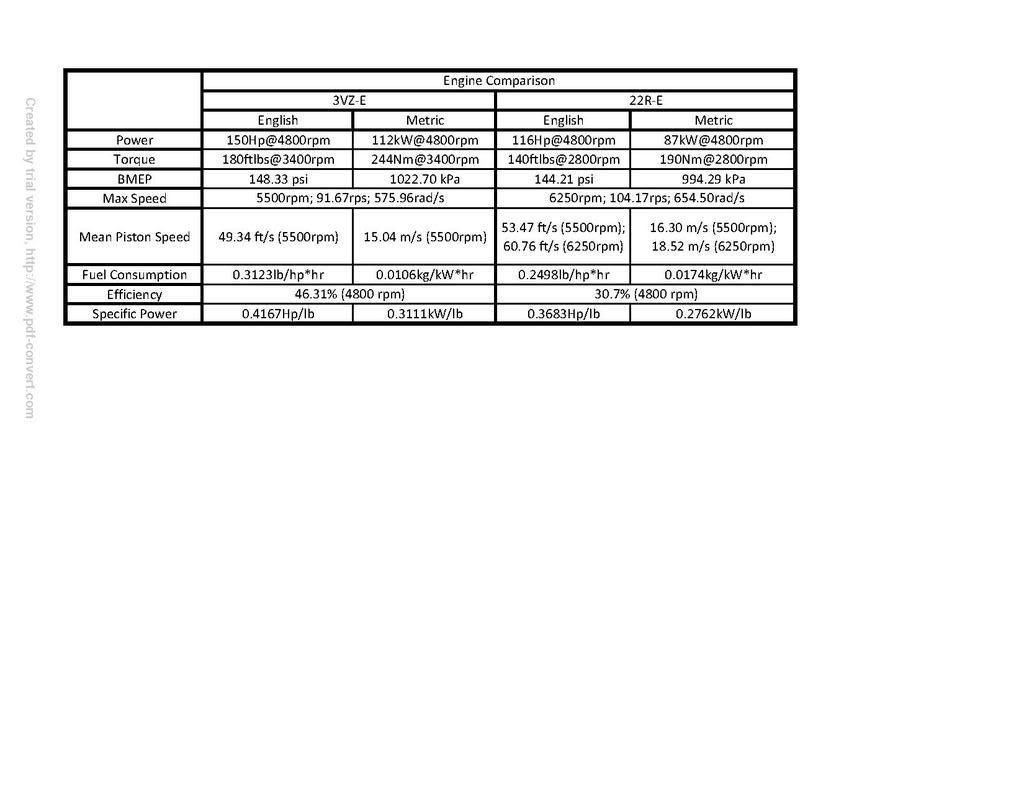
I find it interesting how the 3.0 has a better BMEP, specific power, and efficiency...maybe it isn't all bad?
Note-I made a few assumptions.
3vz-e weight=360lbs; 17.5mpg at 60mph at 68hp at 3000rpm
22r-e weight=315lbs; 24mpg at 60mph at 62hp at 3000rpm
Questions, Comments?
Last edited by jason191918; Sep 13, 2008 at 06:06 PM.
Sep 13, 2008 | 08:13 PM
#18

Registered User
Joined: Feb 2008
Posts: 2,805
Likes: 1
From: Salem, OR
YES! I thought I only had 115hp.
Stupid question.
Brother has an 86 crx. 90hp/90ft lbs. 2k lbs.
My truck. '91. 115hp/140ft lbs. 2400 lbs.
Who would likely win? Has nothing to do with this thread...but I really want to know...lol. I plan on racing him after I rebuild my engine...lol
Stupid question.
Brother has an 86 crx. 90hp/90ft lbs. 2k lbs.
My truck. '91. 115hp/140ft lbs. 2400 lbs.
Who would likely win? Has nothing to do with this thread...but I really want to know...lol. I plan on racing him after I rebuild my engine...lol
Sep 14, 2008 | 07:31 AM
#19
Contributing Member
Joined: Mar 2003
Posts: 11,334
Likes: 0
From: COTKU,Ontario,Canada
Very interesting Jason...
looks like the overall efficiency of the 3.0 is higher at the expense of increased fuel consumption...
another interesting note it seems that based on peak torque point half the available horses are doing all the work... so what are the rest there for? show? lol
looks like the overall efficiency of the 3.0 is higher at the expense of increased fuel consumption...
another interesting note it seems that based on peak torque point half the available horses are doing all the work... so what are the rest there for? show? lol

Thread
Thread Starter
Forum
Replies
Last Post
rlhd00z
95.5-2004 Tacomas & 96-2002 4Runners
10
Feb 21, 2009 07:22 PM
rlhd00z
3.4 Swaps
24
Feb 16, 2009 12:22 PM


