


weber 34/34 issues and heddar problems
 Nov 28, 2010 | 05:01 AM
#1

Thread Starter
Registered User
Joined: Oct 2009
Posts: 67
Likes: 0
weber 34/34 issues and heddar problems
Ok I have a couple of things I would like some opinions on. 1st, I have a weber 34/34 carb installed. Starts, idles and runs good until u turn or abrupt stop and get back on the throttle. Kind of hiccups a couple times. I'm thinking a float prob but don't know if I should raise it or lower it. 2nd, my heddar will not stay tight the nuts just keep coming loose I'm afraid I'm gonna pull the studs out I've lock washer and everything. It's causing the exhaust to blow I've went thru 2 the 3 days ive been driving it. And a quick question which vacuum port in the distributor is suppose to be used I thought it was the one closest to the radiator. If yall could give some advice id greatly appreciate it. Thanks
Nov 28, 2010 | 05:10 AM
#2

Registered User
Joined: Aug 2009
Posts: 13,574
Likes: 72
From: Wilkes-Barre, PA, USA
dizzy port is the one closest the radiator.
carb problem sounds more like a rich/lean issue not float related possibly timing as well. Make sure you have set the carb using the lean best idle procedure. Set your timing to 0 BTDC with the vacuum line to the dizzy disconnected and blocked off before doing this procedure.
Follow it exactly do not take any shortcuts. (these are for a 32/36 but should work for your 34/34 as well.
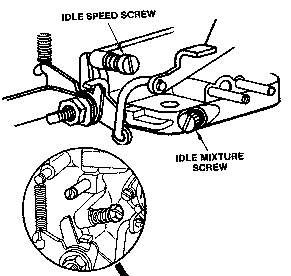
Before you start engine warmed up to normal operating temp and choke disengaged:
Base line Settings
Idle Speed Screw 1 to 1 1/2 turns (closer to 1 but no more than 1 1/2 this is very important engine might not like it let it lope if you have to)
Mixture Screw 2 turns out
SET UP ADJUSTMENTS
Start set up by confirming carb base line settings. Do not depend on the factory delivered settings. Check them before the carb is installed.
All settings are done with choke disengaged or warmed up so that the choke is fully opened and disengaged. This is done on automatic choke carburetors by first opening the choke butterfly by hand and inserting a wood block or wedge of some kind to hold open while the linkage is cycled (linkage operated through its full movement ) to clear the choke cam. (You will hear a metallic click as the cam is released. You can check the fast Idle screw under the choke assembly to confirm that it is not in contact with the choke fast idle cam.)
Set the Idle stop screw (speed screw see above photo) by backing out the Idle speed screw until it is not in contact with the throttle stop lever. Cycle the linkage again to be sure that the linkage comes to close without any assistance. (Checking for linkage bind) Now bring screw back into contact with the lever and continue to open or screwing in 1 turn no more than 11/2 turns.
Set the mixture screw (see above photo) by first screwing in until the screw stops, bottoms out. DO NOT FORCE OR BIND AS THIS WILL CAUSE DAMAGE TO THE SCREW AND IT’S SEAT IN THE BODY OF CARBURETOR. Back out the screw 2 full turns.
TUNING
1. BE SURE TO FOLLOW THE NEXT INSTRUCTIONS IN THE PROPER SEQUENCE, DEVIATION WILL CAUSE THE CARBURETOR TO NOT FUNCTION TO ITS IDEAL SPECIFICATIONS AND MAY NOT PROVIDE THE PERFORMANCE AND FUEL ECONOMY AS DESIGNED.
2. Start the engine, the engine will run very slowly more like a tractor. As long as the engine stays running idle speed is not important at this point.
3. The first thing to do is not set up the idle speed, but to set the Idle mixture screw to lean best idle setting. First, turn in the mixture screw until the engine dies or runs worse, then back out the screw (recommend turning ¼ to ½ turn at a time). The engine should pick up speed and begin to smooth out. Back out ½ turn more, or until the screw does nothing or runs worse then turn back to the point where it ran its best.
4. Use your ear, not a scope or tuning instruments at this point. You want to tune the engine by sound. Adjust to best, fastest and smoothest running point.
5. Now that the mixture screw is at its best running location, you can adjust the Idle speed the screw. The screw will be sensitive and should only take ¼ to ½ turns to achieve the idle speed you like.
6. Check and set idle to your driving preference. Put the car in gear and apply slight load, (AC on) and set the Idle as you like it. Don’t set it too high, as this will cause causes excessive clutch and brake wear. The Idle only needs to be 7 to 900 RPM with light load or AC on.
7. Recheck timing and vacuum hook ups. Recheck mixture screw to lean best idle again. If all is still best and smoothest idle then confirm and note the final settings.
8. To confirm settings with the engine running. Start by screwing in the mixture screw and count the number of turns it takes to bottom out and note if the engine dies. If Idle Mixture screws are with in ½ turn of base line setting then all is well and have fun. Also check the speed screw and note how many total turns from initial contact. You may have opened (turned in) the speed screw. Your final setting should be under 2 full turns. Reset the screws (back in) to the best final settings (Per your notes) and go on a test drive and have fun. If the settings are other than described then you may want to recalibrate the Idle circuit (low speed circuit) to your engines needs. This is done by following the rule of thumb BELOW.
Simple Rules for low speed calibration
If the mixture screw is more than 2 1/2 turns out turns then the Idle jet is too lean (too Small). When the mixture screw is less than 11/2 then the Idle jet is too rich (too large). These assumptions are based on the fact that the speed screw setting is not opened more than 11/2 turns. If the speed screw has to be opened 2 or more turns then this is also an indication of a lean condition usually requiring greater change. At times it may appear to be showing signs of richness or flooding it is really a lean condition. See pictures and notes in the tech 2 article supplied in the kit instructions, view and please understand the need to keep throttle plate as near to closed as possible so as not to prematurely expose the transition holes. This is what causes the visible rich condition, and confirms the need to increase the jet size. JET KITS are available if needed.
EXAMPLE With the speed screw set at no more than (1 1/2) turns in after contact with the stop lever; and the best idle occurring with the mixture screw set at 3 turns from bottom, indicates the need for a larger Idle jet. Achieving the best idle at under 2 turns indicates the need for a smaller idle jet.
Post back what your idle mixture screw is set at after doing this procedure. What pressure are you running the fuel at? Should be regulated at 3-3.5psi using a quality regulator like a Holley with the return line blocked off. Factory fuel pump?
Is it a header or factory manifold? Are you torquing the header nuts when the header is cold or hot? Should be when it is cold. Is it the stud that is loosening or the nut on the stud? Also try using locktite on both sides of the studs.
carb problem sounds more like a rich/lean issue not float related possibly timing as well. Make sure you have set the carb using the lean best idle procedure. Set your timing to 0 BTDC with the vacuum line to the dizzy disconnected and blocked off before doing this procedure.
Follow it exactly do not take any shortcuts. (these are for a 32/36 but should work for your 34/34 as well.
Before you start engine warmed up to normal operating temp and choke disengaged:
Base line Settings
Idle Speed Screw 1 to 1 1/2 turns (closer to 1 but no more than 1 1/2 this is very important engine might not like it let it lope if you have to)
Mixture Screw 2 turns out
SET UP ADJUSTMENTS
Start set up by confirming carb base line settings. Do not depend on the factory delivered settings. Check them before the carb is installed.
All settings are done with choke disengaged or warmed up so that the choke is fully opened and disengaged. This is done on automatic choke carburetors by first opening the choke butterfly by hand and inserting a wood block or wedge of some kind to hold open while the linkage is cycled (linkage operated through its full movement ) to clear the choke cam. (You will hear a metallic click as the cam is released. You can check the fast Idle screw under the choke assembly to confirm that it is not in contact with the choke fast idle cam.)
Set the Idle stop screw (speed screw see above photo) by backing out the Idle speed screw until it is not in contact with the throttle stop lever. Cycle the linkage again to be sure that the linkage comes to close without any assistance. (Checking for linkage bind) Now bring screw back into contact with the lever and continue to open or screwing in 1 turn no more than 11/2 turns.
Set the mixture screw (see above photo) by first screwing in until the screw stops, bottoms out. DO NOT FORCE OR BIND AS THIS WILL CAUSE DAMAGE TO THE SCREW AND IT’S SEAT IN THE BODY OF CARBURETOR. Back out the screw 2 full turns.
TUNING
1. BE SURE TO FOLLOW THE NEXT INSTRUCTIONS IN THE PROPER SEQUENCE, DEVIATION WILL CAUSE THE CARBURETOR TO NOT FUNCTION TO ITS IDEAL SPECIFICATIONS AND MAY NOT PROVIDE THE PERFORMANCE AND FUEL ECONOMY AS DESIGNED.
2. Start the engine, the engine will run very slowly more like a tractor. As long as the engine stays running idle speed is not important at this point.
3. The first thing to do is not set up the idle speed, but to set the Idle mixture screw to lean best idle setting. First, turn in the mixture screw until the engine dies or runs worse, then back out the screw (recommend turning ¼ to ½ turn at a time). The engine should pick up speed and begin to smooth out. Back out ½ turn more, or until the screw does nothing or runs worse then turn back to the point where it ran its best.
4. Use your ear, not a scope or tuning instruments at this point. You want to tune the engine by sound. Adjust to best, fastest and smoothest running point.
5. Now that the mixture screw is at its best running location, you can adjust the Idle speed the screw. The screw will be sensitive and should only take ¼ to ½ turns to achieve the idle speed you like.
6. Check and set idle to your driving preference. Put the car in gear and apply slight load, (AC on) and set the Idle as you like it. Don’t set it too high, as this will cause causes excessive clutch and brake wear. The Idle only needs to be 7 to 900 RPM with light load or AC on.
7. Recheck timing and vacuum hook ups. Recheck mixture screw to lean best idle again. If all is still best and smoothest idle then confirm and note the final settings.
8. To confirm settings with the engine running. Start by screwing in the mixture screw and count the number of turns it takes to bottom out and note if the engine dies. If Idle Mixture screws are with in ½ turn of base line setting then all is well and have fun. Also check the speed screw and note how many total turns from initial contact. You may have opened (turned in) the speed screw. Your final setting should be under 2 full turns. Reset the screws (back in) to the best final settings (Per your notes) and go on a test drive and have fun. If the settings are other than described then you may want to recalibrate the Idle circuit (low speed circuit) to your engines needs. This is done by following the rule of thumb BELOW.
Simple Rules for low speed calibration
If the mixture screw is more than 2 1/2 turns out turns then the Idle jet is too lean (too Small). When the mixture screw is less than 11/2 then the Idle jet is too rich (too large). These assumptions are based on the fact that the speed screw setting is not opened more than 11/2 turns. If the speed screw has to be opened 2 or more turns then this is also an indication of a lean condition usually requiring greater change. At times it may appear to be showing signs of richness or flooding it is really a lean condition. See pictures and notes in the tech 2 article supplied in the kit instructions, view and please understand the need to keep throttle plate as near to closed as possible so as not to prematurely expose the transition holes. This is what causes the visible rich condition, and confirms the need to increase the jet size. JET KITS are available if needed.
EXAMPLE With the speed screw set at no more than (1 1/2) turns in after contact with the stop lever; and the best idle occurring with the mixture screw set at 3 turns from bottom, indicates the need for a larger Idle jet. Achieving the best idle at under 2 turns indicates the need for a smaller idle jet.
Post back what your idle mixture screw is set at after doing this procedure. What pressure are you running the fuel at? Should be regulated at 3-3.5psi using a quality regulator like a Holley with the return line blocked off. Factory fuel pump?
Is it a header or factory manifold? Are you torquing the header nuts when the header is cold or hot? Should be when it is cold. Is it the stud that is loosening or the nut on the stud? Also try using locktite on both sides of the studs.
Last edited by xxxtreme22r; Nov 28, 2010 at 05:20 AM.
Nov 28, 2010 | 06:03 AM
#3
Thread Starter
Registered User
Joined: Oct 2009
Posts: 67
Likes: 0
I've set it like that before. But ill do it again just to make sure. I have pressure regulated at 3.5psi and timing I've always done by ear cause I don't have a light. But it only acts up when I turn or stop abruptly. So I don't see how timing would affect it I could see ur point if it did it all the time. Thanks for the vacuum port info. And its the nuts on the heddar. It's a nwor header and I'm torque while cold and hot and just bout every 30 miles. The only thing I haven't done is lock tight
Nov 28, 2010 | 06:49 AM
#5
Registered User
Joined: Aug 2009
Posts: 13,574
Likes: 72
From: Wilkes-Barre, PA, USA
Not sure exactly how that idle mixture screw works but that is accurate info. If the screw is out too far then you need a bigger idle jet.
The lean best idle procedure assumes you have timing set correctly. I would highly advise you get a timing light on that engine. Tuning timing by ear assumes you have the correct air/fuel mixture. Since there is a question if the mixture is correct, well... you get the point.
You may or may not have a problem with the float. The float cannot and will not adjust for the lack of fuel being sent to the carb by the fuel pump if it is either bad or it cannot keep up with the flowrate requirement of the carb. Good possibility if your running the factory style fuel pump and also have the return line still hooked up. This is why making sure the idle mixture screw and jet sizes are proper for the motor before changing that float.
My guess is here, if your turning or stopping (would probably happen in off-camber situations while off-roading as well) the float gets pulled up thus opening the main jet flooding the carb of fuel and when you hit the throttle this is compounded if the carb itself is running rich. (good chance it is if your not using this carb on a highly modified motor or the carb had not been re-jetted down already.) Which can also happen if the timing is not set correctly.
I am not saying it is or isn't the float but why assume it is if the tuning (timing, spark plug gap, idle mixture etc etc) is not proper on the motor first.
How old is the carb?
As far as the header nuts, what are you using a torque value on the nuts? should be at least 33 ft-lb maybe slightly more with a header. I had to set mine several times with my downey after rebuild till the gasket settled in.
The lean best idle procedure assumes you have timing set correctly. I would highly advise you get a timing light on that engine. Tuning timing by ear assumes you have the correct air/fuel mixture. Since there is a question if the mixture is correct, well... you get the point.
You may or may not have a problem with the float. The float cannot and will not adjust for the lack of fuel being sent to the carb by the fuel pump if it is either bad or it cannot keep up with the flowrate requirement of the carb. Good possibility if your running the factory style fuel pump and also have the return line still hooked up. This is why making sure the idle mixture screw and jet sizes are proper for the motor before changing that float.
My guess is here, if your turning or stopping (would probably happen in off-camber situations while off-roading as well) the float gets pulled up thus opening the main jet flooding the carb of fuel and when you hit the throttle this is compounded if the carb itself is running rich. (good chance it is if your not using this carb on a highly modified motor or the carb had not been re-jetted down already.) Which can also happen if the timing is not set correctly.
I am not saying it is or isn't the float but why assume it is if the tuning (timing, spark plug gap, idle mixture etc etc) is not proper on the motor first.
How old is the carb?
As far as the header nuts, what are you using a torque value on the nuts? should be at least 33 ft-lb maybe slightly more with a header. I had to set mine several times with my downey after rebuild till the gasket settled in.
Last edited by xxxtreme22r; Nov 28, 2010 at 07:00 AM.

Thread
Thread Starter
Forum
Replies
Last Post
Poncho0206
95.5-2004 Tacomas & 96-2002 4Runners
3
Jul 10, 2015 06:21 PM
3434, adjustment, adjustments, carb, carburetor, carbutetor, change, flooding, fuel, idle, jet, mix, problems, screw, stop, throttle, toyota, weber


