


 Feb 9, 2016, 10:13 AM
Last edit by: IB Advertising
See related guides and technical advice from our community experts:
Browse all: Interior Guides
- Toyota 4Runner 1984-1995 How to Swap Gauge Cluster
Step by step instructions for do-it-yourself repairs
Browse all: Interior Guides

Doing the SR-5 Gauge Cluster Swap... HOW TO with pictures.
 Nov 21, 2008 | 08:25 AM
#123

Registered User
Joined: May 2008
Posts: 4,591
Likes: 126
From: Montana
The reason to switch out the sending unit is because...and forgive me but I'm going to throw out terms that may be a bit wrong but the basic idea is right, so...anyway the reason is that the idiot light sending unit is different volts or amps or some such thing and is not meant to run an actual gauge, and apparently it will fry your gauge if you plug it in. The SR5 sending unit is meant to be used with a gauge and will send the correct volts amps whatever and so it won't fry it. If you're going to do the swap before you can afford to swap out the unit or you're lazy, just unplug the sending unit at the engine block end, and wait until you replace the sending unit to plug it in and have a fully functioning cluster. I would want, especially on an older truck, to have that oil gauge working, though.
Nov 21, 2008 | 08:45 AM
#124

The reason to switch out the sending unit is because...and forgive me but I'm going to throw out terms that may be a bit wrong but the basic idea is right, so...anyway the reason is that the idiot light sending unit is different volts or amps or some such thing and is not meant to run an actual gauge, and apparently it will fry your gauge if you plug it in. The SR5 sending unit is meant to be used with a gauge and will send the correct volts amps whatever and so it won't fry it. If you're going to do the swap before you can afford to swap out the unit or you're lazy, just unplug the sending unit at the engine block end, and wait until you replace the sending unit to plug it in and have a fully functioning cluster. I would want, especially on an older truck, to have that oil gauge working, though.
The reason the warning light sender won't work is that when the switch is open (infinite resistance) you get 0 amps flowing and no reading on the gauge. The real problem though comes when you have low pressure (like when first starting the engine) and the switch is closed (0 resistance). By ohms law, V=I*R (volts = amps times resistance), or I = V/R. If R=0, I = really big and gauge goes boom!
 Nov 22, 2008 | 01:29 AM
#126

Registered User
Joined: Aug 2004
Posts: 2,077
Likes: 1
From: Vancouver, WA
Ok so I just got done putting in my SR5 cluster. Now my truck was originally an auto so I had trouble figuring out how to make the manual guages work in my auto truck.
I've seen write ups on how to get the auto gauges to work in a manual but not vise versa.
Up a few posts deserthound finally posted the info I needed. There was one difference with my truck though. He says you need to run a wire off of the coils negative side to the 6th pin on connector A to make the tach work.
Well for me this didn't work, instead I had to run the negative wire to a screw on the back of the cluster marked P. So if you have an auto truck and you are installing manual guages you might need to do this too.

Thanks deserthound for figuring out how to do this swap.
I've seen write ups on how to get the auto gauges to work in a manual but not vise versa.
Up a few posts deserthound finally posted the info I needed. There was one difference with my truck though. He says you need to run a wire off of the coils negative side to the 6th pin on connector A to make the tach work.
Well for me this didn't work, instead I had to run the negative wire to a screw on the back of the cluster marked P. So if you have an auto truck and you are installing manual guages you might need to do this too.
Thanks deserthound for figuring out how to do this swap.
Nov 25, 2008 | 04:10 PM
#127

Registered User
Joined: Nov 2008
Posts: 1,319
Likes: 2
In order to hook up the tach on a 22r which wires need to be connected to these three screws?
P: Power?
IGN: Off the coil above the driver front wheel well?
and the other one: Don't have an idea for this one?
Can someone let me know thanks.
P: Power?
IGN: Off the coil above the driver front wheel well?
and the other one: Don't have an idea for this one?
Can someone let me know thanks.
 Nov 26, 2008 | 08:38 AM
#129
Registered User
Joined: May 2008
Posts: 4,591
Likes: 126
From: Montana
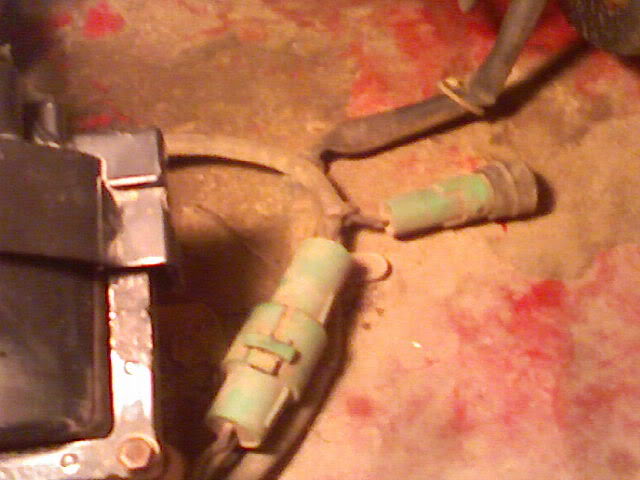
That's what I had to do with mine. If you just punch a tiny hole in that black rubber cover and stuff the wire through and into the plug, it's a nice clean looking snug connection. I plugged it into the correct slot in a plug in back of my cluster, rather than one of those screws.
Last edited by 83; Nov 26, 2008 at 08:39 AM.
Nov 26, 2008 | 11:17 AM
#130
Registered User
Joined: Nov 2008
Posts: 1,319
Likes: 2
don't put it in a screw, at least the ign one because your truck will not start. I did this and would not turn over. As soon as I took it out, it started up. I tried to put in while it was started and as soon as it made connection it wanted to kill the truck.
Jan 7, 2009 | 07:49 PM
#132

Registered User
Joined: Dec 2008
Posts: 1,015
Likes: 0
From: DFW, Texas!
I just did this last weekend.
Regarding the oil sender swap...
Idiot light behavior: closed circuit when low pressure, open circuit when "ok"
(which makes sense, low pressure should make that light come on)
gauge behavior: open circuit when zero pressure, "some resistance" when oil pressure appears, completely closed circuit (no resistance) when pressure is at max reading.
So with the gauge swap and oil pressure sender not changed...
If I turn the ignition key to "on" and let the light tests go out, the oil pressure gauge spikes up to 100% (the sender is trying to tell me "no pressure, turn on idiot light"). As soon as I start the engine, it drops to the bottom ("oil pressure ok, kill idiot light").
If I kill the engine (like, disconnect the coil), the oil pressure gauge again jumps to the top.
No harm, no foul, just need to crawl underneath and change out the sender (which was $45-ish from Pep Boys, bleh).
The tach appears to be correct, all other gauges work as expected.
Regarding the oil sender swap...
Idiot light behavior: closed circuit when low pressure, open circuit when "ok"
(which makes sense, low pressure should make that light come on)
gauge behavior: open circuit when zero pressure, "some resistance" when oil pressure appears, completely closed circuit (no resistance) when pressure is at max reading.
So with the gauge swap and oil pressure sender not changed...
If I turn the ignition key to "on" and let the light tests go out, the oil pressure gauge spikes up to 100% (the sender is trying to tell me "no pressure, turn on idiot light"). As soon as I start the engine, it drops to the bottom ("oil pressure ok, kill idiot light").
If I kill the engine (like, disconnect the coil), the oil pressure gauge again jumps to the top.
No harm, no foul, just need to crawl underneath and change out the sender (which was $45-ish from Pep Boys, bleh).
The tach appears to be correct, all other gauges work as expected.
Jan 8, 2009 | 06:41 AM
#133
Registered User
Joined: May 2008
Posts: 4,591
Likes: 126
From: Montana
I hope that's all the issue is...I haven't experienced it so I can't say for sure, but everybody says you will fry the actual oil gauge in your cluster if you hook the idiot light switch to the gauge..hopefully not.
Jan 8, 2009 | 07:47 AM
#134
Registered User
Joined: Dec 2008
Posts: 1,015
Likes: 0
From: DFW, Texas!
Naw, mine's hooked up right now like that. 
There's only one wire going down to the "oil sensor/switch", so the signal options you can send up to the gauge are quite limited (ranging from "open" to "ground", basically).
To test the gauge (by the book), you either "open" and then "ground" the lead, so what can damage the gauge again?
There's only one wire going down to the "oil sensor/switch", so the signal options you can send up to the gauge are quite limited (ranging from "open" to "ground", basically).
To test the gauge (by the book), you either "open" and then "ground" the lead, so what can damage the gauge again?
Jan 8, 2009 | 08:25 AM
#135
Registered User
Joined: May 2008
Posts: 4,591
Likes: 126
From: Montana
More correctly, the sender for the warning light is just a switch, so it closes when the oil pressure is too low and opens when the pressure is high enough. When closed the light turns on. For the gauge, you need a sender that has a variable resistance that changes with oil pressure. The way the gauge works is that it puts a known voltage across the resistance of the sender and that combination produces a current that varies with the oil pressure. The gauge needle moves up and down as that current increases and decreases.
The reason the warning light sender won't work is that when the switch is open (infinite resistance) you get 0 amps flowing and no reading on the gauge. The real problem though comes when you have low pressure (like when first starting the engine) and the switch is closed (0 resistance). By ohms law, V=I*R (volts = amps times resistance), or I = V/R. If R=0, I = really big and gauge goes boom!
The reason the warning light sender won't work is that when the switch is open (infinite resistance) you get 0 amps flowing and no reading on the gauge. The real problem though comes when you have low pressure (like when first starting the engine) and the switch is closed (0 resistance). By ohms law, V=I*R (volts = amps times resistance), or I = V/R. If R=0, I = really big and gauge goes boom!
Jan 8, 2009 | 08:32 AM
#136
Naw, mine's hooked up right now like that.
There's only one wire going down to the "oil sensor/switch", so the signal options you can send up to the gauge are quite limited (ranging from "open" to "ground", basically).
To test the gauge (by the book), you either "open" and then "ground" the lead, so what can damage the gauge again?
There's only one wire going down to the "oil sensor/switch", so the signal options you can send up to the gauge are quite limited (ranging from "open" to "ground", basically).
To test the gauge (by the book), you either "open" and then "ground" the lead, so what can damage the gauge again?
Jan 8, 2009 | 08:48 AM
#137
Registered User
Joined: Dec 2008
Posts: 1,015
Likes: 0
From: DFW, Texas!
(my bad for not looking it up on the Toyota FSM, haha)
Right below where it says to test with a 3.4 watt light, it shows you how to measure the resistance of the gauge itself. Nominal value is 44ohm.
A dead short (at the sender) would be a current of 1/4amps (12/44).
Right below where it says to test with a 3.4 watt light, it shows you how to measure the resistance of the gauge itself. Nominal value is 44ohm.
A dead short (at the sender) would be a current of 1/4amps (12/44).
Last edited by Windsor; Jan 8, 2009 at 08:50 AM.
Jan 8, 2009 | 08:53 AM
#138
Yes, but 1/4 amp is quite a lot for a sensitive electronic circuit, they usually are designed to handle current in the 10s of milli-amps range. Not sure what the current rating of the gauge circuitry is, but there is likely a reason that the use of a small (i.e. high resistance) light bulb in place of the sender to test the gauge is suggested.
Last edited by 4Crawler; Jan 8, 2009 at 08:55 AM.
Jan 8, 2009 | 09:17 AM
#139
Registered User
Joined: Dec 2008
Posts: 1,015
Likes: 0
From: DFW, Texas!
So perhaps the best advice would be to not let it (the gauge) sit there and cook with the engine not running (no oil pressure).

I'll swap the sender this weekend and report back, but every indication so far leads me to think that I haven't smoked anything yet.
I'll swap the sender this weekend and report back, but every indication so far leads me to think that I haven't smoked anything yet.
Jan 8, 2009 | 09:19 AM
#140

Registered User
Joined: Sep 2007
Posts: 328
Likes: 1
From: UK and Gulf Shores, AL


