


De-Smogging an early 22R
 Dec 1, 2012 | 12:43 PM
#201

Registered User
Joined: Apr 2011
Posts: 4
Likes: 0
It should be able to pass the emissions after being de smogged?
I guess i am a little confused about what can stay and what can go and how it should all be re-routed.
Any advice would be great
I guess i am a little confused about what can stay and what can go and how it should all be re-routed.
Any advice would be great
Last edited by ToyoRook; Dec 1, 2012 at 12:50 PM.
Dec 1, 2012 | 05:47 PM
#202
Thread Starter
Registered User
Joined: Jan 2010
Posts: 447
Likes: 0
From: Sonora, CA (Central Sierra)
So, as I stated in my second or third ever post, and several other times, Emissions Control is required by Federal law, as well as state law in almost every state. Advising you on how to circumvent a smog check is a violation of Federal law, and could get me in big trouble.
What I can do, is share my small knowledge on how the process works, and how your smog components work.
A properly running R motor is fairly efficient, and smog restrictions on allowable levels, etc., loosen up over time. Older vehicles are generally not held to the same smog standard that they were when they were new. I would guess that one large reason for this is that smog components (read EGR valve) plug up and fail over time.
There are a lot of myths that de-smogging a vehicle will make it more powerful, more efficient, get better gas mileage, etc. These are largely false in principle, but are sometimes actually true in application. A newly installed smog/egr system on a newly installed R motor would likely be every bit as fuel efficient as a desmogged rig, and only slightly (probably imperceptably) less powerful.
The real issue here is that these rigs are no longer new, things break or become less functional, and replacing the whole system would be cost-prohibitive. Also, these systems add a lot of both visual and actual complexity to your engine compartment. This can make troubleshooting somewhat challenging at times. Also, some of the smog components could fail in such a way that would make the motor run dirtier, or less efficiently. I absolutely believe that if I were to have my rig wanded today, it would pass that portion of the smog check. It would not, however, pass the visual.
What is included in the visual examination varies from state to state and county to county. In every smog check or precheck that I have seen, however, there is a checklist of what passed and failed, including the visual items, that is presented to the customer. If you have this, you can see what is important to the authorities in your area, and what you would have to fix in order to be compliant.
Getting your vehicle to pass a smog check is another subject in and of itself, but I will try to distill it to it's simplest form: Get the thing running as well as possible. Do a comprehensive tuneup, including, but not limited to:
Change and properly gap your spark plugs
Change your plug wires
Change your distributor cap and rotor
Change your air cleaner
Check, and correct, your ignition timing per the FSM
If needed, ensure that the carb is performing right at both idle, and at rev (I don't remember what the smog check does here, but I would guess around 3000 RPM)
Potentially replace or upgrade your ignition coil for stronger spark
To repair a faulty smog system, an O2 sensor is usually in order
To repair a faulty smog system, a new EGR valve is almost always necessary
Vacuum leaks at any of the VSV's could potentially have negative effects on the vehicle. In a vehicle that needs to pass smog, buying 20 feet or so of vacuum line, and replacing each of those lines one at a time would not be a bad idea.
However, if you decide to give up and only use this vehicle offroad, people often get lazy and put a chunk of aluminum can with a bead of RTV around either edge, and stick that under their EGR instead of buying all the block plates. I don't see why that wouldn't work.
Good luck!
What I can do, is share my small knowledge on how the process works, and how your smog components work.
A properly running R motor is fairly efficient, and smog restrictions on allowable levels, etc., loosen up over time. Older vehicles are generally not held to the same smog standard that they were when they were new. I would guess that one large reason for this is that smog components (read EGR valve) plug up and fail over time.
There are a lot of myths that de-smogging a vehicle will make it more powerful, more efficient, get better gas mileage, etc. These are largely false in principle, but are sometimes actually true in application. A newly installed smog/egr system on a newly installed R motor would likely be every bit as fuel efficient as a desmogged rig, and only slightly (probably imperceptably) less powerful.
The real issue here is that these rigs are no longer new, things break or become less functional, and replacing the whole system would be cost-prohibitive. Also, these systems add a lot of both visual and actual complexity to your engine compartment. This can make troubleshooting somewhat challenging at times. Also, some of the smog components could fail in such a way that would make the motor run dirtier, or less efficiently. I absolutely believe that if I were to have my rig wanded today, it would pass that portion of the smog check. It would not, however, pass the visual.
What is included in the visual examination varies from state to state and county to county. In every smog check or precheck that I have seen, however, there is a checklist of what passed and failed, including the visual items, that is presented to the customer. If you have this, you can see what is important to the authorities in your area, and what you would have to fix in order to be compliant.
Getting your vehicle to pass a smog check is another subject in and of itself, but I will try to distill it to it's simplest form: Get the thing running as well as possible. Do a comprehensive tuneup, including, but not limited to:
Change and properly gap your spark plugs
Change your plug wires
Change your distributor cap and rotor
Change your air cleaner
Check, and correct, your ignition timing per the FSM
If needed, ensure that the carb is performing right at both idle, and at rev (I don't remember what the smog check does here, but I would guess around 3000 RPM)
Potentially replace or upgrade your ignition coil for stronger spark
To repair a faulty smog system, an O2 sensor is usually in order
To repair a faulty smog system, a new EGR valve is almost always necessary
Vacuum leaks at any of the VSV's could potentially have negative effects on the vehicle. In a vehicle that needs to pass smog, buying 20 feet or so of vacuum line, and replacing each of those lines one at a time would not be a bad idea.
However, if you decide to give up and only use this vehicle offroad, people often get lazy and put a chunk of aluminum can with a bead of RTV around either edge, and stick that under their EGR instead of buying all the block plates. I don't see why that wouldn't work.
Good luck!
Dec 6, 2012 | 03:07 PM
#204
ouch!
Check to see if your cat is pluged up, check and clean plugs.
Check, recheck timing per FSM, check your coil per fsm.
Clean the ˟˟˟˟ out of your carb, seafoam treatment to vacume +gas.
Retune per FSM
Check to see if your cat is pluged up, check and clean plugs.
Check, recheck timing per FSM, check your coil per fsm.
Clean the ˟˟˟˟ out of your carb, seafoam treatment to vacume +gas.
Retune per FSM
Dec 6, 2012 | 06:51 PM
#205
Thread Starter
Registered User
Joined: Jan 2010
Posts: 447
Likes: 0
From: Sonora, CA (Central Sierra)
I refer to my above post for what to do next 
She's running like piss, give her some tuning. Sounds like she might be running a bit rich too. I have fought this battle before, I feel your pain. Good luck!
She's running like piss, give her some tuning. Sounds like she might be running a bit rich too. I have fought this battle before, I feel your pain. Good luck!
Dec 20, 2012 | 10:46 AM
#207
Thread Starter
Registered User
Joined: Jan 2010
Posts: 447
Likes: 0
From: Sonora, CA (Central Sierra)
If your smog system is running properly, I would not expect to see ANY mpg gains from this. Many people, however, have vacuum leaks or EGR issues that preclude proper operation, so this may help slightly for some.
Dec 20, 2012 | 11:05 AM
#208
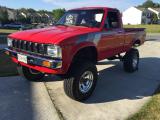
My fuel mileage went up, but of course that was after I fixed all the crap that the previous owner screwed up. I was getting about 6 mpg (not completely sure since the fuel sender wasn't working but 6 is close) and couldn't pull 5th gear or break 50 mph with 33's before I desmogged. When I desmogged, I removed the majority of the smog equipment and capped off what I didn't/couldn't remove, added headers and installed a weber. Before I started my rebuild I was getting anywhere from 19-21 mpg (corrected with 31's) and had a whole lot more power. But like I said, mine wasn't a simple desmog; it involved a little bit of fixin' what the PO did and tuning.
Technically, you should be getting better fuel economy after desmogging. Generally, most smog equipment on a 30 year old truck is clogged and not working anyway thus making the truck run out of tune (unless tuned as it clogs). Also there are emissions electronics that put a load on the alternator/battery which then makes the motor work harder. These things are minimal, but I can add up.
On the other hand, smog equipment also recycles unburned fuel and fumes that are expelled from the exhaust back into the intake. Removing smog equipment would reduce the recycling and technically cause a reduction in fuel economy (assuming that the smog equipment worked to begin with).
Then there is the closed loop vs open loop idle/running. Desmogging basically runs your vehicle in open loop at all times which can be more OR less efficient. With closed loop, you vehicle is constantly monitored by sensors which can also be more OR less efficient. I prefer open loop because it takes out all of the electric and sensor variables.
In my opinion, desmogged trucks run "healthier" because there is less equipment to run and you aren't constantly putting unburnt exhaust in your intake. Think about it, would you rather put fresh, clean air in your engine or dirty exhaust?? There is a picture on my rebuild thread that shows the carbon build up on my pistons.
I truly feel sorry for the folks who have state emissions. I'm rebuilding my 22R to be 100% desmogged using all of LCE's block off plates and eliminating anything that isn't necessary. That bird's nest of vacuum hoses and wires you see under your hood, well that won't be in mine when I'm done. I'll only have wires for the alternator, starter, ignition/coil, temperature sensor, oil pressure sensor, distributor and battery. And the only vacuum hose I will have will be my advance to my alternator and my brake booster. The rest will be completely eliminated.
Check out my rebuild thread below for more info.
Technically, you should be getting better fuel economy after desmogging. Generally, most smog equipment on a 30 year old truck is clogged and not working anyway thus making the truck run out of tune (unless tuned as it clogs). Also there are emissions electronics that put a load on the alternator/battery which then makes the motor work harder. These things are minimal, but I can add up.
On the other hand, smog equipment also recycles unburned fuel and fumes that are expelled from the exhaust back into the intake. Removing smog equipment would reduce the recycling and technically cause a reduction in fuel economy (assuming that the smog equipment worked to begin with).
Then there is the closed loop vs open loop idle/running. Desmogging basically runs your vehicle in open loop at all times which can be more OR less efficient. With closed loop, you vehicle is constantly monitored by sensors which can also be more OR less efficient. I prefer open loop because it takes out all of the electric and sensor variables.
In my opinion, desmogged trucks run "healthier" because there is less equipment to run and you aren't constantly putting unburnt exhaust in your intake. Think about it, would you rather put fresh, clean air in your engine or dirty exhaust?? There is a picture on my rebuild thread that shows the carbon build up on my pistons.
I truly feel sorry for the folks who have state emissions. I'm rebuilding my 22R to be 100% desmogged using all of LCE's block off plates and eliminating anything that isn't necessary. That bird's nest of vacuum hoses and wires you see under your hood, well that won't be in mine when I'm done. I'll only have wires for the alternator, starter, ignition/coil, temperature sensor, oil pressure sensor, distributor and battery. And the only vacuum hose I will have will be my advance to my alternator and my brake booster. The rest will be completely eliminated.
Check out my rebuild thread below for more info.
Dec 31, 2012 | 07:49 PM
#209

Registered User
Joined: Dec 2012
Posts: 202
Likes: 1
Does anyone know where I can find clean line drawing style images of a California smogged 22R and a NON California 22R? I need them so I can print them out and give them to a mechanic to de-smogify a 22R.
Thanks!
Thanks!
Dec 31, 2012 | 08:16 PM
#211
Thread Starter
Registered User
Joined: Jan 2010
Posts: 447
Likes: 0
From: Sonora, CA (Central Sierra)
Jan 1, 2013 | 09:25 AM
#213
Registered User
Joined: Dec 2012
Posts: 202
Likes: 1
I assume that is for a 22R, right? Does anyone know where I can find images like the one below for a California smogged 22R and a NON smogged 22R?
Thanks.
Thanks.
Jan 1, 2013 | 10:20 AM
#214

Registered User
Joined: Dec 2012
Posts: 100
Likes: 0
Jan 1, 2013 | 10:38 AM
#215
Thread Starter
Registered User
Joined: Jan 2010
Posts: 447
Likes: 0
From: Sonora, CA (Central Sierra)
There are no line images of a non smogged 22R, this was never produced by Toyota. The point of this thread is that information on desmogging 22R motors is very hard to come by. For step by step info on how to do this, the best info will come from this thread directly. Just point your mechanic here.
Jan 1, 2013 | 11:08 AM
#216
Registered User
Joined: Dec 2012
Posts: 100
Likes: 0
There are no line images of a non smogged 22R, this was never produced by Toyota. The point of this thread is that information on desmogging 22R motors is very hard to come by. For step by step info on how to do this, the best info will come from this thread directly. Just point your mechanic here.
Jan 1, 2013 | 11:13 AM
#217
Thread Starter
Registered User
Joined: Jan 2010
Posts: 447
Likes: 0
From: Sonora, CA (Central Sierra)
That is the closest I have found as well. The "Federal" version is pretty bare as well. I haven't seen the Canadian one in a while, but I thought it still had an EGR?
Jan 1, 2013 | 08:31 PM
#219
Believe it or not, the Haynes manual for Toyota Pickups (1979-90 I believe) is probably the best place to find all of the smog diagrams for all specs - Federal, California and Canada. I was at PepBoys the other day and saw one on the shelf so I started flipping through it to see how bad it really was compared to my FSM. The one and only thing that I noticed that was better than the FSM was the smog diagrams that are broken down by spec, model and year. There must have been about 20 of them in there. I snapped a picture of the 1983 Federal version for my own reference since I'm going the opposite way - removing any and all smog equipment. I just wanted an idea of what all I didn't need.
The best thing you can do is buy the smog equipment off of somebody that is desmogging their truck. For the most part all the equipment usually works once you clean and unclog everything. I have some of the smog equipment available, but I alread sold the majority of my stuff to guy doing the same as you. I still have a lot of the switches and electronics. Just ask if you need anything like that. Good luck!
The best thing you can do is buy the smog equipment off of somebody that is desmogging their truck. For the most part all the equipment usually works once you clean and unclog everything. I have some of the smog equipment available, but I alread sold the majority of my stuff to guy doing the same as you. I still have a lot of the switches and electronics. Just ask if you need anything like that. Good luck!
Jan 4, 2013 | 07:25 PM
#220

Registered User
Joined: Nov 2012
Posts: 7
Likes: 0
This the the best de-smoging thread I have found and I have been searching for 2 days now, but my question is if I just basically follow this diagram, it would be talking off the same as what pumpkin in took off???


