


1985 toyota pickup 22re xtra cab fuel level sending unit
 Jan 20, 2021 | 07:43 PM
#1
Thread Starter
Registered User
Joined: Sep 2020
Posts: 2
Likes: 1
1985 toyota pickup 22re xtra cab fuel level sending unit
I need to get my fuel level sending unit replaced and of course the specific part matched from my vin is discontinued, anyone ever find a replacement maybe from another year and made it work? 85 xtra cab 22re with 19 gallon fuel tank. Thanks.
 Aug 12, 2021 | 09:04 AM
#3

Registered User
Joined: Jun 2011
Posts: 2
Likes: 0
From: Boise
83320-39705?
Spoiler

for my 1985 extended cab.

Last edited by toy4todd; Aug 12, 2021 at 09:09 AM. Reason: Add text
Aug 19, 2021 | 06:40 PM
#4

Registered User
Joined: Mar 2015
Posts: 3
Likes: 0
Same issue. I am looking at the aftermarket units on ebay for around $40. The seller states not for the 4wd model, showing the round plug as not matching their plug. However, I am wondering if the only problem is swapping out the plug? I will contact the seller shortly but I doubt they have the answer. I may end up buying the unit and taking my chances that I can adapt it. New ones are stupid priced if you can find one, and my pick your parts NEVER have the older 4wd models.
Looking at the 83320-39705, I can see that it should be easily adaptable for our uses. Cheapest is around $150.
I have the 1985 4WD pickup. My sender looks like the picture. The next generation one (83320-39705) looks to fit as they are probably using the same fuel tank. One extra unused wire.
Looking at the 83320-39705, I can see that it should be easily adaptable for our uses. Cheapest is around $150.
I have the 1985 4WD pickup. My sender looks like the picture. The next generation one (83320-39705) looks to fit as they are probably using the same fuel tank. One extra unused wire.
Last edited by saint-yota; Aug 19, 2021 at 06:49 PM.
Aug 20, 2021 | 04:09 AM
#5
Registered User
iTrader: (1)
Joined: Apr 2009
Posts: 13,381
Likes: 100
From: I live in New Tripoli Pa out in the woods

Same issue. I am looking at the aftermarket units on ebay for around $40. The seller states not for the 4wd model, showing the round plug as not matching their plug. However, I am wondering if the only problem is swapping out the plug? I will contact the seller shortly but I doubt they have the answer. I may end up buying the unit and taking my chances that I can adapt it. New ones are stupid priced if you can find one, and my pick your parts NEVER have the older 4wd models.
Looking at the 83320-39705, I can see that it should be easily adaptable for our uses. Cheapest is around $150.
I have the 1985 4WD pickup. My sender looks like the picture. The next generation one (83320-39705) looks to fit as they are probably using the same fuel tank. One extra unused wire.
Looking at the 83320-39705, I can see that it should be easily adaptable for our uses. Cheapest is around $150.
I have the 1985 4WD pickup. My sender looks like the picture. The next generation one (83320-39705) looks to fit as they are probably using the same fuel tank. One extra unused wire.
The thing to be careful of the sending unit and the gauge are a matched set if the vendors change the two might not communicate or the gauge reads really off.
Over the years I have used aftermarket fuel gauges the gauge and sending unit come as a matched set
Aug 20, 2021 | 10:13 PM
#6


If anyone needs adapters, I should be able to build them. I have the round connectors on hand, I have 2 and 3 pin version of them, I've ordered 1, 4, and 5 pin, but I have to wait on shipping from Japan so might take a while to get.
For interchange, it depends on the design, it should be the same basic concept as a TPS but in the tank. Volts in, a ground, and a signal that's basically a variable resistor. Assuming voltage is read, I don't think the resistance really matters too much, the voltage isn't effected by a reading if I thinking right. Clearly if power flows through it, it's effects the voltage, so checking ohm specs wouldn't hurt.
Ok, checked the diagram, there's a bit more to it than I thought. It shows two resistor icons in the fuel sender, not sure what the circled one means, one with the line I'm pretty sure is the variable resistor part. Guessing the other is the main current limiting resistor so a bunch of power doesn't flow through the system and likely a critical value to match. Could always replace that resistor if match the older units though if needed.
1986
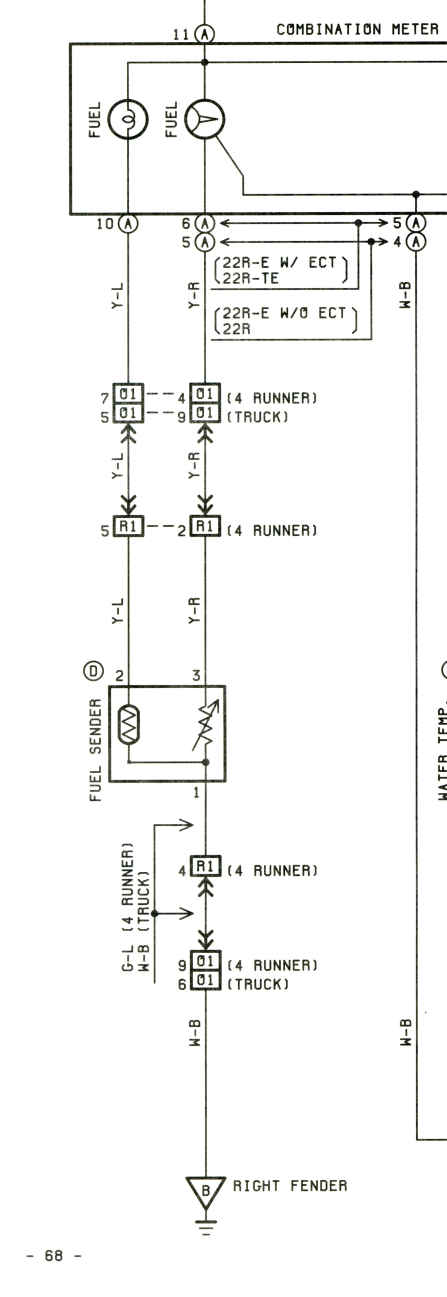
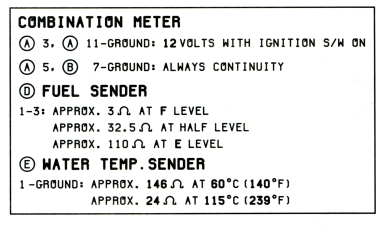
I don't have an 85 wire diagram book, but I have a FSM.
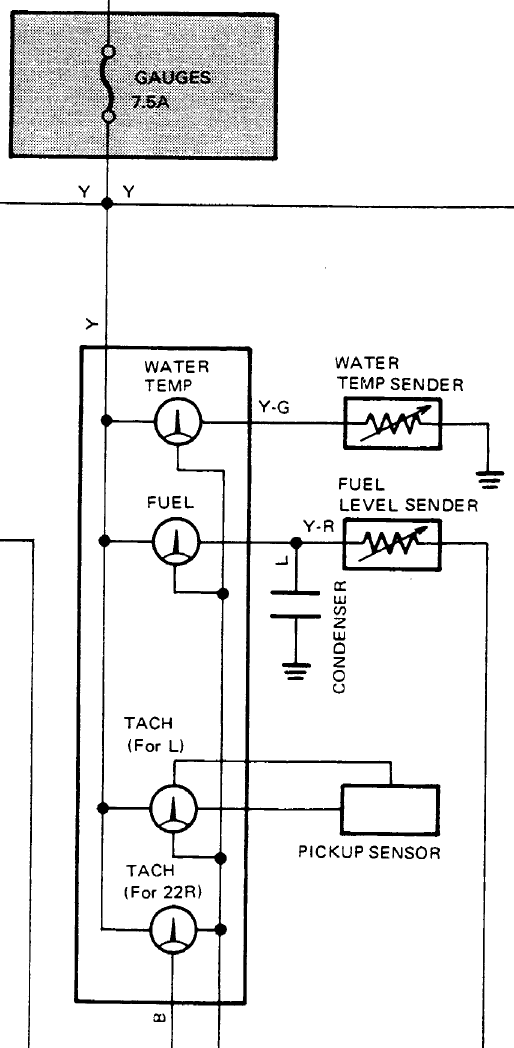
Looks like the older ones just didn't have a fuel light. I also ran across the ohm specs, looks like they are an exact match.
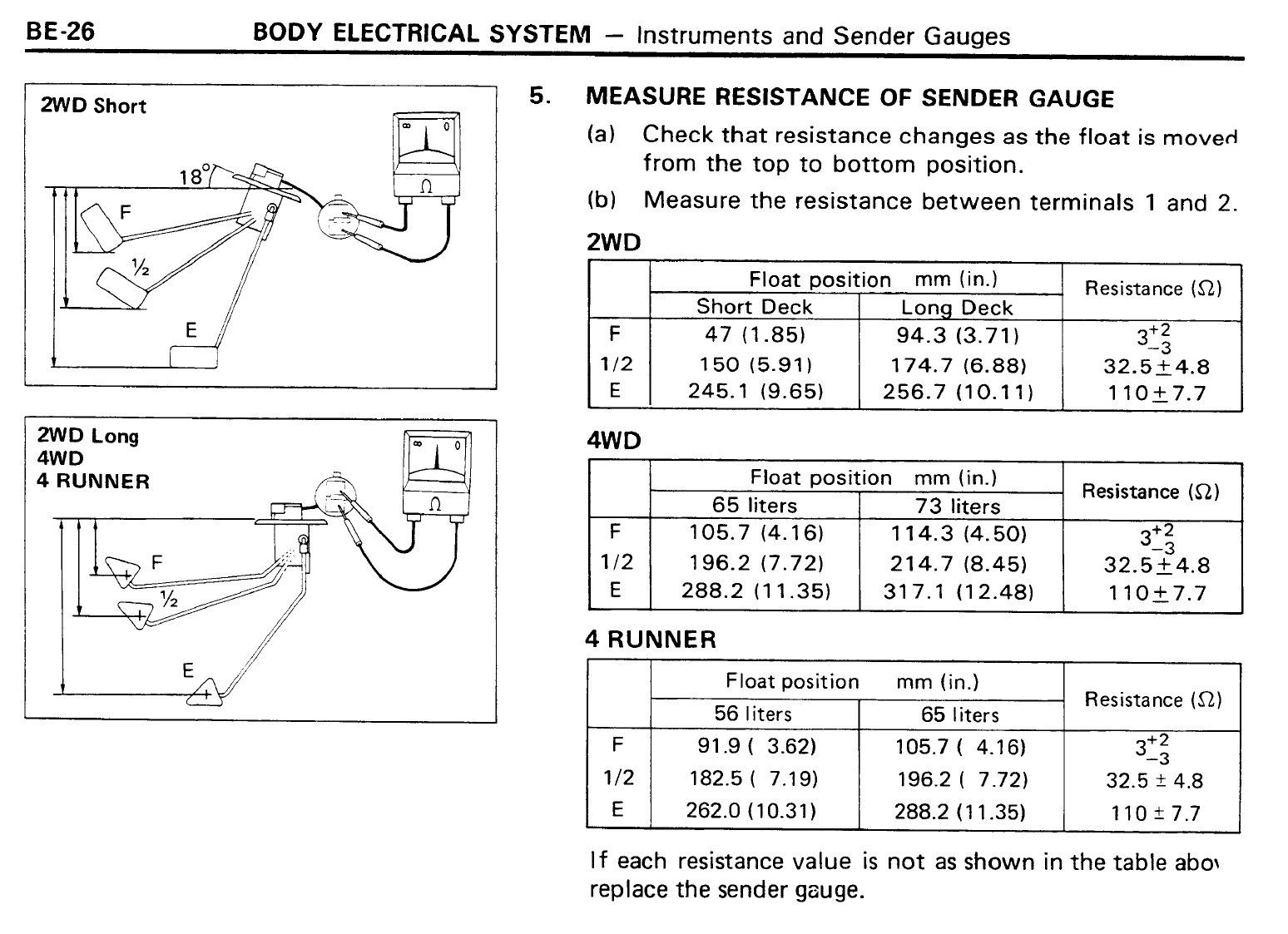
Sadly the 85 and older wire diagrams do not give pin out or connector data, so I'd have to have someone physically check the wire colors and wire locations in their harness for me to find them on the diagram and make the adapter correctly (images would help loads). 2wd, 4wd, and 4runner seems to have the same specs, don't see why there's a difference besides physical like tank size. Oh I guess the 2wd "short" sender is mounted at an angle, while the other ones are mounted flat, guess that would be the big difference.
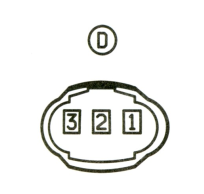
Anyway, photo shows the 2 pin round style connector, I have those, and the 86+ style is a 3 pin white connector, I have the harness side for those (to plug into the sender), so should have what I need on hand to build adapters if someone wants to help figure out the wire colors and take a chance on buying the 86+ style to see if it physically fits right (maybe junkyard one first?). I'd take a pic of the connectors, but I can't seem to find the white 3 pin ones. I know I didn't use them up, but they are an uncommon connector. I also have a kit coming that has several different sizes of the same series connector, so it will have some 3 pins in it.
I figured being OEM, the gauge and sending unit wouldn't have changed much, so I suspect this can be made to work =).
For interchange, it depends on the design, it should be the same basic concept as a TPS but in the tank. Volts in, a ground, and a signal that's basically a variable resistor. Assuming voltage is read, I don't think the resistance really matters too much, the voltage isn't effected by a reading if I thinking right. Clearly if power flows through it, it's effects the voltage, so checking ohm specs wouldn't hurt.
Ok, checked the diagram, there's a bit more to it than I thought. It shows two resistor icons in the fuel sender, not sure what the circled one means, one with the line I'm pretty sure is the variable resistor part. Guessing the other is the main current limiting resistor so a bunch of power doesn't flow through the system and likely a critical value to match. Could always replace that resistor if match the older units though if needed.
1986
I don't have an 85 wire diagram book, but I have a FSM.
Looks like the older ones just didn't have a fuel light. I also ran across the ohm specs, looks like they are an exact match.
Sadly the 85 and older wire diagrams do not give pin out or connector data, so I'd have to have someone physically check the wire colors and wire locations in their harness for me to find them on the diagram and make the adapter correctly (images would help loads). 2wd, 4wd, and 4runner seems to have the same specs, don't see why there's a difference besides physical like tank size. Oh I guess the 2wd "short" sender is mounted at an angle, while the other ones are mounted flat, guess that would be the big difference.
Anyway, photo shows the 2 pin round style connector, I have those, and the 86+ style is a 3 pin white connector, I have the harness side for those (to plug into the sender), so should have what I need on hand to build adapters if someone wants to help figure out the wire colors and take a chance on buying the 86+ style to see if it physically fits right (maybe junkyard one first?). I'd take a pic of the connectors, but I can't seem to find the white 3 pin ones. I know I didn't use them up, but they are an uncommon connector. I also have a kit coming that has several different sizes of the same series connector, so it will have some 3 pins in it.
I figured being OEM, the gauge and sending unit wouldn't have changed much, so I suspect this can be made to work =).
Aug 21, 2021 | 11:01 AM
#7

Registered User


Joined: Jul 2005
Posts: 2,345
Likes: 656
From: Chiloquin, OR
The 86 diagram:
The variable resistor is the level sensor. What the float is attached to and moves as the fuel level rises and drops. Essentially, it changes the resistance to ground of the meter. As the resistance changes, the voltage through the gauge changes, and the gauge pointer moves accordingly.
The symbol of the circled resistor is the sensor for the Low Fuel light that comes on with about 1-3 gallons left in the tank. When it's covered in fuel, it has one resistance, keeping the light shut off, and when the it's uncovered, the resistance lowers, providing a path to ground for the voltage applied to the lamp, allowing it to come on.
Does this all help at all? I do tend to ramble a bit...
Pat☺
The variable resistor is the level sensor. What the float is attached to and moves as the fuel level rises and drops. Essentially, it changes the resistance to ground of the meter. As the resistance changes, the voltage through the gauge changes, and the gauge pointer moves accordingly.
The symbol of the circled resistor is the sensor for the Low Fuel light that comes on with about 1-3 gallons left in the tank. When it's covered in fuel, it has one resistance, keeping the light shut off, and when the it's uncovered, the resistance lowers, providing a path to ground for the voltage applied to the lamp, allowing it to come on.
Does this all help at all? I do tend to ramble a bit...
Pat☺
Trending Topics
Aug 21, 2021 | 11:20 AM
#8
Yea, I had a fairly good idea on how the fuel level sensor work (effectively a Potentiometer, but variable resistor makes more sense to most people). The circled resistor is interesting, I didn't know exactly how the fuel light kicked on/off, I figured it was part of the pot and it just made contact shortly before empty, but looks like it's a little more complicated than that, or it's just not represented in the diagram like I was thinking it would be. I figured the fuel light worked like the TPS sensor for the idle detection.
Anyway, always good to have someone validate info, should mean we both are on the right track xD.
Also I just got a 79 wire diagram book (EWD) and... it shows pinouts! I'll have to dig a litte harder in the 85 and older books, maybe I'm just not looking in the right spots. Oh neat, I got the receipt from the manual too, It was bought 7/2/1986 for $9 or $10 (the invoice isn't clear, the prepay page shows the part numbers but no price). The diagrams are a bit of a pain to follow, but found the connector, looks like 79 they used a different connector than 85, but the drawing looks a lot like one of the ones I have. Btw the foldout in this book for the 4x4 pickup is 10 pages worth of data, 5 wide, 2 tall, massive foldouts.
Also update on the connectors, the connector kit I bought didn't come with the "flat" style 3 pin that the 86+ fuel senders used, it has a 2 row triangle shaped one in the kit. I'll have to either buy more or find which organizer I stuffed them in.
Anyway, always good to have someone validate info, should mean we both are on the right track xD.
Also I just got a 79 wire diagram book (EWD) and... it shows pinouts! I'll have to dig a litte harder in the 85 and older books, maybe I'm just not looking in the right spots. Oh neat, I got the receipt from the manual too, It was bought 7/2/1986 for $9 or $10 (the invoice isn't clear, the prepay page shows the part numbers but no price). The diagrams are a bit of a pain to follow, but found the connector, looks like 79 they used a different connector than 85, but the drawing looks a lot like one of the ones I have. Btw the foldout in this book for the 4x4 pickup is 10 pages worth of data, 5 wide, 2 tall, massive foldouts.
Also update on the connectors, the connector kit I bought didn't come with the "flat" style 3 pin that the 86+ fuel senders used, it has a 2 row triangle shaped one in the kit. I'll have to either buy more or find which organizer I stuffed them in.
Aug 22, 2021 | 12:05 PM
#9
Registered User
Joined: Jul 2005
Posts: 2,345
Likes: 656
From: Chiloquin, OR
I'll have to either buy more or find which organizer I stuffed them in.

What always drove me nuts was people just throwing stuff in, no organization at all. Pins that don't go with the plugs in the same place, plugs and pins just randomly piled into one location, etc. It helped being in charge. I could yell at my guys until it got straightened out.


Enjoy!
Pat☺
Aug 22, 2021 | 12:22 PM
#10
Haha, yea I have like 15 small organizers, I just bought 10 more from harbor freight, nice cheap china made ones and moving all of the same connector series into their own dedicated unit so I can actually label them and get things 100x easier to find. Atm I keep the same series and terminals together, but I have a ton of little organizers and some are misc stuffed together ones just because I have 1-2 of the same series and that's it.
Here's one of the connector series that I have most (maybe all) connector types of. Little better than my old setup =). Need to add labels for the part numbers on the bins, and also add the part numbers to the list for each housing/terminal with their specs etc so re-ordering is a lot easier.
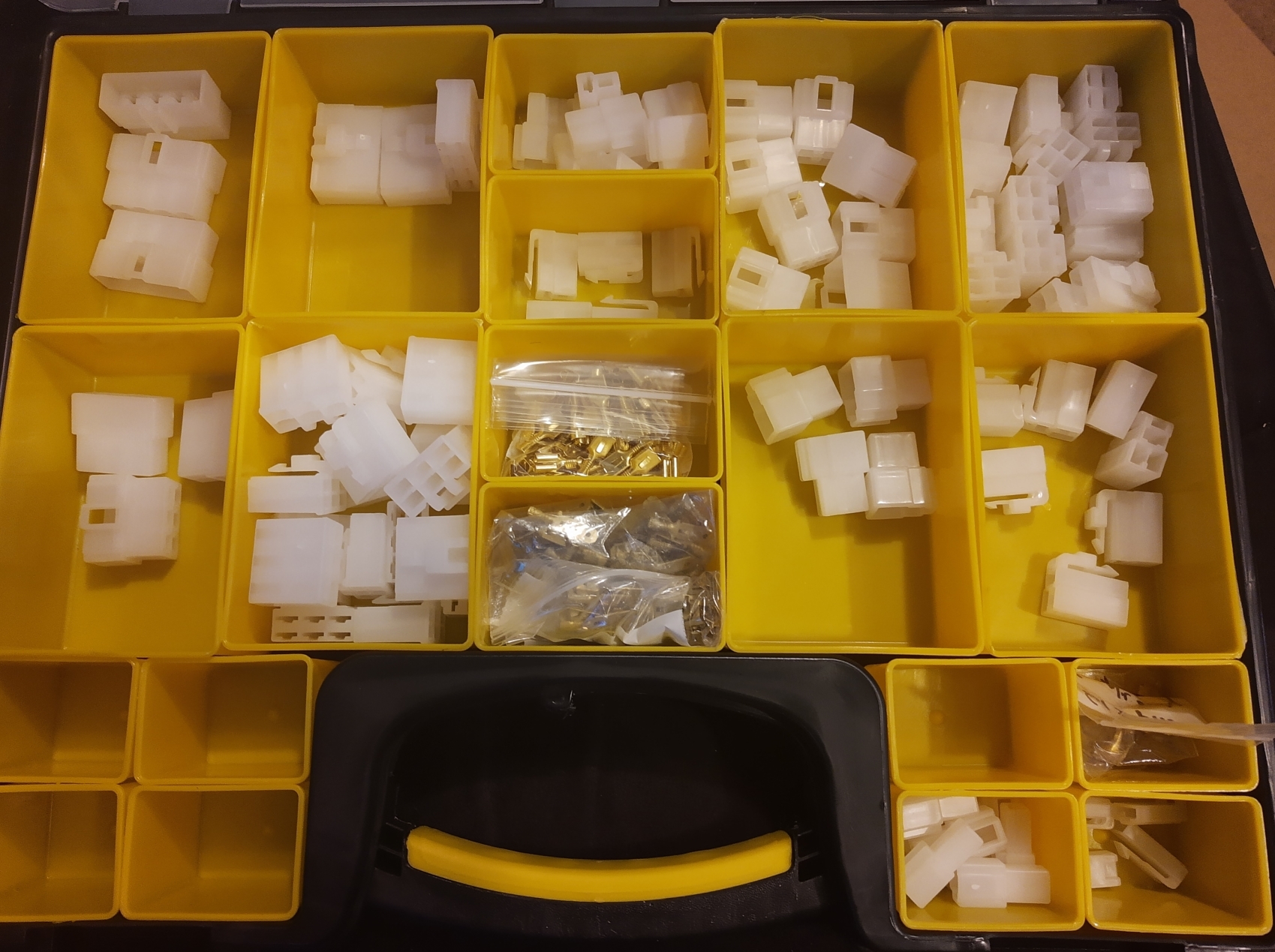
Here's one of the connector series that I have most (maybe all) connector types of. Little better than my old setup =). Need to add labels for the part numbers on the bins, and also add the part numbers to the list for each housing/terminal with their specs etc so re-ordering is a lot easier.
Last edited by atcfixer; Aug 22, 2021 at 01:06 PM.
Aug 24, 2021 | 02:58 PM
#11
Registered User
Joined: Mar 2015
Posts: 3
Likes: 0
I received the $40 aftermarket. I tested the ohms and compared them to the diagram in the manual (same as previous post) since my original was shot. The range on the new one is closer to 12 ohm - 80 ohm, instead of 3 ohm - 110 ohm. What this means in real world on the actual gauge in the truck, as I currently have it in the tank playing with it is that....a full tank registers as 3/4, and 3 gallons registers as just slightly above E, and empty is just below E. If I was so inclined, I could probably open the cluster, pull the needle, and reposition it a little more towards full. However, I would much rather have an accurate E than an accurate F, if you know what I mean...lol. The wiring is no biggie, going to splice in and reuse the round plug style. Weird, though, I swapped the positive and ground to see if it made any difference. It did not. Overall, I am happy with the cost, the quality, and the variance is acceptable for my bare bones fun truck.
As a complete off-topic comment, I replaced the old fuel injectors with 12 port injectors I got off ebay for around $150, and was very impressed by how much smoother and better the rpm power band, especially with my 31 x 10.5's. My truck, when it had the original fuel injectors, did not like those big tires.
As a complete off-topic comment, I replaced the old fuel injectors with 12 port injectors I got off ebay for around $150, and was very impressed by how much smoother and better the rpm power band, especially with my 31 x 10.5's. My truck, when it had the original fuel injectors, did not like those big tires.
Aug 24, 2021 | 03:29 PM
#12
If that aftermarket sender has the fuel light circuit, I'd say add a light somewhere so when it's low on fuel, it will give atleast a warning, instead of running out before it hits "E". Most vehicles can hit "E" and go a fair distance before fully running out, so anyone else driving it will be really confused if they run out a bit early. My 95 ford diesel runs out right as it hits the red of the "E" line, but it has 2 fuel tanks, so now I know there's no fudge range in that gauge.
You could "hack" the sender a little, adding resistance inline would increase resistance, and running a resistor across the signal and ground would decrease the resistance. Would have to do some math to estimate the effect, easiest would be to install a pot, but not sure if any are rated for gas, or how well it would hold up to the road elements. A standard resistor is pretty rugged though. Adding resistance inline adds old value + new value, so 80 + 30 would make you hit the 110ohm (assuming that's full though?). For the other, I had to look up the math again. basically 1/12 + 1/x = 3 ohms, yay for algebra. Looks like it would be a 4 ohm resistor. Of course problem with that is, the "full" ohms would be 3.81 ohms, so would work for empty, but full would be so far off, probably unusable.
For your injectors, have you done a plug check? Sounds like either before the engine didn't run right, or you might be a little lean if I'm thinking right (lean makes more power, but more heat and more damage).
I know it's not quite the same thing, but my 2wd 22r plugged away just fine with like 280k miles and oversized jeep tires on the back. Stock tires are TINY, like 25 or 26in, the jeep tires were something like 29-30in, also remember the 2wd trucks are much higher geared too. It had a ton more power than my old 94 ranger with the 2.3L and the 85 GMC S15 with a 2.8L but both of those trucks probably had running issues too.
You could "hack" the sender a little, adding resistance inline would increase resistance, and running a resistor across the signal and ground would decrease the resistance. Would have to do some math to estimate the effect, easiest would be to install a pot, but not sure if any are rated for gas, or how well it would hold up to the road elements. A standard resistor is pretty rugged though. Adding resistance inline adds old value + new value, so 80 + 30 would make you hit the 110ohm (assuming that's full though?). For the other, I had to look up the math again. basically 1/12 + 1/x = 3 ohms, yay for algebra. Looks like it would be a 4 ohm resistor. Of course problem with that is, the "full" ohms would be 3.81 ohms, so would work for empty, but full would be so far off, probably unusable.
For your injectors, have you done a plug check? Sounds like either before the engine didn't run right, or you might be a little lean if I'm thinking right (lean makes more power, but more heat and more damage).
I know it's not quite the same thing, but my 2wd 22r plugged away just fine with like 280k miles and oversized jeep tires on the back. Stock tires are TINY, like 25 or 26in, the jeep tires were something like 29-30in, also remember the 2wd trucks are much higher geared too. It had a ton more power than my old 94 ranger with the 2.3L and the 85 GMC S15 with a 2.8L but both of those trucks probably had running issues too.
Aug 30, 2021 | 01:03 PM
#13
Registered User
Joined: Mar 2015
Posts: 3
Likes: 0
I actually thought about the resistor idea, but like you said, you can only fix one side of the scale or the other. Or, lol, have a pot wired up inside the cab, dial it one was for and accurate full, and as you run down the tank, dial it the other way for an accurate empty. All that, might as well spend the 150-200 on the proper float.
I had the engine replaced with a rebuilt several years ago with lots of new stuff like distributor, wires and plugs, etc, but they did not replace many items, like the fuel injectors. The truck ran good. What I meant about it not liking the tall tires was related to driving at highway speeds, I found that the "sweet spot", fighting wind resistance, slight road grade, was often 4th gear. I was rarely able to utilize 5th. Now, since replacing the injectors, I can utilize 5th much more often that I used to. My next tires will be 235, which will make 5th gear even better, plus have a bit better off the line torque.
Bare bones truck. No ac, no low fuel light, barely any upholstery even when new, no electric windows or electric locks either. And, for me, the worst part, no extended cab. My father bought this truck new in 1985, I inherited it. I keep it because I doubt I would ever put out the money to buy a 4 wheel drive, and this one allows me to tear up the soft sand desert. 5 speed stick with manual locking hubs, this thing is low maint, easy to keep, easy to repair, and will last virtually forever, but will never be my daily ride.
I had the engine replaced with a rebuilt several years ago with lots of new stuff like distributor, wires and plugs, etc, but they did not replace many items, like the fuel injectors. The truck ran good. What I meant about it not liking the tall tires was related to driving at highway speeds, I found that the "sweet spot", fighting wind resistance, slight road grade, was often 4th gear. I was rarely able to utilize 5th. Now, since replacing the injectors, I can utilize 5th much more often that I used to. My next tires will be 235, which will make 5th gear even better, plus have a bit better off the line torque.
Bare bones truck. No ac, no low fuel light, barely any upholstery even when new, no electric windows or electric locks either. And, for me, the worst part, no extended cab. My father bought this truck new in 1985, I inherited it. I keep it because I doubt I would ever put out the money to buy a 4 wheel drive, and this one allows me to tear up the soft sand desert. 5 speed stick with manual locking hubs, this thing is low maint, easy to keep, easy to repair, and will last virtually forever, but will never be my daily ride.

Thread
Thread Starter
Forum
Replies
Last Post
kawabays
General Electrical & Lighting Related Topics
1
Apr 13, 2010 04:46 PM


