


Can I temporarily remove this emissions component?
 Feb 16, 2007 | 04:03 PM
#1

Thread Starter
Registered User
Joined: Apr 2003
Posts: 991
Likes: 1
From: Juneau, Alaska
Can I temporarily remove this emissions component?
I'm going to drill a hole in my fire wall to run a power cable to my amp and I was hoping I could temporarily remove this emissions component to make it easier. I'm not sure what it's called but is there any reason I shouldn't? I don't want to release chemicals or damage my system.

The hose labeled "A" doesn't look like a vacuum hose to me. What is the green cap labeled "B"?

I plan to drill my hole here.

I have a liquid-tight grommet for the hole.
Erich
The hose labeled "A" doesn't look like a vacuum hose to me. What is the green cap labeled "B"?
I plan to drill my hole here.
I have a liquid-tight grommet for the hole.
Erich
Feb 16, 2007 | 04:08 PM
#3

Contributing Member
Joined: Jul 2005
Posts: 12,261
Likes: 7
From: Siletz,Oregon
heres what i mean https://www.yotatech.com/forums/f96/my-system-install-103429/
Feb 16, 2007 | 04:14 PM
#4

Contributing Member
Joined: Oct 2002
Posts: 5,089
Likes: 0
From: Duvall, WA
Yes. That is just the evaporative charcoal canister. You may remove it and reinstall it, just don't start the rig with it disconnected and take LOTS of pictures of the plumbing before, so you get right after.
Under the green cap is a schrader valve that is used to attach a vacuum gauge when diagnosing emissions problems. The system is under vacuum when the engine is running and for a while after shutdown. However, it's not pressurized or under vacuum after the rig has sat for a while, so it can be gently removed and replaced.
Under the green cap is a schrader valve that is used to attach a vacuum gauge when diagnosing emissions problems. The system is under vacuum when the engine is running and for a while after shutdown. However, it's not pressurized or under vacuum after the rig has sat for a while, so it can be gently removed and replaced.
Feb 16, 2007 | 04:17 PM
#5
Thread Starter
Registered User
Joined: Apr 2003
Posts: 991
Likes: 1
From: Juneau, Alaska
Looks good Elton, and I appreciate the pic. I'm going to go with a new hole though. We get tons of rain and I want to make absolutely sure the wire won't let water in. Plus I already bought the darn grommets 
I'm pretty sure I can remove the emissions thing (what the heck is it called by the way?) and not have a problem.
Erich
I'm pretty sure I can remove the emissions thing (what the heck is it called by the way?) and not have a problem.
Erich
Feb 16, 2007 | 04:20 PM
#6
Thread Starter
Registered User
Joined: Apr 2003
Posts: 991
Likes: 1
From: Juneau, Alaska
Yes. That is just the evaporative charcoal canister. You may remove it and reinstall it, just don't start the rig with it disconnected and take LOTS of pictures of the plumbing before, so you get right after.
Under the green cap is a schrader valve that is used to attach a vacuum gauge when diagnosing emissions problems. The system is under vacuum when the engine is running and for a while after shutdown. However, it's not pressurized or under vacuum after the rig has sat for a while, so it can be gently removed and replaced.
Under the green cap is a schrader valve that is used to attach a vacuum gauge when diagnosing emissions problems. The system is under vacuum when the engine is running and for a while after shutdown. However, it's not pressurized or under vacuum after the rig has sat for a while, so it can be gently removed and replaced.
I'll take some more pics tomorrow and finally scratch running the power cable off my list of things to do!
Erich
Feb 17, 2007 | 04:14 AM
#7

Contributing Member
Joined: Jul 2003
Posts: 8,807
Likes: 3
From: Montreal, QC Canada
Yes. That is just the evaporative charcoal canister. You may remove it and reinstall it, just don't start the rig with it disconnected and take LOTS of pictures of the plumbing before, so you get right after.
Under the green cap is a schrader valve that is used to attach a vacuum gauge when diagnosing emissions problems. The system is under vacuum when the engine is running and for a while after shutdown. However, it's not pressurized or under vacuum after the rig has sat for a while, so it can be gently removed and replaced.
Under the green cap is a schrader valve that is used to attach a vacuum gauge when diagnosing emissions problems. The system is under vacuum when the engine is running and for a while after shutdown. However, it's not pressurized or under vacuum after the rig has sat for a while, so it can be gently removed and replaced.
Trending Topics
Feb 18, 2007 | 09:52 PM
#8
Thread Starter
Registered User
Joined: Apr 2003
Posts: 991
Likes: 1
From: Juneau, Alaska
Yes. That is just the evaporative charcoal canister. You may remove it and reinstall it, just don't start the rig with it disconnected and take LOTS of pictures of the plumbing before, so you get right after.
Under the green cap is a schrader valve that is used to attach a vacuum gauge when diagnosing emissions problems. The system is under vacuum when the engine is running and for a while after shutdown. However, it's not pressurized or under vacuum after the rig has sat for a while, so it can be gently removed and replaced.
Under the green cap is a schrader valve that is used to attach a vacuum gauge when diagnosing emissions problems. The system is under vacuum when the engine is running and for a while after shutdown. However, it's not pressurized or under vacuum after the rig has sat for a while, so it can be gently removed and replaced.
I did have one hose that I just couldn't get to disconnect, but it didn't really matter. I tied the canister up and out of the way.

Here's a link to my grommet install process.
Drilling new grommets through firewall
Erich
Feb 19, 2007 | 03:34 AM
#9

just a little FIY.....you can remove that fat stupid hose that goes to your airbox and put a small filter on it...
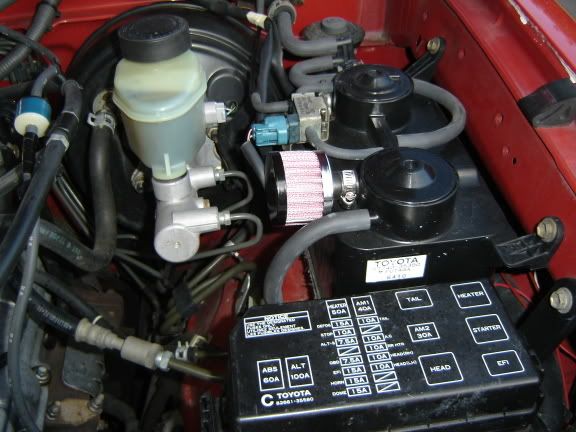
Then cap the hole (pictured below the MAF sensor) on the air box...
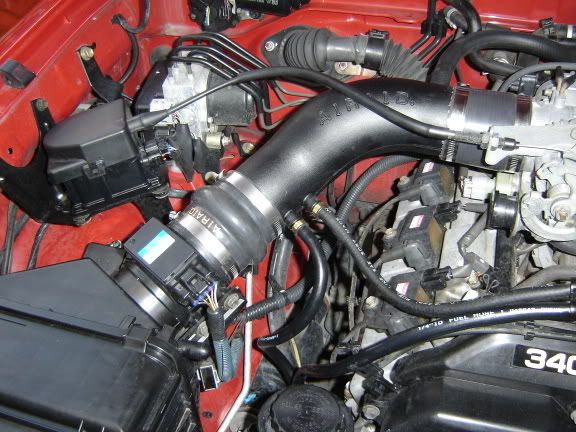
Then cap the hole (pictured below the MAF sensor) on the air box...
Feb 19, 2007 | 05:25 AM
#10
Registered User
Joined: Jun 2002
Posts: 1,040
Likes: 0
From: VA
Bit late now but I removed mine this weekend as part of a stereo power cable install (4 guage)
TO remove it all together is really very easy.
* Remove two 6mm (10 mm head) bolts from fender
* Remove one 6mm (10mm head) nut from lower inner fender close to header
* Remove one small hard vacuum line that is a push fit onto a small (1/16th) barb fitting on top of cannister. (Hose A in your pic)
* At same end, remove large vacuum hose that goes back behind the brake booster. (Hose with white line on in your pic)
* Using a pair of vice grips of similar, squeeze hose retainer and remove breather hose to airbox *hose approx 1/2" diameter (hose all the way to left in your pic
* as above with 3/8" diameter hose that runs to back of inlet manifold (only other hose with clamp on in your pic)
*Lift cannister gently and disconnect two electrical connections on firewall side of cannister.
*Remove.
Takes 5 mins and goes back in 2.
David
Last edited by nrgetic99; Feb 19, 2007 at 05:27 AM.
Feb 19, 2007 | 05:28 AM
#11
Contributing Member
Joined: Jul 2003
Posts: 8,807
Likes: 3
From: Montreal, QC Canada
Feb 19, 2007 | 07:09 AM
#12
Feb 19, 2007 | 07:31 AM
#13
Contributing Member
Joined: Oct 2002
Posts: 5,089
Likes: 0
From: Duvall, WA
Somewhere I have a detail of what each of the hoses does and if what I recall is correct, then all putting a filter on that hose does is remove the vacuum source, meaning that the canister doesn't purge as quickly, meaning it can become saturated easier, meaning a possible contributing factor to early failure.
What is your reasoning behind putting a filter on it in the first place?
Feb 19, 2007 | 07:40 AM
#14
Contributing Member
Joined: Jul 2003
Posts: 8,807
Likes: 3
From: Montreal, QC Canada
I will have to look again, but from what I recall, that hose connects to the intake and the vacuum there is used to help purge vapors from the charcoal canister.
Somewhere I have a detail of what each of the hoses does and if what I recall is correct, then all putting a filter on that hose does is remove the vacuum source, meaning that the canister doesn't purge as quickly, meaning it can become saturated easier, meaning a possible contributing factor to early failure.
What is your reasoning behind putting a filter on it in the first place?
Somewhere I have a detail of what each of the hoses does and if what I recall is correct, then all putting a filter on that hose does is remove the vacuum source, meaning that the canister doesn't purge as quickly, meaning it can become saturated easier, meaning a possible contributing factor to early failure.
What is your reasoning behind putting a filter on it in the first place?
Feb 19, 2007 | 04:03 PM
#15
I will have to look again, but from what I recall, that hose connects to the intake and the vacuum there is used to help purge vapors from the charcoal canister.
Somewhere I have a detail of what each of the hoses does and if what I recall is correct, then all putting a filter on that hose does is remove the vacuum source, meaning that the canister doesn't purge as quickly, meaning it can become saturated easier, meaning a possible contributing factor to early failure.
What is your reasoning behind putting a filter on it in the first place?
Somewhere I have a detail of what each of the hoses does and if what I recall is correct, then all putting a filter on that hose does is remove the vacuum source, meaning that the canister doesn't purge as quickly, meaning it can become saturated easier, meaning a possible contributing factor to early failure.
What is your reasoning behind putting a filter on it in the first place?
After I did this mod, i asked a 25+ year mechanic i know and a Toyota mechanic if it would cause any issues. They both said no...everything designed for emissions doesn't necessarily mean it's good.
Why did i do it? I saw someone else (with a s/c) that did it and thought it looked good. It helps clean up the engine bay some and allows the intake to receive fresher air. I've had it for 6~ months now with no problems and passed an emissions test.
Feb 19, 2007 | 04:20 PM
#16
Contributing Member
Joined: Jul 2003
Posts: 8,807
Likes: 3
From: Montreal, QC Canada
The vacuum is very minimal therefor making it pointless to have. Theres still plenty of air circulation when driving or idling for any vapors to escape/vent. Most of todays charcoal canisters will outlast the engine so premature failure isn't a concern to me.
After I did this mod, i asked a 25+ year mechanic i know and a Toyota mechanic if it would cause any issues. They both said no...everything designed for emissions doesn't necessarily mean it's good.
Why did i do it? I saw someone else (with a s/c) that did it and thought it looked good. It helps clean up the engine bay some and allows the intake to receive fresher air. I've had it for 6~ months now with no problems and passed an emissions test.
After I did this mod, i asked a 25+ year mechanic i know and a Toyota mechanic if it would cause any issues. They both said no...everything designed for emissions doesn't necessarily mean it's good.
Why did i do it? I saw someone else (with a s/c) that did it and thought it looked good. It helps clean up the engine bay some and allows the intake to receive fresher air. I've had it for 6~ months now with no problems and passed an emissions test.
Feb 19, 2007 | 04:40 PM
#17
Contributing Member
Joined: Oct 2002
Posts: 5,089
Likes: 0
From: Duvall, WA
Bah! A friend of my uncle, who once sat next to a member of the Toyoda family on a bullet train, told me that...  hahahaha
Gas is too expensive to vent to the atmosphere, just to add a bit of "engine dress up".
It wouldn't pass a visual inspection in most places and I don't see any real gain. And, for what it's worth, the vacuum is substantial through there. I can stick a dollar bill to the face of my snorkle at idle and it's stronger inside the MAF.
On top of that, I have seen a few charcoal canister saturation issues posted on various forums, so you can keep this mod. I will file it away with the engine dress up kits you can get at Auto Zone
hahahahaGas is too expensive to vent to the atmosphere, just to add a bit of "engine dress up".
It wouldn't pass a visual inspection in most places and I don't see any real gain. And, for what it's worth, the vacuum is substantial through there. I can stick a dollar bill to the face of my snorkle at idle and it's stronger inside the MAF.
On top of that, I have seen a few charcoal canister saturation issues posted on various forums, so you can keep this mod. I will file it away with the engine dress up kits you can get at Auto Zone
Last edited by WATRD; Feb 19, 2007 at 04:41 PM.
Feb 19, 2007 | 04:45 PM
#19
I think I'm to have to just agree to disagree with you on this one. You're engine isn't getting any fresher air and you have gas vapor being directly vented to the atmosphere. I would bet money you wouldn't pass a state emissions test if the test inspector saw that little mod. It's fine if you want to run it, but it rubs me a bit the wrong way to go advocating that this mod somehow buys you something other than one less hose under the hood and it is about as environmentally friendly as running with out a PCV or cat.
 Maybe if you had some knowledge it would be different but all you do is talk without proving anything. And your second sentence makes no sense.
Feb 20, 2007 | 04:56 AM
Maybe if you had some knowledge it would be different but all you do is talk without proving anything. And your second sentence makes no sense.
Feb 20, 2007 | 04:56 AM
#20
Contributing Member
Joined: Jul 2003
Posts: 8,807
Likes: 3
From: Montreal, QC Canada
I have no beef with you personally whatsoever, just your advice regarding this mod.
Last edited by MTL_4runner; Feb 20, 2007 at 07:46 AM.

Thread
Thread Starter
Forum
Replies
Last Post
justdifferentials
Just Differentials
1
Sep 17, 2015 06:14 PM
nickbeauregard
General Vehicle Related Topics (Non Year Related)
12
Aug 7, 2015 06:04 AM


