


a little bit of shock trig

 Mar 19, 2007 | 06:04 PM
#82

Thread Starter
Registered User
Joined: May 2005
Posts: 664
Likes: 0
think about this though, and im still going to talk to a professor tomorrow:
velocity = dx/dt
youre looking at the side of the dx triangle, whereas you should be looking at the hypotenuse[hyp=opp/sin(45)], or(1=.707/.707)... to get the dx part of the velocity eqn. time will also change at the same rate i believe, which cancels out the numerator sin function, making the shaft vertical velocity in either vertical or angled case equal.
this is where i think problems occur.
i drew it up, and ill run it by the teacher, and let you know either way.
velocity = dx/dt
youre looking at the side of the dx triangle, whereas you should be looking at the hypotenuse[hyp=opp/sin(45)], or(1=.707/.707)... to get the dx part of the velocity eqn. time will also change at the same rate i believe, which cancels out the numerator sin function, making the shaft vertical velocity in either vertical or angled case equal.
this is where i think problems occur.
i drew it up, and ill run it by the teacher, and let you know either way.
Last edited by dfoxengr; Mar 20, 2007 at 05:26 AM.
Mar 19, 2007 | 06:10 PM
#83

As I posted earlier, you can see this visually on the following web page:
- http://www.saltire.com/applets/triangles/tri2sia.htm
If you set the sides of the triangle to 10.0 units each and the angle BAC to 90 degrees, this will represent the length of the shock (on the diagonal) at 45 degrees (it'll be upside down as shown). Then "nudge" the AB distance by setting it to 10.1 units (a 0.10 unit change in length) and notice the "shock" length changes from 14.14 to 14.21 units, or a change of 0.07 units or 0.7 times the rate of change of the vertical dimension.
And while this is position, replace (0.10 units) with (0.10 units in 1 second) and you have a velocity.
- http://www.saltire.com/applets/triangles/tri2sia.htm
If you set the sides of the triangle to 10.0 units each and the angle BAC to 90 degrees, this will represent the length of the shock (on the diagonal) at 45 degrees (it'll be upside down as shown). Then "nudge" the AB distance by setting it to 10.1 units (a 0.10 unit change in length) and notice the "shock" length changes from 14.14 to 14.21 units, or a change of 0.07 units or 0.7 times the rate of change of the vertical dimension.
And while this is position, replace (0.10 units) with (0.10 units in 1 second) and you have a velocity.
Last edited by 4Crawler; Mar 19, 2007 at 06:14 PM.
Mar 19, 2007 | 06:51 PM
#84
Thread Starter
Registered User
Joined: May 2005
Posts: 664
Likes: 0
and youre expecting a vertical only change in height of .1 unit to happen in 1 second for both a vertical shock and angled one when the angled one is placing less force on the point, assuming same mass, and along the shaft axis?
i cant believe that.
edit:as ive been calculating and my teacher said the inclined has a lower velocity along the shaft axis
with the angled one, it should occur faster.
i cant believe that.
edit:as ive been calculating and my teacher said the inclined has a lower velocity along the shaft axis
with the angled one, it should occur faster.
Last edited by dfoxengr; Mar 20, 2007 at 05:25 AM.
Mar 19, 2007 | 07:06 PM
#85
Mass stays the same. All that matters to the shock is how fast it's length changes per unit time. That determines the force it generates and whatever that force is acts on the mass supported by the suspension. So the forcing function that drives the suspension up and down does whatever is needed to produce the displacement and keep it the same from trial to trial in order to eliminate the variablility and preserve the scientific method and only make one change at a time to observe the difference.
Last edited by 4Crawler; Mar 19, 2007 at 08:22 PM.
Mar 20, 2007 | 05:23 AM
#86
Thread Starter
Registered User
Joined: May 2005
Posts: 664
Likes: 0
ok just got done talking to my land vehicle dynamics teacher (ME Dr.), he has been in industry for a long long time (20+ years) and has been teaching this class a long time also, specifically worked on shock absorbers in industry, and he said the velocity does not have a sin function in it since the two bodies are connected, we are only concerned with the vertical projected velocity, so the force the inclined damper puts out F = C*V*sin(theta), thus agreeing fully with me. so a 45 degree shock is 70.7% effective. this is for a monotube shock which is what we've been discussing.
ill go to my vibrations teacher later today hopefully.
ill go to my vibrations teacher later today hopefully.
Last edited by dfoxengr; Mar 20, 2007 at 06:26 AM.
Mar 20, 2007 | 05:30 AM
#87
Thread Starter
Registered User
Joined: May 2005
Posts: 664
Likes: 0
Would be a similar type of effect. The spring itself would generate a force in line with it's long axis, force of a linear spring is a function of it's spring constant and it's displacement. Since the spring, at an angle, is compressed less for a given vertical displacement of the suspension, the force in the spring would be reduced by this reduction in compression. Then, since the spring's force is applied at an angle, only the vertical component of that force works to support the load on the suspension. In order to support a similar weight, the suspension would need to compress farther in order to compensate.
Mar 20, 2007 | 01:16 PM
#88
Registered User
Joined: Jul 2006
Posts: 261
Likes: 0
From: home:Oahu,Hawaii School: Fort Collins, CO
i may be the 10th guy to do so, but let me get this straight.
Derek: its 70%
Roger: its 50%
Derek: its 70%, look at this book.
Roger: its 50%
Derek: its 70%, i'll even ask my teachers.
Miscellaneous guy: dude, its 50%.
Derek: its 70% look at the picture.
Roger: its 50%
miscellaneous guy: either or its still crappy handling. we don't care anymore.
Derek: its 70%
Roger: its 50%
Derek: its 70% i asked my teacher.
Roger: you're right if you're thinking of that application.
Derek: its 70.
Derek: its 70.
Derek: its 70.
ROGER PULLS THE OLD SWITCHEROO two years later........
Roger: its 70%.
Derek: its 50%.
Roger: hah gotcha. booyakasha
Derek: its 70%
Roger: its 50%
Derek: its 70%, look at this book.
Roger: its 50%
Derek: its 70%, i'll even ask my teachers.
Miscellaneous guy: dude, its 50%.
Derek: its 70% look at the picture.
Roger: its 50%
miscellaneous guy: either or its still crappy handling. we don't care anymore.
Derek: its 70%
Roger: its 50%
Derek: its 70% i asked my teacher.
Roger: you're right if you're thinking of that application.
Derek: its 70.
Derek: its 70.
Derek: its 70.
ROGER PULLS THE OLD SWITCHEROO two years later........
Roger: its 70%.
Derek: its 50%.
Roger: hah gotcha. booyakasha
Mar 20, 2007 | 02:48 PM
#89
Thread Starter
Registered User
Joined: May 2005
Posts: 664
Likes: 0
Derek: its 70%
Roger: its 50%
Derek: its 70% look at the book picture posted
Roger: well, you're right if you're thinking of that application.
Derek: its 70% i asked my teacher.
.............................................
more like that at the end there. but you get the concept, lol.
Roger: its 50%
Derek: its 70% look at the book picture posted
Roger: well, you're right if you're thinking of that application.
Derek: its 70% i asked my teacher.
.............................................
more like that at the end there. but you get the concept, lol.
Last edited by dfoxengr; Mar 20, 2007 at 02:52 PM.
Mar 20, 2007 | 06:08 PM
#90
So I picked up a 1/2"x4-1/2"x0.062" extension spring and built a little test fixture:
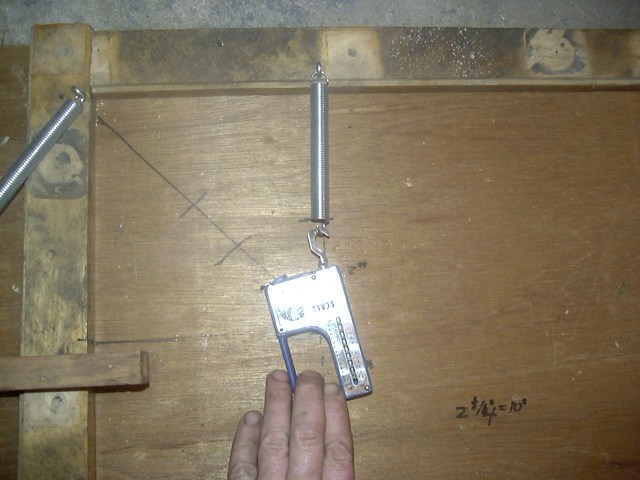
and find if I pull down with a force of 10 lbs. I get an extension of the spring of 2-1/4":
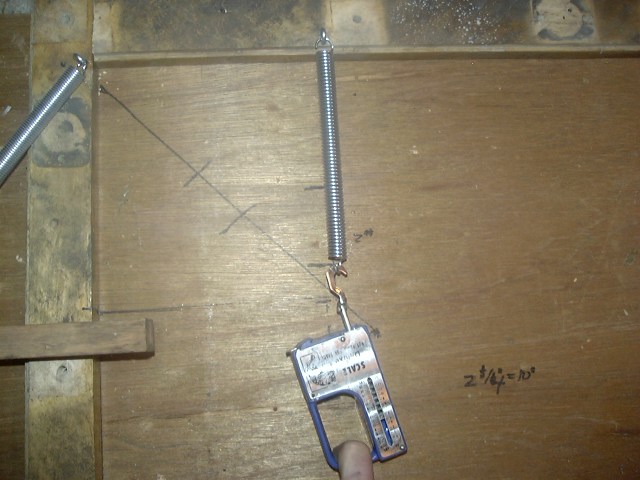
So then I set up a spring at a 45 degree angle with an "axle" to hold it out at that angle:
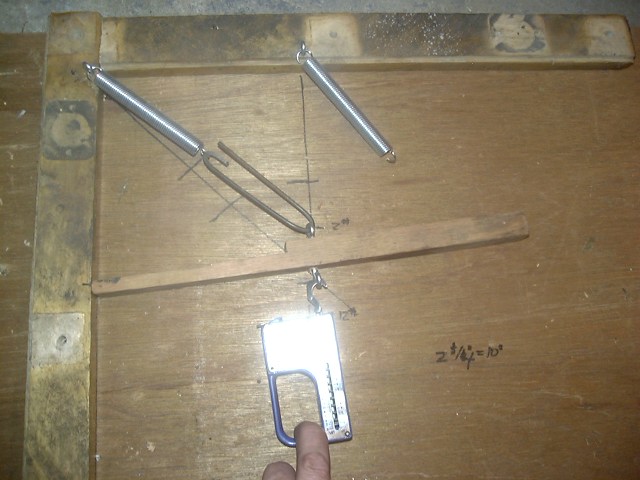
and find that if I pull down the same 2-1/4", I can do so with a force of 5 lbs. and that angled spring is only extended 1-5/8":

Must have gotten a bad batch of springs, because both of them exhibit the same "incorrect" behavior
But if my tests simulate a real world situation, I would say that a spring that supports 10# vertically and only 5# at 45 degrees is only 50% as effective at 45 degrees. And as a further check, I doubled up the springs on the angled test, effectively doubling the spring rate. And lo and behold, that is enough to restore the system to the point a 10 lb. pull creates a vertical deflection of 2-1/4". So it takes 2 springs angled at 45 degrees to do the work of one vertical spring.
And to minimize errors, I test the springs laying flat on the ground, so no gravity effects. Also, pre-loaded the spring scale so the vertical test was done between 2# and 12# and the horizontal test started at 3# and was reading 8# at the test extension. And even without the scale, the difference in pull of the two spring orientations is dramatically different.
If I happen to run across a peer reviewed article on this subject and I can obtain the necessary permission, I will post a reference to it.
and find if I pull down with a force of 10 lbs. I get an extension of the spring of 2-1/4":
So then I set up a spring at a 45 degree angle with an "axle" to hold it out at that angle:
and find that if I pull down the same 2-1/4", I can do so with a force of 5 lbs. and that angled spring is only extended 1-5/8":
Must have gotten a bad batch of springs, because both of them exhibit the same "incorrect" behavior
But if my tests simulate a real world situation, I would say that a spring that supports 10# vertically and only 5# at 45 degrees is only 50% as effective at 45 degrees. And as a further check, I doubled up the springs on the angled test, effectively doubling the spring rate. And lo and behold, that is enough to restore the system to the point a 10 lb. pull creates a vertical deflection of 2-1/4". So it takes 2 springs angled at 45 degrees to do the work of one vertical spring.
And to minimize errors, I test the springs laying flat on the ground, so no gravity effects. Also, pre-loaded the spring scale so the vertical test was done between 2# and 12# and the horizontal test started at 3# and was reading 8# at the test extension. And even without the scale, the difference in pull of the two spring orientations is dramatically different.
If I happen to run across a peer reviewed article on this subject and I can obtain the necessary permission, I will post a reference to it.
Last edited by 4Crawler; Mar 20, 2007 at 07:39 PM.
Mar 20, 2007 | 06:21 PM
#91
Thread Starter
Registered User
Joined: May 2005
Posts: 664
Likes: 0
good for you then, and great test rig. looks like pythagoras will prove it wrong in your spring's case.
ill continue believing the engineering sources i own, and a couple of doctors.
id really like you to find a published source, anywhere showing your number as the answer...please try, id like to get it cleared up.
ill continue believing the engineering sources i own, and a couple of doctors.
id really like you to find a published source, anywhere showing your number as the answer...please try, id like to get it cleared up.
Last edited by dfoxengr; Mar 20, 2007 at 06:27 PM.
Mar 21, 2007 | 06:02 AM
#93

Contributing Member
Joined: Dec 2003
Posts: 2,893
Likes: 2
From: Fort Worth, TX
I think my post was pretty clear. If a damper is angled at 45 degrees, the vertical force it imparts on the axle will be 50% that of the vertical damper.
The problem is that your book is defining a "shock's effectiveness" as the axial force it generates given a fixed vertical velocity applied to one side of it; this is undeniably 70% that of a vertical shock. EDIT:it is also possible the book is assuming the shocks both create the same force; one way or another it is only using one "sin(45)" decomposition. WE are defining a shock's effectiveness as the vertical component force it imparts on the axle given a vertical velocity applied to the shock. When the damper is applied to a car, the only force that we're really interested in is the vertical force imparted on the axle by the shock, not the axial force created by the shock. Since the shock is angled, you need to decompose the axial force created by the shock into two components: perpandicular to the ground, and parallel to the ground. The prepandicular component of the shock's axial force is 70% that of the full axial force being created by it.
So there are two decompositions that take place, one is decomposing the velocity applied to the damper into a velocity in the damper's axial direction, and one perpandicular to that. Using the decomposed velocity you can use the damper's damping coefficient to determine the force the damper creates (which is 70% that of the vertical damper in the 45 degree case). This force is applied along the center axis of the damper, which is in turn at a 45 degree angle relative to the ground/axle. To determine how much of the damper's force is vertical, it must be decomposed yet again.
...and you see where this is going. A simple free body diagram shows that a damper tipped at 45 degrees, with a velocity V applied at it's free end, will produce a vertical force at the axle which is 50% that of a vertical damper.

EDIT: I feel like we're re-living the "will the airplane take-off" thread...
The problem is that your book is defining a "shock's effectiveness" as the axial force it generates given a fixed vertical velocity applied to one side of it; this is undeniably 70% that of a vertical shock. EDIT:it is also possible the book is assuming the shocks both create the same force; one way or another it is only using one "sin(45)" decomposition. WE are defining a shock's effectiveness as the vertical component force it imparts on the axle given a vertical velocity applied to the shock. When the damper is applied to a car, the only force that we're really interested in is the vertical force imparted on the axle by the shock, not the axial force created by the shock. Since the shock is angled, you need to decompose the axial force created by the shock into two components: perpandicular to the ground, and parallel to the ground. The prepandicular component of the shock's axial force is 70% that of the full axial force being created by it.
So there are two decompositions that take place, one is decomposing the velocity applied to the damper into a velocity in the damper's axial direction, and one perpandicular to that. Using the decomposed velocity you can use the damper's damping coefficient to determine the force the damper creates (which is 70% that of the vertical damper in the 45 degree case). This force is applied along the center axis of the damper, which is in turn at a 45 degree angle relative to the ground/axle. To determine how much of the damper's force is vertical, it must be decomposed yet again.
...and you see where this is going. A simple free body diagram shows that a damper tipped at 45 degrees, with a velocity V applied at it's free end, will produce a vertical force at the axle which is 50% that of a vertical damper.
EDIT: I feel like we're re-living the "will the airplane take-off" thread...
Last edited by mastacox; Mar 21, 2007 at 07:55 AM.
Mar 21, 2007 | 06:13 AM
#94
Contributing Member
Joined: Dec 2003
Posts: 2,893
Likes: 2
From: Fort Worth, TX
It doesn't take a doctorate to figure this out, it just takes critical thinking and a free body diagram. Several descriptions in here are very clear, and quite accurate. The problem through this entire thread has been inconsistent defintions of a "shock's effectiveness."
Ask your precious professors, but if you give them the same definition for a shock's effectiveness and the same initial conditions, they will undoubtedly come to the same solution.
Ask your precious professors, but if you give them the same definition for a shock's effectiveness and the same initial conditions, they will undoubtedly come to the same solution.
Last edited by mastacox; Mar 21, 2007 at 12:41 PM.
Mar 21, 2007 | 06:37 AM
#95
Contributing Member
Joined: Dec 2003
Posts: 2,893
Likes: 2
From: Fort Worth, TX
While I'm at it, I would also like to point out that a severely angled shock (such as 45 degrees) will also have a huge drop off in damping as your spring compresses. If you are sitting on flat ground and the shock is at 45 degrees, then whe your axle travels up and the shock's angle increases, the damping reduces.
If you have a vertical shock, it's damping will remain consistent throughout the suspension's travel.
If you have a vertical shock, it's damping will remain consistent throughout the suspension's travel.
Mar 21, 2007 | 06:44 AM
#96
Contributing Member
Joined: Apr 2004
Posts: 5,464
Likes: 6
From: Arvada, Colorado
Well, this thread has certainly been busy.
As much as i hate to say it, assuming that this guy has accurate expressed the problem to the professors and shown them the arguements on this thread, then thier opinions carry weight with me. But really, who the hell cares.
First of all, take a look at this:
These are all quotes from this thread. the points i'm pulling out, i think are clear.
THERE IS ABSOLUTELY NOTHING TO DO WITH ANGLED SHOCKS IN WHAT THIS GUY IS TALKING ABOUT.
So, the 3 extra pages of thread has been ridiculous. we are talking about vertical shocks mounted inboard, NOT shocks mounted on an angle of any kind. Why are we still discussing this? No one is mounting shocks at 45 degrees. Essentally everyone is arguing over semantics and in no way is this relavant to the thread on hand.
It is time to let it go. Roger, Mastacox, and the rest of us can believe whatever we want. this guy can believe what he wants. In the end, nothing else is being accomplished here.
Hes building something different, so what should be being discussed in this thread is how well a vertical set up of 4 shocks will work to deal with body roll and road handling.
As much as i hate to say it, assuming that this guy has accurate expressed the problem to the professors and shown them the arguements on this thread, then thier opinions carry weight with me. But really, who the hell cares.
First of all, take a look at this:
LOOK AT END OF THREAD FOR NEW ?
im needing a little more travel, + my boredom and want to make stuff so i was thinking about playing with my rear shocks on my tacoma.
since a lot of people us a triangle long travel shock setup in the rear i was hoping to duplicate this while retaining my bilstein 5125's.
they would be vertically mounted to a support bar between the frame as usual, and the lower mounts would be moved on top of the axle housing in order to get a u-bolt flip done.
i would basically set it up so i got half of the gained distance for droop and the other half of compression.
i wont have to shoot the shocks up into the bed either, and the spare wont be in the way.
only problem i forsee is the prop valve which i can move a bit to obtain this.
OR
could i even move the shocks inboard 6-8" and tie the lower mounts into the axles strengthening that i will be doing?
anyone have any good design ideas for my little project?
a combination of mig, tig, and stick will be used to accomplish this task, and the tabs for all mounting points would be 1/4 or so low carbon steel.
thanks for the input.
-derek
im needing a little more travel, + my boredom and want to make stuff so i was thinking about playing with my rear shocks on my tacoma.
since a lot of people us a triangle long travel shock setup in the rear i was hoping to duplicate this while retaining my bilstein 5125's.
they would be vertically mounted to a support bar between the frame as usual, and the lower mounts would be moved on top of the axle housing in order to get a u-bolt flip done.
i would basically set it up so i got half of the gained distance for droop and the other half of compression.
i wont have to shoot the shocks up into the bed either, and the spare wont be in the way.
only problem i forsee is the prop valve which i can move a bit to obtain this.
OR
could i even move the shocks inboard 6-8" and tie the lower mounts into the axles strengthening that i will be doing?
anyone have any good design ideas for my little project?
a combination of mig, tig, and stick will be used to accomplish this task, and the tabs for all mounting points would be 1/4 or so low carbon steel.
thanks for the input.
-derek
over spring break i hope to do the 4 shocks on the rear.
2- 9.5" travel foxes about center between diff and drum, and then my billstein 5125's a bit more inboard than that. this should retain good roll resistance and will give me about 2/3 more travel.
upper crossmember will be bolted in.
i modified my spare to sit it above the frame, and i removed the lspv over winter break so i have tons more room to work with now.
eventually ill be adding longer leafs, and longer, relocated spring shackles.
running stock length 3" lifted alcan pack now
will update as i progress.
2- 9.5" travel foxes about center between diff and drum, and then my billstein 5125's a bit more inboard than that. this should retain good roll resistance and will give me about 2/3 more travel.
upper crossmember will be bolted in.
i modified my spare to sit it above the frame, and i removed the lspv over winter break so i have tons more room to work with now.
eventually ill be adding longer leafs, and longer, relocated spring shackles.
running stock length 3" lifted alcan pack now
will update as i progress.
THERE IS ABSOLUTELY NOTHING TO DO WITH ANGLED SHOCKS IN WHAT THIS GUY IS TALKING ABOUT.
So, the 3 extra pages of thread has been ridiculous. we are talking about vertical shocks mounted inboard, NOT shocks mounted on an angle of any kind. Why are we still discussing this? No one is mounting shocks at 45 degrees. Essentally everyone is arguing over semantics and in no way is this relavant to the thread on hand.
It is time to let it go. Roger, Mastacox, and the rest of us can believe whatever we want. this guy can believe what he wants. In the end, nothing else is being accomplished here.
Hes building something different, so what should be being discussed in this thread is how well a vertical set up of 4 shocks will work to deal with body roll and road handling.
Last edited by AxleIke; Mar 21, 2007 at 06:47 AM.
Mar 21, 2007 | 07:14 AM
#97
Contributing Member
Joined: Dec 2003
Posts: 2,893
Likes: 2
From: Fort Worth, TX

Nothing wrong with a little debate; but, this isn't a matter of belief, it's a matter of fact. The fact is that angling a shock will drastically degrade it's performance, as will mounting it closer to the center of the axle. As a general rule, you want the shock to be as far out as possible, and as vertical as possible.
I made a beautiful little graph too; 45 degrees is right in the middle. Looking at the graph shows a very important result, angling the shock up to 15 degrees will not severely degrade the shock's performace (the shock will still be 93% effective at 15 degrees inclination).
Last edited by mastacox; Mar 22, 2007 at 08:30 AM.
Mar 21, 2007 | 07:55 AM
#98
Contributing Member
Joined: Apr 2004
Posts: 5,464
Likes: 6
From: Arvada, Colorado
He is going to mount the shocks vertically, so any angle stuff is irrelevant. Hes looking at mounting 2 shocks per side to elliminate the degradation due to moving inboard. I think this is what should be discussed as it is the topic of this thread.
I'm not dissagreeing with you on the angle stuff...Your explanation and graph make sense to me. His do not make sense to me. However, he's asked some other ME's, and he is convinced. No amount of talking on here is going to change his mind. None of his arguements are going to change yours. I'm saying lets move to the problem that is actually at hand here.
I understand where you are coming from. I have the same feelings of frustration when i try to explain to idiot people why the cheapest possible modifications to a truck are rarely the best. However, most people are morons, so all i do is bang my head against the wall, and a bunch of people ruin perfectly good trucks with junk. Such is the life of the internet. You're situation is slightly different, becasue you are at least dealing with someone who is able to converse at the same level, even though he dissagrees with you.
My only reason for posting was that we are arguing something that isn't going to go anywhere. It's the tech section, granted, but we should work on the problem presented in the begining and not the angle.
Last edited by AxleIke; Mar 21, 2007 at 07:57 AM.
Mar 21, 2007 | 08:20 AM
#99
Contributing Member
Joined: Dec 2003
Posts: 2,893
Likes: 2
From: Fort Worth, TX
For each case:
"100% effectiveness" would be defined as this distance between each shock and its correspoding WMS being zero (which is obviously impossible) and "minimum % effectiveness" being both shock mounted at the center of the axle. However, effectiveness dows not vary linearly between the two points, it is a parabolic curve.
You will in general want to mount the shock as close to the WMS as possible, usually just inboard of the drum/disc braking assembly. For the first case, shock effectiveness is not immediately obvious and I need to think about it; the velocity at each shock will be a fraction of the velocity seen at the wheel rolling over the rock, each velocity depending on how far they are from the wheel that is moving. For the second case, 50% effectiveness would be located half-way between the WMS and center of the axle.
As menthioned by flyg so very long ago, it is also possible to make up for the shock's "effectiveness" in both angled and inboard cases by looking at the desired damping ratio for the 100% effective case, and then increasing your damping ratio based on the shock's rated "effectiveness" in either/both cases. However, without a progressive-rate damper this is less possible in the angled shock's case because its effectiveness decreases as the suspension stuffs (and the angle therefore increases).
Last edited by mastacox; Mar 21, 2007 at 02:55 PM.