When you click on links to various merchants on this site and make a purchase, this can result in this site earning a commission. Affiliate programs and affiliations include, but are not limited to, the eBay Partner Network.
I'm curious if your results have changed much too. I've had several analyses done on my oil over the last 2 years or so (through blackstone). I'm running (and have been running) conventional 5w-30 castrol. Blackstone has me up to 10,000 mile oil changes now...and I don't exactly drive the thing easy either, lol. I do always make sure it is warm before driving even remotely hard...I'm convinced that is the true life extender in any engine, more so than any high dollar oil ever will be.
'02 4runner here as well, with 100k miles. I've had lead readings come in high at times, but nowhere near as high as yours...they claimed it to be "particle streak" or a piece of dirt/carbon lodged between the crank and a bearing that was digging in that eventually worked itself free.
Currently I'm running Valvoline SynPower 5W-30 Synthetic Oil & a Purolator PureOne PL10241 filter.
Weather permitting, I'll be changing my oil and the oil in my wife's 4Runner this weekend and sending both samples off to Blackstone. I'll be refilling with Valvoline SynPower 10W-30 Synthetic & filter will be Purolator PureOne PL10241 again on both.
My 4Runner will hit 100K miles next month and my wife's 4Runner currently has 125K miles on her freshly rebuilt swapped motor (remember the rod slung on her @ 115K miles), so I'm curious to see UOA reports on both vehicles.
I did my first UOA on my '99 last month. Lead, iron and copper were all high on mine. 6000 miles on the oil, don't know what kind. It was oil that was in the truck when I bought it. Blackstone said to try a 3000 mile interval, re-test and see what it looks like. I'm hoping for the best.
I also just sent in a sample from my '96 with 180,000 miles that I sold to my brother. Haven't got the results, but very interested to see it as well.
Rockslide, do you care if I post my charts in this thread as well? Or would you prefer not?
I did my first UOA on my '99 last month. Lead, iron and copper were all high on mine. 6000 miles on the oil, don't know what kind. It was oil that was in the truck when I bought it. Blackstone said to try a 3000 mile interval, re-test and see what it looks like. I'm hoping for the best.
I also just sent in a sample from my '96 with 180,000 miles that I sold to my brother. Haven't got the results, but very interested to see it as well.
Rockslide, do you care if I post my charts in this thread as well? Or would you prefer not?
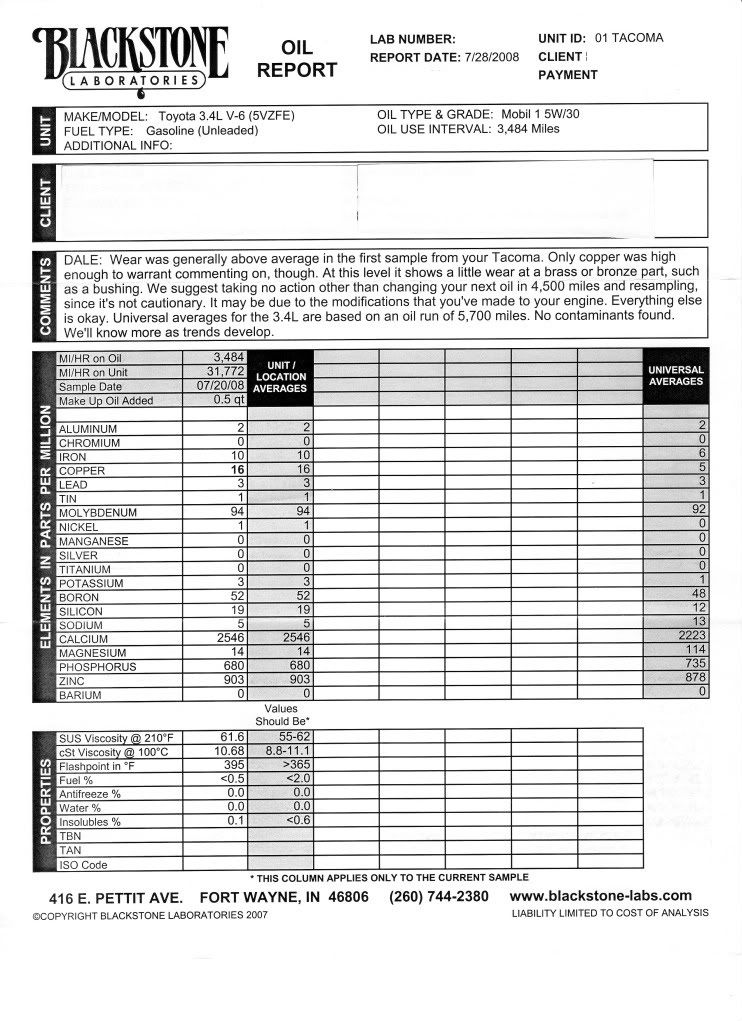
Yeah mine was high in copper too (16)
I don't really know what parts in the 5VZ are copper or bronze, anyone know?
This is just a thought and I admit I've never done an analysis so I'm not claiming what I'm saying is the best advice, but I'm merely wondering about it. Maybe it's just me, but this oil analysis stuff seems a little excessive if you're not having problems. I've found that trying to find something wrong with your truck will only lead to worry and it'll tax your wallet trying to prevent crap that will probably never even be an issue anyways.
Would you guys really go replace all the bearings in your engine as preventative maintenance becasue a print out says you have high lead levels? I doubt it, you'll probably just wait to see if you develop problems and then fix them when they come up. So what good is knowing that your lead levels are high (or whatever substances)? What about new engines, don't you guys think they'll have even higher lead levels because the parts are just starting to wear in?
I agree Brian, but I think a lot of it is curiosity; knowing the intricacies of something you spend so much time with (didn't mean for that to sound like relationship advice).
A similar example:
A lot of guys will deny it, but lets be real: when your check engine light comes on, you stare at it with disgust and use a few choice words but deep down in the back of your head you're just a little bit excited about what that code is going to be.
But, I like deciphering through the small clues to get a glimpse of the bigger picture though, I guess that's why I'm a Pathologist.
This is just a thought and I admit I've never done an analysis so I'm not claiming what I'm saying is the best advice, but I'm merely wondering about it. Maybe it's just me, but this oil analysis stuff seems a little excessive if you're not having problems. I've found that trying to find something wrong with your truck will only lead to worry and it'll tax your wallet trying to prevent crap that will probably never even be an issue anyways.
Would you guys really go replace all the bearings in your engine as preventative maintenance becasue a print out says you have high lead levels? I doubt it, you'll probably just wait to see if you develop problems and then fix them when they come up. So what good is knowing that your lead levels are high (or whatever substances)? What about new engines, don't you guys think they'll have even higher lead levels because the parts are just starting to wear in?
I agree in part as well, but there are things you can do if you know about specific wear areas. You don't have to replace bearings...but you can switch to better oil, shorten your oci, not idle as much, little things that make a difference. And like the other fellow said, I like to know as much as I can....short of pulling rod caps apart and looking at bearings, lol. To me, $22.50 is pretty cheap to see what's going on inside the motor. I'm not going to do UOA's every oil change from now till eternity by any means. Just an initial check, a follow up for comparison, and then one down the road just to "check in".
That makes sense to do it initially and then again down the road to see how much worse it has gotten. I'm sure mine would have high levels of everything being that I have 197K.
I agree in part as well, but there are things you can do if you know about specific wear areas. You don't have to replace bearings...but you can switch to better oil, shorten your oci, not idle as much, little things that make a difference. And like the other fellow said, I like to know as much as I can....short of pulling rod caps apart and looking at bearings, lol. To me, $22.50 is pretty cheap to see what's going on inside the motor. I'm not going to do UOA's every oil change from now till eternity by any means. Just an initial check, a follow up for comparison, and then one down the road just to "check in".
X2...I'm doing it to find an oil that matches up good with my setup and to find out how long I can go between changes with that oil. The idea is to find out if you have high wear BEFORE the bearings go bad. Its also a good way to find out if you have fuel dilution or a coolant leak. The UOA is better at evaluating the oil than it is the engine though. Keep in mind you can pull a sample though the dip stick tube and check it without draining it out, if the UOA is good you can just leave it in and extend the OCI.
Like okie81 said, it's more of a curiosity thing for me. I like seeing how different oils compare. After this next test, I don't plan to do another UOA for quite some time.
Of course I'm having the used oil analyzed on my wife's 4Runner since this will be the 2nd oil change since the motor swap. I'm real curious to see how this donor motor is doing internally. (Want to see photos of a rod busting a hole in a block, check it out: https://www.yotatech.com/forums/f2/m...d-pics-185253/)
Here's the skinny... there is no data... quantitative or qualitative data that clearly defines what amount of "particles" or other UOA "test" components that correlates to ANY evidence of engine failure in oil lubrication!!!
In other words... how much lead, or copper, or whatever is needed in an UOA sample to define "engine failure"... of any kind???
There may be some data... I just have not seen it?? Ask Blackstone to produce it??
That's just my worthless opinion
Not to call you out Gnarly--but the armed services use this quite a bit. They not only use it to determine whether oil has to be changed but to give them an indicator of something going bad in the engine. A worn bearing will shed more particles than a good bearing right?
I think this program started back in the 50's and is touted as one of the best money saving programs put in place by the armed services.
Its interesting to note that in Rock's first UOA with M1 it stayed more solidly in the W30 viscosity where the 2nd one with PP it was barely a W30, closer to the W20 range than the M1.
SAE GRADE…………….MIN-cST-100°………………MAX-Cst
10w……………………4.10………………………….xx
20w………………………..5.60……………………….9.29
30w…………………………9.30……………………..…12.49
40w……………………….12.50……………………………16.29
50w………………………..16.30………………………………21.89
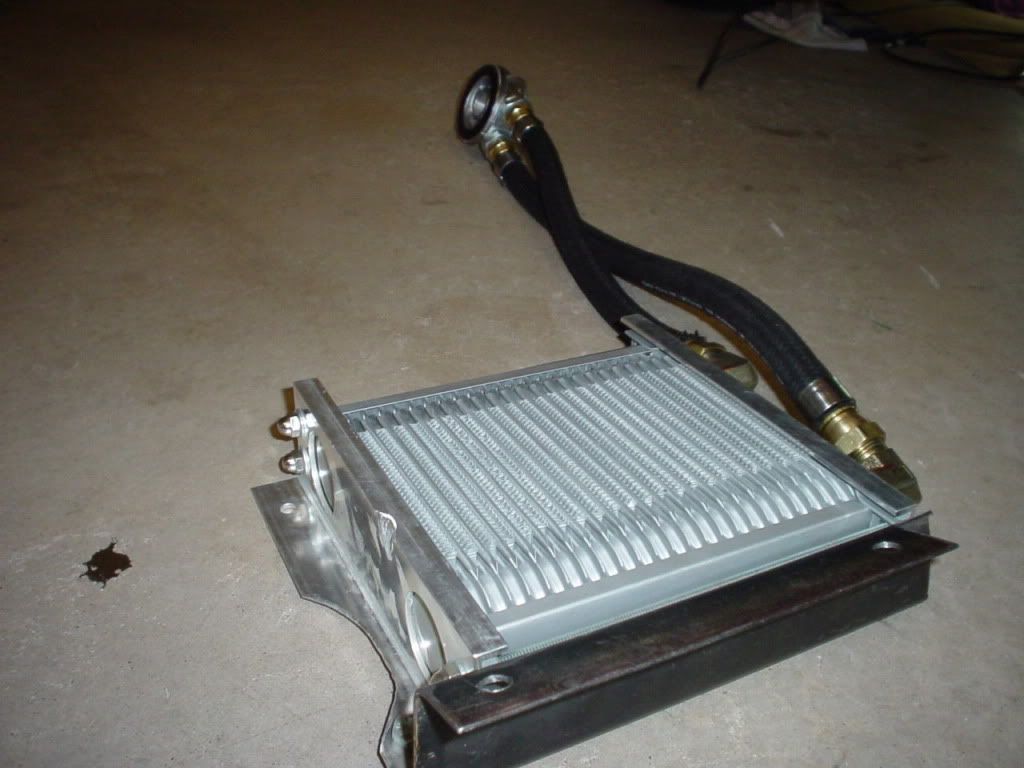
On a side note I'm thinking these brass fittings may be the source of my high copper readings:
So far I've just had one UOA on this truck and the OCI started right after installing the oil cooler. Next UOA will be interesting.



 Dec 30, 2008 | 06:55 PM