When you click on links to various merchants on this site and make a purchase, this can result in this site earning a commission. Affiliate programs and affiliations include, but are not limited to, the eBay Partner Network.
Pulled off my roof rack rails for the first time to do a complete polish & wax. Each rail is held on with a series of Torx screws which thread into captive nuts that are somehow attached to roof from the inside. On my vehicle there was some waterproofing sealant on the threads which protected them from moisture. Unfortunately there is also a plastic bushing hidden under the end caps of each rail with a square hole that penetrates the roof. These bushings and the associated holes seem to serve no purpose other than as a hidden location for rust, and mine are all rusted and needing bodywork. Seriously Toyota? There is nothing on the rails that engages with these bushings, and the end caps do not seal against moisture. In a rain or even at the car wash there is nothing to prevent water from soaking the bushings or even washing over them to fall down inside the car. I will probably glue a cap on these bushings once I repair the damage.
And don't get me started on the windshield pillar rust issue - that's a whole 'nother rant.
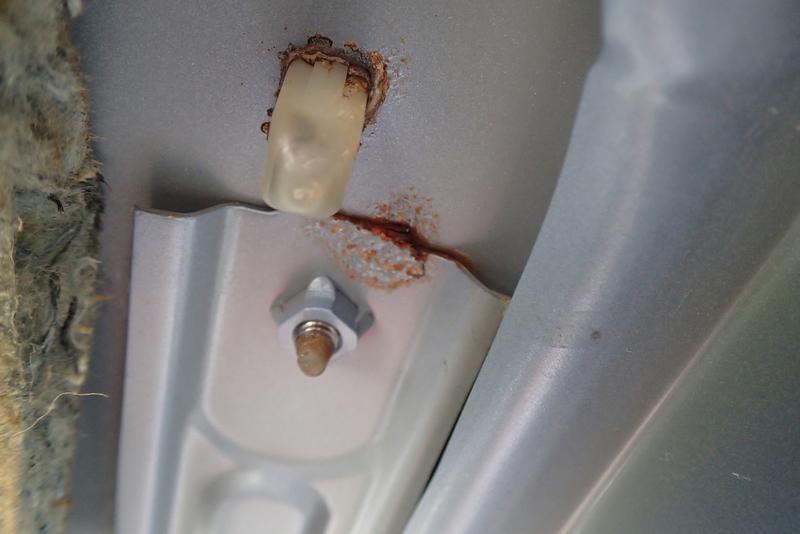
Pics show the two rearmost bushings are the worst. I have applied some evaporust gel to halt the corrosion, but you can see paint bubbling up around each bushing due to rust. The worst rust spot is actually just in front of one bushing, and it appears the black plastic rail that sits directly on the roof seals well enough to trap moisture that leaks in around the screws. This moisture is probably propelled towards the rear of the car during driving, where it is trapped. Thinking of cutting the plastic trim a bit to let this area drain.
Last edited by tns1; Jun 22, 2021 at 07:01 AM.
Reason: add pics
I've had my rails off a few times over the years and have not found rust there. But the design, as you rightly state, is just asking for rust to develop.
Any clue what those bushings are for? Other models do not have these penetrations. It almost seems like the plastic end caps were supposed to tab into these, but mine don't. Since it is a hidden area I may just epoxy them closed once I clean the area up.
The plastic doo-dad from underneath, along with a smidge of rust. The outside wasn't showing any rust around it.
I don't know what their purpose is, but I cut the end off and run wiring through it on the driver side.
You can see a couple of the bolts with the captive nuts
They are likely for assembly line ease. The rails can click into those plastic holes and stay in place while the screws are run in without the risk of the rails moving around.
Yes, I pulled them out and saw they were closed end, so water can't just pour in like I thought. They just push into the roof and have no sealer. Good to know I can get at the underside if needed. For now I scraped away most of the rust and applied more EvapoRust gel. I'll do a real repair later.
Update -
Getting ready to do a permanent fix for these rust spots as they keep growing. The evaporust gave some protection but isn't a converter. I'll probably remove the plastic plugs, grind away the rust, then primer and paint. I plan to close up the square holes with epoxy to really seal against future corrosion. Its all hidden under the rail trim so it does not have to look good.
I noticed when I took the rails off that each screw had some tar like substance that protected the threads pretty well considering its been over 20yrs. I'll ask Toyota, but any idea what to use here?
If nothing else comes to mind I have some copper or aluminum based anti-seize that might work long term.
I decided to pull the headliner to check for rust inside those 4 roof holes. I had no idea the A-pillar grab handles were going to be so difficult. I was careless and stripped one of the phillips heads. I used an Irwin easy-out kit to drill enough for a remover bit. The screw didn't turn, but the screw head busted off flush with the pillar. The A-pillar trim is easy to remove with no handle in the way. Next I used a 1/8" drill to carefully drill all the way thru the broken stud but I could tell the easy-out was going to break first. Finally I applied heat from a Weller solder gun for about 15 minutes and the easy-out was just able to remove the stud. The moral is even moderate heat works well against loctite.
Big surprise. When I started grinding away those rust spots I decided to pull the spoiler supports. Underneath these was even more rust. Rusted through in spots. Probably a good idea to pull the top rails and spoiler every few years.
Update:
After grinding away the rust, I plugged the four roof openings with two-piece sheet metal plates/plugs that I epoxied in with JBWeld. I used a similar gauge metal to better match the roof contour. Since there had been some rust inside these holes I removed what I could then coated the patch area on the inside with an aluminum paint called Rust Bullet.
Last edited by tns1; Sep 20, 2025 at 11:26 AM.
Reason: update



 Jun 20, 2021 | 09:22 PM