When you click on links to various merchants on this site and make a purchase, this can result in this site earning a commission. Affiliate programs and affiliations include, but are not limited to, the eBay Partner Network.
Roughly 2 years ago I traded for a 1992 single cab 5 lug pickup. It was just about as spotless as you can get in the mid west. I had every intention of doing a low SAS to it and converting to 4x4. But my plans changed a little. When shopping for axles I came across a 1980 rolling chassis with a bed. I figured the bed and the frame would be shot, but it wasn't much more than just a set of good axles so I bit on it.
After I drug it home I was surprised to find that the frame was practically spotless. and the bed was in better shape than most 89-95 pickups in my area. I planned on selling the bed and using the frame to change the whole body over. But after taking some measurements I found out that in the 1st generation Toyota made 4x4 long beds and as luck would have it, I ended up with one. So using my short bed was out of the question, and finding a 3rd gen long bed off of a 2wd 1 ton is almost impossible around me. So I went to work on repairing the bed for my project.
The center section of the bed floor was shot and the tail gate had some rot in the corners of it. But other than that, there was nothing more than some surface rust. With very few exceptions there wasn't even blistering or flaking in the steel. The worst areas were where the body caulk used to be. But I peeled out all the caulk and wire brushed in all the cracks to get rid of it.
The bed floor had to be replaced and there are almost no reproductions of the wavy pattern in the floor. So I ended up going with 14ga diamond plate. It added quite a bit of weight. But it is much stronger and will resist rot for a long time. I painstakingly drilled out what seemed like 100s of spot welds that kept the floor in place.
The cross members were still in great shape which was shocking given how rotten the floor piece was.
After welding, the floors were painted black. I am using tractor paint on everything in this project. I added hardener to all the base coats and I am putting acrylic clear coat on all the body panels to help with the sun fading problem.
For the body, I am using an off white cream color.
The frame got some rust converting acid on it to neutralize any surface rust, then it got primed and painted gloss black. So far I am pleased with the hardened tractor paint. This sat outside for almost a year while I was building my garage. So far nothing has peeled, flaked, or faded.
The next problem I ran into was that the original 4 speed crossmember was trashed, plus it was different than the newer W56 crossmembers. The original 4 speed crossmembers are mounted perfectly centered on the frame and the bolt spacing is closer from front to back. The new ones are offset to the driver side. I believe I got 3 bolts to line up on the new cross member. I had to drill out the front nut on the drivers outside. I had to drill 2 holes in the bottom of the frame (plus access holes in the frame). Then I had to weld in a large piece of angle iron to get the 2 inside framerail bolts on the passenger side.
I forgot to take a picture of where I welded in the angle iron. But you can use your immagination on that passenger side where you see the two bolt holes are inside of the frame rail.
Up next was repairing the tail gate where the corners were rotted out. I cut out the steel where it was thin from rust then welded in some patches
I finally got my garage built so the project can continue. Here is the 2wd being torn down next to the 4x4 frame.
The engine is patiently waiting to be gone through. I've got all the timing chain parts, oil pump, water pump, front and rear main seals, a 4x4 clutch kit, and some gloss red engine paint for the timing cover, valve cover, and intake.
After I did this, I found that there is a much easier way to pull a cab than I did it. I lifted it up with cinder blocks, bottle jacks, and an engine hoist. I lifted it high enough to slide the 2wd complete chassis out from under it. Then I took off the front axle and nosed the 4x4 chassis under it. I then lifted it up again and put the front axle back on. Then removed the wood blocks. It turns out the engine hoist would have lifted it by itself with 2 straps. I found that out online after I had already got the body sat back down.
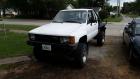
This is how it all sits today.
The bed and cab are on 5/8th thick 2 inch diameter poly body mounts. I have 1 inch plastic body lift pucks on order to lift the bed up to match the cab. They definitely moved the accent line between 1st gen and 3rd gen. Also the body mount holes are different. I am going to have to drill some off center holes to make it work. Plus I will have to grind off the body mount "cups" from the frame so the bushings will sit flat. Hopefully in a week or two I will have more to add. I would have started this thread sooner, but I figured it would take forever to get moving on this project. And no one likes a year of dead space in the middle of a build up.
I got a little more work done this weekend. I got the body bolted down to the frame, I put new contacts in the starter, and I replaced all the seals and o rings in my power steering gear box. I got the gear box used so I had no idea if it leaked or not. I went ahead and replaced all the seals.
I was able to drill new holes in all of the body mounts to make the 3rd gen cab fit. The rear pair of mounts and the front pair of mounts were pretty close and just needed some off center holes. The middle one is off pretty far. I'm not sure I like how it is now.
Here are the rear mounts. I just had to drill a new hole in the frame about a half inch from the original. I also drilled an off center hole in my poly body bushing so it could still sit in the body mount cup like it is supposed to. Here are pictures from the top and bottom of the back mount.
Up next I did the front mounts. They were a little more difficult but not too bad. I had to drill new holes in the body and use the original holes from the frame. I also had to cut the cups off the frame. They just ended up a little inside and to the back of the original hole. I also had to dent the core support a tiny bit to get the nut to fit with it being so close.
The last ones I did were the middle mounts. They ended up being the furthest off from either the hole in the frame and the hole in the cab. I had to drill off center holes on both.
Also the cab is higher off the frame from this mount than the other two. I thought the cab was just not sitting down right. But I measured from floor to frame and the cab was sitting level from front to back. The mounts were at different heights. There is also no way to get a big washer in the cab floor with the bolt so off centered. So the body mount bushings are hanging off and I had to stack 2 of them together to get the height right.
I may have to get some 1/4" steel and weld a plate on that can hang over and support that body mount like it is supposed to. I don't think I can trust 4 out of 6 mounts to hold the body on in the case of an accident. No one likes it when your cab does its best impersonation of a space capsule.
I've been busy getting little things. Nothing exciting has happened, but progress is progress.
I started getting my gas tank ready to put in the truck. It looks like it is a second gen gas tank judging by the electric plugs that were on it. I was able to use the sending unit from my 2wd. It looked identical in size to the one that was in it. But the plugs were way different. Plus the sending unit in the 4x4 tank was shot. I had to use the gas tank bracket from the 4x4 tank because it reached way further into the tank. I tested the pump on my car battery and it spun. I had to cut off the plug that was on it and replace it with the plug from the 2wd since they were different plugs. The biggest problem I had was that the fitting twisted off the fuel line when this tank was pulled. But I found out I could just flare it and put a new fitting on it.
The fitting is 14mmx1.5mm and it is for an 8mm or 5/16 fuel line. I had to order some of the fittings off of ebay. Luckily I already had a flaring tool from Harbor Freight that fits almost any line. Oddly enough, it does a way better flare on 5/16ths line than it does on 3/16ths brake line.
After getting the gas tank ready to put in, I put in the body lift blocks. Plus I ran the wires, fuel lines, and brake lines that go inside of the gas tank. The 1 inch lift helped line up the bed body lines with the cab.
I got the power steering box rebuilt with a reseal kit and I got it mounted in the truck. The 4x4 box sat further away from the cab than the 2wd box sat. It also wasn't lined up perfectly. I found out the 4x4 steering shafts have a U-joint in them that the 2wd doesn't have.
I ordered a Toyota U-joint off ebay to cut and weld on to my rag joint. It came off a Camry or MR2 or something like that. But it seems like they are all the same size if they go on a Toyota.
I cut off the spline clamp on the U-joint and welded it to the spline clamp on the rag joint.
Here is a test fit to make sure it works.
next I took a 9/16th bolt cut it to fit through the middle, then drilled 8th inch holes at each end then pinned it with roll pins. I got worried that my weld may crack some day and leave me without steering while flying down the interstate. I needed a backup for the weld so I could sleep at night.
I had to make a longer soft line for the fuel because the old one was about 8 inches short of reaching the fuel hard line. I assume this had to do with this truck being a long bed. I got 14mm fuel line threads to 5/16 barb fittings and made a new soft line.
The 2wd fuel filler neck fits, but I had to drill 2 new holes in the bed side to bolt it in. I guess they changed the pattern. Plus the 2wd neck is a little stretched. But it works for now.
What was supposed to be a routine transmission seal job had to turn into more. The input bearing was completely toasted. It made for a wobbly input shaft. Luckily the other shafts appear good and tight. Plus the counter shaft bearing has no play in it.
Some of the ball bearing keepers were completely worn through. Plus the inside of the race was torn up both on top and bottom.
I've also got the engine torn down as far as I plan to. Its ready to clean up, and replace everything that is a wear item.
Holy timing chain slap Batman!!!!!
There were also some ribs broken off inside the aluminum timing cover. But it looks like nothing is worn or cracked through, so I am going to roll with it.
For the floor, I believe it was 14ga (3/32) diamond plate. And sheet metal for the tailgate was 20 or 22 gauge.
That timing chain was about to go. Even with the tensioner all the way out it was a little loose. The new timing chain is good and tight with the tensioner about at full compression.
I got the new timing chain set on. Hopefully this one holds up a little bit better. It came with a metal guide on the right side. The left side is still plastic.
I got the new input bearing in the transmission and I got it all sealed up and ready to go in the truck. I haven't done the output seals yet. I figure it will be easier once i get it in and don't have to mess with the transmission trying to rock and fall over.
I've also decided to try my hand at engine painting. I got some duplicolor engine paint from Oreilly's. It is supposed to be bright red. Unfortunately the first can does not match the second can. I got the valve cover and timing cover with the first can. The second can went on the plenum and thermostat. You can see the first can was way brighter and more orange than the second. This is probably going to bother me until it all falls off in a year.
In two places I failed to remove all the old RTV from the bolt holes. No I have two through holes that used to be blind holes. Hopefully cracks don't spread into the block. One was on the right side of the engine on the top timing cover bolt. And one was on the right side of the bottom for the oil pan.
All the accessories are back on the engine and I dropped it back in the bay. Except for the AC compressor. It is still tied up to the fender. The bolt holes on the engine mount don't line up super well though. I was able to get the big bolts into 1 of the holes. But the other was not lined up perfect and I had to go one size down on bolts. So the back of the engine mount has what I believe is a 10mm bolt and the front hole has an 8mm bolt.
You can definitely see the miss matched colors in this picture. You can probably also tell why I am not happy with duplicolor right now.
I've gotten a few more things taken care of on this project. The next hurdle that I ran into was that the W56 I am using is about 5 or 6 inches longer than the L series transmission that came with the frame. I wish I had known this when I fabbed up the cross member. Since the cross member was set in stone and I didn't want to drill more holes in the frame. I had to make an extension on the new cross member.
The only tube stock I had laying around was 2x2 14ga box. Luckily the tube ended up being about the same gauge as the stamped cross member. I notched it out to fit over the cross member. I drilled the holes for the bolts, then used a hole saw to make an access hole for the socket on the under side.
The finished product. Hopefully it holds. I'm not sure how the cross member will hold up being offset like that. But if it dies, I'll invest the money on a trail gear cross member that bolts to the back of the transfer case.
Next up is something that I had to guess on. My speed sensor on the W56 was cable driven but my 92 pickup is electronic. So I ordered a cheap speed sensor off of ebay. From what I can find, there are 2 types of speed sensors, small diameter and big diameter. I took my cable driven unit out and it looked like the wide diameter ones i found online. Here they are sitting together.
Dont be fooled by the packaging, that is not a real Toyota sensor. It was 18 dollars on ebay. the real deal from Toyota is in the 200s of dollars. But the diameter and mounting depth turned out the same. The next problem was the gear on the end. As you can see below, they are different. The new one is white and the old one is greyish.
So I pulled the gear out of the cable sensor to put in the electronic one. There was only one problem. The electric gear had a shorter shaft and 2 notches instead of 1. So I had to grind the end down on the cable gear shaft. And use an angle grinder to make the 2nd notch across from the first notch. Here they are after I made them identical.
Now that they matched, I put the old cable gear shaft (the grey one) into the new electronic sensor. It all fit. But I wont know if it works until I get it running.
The last transmission related problem I have is that my driveshafts on hand are all the wrong length. I have a 46" drive shaft from a 94 V6 Auto 4runner. (left over from a previous build) and a 57" driveshaft that I purchased for this build. It came from a 1st gen long bed identical to the frame I have. I figured that would be the easiest way since it was purpose built for this wheel base. But thanks to the transmission length problem, it made my measured length 52". This was too long for the 4runner shaft and too short for the 1st gen shaft. I also have 2 or 3 spare front shafts on hand and I got an idea.
The double cardin in 4" longer than the stock U-Joint. And I found out that Toyota is kind enough to extend the joint inside of the shaft by and inch or two. This gives you a good lip to ensure that the shaft is straight when you put the joint back into the tube. And it's a fairly easy surgery. You take an angle grinder and cut right at the base of the weld at the joint. You just have to keep spinning the shaft by hand and cutting a little at a time unit you are through the shaft, but not into the mounting stub on the joint. Then a chisel can separate the joint from the tube. Once I had the double cardin out and cleaned up. I cut off the U-joint. I cut it off at the weld also just so it would make a fairly straight cut. Your cut doesn't have to be perfectly flat. You will just end up with gaps when you pound the double cardin back onto the tube.
It takes quite a bit of force to get the joint onto the tube. It's a good tight fit, so it lined itself up pretty good. I haven't welded it yet. Hopefully I can get that done this week. I will have to balance it on the truck when I get it running. I've never done it, but it looks easy enough with some hose clamps and trial and error.
I have the engine all put back together now and I am messing with intake setups. I wanted to keep the factory air box on it since the cheap-o "cold air intakes" always have the flimsiest mounting for their cone filters. I ordered two silicone elbows and a 2.75" aluminum intercooler tube. I had to trim the fan shroud a tiny bit to fit. But other than that, It looks decent and feels plenty stout. I also got a cheap drop in filter for now. I'll use it for 6 months to a year and see how filthy my throttle body gets. If it stays clean enough I'll keep the filter. If not, I'll go back to stock or get a high dollar drop in.
I decided to finish up my interior. It was way cheaper to put boat carpet in it than vinyl. It cost me about 30 bucks for contact cement and 6 ft of carpet. I didn't do the greatest job on it, but most of the weird contours are going under the seats.
I got the seats and shift boot back in as well, but I didn't think to take a picture.
Up next I took a gamble on some eBay headers. I'll buy something nice later on when I can afford it. But for now I just need it running again. The fit on them is fantastic and the welds look like they penetrated well. The only thing that bothers me on them is that the flanges are cast steel and they didn't even bother to machine the mounting surface. Luckily they fit pretty flat and bolted down solid.
The rest of the exhaust is made up of Rock Auto bolt together parts. I used V6 pipes since they are 2" diameter which is 1/4 bigger than the 4 cyl tubing. The flange of the headers bolted right up to the flange of the exhaust pipe. I went with a Walker stainless Quiet Flow muffler.
Up next I started on brakes. The original calipers were completely rusted solid. I had to use my grease gun to pop the pistons out. It made a nasty mess. But it got the job done. At some point I will upgrade the brakes to V6 calipers and cruiser disks. But that will have to wait until I have more cash to blow. Right now it's on the cheap.
Up next I put my fluids in to start it up. Unfortunately coolant came out all over the place on the timing cover. It came out the sides and the front and even inside into the oil pan. I was afraid the timing cover may have been bad in some way so I ordered a new one and I sealed it up everywhere. I feel like I made a permatex monster. But it held all of the fluids.
The engine is all back together now. It practically fired right up. It took about 20s - 30s of cranking and it ran. I set the timing advance to 10 degrees and its ready to go. I have to get the brakes installed and bled, plus finish up my drive shafts. Then it will be ready to test drive.
I decided to finish up my interior. It was way cheaper to put boat carpet in it than vinyl. It cost me about 30 bucks for contact cement and 6 ft of carpet. I didn't do the greatest job on it, but most of the weird contours are going under the seats.
I got the seats and shift boot back in as well, but I didn't think to take a picture.
Up next I took a gamble on some eBay headers. I'll buy something nice later on when I can afford it. But for now I just need it running again. The fit on them is fantastic and the welds look like they penetrated well. The only thing that bothers me on them is that the flanges are cast steel and they didn't even bother to machine the mounting surface. Luckily they fit pretty flat and bolted down solid.
The rest of the exhaust is made up of Rock Auto bolt together parts. I used V6 pipes since they are 2" diameter which is 1/4 bigger than the 4 cyl tubing. The flange of the headers bolted right up to the flange of the exhaust pipe. I went with a Walker stainless Quiet Flow muffler.
Up next I started on brakes. The original calipers were completely rusted solid. I had to use my grease gun to pop the pistons out. It made a nasty mess. But it got the job done. At some point I will upgrade the brakes to V6 calipers and cruiser disks. But that will have to wait until I have more cash to blow. Right now it's on the cheap.
Up next I put my fluids in to start it up. Unfortunately coolant came out all over the place on the timing cover. It came out the sides and the front and even inside into the oil pan. I was afraid the timing cover may have been bad in some way so I ordered a new one and I sealed it up everywhere. I feel like I made a permatex monster. But it held all of the fluids.
The engine is all back together now. It practically fired right up. It took about 20s - 30s of cranking and it ran. I set the timing advance to 10 degrees and its ready to go. I have to get the brakes installed and bled, plus finish up my drive shafts. Then it will be ready to test drive.
I'ts been a while since I have updated my build. The engine is all back together and running now. It doesn't appear to be leaking anything now. I've done some more work on my drive shafts. Both the front and the back were still too short. For the front, I ordered a drive shaft off of a 2010 4runner since they are quite a bit longer than the old ones. But it didn't turn out like I wanted it to. The new ones don't have exactly the same inner diameter as the old ones. The center of the joint didn't line the shaft up when I welded it since it wasn't a perfect press fit. It ended up with quite a bit of run out when you spin it. Probably a half inch or more. But it's on the front so we will see how fast I can go in 4x4 before it becomes a problem.
The length is pretty much spot on. As long as it doesn't rattle itself apart.
Up next was the rear drive shaft. I had to replace the U-joints in the double cardin. That is one of my least favorite jobs. After pulling it apart, I found out most of the slop in it was from missing the center needle bearings. When I changed out the U-Joints I stuffed needle bearings from the old joints into the center. Hopefully it works that way. They seemed to be the right size. I'll know real quick if they fall right back out.
I moved the drive line spacer from the front axle to the back. It made the rear drive shaft just about the correct length.
I finished up all of my brake work. The back brakes were a pain. The E-Brake lever on the drum was frozen. I sprayed it with PB blaster and beat it with a hammer until it started moving. Eventually it loosened up after working it back and forth. The rest of the job wasn't too bad except for getting all the springs back into place.
I also ran new brake lines on the rear axle and I replaced all the soft lines and the hard lines on the front brake caliper.
I got some wheels and tires to go on it. They were stock wheels and tires off of a newer Tacoma.
Everything was great.... except they didn't fit. Toyota changed the backspacing after 1986. The 86 and newer wheels have 4"-5" of back spacing. The 79 - 85 wheels have closer to 3". Unfortunately I had to put 1.25" spacers on front and back to fit the new tires and wheels.
I got hub centric spacers. Turns out you need hub centric in the rear and lug centric in the front. The hub centering ring on the spacer wont fit over the hub body. I spent a couple hours grinding it out to fit the spacer.
Up next I started on body work. I got paint on the cab, fenders, and hood. The paint ran everywhere so I will have to sand it down in the spring and do another coat. I didn't clear coat it yet since i will be sanding it down again.
I still have to fab up a bumper mount before the body is finished. The 3rd gen bumper doesn't bolt to a 1st gen frame. The 1st gen is threaded in the middle of the frame to bolt a bumper on. The 3rd gen bolted to the sides of the frame. But I should be able to make some adapter brackets fairly easy.
The last thing will be shocks.Then comes test driving.
I think I'm going to like bed too. I'll make sure after I get the front bumper on. I haven't gotten a chance to really step back from it and see how everything goes together. I want to see the body lines from a distance and compare wheel opening height. Plus see what the profile is from the back. There is about an inch difference in width on each side between the cab and bed. If it looks too goofy I'll have to search far and wide for a 3rd gen rust free long bed.



 Jul 28, 2020 | 07:13 AM