


Automatic transmission problems, need help!
 Aug 24, 2003 | 02:13 PM
#1
Thread Starter
Registered User
Joined: Feb 2003
Posts: 82
Likes: 0
From: Paramaribo, Surinam, South-America
Automatic transmission problems, need help!
My transmission misbehaves from time to time. About once a month the car won't come out the garage or lets me down just after a corner or a traffic light. The engine runs OK but transmission seems to slip or do nothing. Sometimes the car moves very slowly if I rev up the engine.
The standard solution I found for this is to rev up the engine quite high in forward and reverse a number of times, while putting my weight on the brake, and after a while something would suddenly 'catch' and I could drive off and I would not have this problem for a month or so. Now I have repaired the heads and the car is again in one piece, the A/T problem has become worse. I've driven about a 100 miles with it and now the car pulls away normally and after about 10-20 meters the transmission just quits; 100% slippage or it totally disengages. When I wait a minute or so, start the engine and immediately put the car in Drive I can drive for another 10-20 meters. And so on, and so on.
I've disassembled the start prevention switch, and have cleaned and resurfaced it so the contacts are now as new. I also took a good long look at the shift lever linkage and decided it was a bit off and adjusted that too. The Kick Down cable was a bit off too so I took care of that as well. But it made no real difference.
I discovered that when I switch off the engine when it won't move, floor the accelerator for a second, start the car again and it would move in forward and reverse for a bit (long enough for 10-20 meters).
Perhaps it has something to do with the Kick Down mechanism. The trick I used before (rev up in forward and reverse) doesn't seem to work anymore, possibly because the Kick-Down cable is adjusted differently after I had to remove it for the head gasket job. Perhaps engaging Kick-Down resets something in the box.
There are no A/T specialists overhere so the only response of those who claim to know anything would be to replace all the disks. And for a fortune, since there is no ample supply of Toyota 4Runner parts either.
I'm still not convinced the problem is bad disks.
A: If the disks were worn or burned would the car not show signs of slippage all the time? I had the oil changed and the old oil appeared to be red and clean and didn't smell burned to me.
B: Could the computer switch off the gearbox for some mysterious reason? I mean, is the mechanism there to do that?
C: Are there electronically controlled hydraulic valves inside the transmission?
D: Could Kick-Down change something in the transmission so that a sticky or leaky valve would mend its ways? I always explained this problem as being caused by a particle of something between the seats of one of the hydraulic valves, and my revving and shifting would blow it away, eventually. Perhaps the filter is missing, who knows, I didn't look (BTW, what moron puts a filter *inside* a machine)?
 Anyone with some knowledge on A/T's please chime in.
Ava.
The standard solution I found for this is to rev up the engine quite high in forward and reverse a number of times, while putting my weight on the brake, and after a while something would suddenly 'catch' and I could drive off and I would not have this problem for a month or so. Now I have repaired the heads and the car is again in one piece, the A/T problem has become worse. I've driven about a 100 miles with it and now the car pulls away normally and after about 10-20 meters the transmission just quits; 100% slippage or it totally disengages. When I wait a minute or so, start the engine and immediately put the car in Drive I can drive for another 10-20 meters. And so on, and so on.
I've disassembled the start prevention switch, and have cleaned and resurfaced it so the contacts are now as new. I also took a good long look at the shift lever linkage and decided it was a bit off and adjusted that too. The Kick Down cable was a bit off too so I took care of that as well. But it made no real difference.
I discovered that when I switch off the engine when it won't move, floor the accelerator for a second, start the car again and it would move in forward and reverse for a bit (long enough for 10-20 meters).
Perhaps it has something to do with the Kick Down mechanism. The trick I used before (rev up in forward and reverse) doesn't seem to work anymore, possibly because the Kick-Down cable is adjusted differently after I had to remove it for the head gasket job. Perhaps engaging Kick-Down resets something in the box.
There are no A/T specialists overhere so the only response of those who claim to know anything would be to replace all the disks. And for a fortune, since there is no ample supply of Toyota 4Runner parts either.
I'm still not convinced the problem is bad disks.
A: If the disks were worn or burned would the car not show signs of slippage all the time? I had the oil changed and the old oil appeared to be red and clean and didn't smell burned to me.
B: Could the computer switch off the gearbox for some mysterious reason? I mean, is the mechanism there to do that?
C: Are there electronically controlled hydraulic valves inside the transmission?
D: Could Kick-Down change something in the transmission so that a sticky or leaky valve would mend its ways? I always explained this problem as being caused by a particle of something between the seats of one of the hydraulic valves, and my revving and shifting would blow it away, eventually. Perhaps the filter is missing, who knows, I didn't look (BTW, what moron puts a filter *inside* a machine)?
Anyone with some knowledge on A/T's please chime in. Ava.
Aug 25, 2003 | 05:23 AM
#2

Registered User
Joined: Dec 2002
Posts: 4,697
Likes: 0
From: Deep Gap, NC
Email John at IPT, and he can tell you what's wrong with it. His email is sales@importperformancetrans.com.
Also for your throttle kickdown cable, check out this thread: https://www.yotatech.com/forums/show...t=tranny+saver
That's all I can offer, but John did my valve body upgrade is a very nice guy. Tell him Chris Rademacher sent you!
Chris
Also for your throttle kickdown cable, check out this thread: https://www.yotatech.com/forums/show...t=tranny+saver
That's all I can offer, but John did my valve body upgrade is a very nice guy. Tell him Chris Rademacher sent you!
Chris
Aug 25, 2003 | 05:58 AM
#3
Thread Starter
Registered User
Joined: Feb 2003
Posts: 82
Likes: 0
From: Paramaribo, Surinam, South-America
Originally posted by ravencr
That's all I can offer, but John did my valve body upgrade is a very nice guy. Tell him Chris Rademacher sent you!
Chris
That's all I can offer, but John did my valve body upgrade is a very nice guy. Tell him Chris Rademacher sent you!
Chris
 :
:Ava.
Aug 25, 2003 | 06:03 AM
#4
Registered User
Joined: Dec 2002
Posts: 4,697
Likes: 0
From: Deep Gap, NC
Nope, I have two 4runner's. The one I'm selling is not the one I had my Valve Body done on. I also drive a 1997 Limited 4runner, which is the one that I did the Valve Body on.
Chris
Chris
Aug 26, 2003 | 06:33 PM
#5
Thread Starter
Registered User
Joined: Feb 2003
Posts: 82
Likes: 0
From: Paramaribo, Surinam, South-America
Originally posted by ravencr
Email John at IPT, and he can tell you what's wrong with it. His email is sales@importperformancetrans.com.
Also for your throttle kickdown cable, check out this thread: https://www.yotatech.com/forums/show...t=tranny+saver
That's all I can offer, but John did my valve body upgrade is a very nice guy. Tell him Chris Rademacher sent you!
Chris
Email John at IPT, and he can tell you what's wrong with it. His email is sales@importperformancetrans.com.
Also for your throttle kickdown cable, check out this thread: https://www.yotatech.com/forums/show...t=tranny+saver
That's all I can offer, but John did my valve body upgrade is a very nice guy. Tell him Chris Rademacher sent you!
Chris
There was a very thin layer of very small fibers on the very fine mesh filter in my transmission, no large particles or anything, not even on the bottom of the case. After cleaning the filter the car shifted better than I remember it ever did.
Thanks Chris,
Ava.
Last edited by Ava; Aug 26, 2003 at 06:35 PM.
Aug 26, 2003 | 06:38 PM
#6
Registered User
Joined: Dec 2002
Posts: 4,697
Likes: 0
From: Deep Gap, NC
No problem! Did you do a complete tranny flush?
Chris
Chris
Aug 27, 2003 | 07:10 AM
#7
Thread Starter
Registered User
Joined: Feb 2003
Posts: 82
Likes: 0
From: Paramaribo, Surinam, South-America
Originally posted by ravencr
No problem! Did you do a complete tranny flush?
Chris
No problem! Did you do a complete tranny flush?
Chris
Ava.
Trending Topics
Aug 27, 2003 | 07:31 AM
#8
Registered User
Joined: Dec 2002
Posts: 4,697
Likes: 0
From: Deep Gap, NC
Good deal! I'm glad it worked out for you, because tranny work is very expensive as you probably know.
Chris
Chris
Sep 3, 2003 | 10:06 PM
#9

Registered User
Joined: Aug 2003
Posts: 513
Likes: 0
From: Glenville, NY
Ava, I used to do trans for a living a 'long' time ago, and though I wouldn't call my self an 'expert' any longer I feel pretty safe in saying that if you found any type of 'fiber' material on the transmission filter, it is not a good thing. There is only one place non-metalic fiber material can come from inside the transmission. And that is from the friction disks. If you have ever seen one, it is basically a metal disk with a friction material bonded to both sides. These friction disks are then stacked with plain steel disks in an alternating pattern inside a clutch 'pack'. Usually, the plain steel plates have gear like teeth on the outer edge and the friction plates have teeth on the inner edges. When this stack of plates is compressed together by a hydrolically activated piston, they then turn as a unit and lock the inner hub and outer shell of the clutch pack together. The typical automatic transmission has between three to five of these clutch packs, and as the transmission changes gears, different clutch packs are activated in combination with planatary gear sets to provide different gear ratios. The friction material on these disks is usually only a 1/16 of an inch or less in thickness, and is not designed to wear down in normal use like a brake pad. The most common reason for this material to start to wear off is a slow loss of hydrolic pressure to the piston in the clutch pack, or an improperly timed shift which takes too long to occur. Think of it in terms of a standard clutch, if you take a very long time to slowly release the clutch while reving the engine, the clutch disk will wear down while it is spinning at a different speed than the flywheel and pressure plate until they finally lock together as a unit. If you keep repeating this process, the clutch disk will eventually wear down to the point that it will no longer work.
In your case, I suspect that one or more of the clutch packs in your transmission has been slipping for some time now, and you weren't aware of it. The material you found on the filter came from it, and got sucked into the filter where it restricted the flow of fluid through the filter to the pump. When the pump can't pull enough fluid up from the sump ( through the filter ), it isn't able to generate enough hydrolic pressure to run the transmission properly. This loss of pressure then generates more wear which in turn causes more wear. A vicious circle. By cleaning the filter, you have probably only temporarily 'solved' the problem. Unfortunately, what ever started the friction plate wear in the first place is still there, and will continue to generate more material until the plates wear down so far that they can no longer be compressed together to lock up. At that point, you will lose at least one gear, and if it is first gear or reverse, the truck will not move in that direction any more.
I appologize for the long winded post, and I hope I didn't get too techinical. I know this isn't the good news you were hoping for, but I have seen too many of this type of problem to believe in the 'maybe it will go away' miracle cure. One last piece of advice, don't run down to the local auto parts store and buy one of those transmission repair kits that come in a bottle. They DON"T work. You will most likely have to have the transmission torn down, and repaired before long.
Good luck
In your case, I suspect that one or more of the clutch packs in your transmission has been slipping for some time now, and you weren't aware of it. The material you found on the filter came from it, and got sucked into the filter where it restricted the flow of fluid through the filter to the pump. When the pump can't pull enough fluid up from the sump ( through the filter ), it isn't able to generate enough hydrolic pressure to run the transmission properly. This loss of pressure then generates more wear which in turn causes more wear. A vicious circle. By cleaning the filter, you have probably only temporarily 'solved' the problem. Unfortunately, what ever started the friction plate wear in the first place is still there, and will continue to generate more material until the plates wear down so far that they can no longer be compressed together to lock up. At that point, you will lose at least one gear, and if it is first gear or reverse, the truck will not move in that direction any more.
I appologize for the long winded post, and I hope I didn't get too techinical. I know this isn't the good news you were hoping for, but I have seen too many of this type of problem to believe in the 'maybe it will go away' miracle cure. One last piece of advice, don't run down to the local auto parts store and buy one of those transmission repair kits that come in a bottle. They DON"T work. You will most likely have to have the transmission torn down, and repaired before long.
Good luck
Sep 4, 2003 | 02:37 AM
#10
Contributing Member
Joined: Jul 2003
Posts: 8,807
Likes: 3
From: Montreal, QC Canada
Hey Ava,
Sadly techwrench is correct but I think if you pulled the pan, thoroughly cleaned the filter and keep changing that tranny fluid that it may limp for a while. I would pull the pan again in about 10,000 miles and see what kind of buildup you have in the filter at that point. Then you have a gage as to how fast the clutch packs will be wearing out. I also reccomend a drain and fill of the tranny pan every 15K and this is even more vital if you don't have access to a flushing machine. You can flush it through the cooler lines which is what I would do first, then switch to the regular 15K service (about every 5 oil changes). Who knows, the tranny might surprise everyone with a little emergency TLC right now.
This like might help with your diagnosis and maintenance:
http://www.gadgetonline.com/TransFlush.htm
Sadly techwrench is correct but I think if you pulled the pan, thoroughly cleaned the filter and keep changing that tranny fluid that it may limp for a while. I would pull the pan again in about 10,000 miles and see what kind of buildup you have in the filter at that point. Then you have a gage as to how fast the clutch packs will be wearing out. I also reccomend a drain and fill of the tranny pan every 15K and this is even more vital if you don't have access to a flushing machine. You can flush it through the cooler lines which is what I would do first, then switch to the regular 15K service (about every 5 oil changes). Who knows, the tranny might surprise everyone with a little emergency TLC right now.
This like might help with your diagnosis and maintenance:
http://www.gadgetonline.com/TransFlush.htm
Last edited by MTL_4runner; Sep 4, 2003 at 02:40 AM.
Sep 4, 2003 | 11:06 AM
#11
Thread Starter
Registered User
Joined: Feb 2003
Posts: 82
Likes: 0
From: Paramaribo, Surinam, South-America
TechWrench,
I'm sure you're right that there is something wrong that makes te transission slip more than it should. My mileage went back up again after cleaning the filter, so that helped increasing pressure and prevent slippage.
So the plates don't wear normally, but this car is a special case. I think it has a long history of getting maintenance only when it stopped working. I just overhauled the two heads that were eaten away by water, I assume. I suggest the oilpan hasn't been removed more than twice over its 10-11 years of service. Wouldn't you not expect a very low amount of fiber on the filter in this case? An amount less than a raked-off teaspoon?
My suggestion is that at times (about once a month after a stop (parking, traffic lights) there is not enough pressure due to a sticky valve or a wrong sized O-ring that pops partly from ist seat and pops back in when I create shockwaves by fiercly revving in forward and reverse with my foot on the brake.
Do you think I'm right? Or could the problem be *outside* the gearbox? One of the solenoid valves I saw when I removed the oilpan? Could it be the kick-down mechanism?
And no, you're not too technical (for me). I'm not a mechanic but I've been places, from overhauling and tuning two and fourstroke engines, electrician, metal turner and miller, toolmaker, welder and cutter, and everything from an electroninc engeneer to programming and repairing computers. I only whish more replies were as thorough as yours.
Thanks,
Ava.
I'm sure you're right that there is something wrong that makes te transission slip more than it should. My mileage went back up again after cleaning the filter, so that helped increasing pressure and prevent slippage.
So the plates don't wear normally, but this car is a special case. I think it has a long history of getting maintenance only when it stopped working. I just overhauled the two heads that were eaten away by water, I assume. I suggest the oilpan hasn't been removed more than twice over its 10-11 years of service. Wouldn't you not expect a very low amount of fiber on the filter in this case? An amount less than a raked-off teaspoon?
My suggestion is that at times (about once a month after a stop (parking, traffic lights) there is not enough pressure due to a sticky valve or a wrong sized O-ring that pops partly from ist seat and pops back in when I create shockwaves by fiercly revving in forward and reverse with my foot on the brake.
Do you think I'm right? Or could the problem be *outside* the gearbox? One of the solenoid valves I saw when I removed the oilpan? Could it be the kick-down mechanism?
And no, you're not too technical (for me). I'm not a mechanic but I've been places, from overhauling and tuning two and fourstroke engines, electrician, metal turner and miller, toolmaker, welder and cutter, and everything from an electroninc engeneer to programming and repairing computers. I only whish more replies were as thorough as yours.
Thanks,
Ava.
Sep 4, 2003 | 11:30 AM
#12
Contributing Member
Joined: Jun 2002
Posts: 7,454
Likes: 10
From: Eastern NC
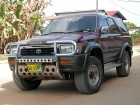
Ava, I love that brush guard you have on your 4Runner, did you get it or was it already on when you bought it?
Sep 4, 2003 | 05:32 PM
#13
Thread Starter
Registered User
Joined: Feb 2003
Posts: 82
Likes: 0
From: Paramaribo, Surinam, South-America
Originally posted by Paul H.
Ava, I love that brush guard you have on your 4Runner, did you get it or was it already on when you bought it?
Ava, I love that brush guard you have on your 4Runner, did you get it or was it already on when you bought it?
It was already on it, as was the bull-bar and belly plate. This car was imported used, and probably from Japan.
But I'm not very familiar with the names of all the accessories.
The chrome thing on the front is a bull-bar? The aluminum plate is a belly plate? Or is that the steel plate below the front of the engine? And what are those boards called below the doors?
Ava.
Last edited by Ava; Sep 4, 2003 at 05:35 PM.
Sep 4, 2003 | 05:45 PM
#14
Thread Starter
Registered User
Joined: Feb 2003
Posts: 82
Likes: 0
From: Paramaribo, Surinam, South-America
TechWrench,
I was thinking, could this fiber, when it gets past the filter, be responsible for keeping a valve open just enough to prevent build up of pressure?
Then I could try exhanging the oil a couple of times as replacement for a tranny flush to get as much of the fibers out as possible.
Ava.
I was thinking, could this fiber, when it gets past the filter, be responsible for keeping a valve open just enough to prevent build up of pressure?
Then I could try exhanging the oil a couple of times as replacement for a tranny flush to get as much of the fibers out as possible.
Ava.
Sep 4, 2003 | 06:09 PM
#15
Contributing Member
Joined: Jul 2003
Posts: 8,807
Likes: 3
From: Montreal, QC Canada
Originally posted by Ava
TechWrench,
I was thinking, could this fiber, when it gets past the filter, be responsible for keeping a valve open just enough to prevent build up of pressure?
Then I could try exhanging the oil a couple of times as replacement for a tranny flush to get as much of the fibers out as possible.
Ava.
TechWrench,
I was thinking, could this fiber, when it gets past the filter, be responsible for keeping a valve open just enough to prevent build up of pressure?
Then I could try exhanging the oil a couple of times as replacement for a tranny flush to get as much of the fibers out as possible.
Ava.
Sep 4, 2003 | 07:21 PM
#16
Registered User
Joined: Oct 2002
Posts: 1,091
Likes: 0
From: Calgary
I am almost a hundred percent sure that your problem is being caused by the number 1 shift solenoid. Mine had the same intermitant problem. Pulling the codes will tell you for sure. I'll bet you that it's throwing a code 62. It's not a hard fix, just a little spendy when you see what the solenoid looks like. Pull the codes is the easiest way to find out. It is the same procedure as the engine codes just watch the o/d light flash instead. If you need any info or help getting a part I would be happy to help.
Steve
P.S. yes there are four solenoids in the trans.
Steve
P.S. yes there are four solenoids in the trans.
Last edited by Babypig; Sep 4, 2003 at 07:29 PM.
Sep 4, 2003 | 08:23 PM
#17
Thread Starter
Registered User
Joined: Feb 2003
Posts: 82
Likes: 0
From: Paramaribo, Surinam, South-America
Originally posted by Babypig
I am almost a hundred percent sure that your problem is being caused by the number 1 shift solenoid. Mine had the same intermitant problem. Pulling the codes will tell you for sure. I'll bet you that it's throwing a code 62. It's not a hard fix, just a little spendy when you see what the solenoid looks like. Pull the codes is the easiest way to find out. It is the same procedure as the engine codes just watch the o/d light flash instead. If you need any info or help getting a part I would be happy to help.
Steve
P.S. yes there are four solenoids in the trans.
I am almost a hundred percent sure that your problem is being caused by the number 1 shift solenoid. Mine had the same intermitant problem. Pulling the codes will tell you for sure. I'll bet you that it's throwing a code 62. It's not a hard fix, just a little spendy when you see what the solenoid looks like. Pull the codes is the easiest way to find out. It is the same procedure as the engine codes just watch the o/d light flash instead. If you need any info or help getting a part I would be happy to help.
Steve
P.S. yes there are four solenoids in the trans.
My Surf is a '93, will it have codes for these kind of things?
And which is the #1 solenoid? And what was wrong with it on your car?
Ava.
Sep 4, 2003 | 09:49 PM
#18
Registered User
Joined: Aug 2003
Posts: 513
Likes: 0
From: Glenville, NY
Originally posted by Ava
TechWrench,
I was thinking, could this fiber, when it gets past the filter, be responsible for keeping a valve open just enough to prevent build up of pressure?
Then I could try exhanging the oil a couple of times as replacement for a tranny flush to get as much of the fibers out as possible.
Ava.
TechWrench,
I was thinking, could this fiber, when it gets past the filter, be responsible for keeping a valve open just enough to prevent build up of pressure?
Then I could try exhanging the oil a couple of times as replacement for a tranny flush to get as much of the fibers out as possible.
Ava.
You said this fiber amounted to only a 'spoonful' in you earlier post. This seems unusual, in that some of the symptoms you describe would fit the 'classic' ones for a pump which is starving for fluid. This generally only happens for two reasons, the sump is low on fluid or the filter is so clogged that fluid can't pass through it fast enough to meet the pumps demands. There are generally two types of material used for filter material in transmissions. One type is a very fine mesh brass screen, and the other is a fiber mat type filter. In either case, it would usually take a uniform coating of debris on the filter to restrict flow through it enough to impact the pumps operation. And that much material should never wear off the friction plate during normal operations. So I would have to say that changing the oil several times in order to flush the loose material from the unit couldn't hurt, but I still wouldn't hold out a lot of hope for it being a long term fix. I don't wish to sound so negative, but experience has taught me to be prepared for the worst when these types of symptoms occur. I hope this helps.
And again, good luck.
Last edited by TechWrench; Sep 4, 2003 at 09:51 PM.
Sep 4, 2003 | 11:55 PM
#19
Registered User
Joined: Oct 2002
Posts: 1,091
Likes: 0
From: Calgary
www.off-road.com/toyota/tech/codes/
jump the TE1 and E1 terminals in the diagnostic box under the hood. It's a little black box on the right fender under the hood. I can post pics tommorow. Do this with the ignition off. Once you have it jumped turn the key to on, you don't have to start it, and you may have to press the accelerator pedal to get them to flash. the o/d light will flash in sequence.
My truck wouldn't go right away in first. If i revved it it would suddenly grab and go. Or if I changed the gears manually it would work fine, stearting in first and on up through the gears. You can also search this site for ways to check the codes, they should go out after you take the jumper wire out of the diagnostic terminals.
I'll look for the other pages of info and send them along as well. It really isn't that hard an install.
Steve
jump the TE1 and E1 terminals in the diagnostic box under the hood. It's a little black box on the right fender under the hood. I can post pics tommorow. Do this with the ignition off. Once you have it jumped turn the key to on, you don't have to start it, and you may have to press the accelerator pedal to get them to flash. the o/d light will flash in sequence.
My truck wouldn't go right away in first. If i revved it it would suddenly grab and go. Or if I changed the gears manually it would work fine, stearting in first and on up through the gears. You can also search this site for ways to check the codes, they should go out after you take the jumper wire out of the diagnostic terminals.
I'll look for the other pages of info and send them along as well. It really isn't that hard an install.
Steve
Sep 5, 2003 | 05:52 AM
#20
Thread Starter
Registered User
Joined: Feb 2003
Posts: 82
Likes: 0
From: Paramaribo, Surinam, South-America
Originally posted by Babypig
www.off-road.com/toyota/tech/codes/
jump the TE1 and E1 terminals in the diagnostic box under the hood. It's a little black box on the right fender under the hood. I can post pics tommorow.
Steve
www.off-road.com/toyota/tech/codes/
jump the TE1 and E1 terminals in the diagnostic box under the hood. It's a little black box on the right fender under the hood. I can post pics tommorow.
Steve
I know what and where the diagnostic box is, but I don't have much specifics on it. You don't have to post pics for my sake, but others might wat to see them, so please go ahead.
Those are the same contacts I use to set the ignition and all it does is flash that it's okay (well, now it is, perhaps I'll have to wait until it malfunctions again).
Did your car not move in any direction or just not forward? Mine didn't do both, so can that be the same solenoid?
And I don't remember seeing four solenoids, just the two on the left of the car. Where are the other two located? Or did I just forget about them? :pat:
I *know* it's just a valve, not a worn down pack of clutches, but nobody seems to want me to repair it. If a valve leaks, the clutch controlled by it slips, causing wear, clogging the filter. If I can repair the valve, the slipping would be over (as long as there is enough friction material left). This particular valve seems not to malfunction all the time, only around the time the car won't go. This could mean the plates are still good enough. After cleaning the filter the car shifts much more positive so there must be some material left on the plates.
Ava.
Sep 5, 2003 | 06:07 AM
#21
Thread Starter
Registered User
Joined: Feb 2003
Posts: 82
Likes: 0
From: Paramaribo, Surinam, South-America
Originally posted by TechWrench
Ava; Yes, the fibers, and any other material, ...
Ava; Yes, the fibers, and any other material, ...
We can assume the filter mesh is fine enough so that what gets trough won't be of enough significance.
I think we also can conclude that the plates are not the cause.
Take my word for it, if I go ahead and ask someone overhere to repair it I'll end up with a set of new plates ($500 US) and the cause not taken away. I need to find what's responsible for the stalling first.
Do you know where I can find good schematics about (this)transmission(s) on the net?
Ava.
Sep 5, 2003 | 06:46 AM
#22
Thread Starter
Registered User
Joined: Feb 2003
Posts: 82
Likes: 0
From: Paramaribo, Surinam, South-America
Originally posted by Babypig
www.off-road.com/toyota/tech/codes/
jump the TE1 and E1 terminals in the diagnostic box under the hood. It's a little black box on the right fender under the hood. I can post pics tommorow. Do this with the ignition off. Once you have it jumped turn the key to on, you don't have to start it, and you may have to press the accelerator pedal to get them to flash. the o/d light will flash in sequence.
Steve
www.off-road.com/toyota/tech/codes/
jump the TE1 and E1 terminals in the diagnostic box under the hood. It's a little black box on the right fender under the hood. I can post pics tommorow. Do this with the ignition off. Once you have it jumped turn the key to on, you don't have to start it, and you may have to press the accelerator pedal to get them to flash. the o/d light will flash in sequence.
Steve
I just see that I have interpreted the table incorrectly. The checklight just keeps flashing. Not eight pulses and a pause, but contiuously.
The O/D light flashes only when O/D is engaged and it flashes a bit delayed.
Also, what does it mean if the red light for the O2 sensor is on before I start? It goes off when the engine runs. Does it mean the sensor is OK?
Ava.
Sep 5, 2003 | 06:48 AM
#23
Contributing Member
Joined: Jul 2003
Posts: 8,807
Likes: 3
From: Montreal, QC Canada
Originally posted by Ava
Take my word for it, if I go ahead and ask someone overhere to repair it I'll end up with a set of new plates ($500 US) and the cause not taken away. I need to find what's responsible for the stalling first.
Ava.
Take my word for it, if I go ahead and ask someone overhere to repair it I'll end up with a set of new plates ($500 US) and the cause not taken away. I need to find what's responsible for the stalling first.
Ava.
Sep 5, 2003 | 06:59 AM
#24
Thread Starter
Registered User
Joined: Feb 2003
Posts: 82
Likes: 0
From: Paramaribo, Surinam, South-America
Originally posted by MTL_4runner
You sound like you know what is wrong with it already.
You sound like you know what is wrong with it already.
What, a wheely? With a 3VZ-E?

Ava.
Sep 5, 2003 | 08:02 AM
#25
Contributing Member
Joined: Jul 2003
Posts: 8,807
Likes: 3
From: Montreal, QC Canada
I don't think that the general concensus was that your plates are gone. It was said that you may already have done damage to the plates or they may be severly worn potentially because of the valve problem as was discussed and the lack of maintenance throughout the trucks history.
I think the general direction people targeted was a lack of fluid pressure to engage the plates. I think it was also suggested that either the pump was being starved of fluid from contamination on the filter (which I assume you cleaned already), a clogged passage restricting fluid flow, or a stuck valve. It would seem wise to remove as much of the old fluid as possible in an attempt to free any sticking parts.
This little wealth of info from Toyota 4X4 might help:
Here are some specifics about the tranny itself.
The A340E/A340F/A340H 4-Speed Automatic Overdrive Transmission
This is Toyotas ECT (Electronically Controlled Transmission) automatic. It is used in both 22RE (4wd) models and in the 3VZ-E and 22R-TE (both 2wd and 4wd)
1st 2.804, 2nd 1.531, 3rd 1.000, 4th 0.705 Reverse: 2.393.
The 4WD version (A340H) has a transfer case with low-range gearing of 2.659:1
Models designated A340F have (I think) the VF2A transfer case with a 2.566:1 low range
Someone who asked to be anonymous sent the following info:
The codes breakdown is as follows
A 340 H
A = automatic transmission
3 = 3 series
4 = 4 speed
0 = gear ratio / minor change
H = hydraulic transfer case (includes ECT)
F = mechanical transfer case (includes ECT)
E = Electronic Controlled Transmission (used on 2WD 4Runners, other 2WD Toyota vehicles)
This transmission uses 2 solenoids to control the shifting.
solenoid 1 solenoid 2
1 th = ON OFF
2 nd = ON ON
3 rd = OFF ON
4 th = OFF OFF
The throttle cable is used for line pressure, it can be disconnected and
the transmission will still shift normally.
But if youloose power to your 2 shift solenoid, you will be taking off in
OverDrive.
What you should do is :
Select LOW 1 . (1 st gear) then 2nd ( 3rd gear) then D (over drive)
A bit of an information overload but I hope it helps ya out. 
I think the general direction people targeted was a lack of fluid pressure to engage the plates. I think it was also suggested that either the pump was being starved of fluid from contamination on the filter (which I assume you cleaned already), a clogged passage restricting fluid flow, or a stuck valve. It would seem wise to remove as much of the old fluid as possible in an attempt to free any sticking parts.
This little wealth of info from Toyota 4X4 might help:
First suggestion:
If the fluid is that bad it has been slipping for some time.
Drain the tranny first at the plug,and the transfer case plug,do not pull the pan yet!
Put in Dextron 3 and see if moves and shifts. If it moves and feels sluggish shifting or slipps when trying to take off stop. Get a manual run the codes for the tranny diagnostics and see if has any. Sometimes solenoids will give you a code as well as a speed sensor that could cause your problem. Most of the a340h problems were shift solenoids and can be replaced by dropping the pan and unbolting them from the valve body. But if this has been doing this for very long that amounts to pissing on a high rise fire. Too little too late if ya get my drift. If you have a shop you trust take it in have them check before it gets to a point where it wont move even in 4low.
If this shift ok in 4 low ,through all the gears 2-3 no od in 4wheel it may be ok. Or saveable at a reasonable cost.
Check your ECT trany computer make sure its plugged in and you have good connections,if youhave an electrical problem to the ecu or no power from it ,the tranny will start in high gear,which would appear to be slipping from a start. Which it is in theory,because it can't take that kinda torque from a standstill.
Second suggestion:
Try some TransX fluid in it, this will soften up the inner seals maybe .
It sound like your direct clutch seals are rolled or flat,if it does it in reverse which it probably does also it has the reverse brake seals out. Same type o-rings , again same problem, if that is the case you're soon to be slipping will then be stopped.
Try the transx and if that doesn't do it save your money ,your going to either have to have an overhaul or get a used tranny.
Last suggestion:
When you start up in the morning and want to go, try manually shifting between gears to see if it works that way ok. If it does then I would suspect the shift solenoids inside the tranny on the valve body. This can be checked form the ECU connections. Not sure is a "Haynes" manual showns the location but the factory manuals do of course.
Something to thing about and it's a quick and easy test.
Oops, forgot to mention that it would be either the #1 or #2 shift solenoids to test first. The lockup solenoid usually is ok but the #2 is know to go bad. The solenoids should measure 12-15 ohms resistance from the ECU connector to ground. Only suspect the solenoids if your tranny works fine if you manually shift through the gears. It takes less than 15 minutes to check the solenoids though if you want to satisfy your curiosity.
If the fluid is that bad it has been slipping for some time.
Drain the tranny first at the plug,and the transfer case plug,do not pull the pan yet!
Put in Dextron 3 and see if moves and shifts. If it moves and feels sluggish shifting or slipps when trying to take off stop. Get a manual run the codes for the tranny diagnostics and see if has any. Sometimes solenoids will give you a code as well as a speed sensor that could cause your problem. Most of the a340h problems were shift solenoids and can be replaced by dropping the pan and unbolting them from the valve body. But if this has been doing this for very long that amounts to pissing on a high rise fire. Too little too late if ya get my drift. If you have a shop you trust take it in have them check before it gets to a point where it wont move even in 4low.
If this shift ok in 4 low ,through all the gears 2-3 no od in 4wheel it may be ok. Or saveable at a reasonable cost.
Check your ECT trany computer make sure its plugged in and you have good connections,if youhave an electrical problem to the ecu or no power from it ,the tranny will start in high gear,which would appear to be slipping from a start. Which it is in theory,because it can't take that kinda torque from a standstill.
Second suggestion:
Try some TransX fluid in it, this will soften up the inner seals maybe .
It sound like your direct clutch seals are rolled or flat,if it does it in reverse which it probably does also it has the reverse brake seals out. Same type o-rings , again same problem, if that is the case you're soon to be slipping will then be stopped.
Try the transx and if that doesn't do it save your money ,your going to either have to have an overhaul or get a used tranny.
Last suggestion:
When you start up in the morning and want to go, try manually shifting between gears to see if it works that way ok. If it does then I would suspect the shift solenoids inside the tranny on the valve body. This can be checked form the ECU connections. Not sure is a "Haynes" manual showns the location but the factory manuals do of course.
Something to thing about and it's a quick and easy test.
Oops, forgot to mention that it would be either the #1 or #2 shift solenoids to test first. The lockup solenoid usually is ok but the #2 is know to go bad. The solenoids should measure 12-15 ohms resistance from the ECU connector to ground. Only suspect the solenoids if your tranny works fine if you manually shift through the gears. It takes less than 15 minutes to check the solenoids though if you want to satisfy your curiosity.
The A340E/A340F/A340H 4-Speed Automatic Overdrive Transmission
This is Toyotas ECT (Electronically Controlled Transmission) automatic. It is used in both 22RE (4wd) models and in the 3VZ-E and 22R-TE (both 2wd and 4wd)
1st 2.804, 2nd 1.531, 3rd 1.000, 4th 0.705 Reverse: 2.393.
The 4WD version (A340H) has a transfer case with low-range gearing of 2.659:1
Models designated A340F have (I think) the VF2A transfer case with a 2.566:1 low range
Someone who asked to be anonymous sent the following info:
The codes breakdown is as follows
A 340 H
A = automatic transmission
3 = 3 series
4 = 4 speed
0 = gear ratio / minor change
H = hydraulic transfer case (includes ECT)
F = mechanical transfer case (includes ECT)
E = Electronic Controlled Transmission (used on 2WD 4Runners, other 2WD Toyota vehicles)
This transmission uses 2 solenoids to control the shifting.
solenoid 1 solenoid 2
1 th = ON OFF
2 nd = ON ON
3 rd = OFF ON
4 th = OFF OFF
The throttle cable is used for line pressure, it can be disconnected and
the transmission will still shift normally.
But if youloose power to your 2 shift solenoid, you will be taking off in
OverDrive.
What you should do is :
Select LOW 1 . (1 st gear) then 2nd ( 3rd gear) then D (over drive)
Finally some helpful cross reference info:
In my pursuit to replace my shift solenoids, i found some useful cross reference info. The #1 and #2 shift solenoids (85420-22080) were the same in all of the following vehicles. I wanted to swap in some used ones b4 i buy new ones to make sure i have the problem found. Auto tranny trucks are rare in the junk yards around here, so this list should come in handy when i go looking...
85-88 Cressida
84-95 Trucks (2wd & 4wd)
93-98 T100
92-97 Previa Van
86.5-92 Supra
In my pursuit to replace my shift solenoids, i found some useful cross reference info. The #1 and #2 shift solenoids (85420-22080) were the same in all of the following vehicles. I wanted to swap in some used ones b4 i buy new ones to make sure i have the problem found. Auto tranny trucks are rare in the junk yards around here, so this list should come in handy when i go looking...
85-88 Cressida
84-95 Trucks (2wd & 4wd)
93-98 T100
92-97 Previa Van
86.5-92 Supra
Last edited by MTL_4runner; Sep 5, 2003 at 09:02 AM.


