


Battery/Alternator light coming on
 Mar 28, 2013 | 05:39 PM
#1

Thread Starter
Registered User
Joined: Jan 2005
Posts: 266
Likes: 0
From: Summit County Colorado
Battery/Alternator light coming on
I have a dual battery set up in my truck. I also have a 130 amp alternator upgrade from a toyota tundra 4.7L v8. Couple weeks ago my battery light came. I found that my battery isolator failed so i replaced it. Driving home the other night my battey light came on again. Voltage drop on the battery is 11.92 volts (its a brand new battery). Voltage drop at the isolator is 1v. Voltage drop at the alternator is 1v. When i rev up the engie the battry light goes off on the dash as soon as rpms drop down again the light goes back on. Had the alteranor bench tested at two auto parts stores. Both stores said the alternator is good. Any ideas? thanks in advance
Mar 28, 2013 | 06:11 PM
#3

Registered User


Joined: Mar 2012
Posts: 7,125
Likes: 681
Monitoring Charging Current would be Very helpful
...Voltage drop on the battery is 11.92 volts (its a brand new battery)...When i rev up the engie the battry light goes off on the dash as soon as rpms drop down again the light goes back on. Had the alteranor bench tested at two auto parts stores. Both stores said the alternator is good. Any ideas? thanks in advance
What's your batt voltage when rpm drops? Does it go lower than 13.5V? If it does, that's why your batt /charge light fault light comes on.
Your alternator may be fine but maybe two batteries are just to much for it. Tried running with auxiliary battery and isolator disconnected?
Would be very helpful to monitor charging current with a clamp-on ammeter. Don't want my nice Fluke in the rough and tumble world of the 4Runner so I Got this from HF.
If current coming out of your alternator is less than rated 130Amps, Voltage is between 13.5-14.5V, but "L" output is low then alternator is bad.
 Mar 28, 2013 | 07:50 PM
#5
Thread Starter
Registered User
Joined: Jan 2005
Posts: 266
Likes: 0
From: Summit County Colorado
ok i have to double check on that wiring L might be the light signal not sure. I cut apart a lot of my wiring harness and could not find any broken wires or anything like that. I do have a wire that t's off from the L terminal (or at least i think its L terminal) wire onto the delectron connection on the alternator which i though could of been bad wiring. I will fix that wire tomorrow. If i by pass the isolator would the wire from the alternator connect to positive side of the battery?
Last edited by cccp; Mar 28, 2013 at 07:51 PM.
Mar 28, 2013 | 11:18 PM
#7
Registered User
Joined: Mar 2012
Posts: 7,125
Likes: 681
I'm not familiar with Isolator. It may be less work to first measure current output of alt with isolator & aux battery connected, then IF current exceeds alt capacity, temporarily wire like stock to see if the second battery is causing overload.
Best wishes.
Trending Topics
Mar 29, 2013 | 08:43 AM
#9
Registered User
Joined: Mar 2012
Posts: 7,125
Likes: 681
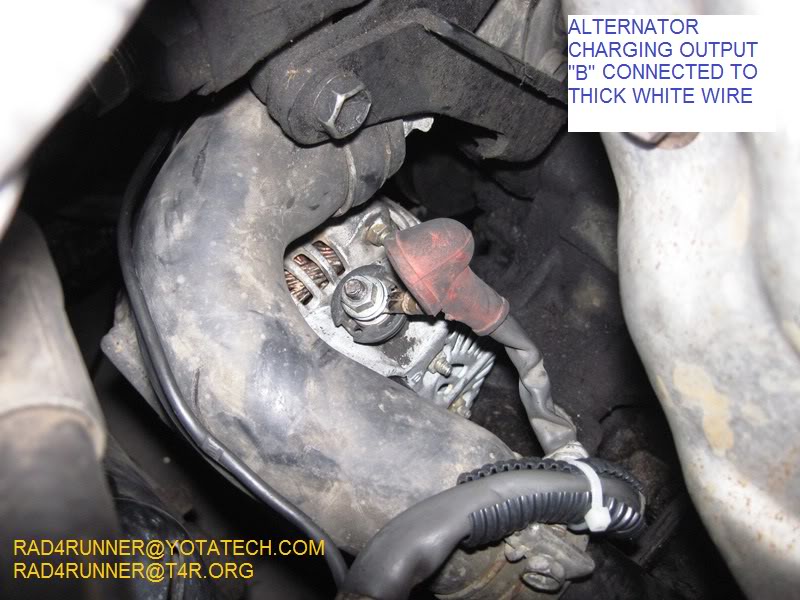
"B" Charging output of alternator:
Typical alternator pin-outs:
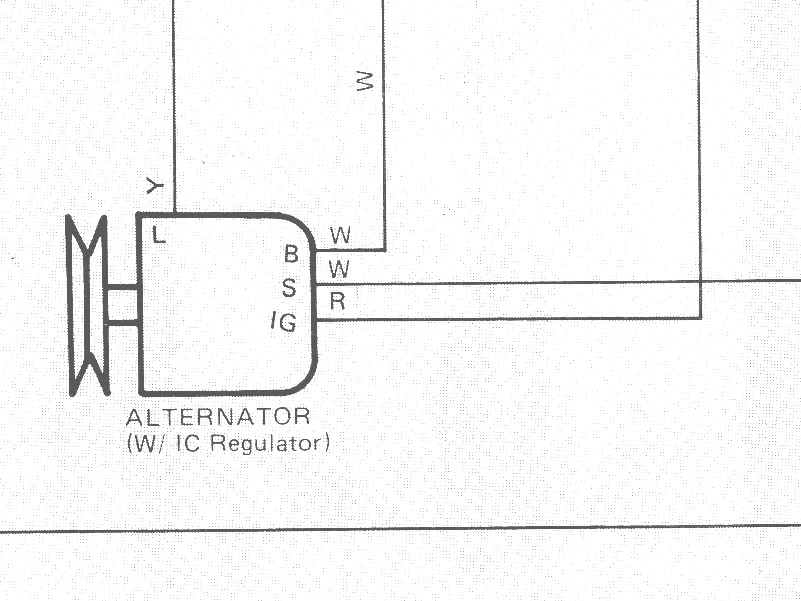
L - charge Light. Normal operation 12V. Fault condition L goes low. When L is low charge light on.
"B" is charging output. Thick wire, Connect to battery among/in between fusible link and main fuses.
"IG" excitation current for stator.
Last edited by RAD4Runner; Mar 29, 2013 at 08:45 AM.
Mar 29, 2013 | 11:42 AM
#10
Thread Starter
Registered User
Joined: Jan 2005
Posts: 266
Likes: 0
From: Summit County Colorado
ok so i just got back from working on the truck again. After fixing my wire on the S terminal (it looked like it was pinched) I first wired the alternator terminal B on the isolator and tarted the truck when it first started the battery light dimmed out and went out for a second or two but than came back on. bringing up the rpms made the light go out. I than checked the voltage drop at the battery it was at 11.92v. Voltage drop at the isolator is 1.1v and voltage drop at aternator was at 1.1v. I than brougt up my rpms up and checked the voltage drop at the battery it went up to 13.92 volts. At the isolator it was at 13.95v and at the alternator it was at 13.95v. The battery light still is staying on. I by passed my isolator and connected terminal B from the alternator directly to positive side of the battery voltage drop at the battery was at 13.95 and at the alternator 13.96v. The battery light is still on and now it does not matter if i bring up the rpms up or not the light is on constatly
Mar 29, 2013 | 12:53 PM
#11
Registered User
Joined: Mar 2012
Posts: 7,125
Likes: 681
.... I than checked the voltage drop at the battery it was at 11.92v. Voltage drop at the isolator is 1.1v and voltage drop at aternator was at 1.1v. I than brougt up my rpms up and checked the voltage drop at the battery it went up to 13.92 volts. At the isolator it was at 13.95v and at the alternator it was at 13.95v. The battery light still is staying on. I by passed my isolator and connected terminal B from the alternator directly to positive side of the battery voltage drop at the battery was at 13.95 and at the alternator 13.96v. The battery light is still on and now it does not matter if i bring up the rpms up or not the light is on constatly
- Regulator/internal electronics of alt is bad.
- Regulator is OK but something is loading (almost short circuit to ground) "L" output and forcing it to go that low (less likely, but still possibility).
Mar 30, 2013 | 06:49 AM
#12
Thread Starter
Registered User
Joined: Jan 2005
Posts: 266
Likes: 0
From: Summit County Colorado
This is what kinda threw me off when i first checked the voltage drop at the alternator it was at 1.1v but after reving up the engine it went up to 13.96 v and thats where it stayed after i brought the rpms down. I could not get it to read 1.1 v after that. Everything seemed ok like the alternator was charging but the light is still on. The battery gauge is reading normal range. I will try and pull up a wiring diagram
Mar 30, 2013 | 09:02 AM
#13
Thread Starter
Registered User
Joined: Jan 2005
Posts: 266
Likes: 0
From: Summit County Colorado
here is a write up from another site on how to upgrade the alternator http://forum.ih8mud.com/80-series-te...0-amp-pdf.html
Mar 30, 2013 | 09:06 AM
#15
Registered User
Joined: Mar 2012
Posts: 7,125
Likes: 681
here is a write up from another site on how to upgrade the alternator http://forum.ih8mud.com/80-series-te...0-amp-pdf.html
Mar 30, 2013 | 10:37 AM
#16
Thread Starter
Registered User
Joined: Jan 2005
Posts: 266
Likes: 0
From: Summit County Colorado
 Mar 30, 2013 | 02:18 PM
#18
Registered User
Joined: Mar 2012
Posts: 7,125
Likes: 681
Happy Easter!
Now we're talking 
Please see my notes...
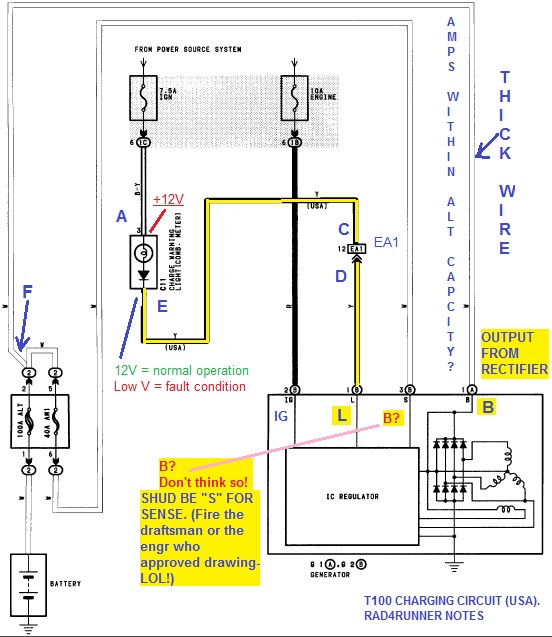
Here are important points to check:
With ignition off, F should be 11.92V
Disconnect connector EA1.
Leave EA1 disconnected. Ignition on, engine running:
With EA1 disconnected, charge light should be off.
If charge light stays on with EA1 disconnected, check Voltage at "E" or "C". Should be high or 12V. If low:
1) Measure current through thick white output wire (B) with clamp-on ammeter (Harbor Freight is your friend) Should be within capacity of alternator.
2) Measure volt @ F. Should be between 13.5 & 14.5V.
Measure "D" = "L" output:
If 1 good, but 2 bad, = bad regulator/alternator.
If 2 exceeds alt capacity- check for shorts, possibly bad battery...
More details if you wanna to analyze...
Normal operation condition:
A: 12V nominal when ignition on.
B: ALT output 13.5 to 14.5 V
E (=voltage "L") = 12V when ignition on
Volt@A - volt@E = 0 =>> no potential difference across charge light & diode =>> charge light OFF.
F = batt voltage: 11.92 With ignition OFF. 13.5-14.5 V with charging circuit running normally.
IG: (supplies current to stator to regulate output): 12V nominal when ignition on
S (sense voltage: feedsback abbt V to regulatr so regulator cna adjust.
( I think schematic is poorly labeled. The "B" pin connected to regulator should be "S" for sensing battery voltage as feedback to regulator.
Fault Condition:
A: 12V nominal when ignition on.
E: low, approx 2V? 1.1V?
Volt@A - volt@E =/~ 10V = Potential diff across charge light & diode => current flows => light ON
Please see my notes...
Here are important points to check:
With ignition off, F should be 11.92V
Disconnect connector EA1.
Leave EA1 disconnected. Ignition on, engine running:
With EA1 disconnected, charge light should be off.
If charge light stays on with EA1 disconnected, check Voltage at "E" or "C". Should be high or 12V. If low:
- Look for shorts to ground.
- Makes sure nothing is connected to negative side of charge light-diode circuit.
- Check for any after-market wiring connected to negative side of bulb-diode circuit (eqpt that only come on when IGN is on like DRL).
- IF Canadian model, also disconnect connection from dDRL circuit to isolate problem.
1) Measure current through thick white output wire (B) with clamp-on ammeter (Harbor Freight is your friend
) Should be within capacity of alternator.2) Measure volt @ F. Should be between 13.5 & 14.5V.
Measure "D" = "L" output:
- If 1&2 good, D should be 12V. Reconnect EA1. Charge light should stay OFF.
- If If 1&2 good but D is low, IC/regulator bad. Replace alternator.
If 1 good, but 2 bad, = bad regulator/alternator.
If 2 exceeds alt capacity- check for shorts, possibly bad battery...
More details if you wanna to analyze
...Normal operation condition:
A: 12V nominal when ignition on.
B: ALT output 13.5 to 14.5 V
E (=voltage "L") = 12V when ignition on
Volt@A - volt@E = 0 =>> no potential difference across charge light & diode =>> charge light OFF.
F = batt voltage: 11.92 With ignition OFF. 13.5-14.5 V with charging circuit running normally.
IG: (supplies current to stator to regulate output): 12V nominal when ignition on
S (sense voltage: feedsback abbt V to regulatr so regulator cna adjust.
( I think schematic is poorly labeled. The "B" pin connected to regulator should be "S" for sensing battery voltage as feedback to regulator.
Fault Condition:
A: 12V nominal when ignition on.
E: low, approx 2V? 1.1V?
Volt@A - volt@E =/~ 10V = Potential diff across charge light & diode => current flows => light ON


