


What happens when I short "T" & "E1"?
 Jan 3, 2012 | 05:02 PM
#1

Thread Starter
Registered User
Joined: Nov 2011
Posts: 14
Likes: 0
From: Beaumont, CA
What happens when I short "T" & "E1"?
What does shorting these two terminals do, and why does it need to be done when setting distributor timing?
I did it and don't mind having to do it, just want to know why it's necessary/ what happens in the engine controller.
1990 Pickup with 22RE/ California emissions, 2WD, man trans
THANKS
I did it and don't mind having to do it, just want to know why it's necessary/ what happens in the engine controller.
1990 Pickup with 22RE/ California emissions, 2WD, man trans
THANKS
 Jan 5, 2012 | 06:46 AM
#3

Registered User
Joined: Mar 2008
Posts: 12,723
Likes: 6
From: Temecula Valley, CA
like he said, sort of....
It puts the ecu into a mode that permits adjustment of the timing, as mentioned.
However, there is at least one instance where inserting the jumper will not allow that to occur: if the throttle position sensor is malfunctioning and not signalling the "throttle closed" or idle condition. If everything is well, inserting the jumper as indicated will likely cause the idle speed to noticibly drop. If the idle doesn't drop, it's possible the throttle position sensor or wiring is malfunctioning, it is misadjusted or maybe the throttle itself isn't physically closing. A near dead giveaway it's the tps or throttle causing an issue is the jumper is properly inserted and the timing marks still jump around under the timing light.
It's also worth noting that the idle speed should be corrected if the initial timing changes, and similarly should be done with the jumper inserted. So setting the timing may not simply be insert the jumper, set timing, remove jumper but more like insert jumper, set timing, adjust idle, set timing... etc... until the timing and idle are both correct, then remove the jumper.
And ideally, adjustments should be done with the engine warmed up to operating temperature, after the thermostat has opened at least a few times to minimize the possibility of coolant temp affecting the timing and idle speed.
Sorry for the long winded add-on reply.
It puts the ecu into a mode that permits adjustment of the timing, as mentioned.
However, there is at least one instance where inserting the jumper will not allow that to occur: if the throttle position sensor is malfunctioning and not signalling the "throttle closed" or idle condition. If everything is well, inserting the jumper as indicated will likely cause the idle speed to noticibly drop. If the idle doesn't drop, it's possible the throttle position sensor or wiring is malfunctioning, it is misadjusted or maybe the throttle itself isn't physically closing. A near dead giveaway it's the tps or throttle causing an issue is the jumper is properly inserted and the timing marks still jump around under the timing light.
It's also worth noting that the idle speed should be corrected if the initial timing changes, and similarly should be done with the jumper inserted. So setting the timing may not simply be insert the jumper, set timing, remove jumper but more like insert jumper, set timing, adjust idle, set timing... etc... until the timing and idle are both correct, then remove the jumper.
And ideally, adjustments should be done with the engine warmed up to operating temperature, after the thermostat has opened at least a few times to minimize the possibility of coolant temp affecting the timing and idle speed.
Sorry for the long winded add-on reply.
Last edited by abecedarian; Jan 5, 2012 at 08:39 AM.





Trending Topics
 Jan 5, 2012 | 12:00 PM
#10
Thread Starter
Registered User
Joined: Nov 2011
Posts: 14
Likes: 0
From: Beaumont, CA
Thanks to MudHippy and abecedarian!!! Those were exactly the answers I was looking for.
As to "T" or "T1", my 1988 FSM I got for free called it the "T" while it's marked "TE1" on the sticker inside the test connector cover....
THANKS to all for the posts!
As to "T" or "T1", my 1988 FSM I got for free called it the "T" while it's marked "TE1" on the sticker inside the test connector cover....
THANKS to all for the posts!
Jan 5, 2012 | 04:13 PM
#11
Registered User
Joined: Jan 2007
Posts: 6,106
Likes: 27
You're very welcome sir!
It's not from an FSM...nice try though! (expletive deleted)
Oh yeah...TONS more sense!!! Didn't answer his question AT ALL!!!
Grow up....
Now that's ^^^ all information found in the FSM(some of which isn't even correct). The info I provided ISN'T IN THE FSM!!! And answered the OP's question FULLY!!!
1. The idle speed condition you've completely distorted. You adjust the idle speed FIRST. Then you set the ignition timing. Then you recheck/readjust the idle speed IF necessary. Again, all in the FSM.
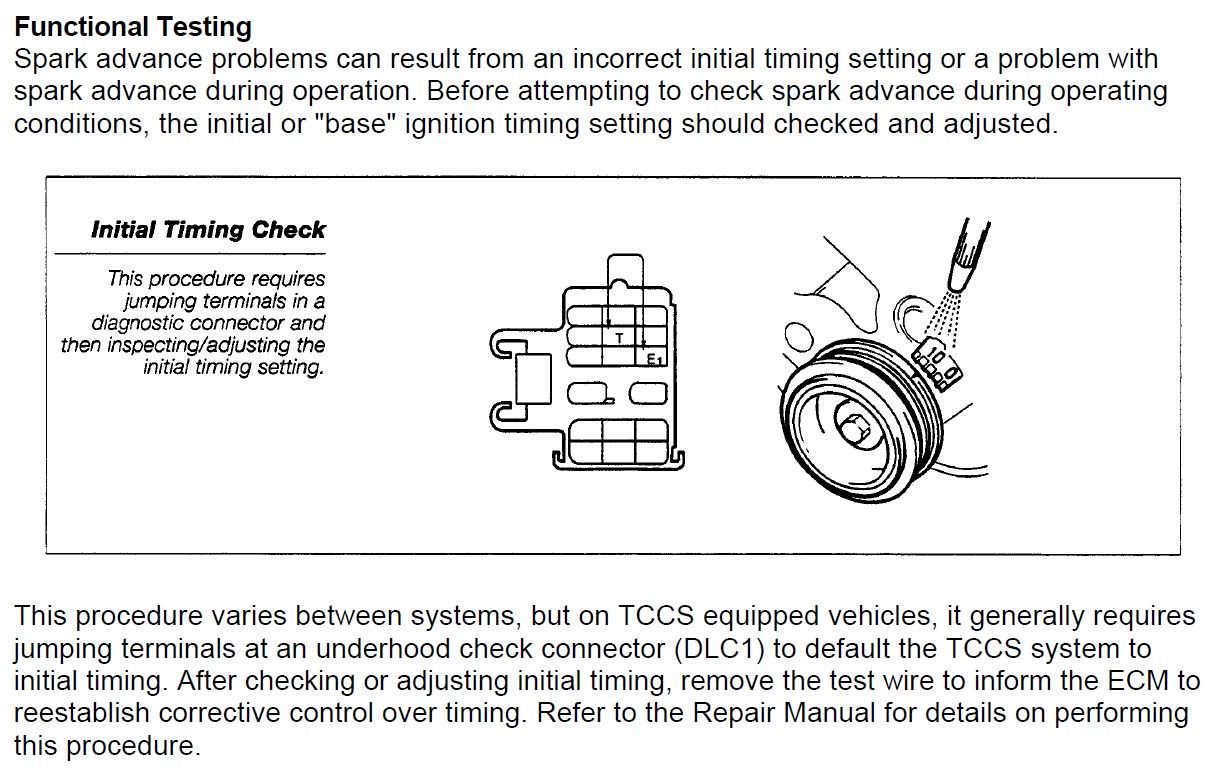
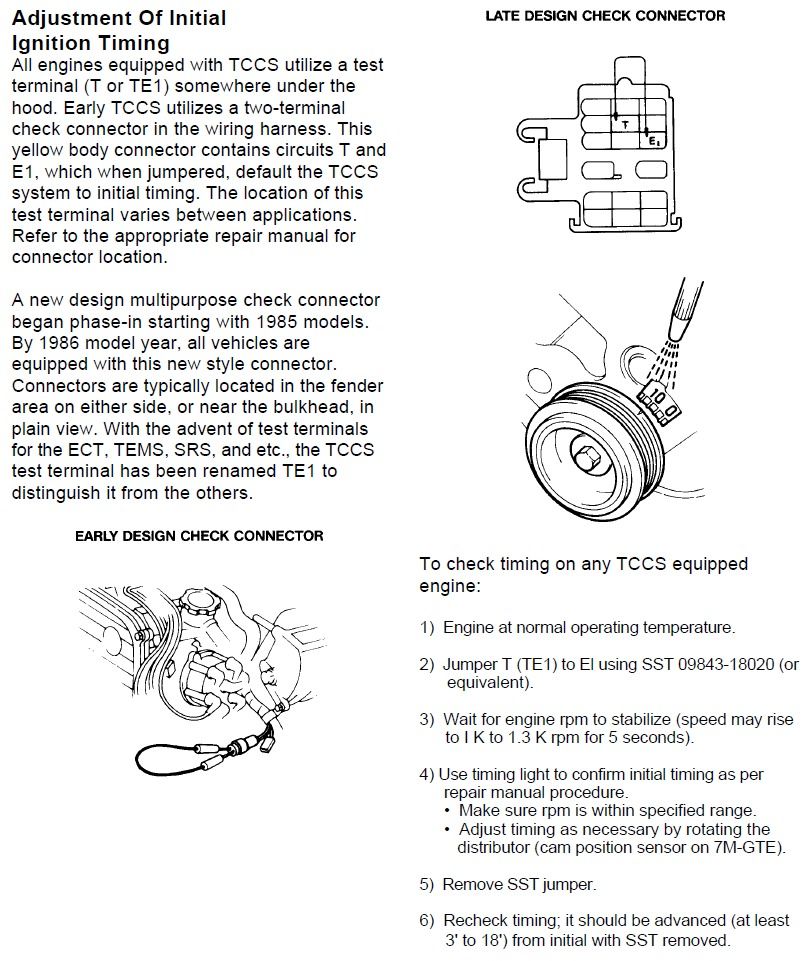
2. The idle speed SHOULD NOT drop IF ANYTHING it will raise temporarily, then stabilze at the normal idle rpm. See pic below.
3. You DON'T have to jump the check connectors to adjust the ignition timing. Meaning NO, it DOESN'T put the ECU in a mode that permits adjustment of the ignition timing. It puts the ECU in a mode that allows adjustment the ignition timing to be MORE ACCURATE!!!
It's not from an FSM...nice try though! (expletive deleted)
Oh yeah...TONS more sense!!! Didn't answer his question AT ALL!!!
Grow up....
like he said, sort of....
It puts the ecu into a mode that permits adjustment of the timing, as mentioned.
However, there is at least one instance where inserting the jumper will not allow that to occur: if the throttle position sensor is malfunctioning and not signalling the "throttle closed" or idle condition. If everything is well, inserting the jumper as indicated will likely cause the idle speed to noticibly drop. If the idle doesn't drop, it's possible the throttle position sensor or wiring is malfunctioning, it is misadjusted or maybe the throttle itself isn't physically closing. A near dead giveaway it's the tps or throttle causing an issue is the jumper is properly inserted and the timing marks still jump around under the timing light.
It's also worth noting that the idle speed should be corrected if the initial timing changes, and similarly should be done with the jumper inserted. So setting the timing may not simply be insert the jumper, set timing, remove jumper but more like insert jumper, set timing, adjust idle, set timing... etc... until the timing and idle are both correct, then remove the jumper.
And ideally, adjustments should be done with the engine warmed up to operating temperature, after the thermostat has opened at least a few times to minimize the possibility of coolant temp affecting the timing and idle speed.
Sorry for the long winded add-on reply.
It puts the ecu into a mode that permits adjustment of the timing, as mentioned.
However, there is at least one instance where inserting the jumper will not allow that to occur: if the throttle position sensor is malfunctioning and not signalling the "throttle closed" or idle condition. If everything is well, inserting the jumper as indicated will likely cause the idle speed to noticibly drop. If the idle doesn't drop, it's possible the throttle position sensor or wiring is malfunctioning, it is misadjusted or maybe the throttle itself isn't physically closing. A near dead giveaway it's the tps or throttle causing an issue is the jumper is properly inserted and the timing marks still jump around under the timing light.
It's also worth noting that the idle speed should be corrected if the initial timing changes, and similarly should be done with the jumper inserted. So setting the timing may not simply be insert the jumper, set timing, remove jumper but more like insert jumper, set timing, adjust idle, set timing... etc... until the timing and idle are both correct, then remove the jumper.
And ideally, adjustments should be done with the engine warmed up to operating temperature, after the thermostat has opened at least a few times to minimize the possibility of coolant temp affecting the timing and idle speed.
Sorry for the long winded add-on reply.
1. The idle speed condition you've completely distorted. You adjust the idle speed FIRST. Then you set the ignition timing. Then you recheck/readjust the idle speed IF necessary. Again, all in the FSM.
2. The idle speed SHOULD NOT drop IF ANYTHING it will raise temporarily, then stabilze at the normal idle rpm. See pic below.
3. You DON'T have to jump the check connectors to adjust the ignition timing. Meaning NO, it DOESN'T put the ECU in a mode that permits adjustment of the ignition timing. It puts the ECU in a mode that allows adjustment the ignition timing to be MORE ACCURATE!!!
Last edited by MudHippy; Jan 5, 2012 at 04:20 PM.
Jan 5, 2012 | 06:11 PM
#12
Registered User
Joined: Mar 2008
Posts: 12,723
Likes: 6
From: Temecula Valley, CA
Ummm, okay MudHippy.
But even your post says:
"4) ... make sure RPM is within specified range... adjust timing by rotating the distributor...."
Logic suggests you would follow the FSM and adjust the rpm (it says so: "make sure....") then adjust timing ... then adjust rpm and timing....
Just saying.
and if the dynamic ecu controlled timing is at say 9 and drops to 5 with the jumper installed, the idle will decrease if everything isn't set properly.
But even your post says:
"4) ... make sure RPM is within specified range... adjust timing by rotating the distributor...."
Logic suggests you would follow the FSM and adjust the rpm (it says so: "make sure....") then adjust timing ... then adjust rpm and timing....
Just saying.
and if the dynamic ecu controlled timing is at say 9 and drops to 5 with the jumper installed, the idle will decrease if everything isn't set properly.
Last edited by abecedarian; Jan 5, 2012 at 06:14 PM.
Jan 6, 2012 | 09:36 AM
#14
Registered User
Joined: Mar 2008
Posts: 12,723
Likes: 6
From: Temecula Valley, CA
and answered the op's question completely, right?
umm, okay. So why would MudHippy say:
Answered with a photo of the FSM page (or maybe some other scan).
The scan you posted "first" didn't say that, did it?
I don't need a pic to tell me my idle could raise. Obviously it will raise if the timing changes... or maybe even lower, which has been my experience.
Okay. If that's true, why does your "first" pic say you have to jump terminals to set initial timing? Realistically, any idiot that knows a thing or two about ignition timing knows that if you move the distributor it will change your timing. The jumper puts the ECU into a mode that ... wait for it ... permits adjusting initial timing. And that's what I said.
umm, okay. So why would MudHippy say:
"Now that's ^^^ all information found in the FSM(some of which isn't even correct). The info I provided ISN'T IN THE FSM!!! And answered the OP's question FULLY!!!
1. The idle speed condition you've completely distorted. You adjust the idle speed FIRST. Then you set the ignition timing. Then you recheck/readjust the idle speed IF necessary. Again, all in the FSM.
2. The idle speed SHOULD NOT drop IF ANYTHING it will raise temporarily, then stabilze at the normal idle rpm. See pic below.
3. You DON'T have to jump the check connectors to adjust the ignition timing. Meaning NO, it DOESN'T put the ECU in a mode that permits adjustment of the ignition timing. It puts the ECU in a mode that allows adjustment the ignition timing to be MORE ACCURATE!!!"

 Jan 6, 2012 | 04:56 PM
#17

Registered User
Joined: Dec 2011
Posts: 126
Likes: 0
FSM is Factory Repair Manual.
It's the repair manual Toyota provides for the vehicle.
All jumping TE1 and E1 does is put the ECU in check mode. It standardizes some of the outputs. ONE of the things you can do with it is adjust timing.
FYI, the easy way to tell if your IDL contact isn't working/adjusted right is with TE1 and E1 jumped if the ECU doesn't see an IDL signal or the AC mag clutch is on [will open the IDL contact] you will get a code 41? [it may be a different code, I'm not positive that's it]. As long as you don't get a code 41 the ECU is seeing an IDL signal.
It's the repair manual Toyota provides for the vehicle.
All jumping TE1 and E1 does is put the ECU in check mode. It standardizes some of the outputs. ONE of the things you can do with it is adjust timing.
FYI, the easy way to tell if your IDL contact isn't working/adjusted right is with TE1 and E1 jumped if the ECU doesn't see an IDL signal or the AC mag clutch is on [will open the IDL contact] you will get a code 41? [it may be a different code, I'm not positive that's it]. As long as you don't get a code 41 the ECU is seeing an IDL signal.
Jan 6, 2012 | 05:08 PM
#18

Registered User
Joined: Aug 2010
Posts: 2,027
Likes: 1
From: Oregon, USA


 Jan 6, 2012 | 05:25 PM
#20
Registered User
Joined: Mar 2008
Posts: 12,723
Likes: 6
From: Temecula Valley, CA

FYI, the easy way to tell if your IDL contact isn't working/adjusted right is with TE1 and E1 jumped if the ECU doesn't see an IDL signal or the AC mag clutch is on [will open the IDL contact] you will get a code 41? [it may be a different code, I'm not positive that's it]. As long as you don't get a code 41 the ECU is seeing an IDL signal.


