


Synthetic Oil what weight?
 Nov 12, 2009 | 09:50 AM
#41

Registered User
Joined: Jan 2008
Posts: 1,085
Likes: 7
From: Connecticut
I run 5w30 year round. 5w30 is ALWAYS a better choice than 10w. MOST engine wear occurs at start-up. You WANT a thin oil at start-up so it pumps through the system quickly and easily. At operating temperature, 5w30 is the same viscosity as 10w30. There's no benefit to running the 10w over the 5w.
There is currently in this country a bias in favor of using lighter weight oils. As far as I can tell, automotive engineers in europe and asia do not share this bias to anywhere near the same degree: they are using and recommending heavier weight oils (except for synthetic, which are a different story). I'm all for oil flow at startup, but the engine spends the majority of time running at operating temperature, and I want to be sure I'm protecting the motor very well the majority of the time. While a good flow of a lighter weight oil will probably be best for bearings, a slightly heavier oil will do a better job protecting cam lobes and rings/cylinder walls. Thinner oils will NOT protect those as well. Also, the best protection for cams & rings/cylinders comes from the zinc zddp additive, and almost without exception, the heavier weight oils contain more of those. That's true for almost all oil manufacturers. It's one of the main reasons I always used Syntec 20W50 in the summers when I lived in the southwest. My veezy now has 282k miles and is still in great shape, so I can't have hurt it too bad.
True synthetic group IV or group V oils are a different story, as mentioned. They have a naturally high viscosity range, or more properly, they do not thicken much when cold nor thin much when hot. So most of them have very little or no VIIs. No VIIs means none to wear out, and besides, the syn oils are more stable and don't break down much over time. So for syn oils, yes, a 5W30 is usually a better choice than 10W30. But be aware that the labeled weight doesn't tell the whole story. You have to compare the viscosity specs of the different products you're considering. There are a couple 0W30 syns that have better overall viscosity performance than some of the 5W30s. It really does vary. The bobistheoilguy forum is a good source of info on that.
EDIT: I should add that in areas with very cold winters (like Canada, & colder areas in the U.S.) it really is necessary to use a 0W30 or 5W30 oil to keep it flowing at startup; otherwise you do run the risk of engine damage. For that reason, folks in those areas really ought to use good synthetic oils in the winter, to make sure it flows at startup and still provides excellent lubrication at operating temp.
Some links that may be of interest:
http://www.synlube.com/viscosit.htm
http://www.bobistheoilguy.com/forums...Number=1518329
http://www.bobistheoilguy.com/forums...=750821&page=1
http://www.bobistheoilguy.com/forums...t&Number=78490
http://www.bobistheoilguy.com/forums...&Number=142436
http://www.bobistheoilguy.com/forums...&Number=530370
http://www.bobistheoilguy.com/index....onth&Itemid=78
Last edited by sb5walker; Nov 12, 2009 at 01:23 PM.
Nov 12, 2009 | 10:44 AM
#43

Registered User
Joined: Oct 2008
Posts: 63
Likes: 0
From: San Marcos, CA
valvoline high mileage 10w30 synthetic blend in the red bottle works really well i had a leak before using it but fixed my head gasket and still use it and no leaks and the pressure is perfect but if your snow plowing or snow wheeling use the 5w30 but i live in california so its 10w30 year round
 Nov 12, 2009 | 11:57 AM
#45

Registered User
Joined: Apr 2009
Posts: 5,592
Likes: 24
From: Dixon, Ca
MM I may try the Valv blend myself, i wonder if there is a 5/30. Good oil info here, thank you all for links and info. I think back on the cold NH mornings i started my truck, eeeeeeeech. I am now in Napa Ca. now so we will see how it goes.
 Nov 12, 2009 | 06:30 PM
#47
Registered User
Joined: Nov 2009
Posts: 29
Likes: 0
From: Doral, Florida
IMO that's only true if you're using a synthetic. The wider range of viscosity in a dino oil requires more viscosity index improvers, which are polymer molecules that unwind as they get hot to increase the viscosity of an oil when it gets hot. Despite improvements over the years, these still do wear out over time. A 10W30 dino oil is a 10 weight oil with added VIIs. A 5W30 is a 5 weight with more VIIs added. As these wear out, the oil reverts to its true weight, the lower number. Also, the polymer molecules only thicken the oil to help it maintain a film on the metal parts, it does not give the oil the superior high-pressure lubricating properties of a heavier weight oil. It just keeps the thinner oil in place. So the 5W30 is based on an oil that is thinner than the 10W30. And while those products have the same viscosity at operating temp (when the oils are fresh), remember that viscosity is only the measure of the thickness, or resistance to flow, of an oil; not a measure of its lubricating ability.
There is currently in this country a bias in favor of using lighter weight oils. As far as I can tell, automotive engineers in europe and asia do not share this bias to anywhere near the same degree: they are using and recommending heavier weight oils (except for synthetic, which are a different story). I'm all for oil flow at startup, but the engine spends the majority of time running at operating temperature, and I want to be sure I'm protecting the motor very well the majority of the time. While a good flow of a lighter weight oil will probably be best for bearings, a slightly heavier oil will do a better job protecting cam lobes and rings/cylinder walls. Thinner oils will NOT protect those as well. Also, the best protection for cams & rings/cylinders comes from the zinc zddp additive, and almost without exception, the heavier weight oils contain more of those. That's true for almost all oil manufacturers. It's one of the main reasons I always used Syntec 20W50 in the summers when I lived in the southwest. My veezy now has 282k miles and is still in great shape, so I can't have hurt it too bad.
True synthetic group IV or group V oils are a different story, as mentioned. They have a naturally high viscosity range, or more properly, they do not thicken much when cold nor thin much when hot. So most of them have very little or no VIIs. No VIIs means none to wear out, and besides, the syn oils are more stable and don't break down much over time. So for syn oils, yes, a 5W30 is usually a better choice than 10W30. But be aware that the labeled weight doesn't tell the whole story. You have to compare the viscosity specs of the different products you're considering. There are a couple 0W30 syns that have better overall viscosity performance than some of the 5W30s. It really does vary. The bobistheoilguy forum is a good source of info on that.
EDIT: I should add that in areas with very cold winters (like Canada, & colder areas in the U.S.) it really is necessary to use a 0W30 or 5W30 oil to keep it flowing at startup; otherwise you do run the risk of engine damage. For that reason, folks in those areas really ought to use good synthetic oils in the winter, to make sure it flows at startup and still provides excellent lubrication at operating temp.
Some links that may be of interest:
http://www.synlube.com/viscosit.htm
http://www.bobistheoilguy.com/forums...Number=1518329
http://www.bobistheoilguy.com/forums...=750821&page=1
http://www.bobistheoilguy.com/forums...t&Number=78490
http://www.bobistheoilguy.com/forums...&Number=142436
http://www.bobistheoilguy.com/forums...&Number=530370
http://www.bobistheoilguy.com/index....onth&Itemid=78
There is currently in this country a bias in favor of using lighter weight oils. As far as I can tell, automotive engineers in europe and asia do not share this bias to anywhere near the same degree: they are using and recommending heavier weight oils (except for synthetic, which are a different story). I'm all for oil flow at startup, but the engine spends the majority of time running at operating temperature, and I want to be sure I'm protecting the motor very well the majority of the time. While a good flow of a lighter weight oil will probably be best for bearings, a slightly heavier oil will do a better job protecting cam lobes and rings/cylinder walls. Thinner oils will NOT protect those as well. Also, the best protection for cams & rings/cylinders comes from the zinc zddp additive, and almost without exception, the heavier weight oils contain more of those. That's true for almost all oil manufacturers. It's one of the main reasons I always used Syntec 20W50 in the summers when I lived in the southwest. My veezy now has 282k miles and is still in great shape, so I can't have hurt it too bad.
True synthetic group IV or group V oils are a different story, as mentioned. They have a naturally high viscosity range, or more properly, they do not thicken much when cold nor thin much when hot. So most of them have very little or no VIIs. No VIIs means none to wear out, and besides, the syn oils are more stable and don't break down much over time. So for syn oils, yes, a 5W30 is usually a better choice than 10W30. But be aware that the labeled weight doesn't tell the whole story. You have to compare the viscosity specs of the different products you're considering. There are a couple 0W30 syns that have better overall viscosity performance than some of the 5W30s. It really does vary. The bobistheoilguy forum is a good source of info on that.
EDIT: I should add that in areas with very cold winters (like Canada, & colder areas in the U.S.) it really is necessary to use a 0W30 or 5W30 oil to keep it flowing at startup; otherwise you do run the risk of engine damage. For that reason, folks in those areas really ought to use good synthetic oils in the winter, to make sure it flows at startup and still provides excellent lubrication at operating temp.
Some links that may be of interest:
http://www.synlube.com/viscosit.htm
http://www.bobistheoilguy.com/forums...Number=1518329
http://www.bobistheoilguy.com/forums...=750821&page=1
http://www.bobistheoilguy.com/forums...t&Number=78490
http://www.bobistheoilguy.com/forums...&Number=142436
http://www.bobistheoilguy.com/forums...&Number=530370
http://www.bobistheoilguy.com/index....onth&Itemid=78
WHY DON'T use full synthetic 5W-40 and have the best of both worlds:
- protect engine wear at strart-up (5w)
- protect engine wear at operating temps (40)
So it will flow much faster than a conventional dino motor oil during initial start-up, yet at normal operating temperatures it will act like a regular Grade 40 oil.
In fact, the lower the first number the better and the higher the last number the better. and it would apply to hot and cold weather equally.
actually a synthetic 0w-50 would be a better example
what I DON'T KNOW is.. if such a thin cold-start oil will begin to leak trough a 100K+ miles engine's @ss and every other gasket orifice after the sludge is removed..!! If that is the case, then I would say 10w-40 would be the perfect combination for a full synthetic oil.
Last edited by livehho; Nov 12, 2009 at 06:54 PM.
May 17, 2010 | 09:13 PM
#48

Registered User
Joined: Jan 2005
Posts: 1,600
Likes: 1
From: Leadville Colorado
I'm going to beat a dead horse here and ask, what do you guys think about shell rotella t 5W40 synthetic? It has plenty of ZDDP which is good for our flat tappet engines and is much cheaper than the Amsoil 10W40?
I just moved to Colorado and where I live at 10K feet it doesn't really get warmer than 65 or so here and I'm looking to eliminate my warm start valve rattle I've been getting. Right now I'm running Castrol 10W30 high mileage and it rattles on a warm start when temps are above 50. My friend has been trying to get me to use the shell rotella t 5W40 synthetic since it flows good cold and is a 40 weight when hot. My 1990 22RE has only 108K miles and doesn't leak, I'd just hate to spring a few leaks but I've found running a dino 10W40 shuts my valve train up but I think the synthetic rotella t would be better for my cold conditions out here.
Isn't synthetic oil creating oil leaks just a fallacy these days anyways?
I just might take the plunge and put some Shell Rotella T 5w40 synthetic in tomorrow or should I go for the Rotella T 15W40 instead for year round?
I know some of you have run the 15W40 so chime in if you want.
I just moved to Colorado and where I live at 10K feet it doesn't really get warmer than 65 or so here and I'm looking to eliminate my warm start valve rattle I've been getting. Right now I'm running Castrol 10W30 high mileage and it rattles on a warm start when temps are above 50. My friend has been trying to get me to use the shell rotella t 5W40 synthetic since it flows good cold and is a 40 weight when hot. My 1990 22RE has only 108K miles and doesn't leak, I'd just hate to spring a few leaks but I've found running a dino 10W40 shuts my valve train up but I think the synthetic rotella t would be better for my cold conditions out here.
Isn't synthetic oil creating oil leaks just a fallacy these days anyways?
I just might take the plunge and put some Shell Rotella T 5w40 synthetic in tomorrow or should I go for the Rotella T 15W40 instead for year round?
I know some of you have run the 15W40 so chime in if you want.
May 17, 2010 | 09:24 PM
#49
Registered User
Joined: Jan 2008
Posts: 1,085
Likes: 7
From: Connecticut
The new product is the Rotella T6 5W-40, and yes, it looks like an awesome oil for year-round, so long as temps don't go below about -20 F. Gonna try it myself next oil change. I've heard it can often be found at Wallyworld.
Last edited by sb5walker; May 19, 2010 at 12:13 PM.
May 17, 2010 | 09:34 PM
#50
Registered User
Joined: Jan 2005
Posts: 1,600
Likes: 1
From: Leadville Colorado
I know, I was just at Wallyworld today...It's about an hour drive through the mountains though so I'm going to see if the carquest in town here has it.
From what I understand the t6 Rotella T is not fully synthetic but has additives fro seals anyways so it shouldn't create any leaks. I think I'm just going to get it though, I'm sick of the warm start valve rattle and I don't want to run a dino 10W40 oil, so I'm between a rock and a hard place I suppose...
From what I understand the t6 Rotella T is not fully synthetic but has additives fro seals anyways so it shouldn't create any leaks. I think I'm just going to get it though, I'm sick of the warm start valve rattle and I don't want to run a dino 10W40 oil, so I'm between a rock and a hard place I suppose...
May 17, 2010 | 09:53 PM
#51
Registered User
Joined: Jan 2008
Posts: 1,085
Likes: 7
From: Connecticut
It's the T5 that is the blend; the T6 is a full syn. It's probably made from Shell's excellent XHVI Grp III+ base oil, judging by the low pour point (-45C, -49F). Group IIIs are made from petroleum and they don't cause leaks. Even the true syn group IVs & Vs these days have enough esters as you mentioned so they don't dry out seals, but they still dissolve sludge that may be plugging gaps.
Last edited by sb5walker; May 17, 2010 at 09:54 PM.
May 17, 2010 | 10:22 PM
#52
Registered User
Joined: Jan 2005
Posts: 1,600
Likes: 1
From: Leadville Colorado
It seems like the rotella T is the best of both worlds with the 40 weight when warm and 5 weight when cold. Also, it won't shear like a dino oil, plus I plan to change it every 3K anyways so I think i'll be good. I've found Castrol 10W40 weight oil quieted my valves on the drive out here from Mass last month.
I just can't run a 10W40 year round out here, it's too cold except for about 2-3 months tops. It's mostly just warm for a few hours during the day.
I'm going to get some Rotella T tomorrow, and coupled with my new Tundra filter I hope the old girl likes the combo.
Like you said, I'm concerned about sludge dissolving and leaking but I've been running Castrol high mileage for the last 1400 miles so I would think the detergents in the high mileage might have dislodged anything already, unless the gasket swelling additives counteract that....Most likely I'm over thinking things. I'll just have to make sure to get the T6.
I just can't run a 10W40 year round out here, it's too cold except for about 2-3 months tops. It's mostly just warm for a few hours during the day.
I'm going to get some Rotella T tomorrow, and coupled with my new Tundra filter I hope the old girl likes the combo.
Like you said, I'm concerned about sludge dissolving and leaking but I've been running Castrol high mileage for the last 1400 miles so I would think the detergents in the high mileage might have dislodged anything already, unless the gasket swelling additives counteract that....Most likely I'm over thinking things. I'll just have to make sure to get the T6.
Last edited by pruney81; May 17, 2010 at 10:29 PM.
May 17, 2010 | 10:39 PM
#53

Registered User
Joined: Feb 2008
Posts: 1,417
Likes: 0
From: hendersonville, TN.
you can run pretty much any oil and you will be fine. the real thing to worry about is the filter. I use Exxon superflo and a royal purple filter.. I have 240k miles on my 3vze (all original) and have not had a single problem with leaks. plus the RP oil filter lasts me 2 oil changes. I change the oil every 3k miles and the filter every 6k miles..
May 17, 2010 | 10:42 PM
#54
Registered User
Joined: Jan 2005
Posts: 1,600
Likes: 1
From: Leadville Colorado
I know, I am from the school of oil is oil and the thicker the better honestly.
When I lived in California I ran Castrol 20W50 in both of my old 1st gen 22re's. It's just a little different up here at 10K ft. where it's down into the 30's every night during the summer. I've never been a fan of using synthetic in these motors but I'm kind of thinking I'd like to try the Rotella T 5w40 syn.
I always use Toyota filters BTW.
I just don't want to spring any leaks but I guess the only to know is to try it right? lol
When I lived in California I ran Castrol 20W50 in both of my old 1st gen 22re's. It's just a little different up here at 10K ft. where it's down into the 30's every night during the summer. I've never been a fan of using synthetic in these motors but I'm kind of thinking I'd like to try the Rotella T 5w40 syn.
I always use Toyota filters BTW.
I just don't want to spring any leaks but I guess the only to know is to try it right? lol
Last edited by pruney81; May 17, 2010 at 10:46 PM.
May 18, 2010 | 10:10 AM
#55
Registered User
Joined: Jan 2008
Posts: 1,085
Likes: 7
From: Connecticut
gNARLS I consider your opinion far from worthless; your posts have given me much to think about on this subject. I agree with pretty much all of what you said except for one comment which used to reflect my thinking but no longer does. You say you're now running a 10W-40 but at freezing would run 0W-30 or 10W-30. Since I used to think that a 10W-30 was better for cold weather than a 10W-40, I'm sure many others are mistaken about this too. A 10W-30 and 10W-40 will behave almost exactly the same at cold temps and and therefore the 10W-30 is no better than the 10W-40 in freezing temps.
The reason is that the left hand number, the 0W or 10W, represents the "weight" of the oil at 0° F (-18° C). While the right number (30 vs 40) represents the viscosity at 212° F (100° C) - in other words, around operating temp. The thermostat will keep the motor at about 180° - 190° F whether in winter or summer, except in extreme hot or cold temps. So the 10W-30 and 10W-40 will have the same weight at 0° F, but will flow differently at operating temp. And the 0W-30 and 10W-30 will have the same weight once the motor reaches operating temp, but for startup, the 0W-30 will flow at much lower temps than the 10W-30.
The SAE "weight" measurements are confusing because they were developed back when there were only single weight petroleum oils, and the "weight" was a measure of time for a given quantity of oil to flow through a calibrated tube at a given temp. The 10 weight flowed four times quicker than the 40. Yet both of them thickened up considerably when cold. The 40 was so thick at freezing it would hardly flow at all, so in cold temps, the lighter weight oil had to be used, even though it would be MUCH thinner once the engine reached operating temp. The invention of polymer molecules called viscosity index improvers (VII) helped because you could have an oil that flowed like a 10 weight at cold temps and flowed like a 40 weight at operating temp.
The SAE rating of a 10W-40 makes it sound like it's thinner at 0° F than at 212°, but as mentioned, nothing could be further from the truth.
The specs on Exxon Superflo 10W-40 mentioned above are a typical example. At 212° F (100° C) its true viscocity measures 14.1 cSt (centistokes - a measure of time for a given quantity to flow through a calibrated tube), yet at 104° F (40° C) it measures 94 cSt. In other words, the oil is more than 6 times thicker at 104° than it is at operating temp, and at 104 degrees, only 1/6th as much oil will flow into the bearings in a given amount of time than will flow once the motor reaches operating temp.
Viscosity rises even more quickly as temps drop below freezing. This chart shows how dramatically oil thickens as it gets to freezing. The "PP" product listed is Pennzoil Platinum, a synthetic, and the "RP" is Royal Purple:
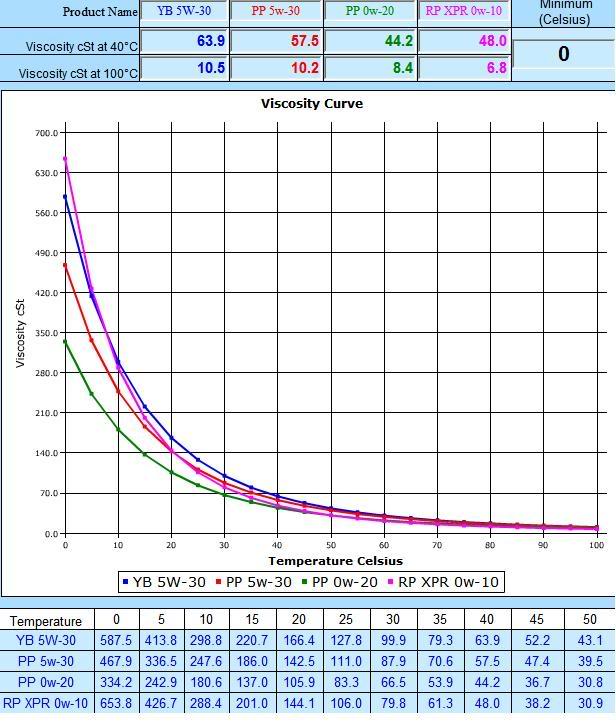
Look at the Pennzoil Platinum 5W-30 for example. At 100° C (212° F) it's at 10.2 cSt, at 40° C (104° F) it's at 57.5 cSt (about 5x thicker) but at 0° C (32° F) it has a cSt of 468, or 45 times thicker than at operating temp. At 0 degrees, only 1/45th or about 2 percent as much oil will flow into your bearings than at operating temp. And that's for a synthetic 5W-30. A 10W-40 will perform worse, and a petroleum 10W-40 will perform much worse.
Info on viscosity: http://www.synlube.com/viscosit.htm . . . http://www.carbibles.com/viscosity.html
This post has some more info on the viscosity of winter oils, and how they perform after several thousand miles. It has a couple videos that show how much thicker oil is below freezing: http://www.toyotanation.com/forum/sh...9&postcount=40
To sum up, since the right-hand number of oil is the weight at operating temp, your choice should be based mainly on how loose the bearings are, the signs of which are high motor mileage and low oil pressure. Other issues that probably call for heavier oil include excess engine noise, excess oil consumption, or possibly leaks. (With leaks, also consider using a good high-mileage oil that contains more seal-swelling esters, like Valvoline MaxLife.)
In a low mileage motor with tight bearings, 10W-30 is good, but higher mileage trucks benefit from heavier weight oil like 10W-40 or better yet a 15W-40. Basically, lighter oil flows better which is good for bearings, for cooling, and for gas mileage, but heavier oil can provide more protection for sliding parts like cam lobes and rings/cylinder liners. If too thin, oil won't protect bearings & sliding parts, leading to excessive wear. If too thick, it won't flow into and through bearings, leading to oil starvation, overheating & bearing damage.
And choose the left number based on coldest temp expected, to make sure it will flow decently well on startup, when most of the wear of a motor happens. Because oil thickens up so much when cold, as a rough guide, I wouldn't use a 20W-something below freezing, nor a 15W- below about 20F, nor 10W- below say about 5-10 deg F. 5W- can be used down to about -10 deg F. Below -10 F, a 0W- would be best.
So if you run 10W-40 or 15W-40 in summer, and live in an area with freezing temps in winter, choose a 5W-40 or 0W-40 in the winter. Likewise if you run 10W-30 summer, use 5W-30 or 0W-30 in freezing temps, or if you run 15W-50 or 20W-50 in summer, a 5W-50 might work for the winter, or a 0W-40 in very cold temps.
The reason is that the left hand number, the 0W or 10W, represents the "weight" of the oil at 0° F (-18° C). While the right number (30 vs 40) represents the viscosity at 212° F (100° C) - in other words, around operating temp. The thermostat will keep the motor at about 180° - 190° F whether in winter or summer, except in extreme hot or cold temps. So the 10W-30 and 10W-40 will have the same weight at 0° F, but will flow differently at operating temp. And the 0W-30 and 10W-30 will have the same weight once the motor reaches operating temp, but for startup, the 0W-30 will flow at much lower temps than the 10W-30.
The SAE "weight" measurements are confusing because they were developed back when there were only single weight petroleum oils, and the "weight" was a measure of time for a given quantity of oil to flow through a calibrated tube at a given temp. The 10 weight flowed four times quicker than the 40. Yet both of them thickened up considerably when cold. The 40 was so thick at freezing it would hardly flow at all, so in cold temps, the lighter weight oil had to be used, even though it would be MUCH thinner once the engine reached operating temp. The invention of polymer molecules called viscosity index improvers (VII) helped because you could have an oil that flowed like a 10 weight at cold temps and flowed like a 40 weight at operating temp.
The SAE rating of a 10W-40 makes it sound like it's thinner at 0° F than at 212°, but as mentioned, nothing could be further from the truth.
The specs on Exxon Superflo 10W-40 mentioned above are a typical example. At 212° F (100° C) its true viscocity measures 14.1 cSt (centistokes - a measure of time for a given quantity to flow through a calibrated tube), yet at 104° F (40° C) it measures 94 cSt. In other words, the oil is more than 6 times thicker at 104° than it is at operating temp, and at 104 degrees, only 1/6th as much oil will flow into the bearings in a given amount of time than will flow once the motor reaches operating temp.
Viscosity rises even more quickly as temps drop below freezing. This chart shows how dramatically oil thickens as it gets to freezing. The "PP" product listed is Pennzoil Platinum, a synthetic, and the "RP" is Royal Purple:
Look at the Pennzoil Platinum 5W-30 for example. At 100° C (212° F) it's at 10.2 cSt, at 40° C (104° F) it's at 57.5 cSt (about 5x thicker) but at 0° C (32° F) it has a cSt of 468, or 45 times thicker than at operating temp. At 0 degrees, only 1/45th or about 2 percent as much oil will flow into your bearings than at operating temp. And that's for a synthetic 5W-30. A 10W-40 will perform worse, and a petroleum 10W-40 will perform much worse.
Info on viscosity: http://www.synlube.com/viscosit.htm . . . http://www.carbibles.com/viscosity.html
This post has some more info on the viscosity of winter oils, and how they perform after several thousand miles. It has a couple videos that show how much thicker oil is below freezing: http://www.toyotanation.com/forum/sh...9&postcount=40
To sum up, since the right-hand number of oil is the weight at operating temp, your choice should be based mainly on how loose the bearings are, the signs of which are high motor mileage and low oil pressure. Other issues that probably call for heavier oil include excess engine noise, excess oil consumption, or possibly leaks. (With leaks, also consider using a good high-mileage oil that contains more seal-swelling esters, like Valvoline MaxLife.)
In a low mileage motor with tight bearings, 10W-30 is good, but higher mileage trucks benefit from heavier weight oil like 10W-40 or better yet a 15W-40. Basically, lighter oil flows better which is good for bearings, for cooling, and for gas mileage, but heavier oil can provide more protection for sliding parts like cam lobes and rings/cylinder liners. If too thin, oil won't protect bearings & sliding parts, leading to excessive wear. If too thick, it won't flow into and through bearings, leading to oil starvation, overheating & bearing damage.
And choose the left number based on coldest temp expected, to make sure it will flow decently well on startup, when most of the wear of a motor happens. Because oil thickens up so much when cold, as a rough guide, I wouldn't use a 20W-something below freezing, nor a 15W- below about 20F, nor 10W- below say about 5-10 deg F. 5W- can be used down to about -10 deg F. Below -10 F, a 0W- would be best.
So if you run 10W-40 or 15W-40 in summer, and live in an area with freezing temps in winter, choose a 5W-40 or 0W-40 in the winter. Likewise if you run 10W-30 summer, use 5W-30 or 0W-30 in freezing temps, or if you run 15W-50 or 20W-50 in summer, a 5W-50 might work for the winter, or a 0W-40 in very cold temps.
May 18, 2010 | 10:19 AM
#56
Registered User
Joined: Feb 2008
Posts: 1,417
Likes: 0
From: hendersonville, TN.
you can have all the fancy graphs in the world showing all kinds of properties and such.. but when it comes down to it, each motor will react different to the next with the same oil in it.. kinda like bench racing, yea your dyno slip says you have more power in the same car but my track slip says your car is still slow...
this thread is all about opinions and advice for the original poster. so one should not try to say another is wrong.. because you might end up looking like an ass...
this thread is all about opinions and advice for the original poster. so one should not try to say another is wrong.. because you might end up looking like an ass...
 May 18, 2010 | 10:33 AM
#58

Contributing Member
Joined: Nov 2002
Posts: 10,666
Likes: 5
From: Oklahoma State
The new product is the Rotella T6 5W-40, and yes, it looks like an awesome oil for year-round, so long as temps don't go below about -30 F. Gonna try it myself next oil change. I've heard it can often be found at Wallyworld.
 May 18, 2010 | 11:36 AM
#59
Registered User
Joined: Apr 2009
Posts: 5,592
Likes: 24
From: Dixon, Ca
Sure motors will act diff, but not that much to measure. !00c is the standard of engine temps, and it sounds like thats what oil Co's shoot for in the viscosity levels. I have read a bit and so I have been using 5w30 syn blend, Valvoline. I am due for a change today. All my trips are short, so the change is due at less than a 3000 mile mark.
I love OIL FORUMS
I love OIL FORUMS
May 18, 2010 | 03:43 PM
#60
Registered User
Joined: Jan 2005
Posts: 1,600
Likes: 1
From: Leadville Colorado
Well I just changed over to the Valvoline Syn blend 10W40 and the Toyota filter 90915-YZZD3. It did make some noise when I first cranked it because I think the larger filter takes longer to fill, next time I will put some oil in the filter first.


