When you click on links to various merchants on this site and make a purchase, this can result in this site earning a commission. Affiliate programs and affiliations include, but are not limited to, the eBay Partner Network.
I've lurked these forums for years but never posted, so thanks ahead for all the wisdom I've gained previously and in the future.
Useless glamor shots below the post.
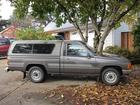
I've been the proud owner of an '84 2WD for about 9 years, and only just hit the 200k mark about 6 months ago. It's been a trusty steed, carrying me to all the good camping spots up and down the west coast and only once letting me down (bad fuel pump, driving from Oakland to Tucson).
After nearly 8 years of living in Tucson, I finally decided that I am a whimp and need A/C and 4WD, so I found myself a sweet '98 4runner to replace Red Truck. Being sentimental, I've decided to drive Red back to its home in Washington so my parents and sister can use it.
My question is, what kind of preventative maintenance should I consider doing before forking it over to my (somewhat less mechanically interested) family? Here's the basic maintenance history from the past 5 years:
- Regular oil, filter, plug & brake pad changes
- New OEM-spec radiator and water pump at about 195k
- New fuel pump at about 175k
- New brake master cyl and front rotors at about 175k
- New battery, cap, rotor, wires, plugs and ignition coil at about 180k
- New shocks and tires at 200k.
That's it. Haven't touched anything else. Previous owner did a few standard things and the first owner babied it for the first 20 years of its life (regular dealer service).
I know the whole "run it til it blows" mentality with this era of yota, but since I'm giving it over to my family I'd rather do whatever I can to make sure it purrs.
Thanks again and cheers!
Just after buying it in 2011:
A few months ago with new general grabber tires:
The new Toy ('98 with dealer-installed supercharger, 4WD and locking diff):
When you did the shocks and tires, did you change out the steering stabilizer?
Have you changed, or at least greased, the front wheel bearings? Have you changed the oil in the transmission, and differential, yet? Have you ever done the valve lash alignment, and replaced the valve cover gasket? PCV valve replacement? Fuel filter replacement?
Above is the maintenance schedule page out of the FSM. Look it over, and see what you've done, and not done, then you can focus on the still remaining procedures.
When you did the shocks and tires, did you change out the steering stabilizer?
Have you changed, or at least greased, the front wheel bearings? Have you changed the oil in the transmission, and differential, yet? Have you ever done the valve lash alignment, and replaced the valve cover gasket? PCV valve replacement? Fuel filter replacement?
Above is the maintenance schedule page out of the FSM. Look it over, and see what you've done, and not done, then you can focus on the still remaining procedures.
Thank you! These are the kinds of things I haven't thought about, so I will add them to my list. I am in the process of going through documents from the previous owners to see what has been done and when, then I'll refer to the FSM and try to catch up some of these things. From your list, the only thing I have done for sure is the fuel filter (same time as fuel pump).
Anything else that isn't in the FSM schedule that folks feel like they wish they had done before it went unexpectedly? Should I think about doing the clutch, or does that give enough warning before it goes? Do I need to worry about the timing chain or timing chain guide? I suppose if I do a valve job, I can check the condition of the timing chain & guide at the same time.
Should I think about doing the clutch, or does that give enough warning before it goes? Do I need to worry about the timing chain or timing chain guide? I suppose if I do a valve job, I can check the condition of the timing chain & guide at the same time.
The only indication that I am aware of, other than inspecting it visually, is if the clutch slips when you accelerate. IE: You step hard on the gas after upshifting. Does the engine accelerate (RPM increases) without a corresponding increase in vehicle speed. Very similar to breaking traction, like when you hit a patch of ice when accelerating. You can hear the engine speed up, without the vehicle accelerating correspondingly.
As for the timing chain, and it's guides: You can pretty easily inspect the chain, and it's guides, with the valve cover off. A flashlight will illuminate the chain and the guides very nicely. You can reach in with a tool, like a screwdriver, and see what the tension on the chain is. Or your fingers, if they'll reach. If it's a bit floppy, or seems loose, either the chain has stretched, the guides are worn out, or a combination of both. Either way, any indication or a worn, stretched, chain, or worn guides, is reason to replace the chain and guides. If it were me, and it was on my 4Runner, I would replace the guides with the steel ones, not the OEM plastic ones.
No need, unless it's damaged, to change the timing chain cover. Did the chain wear on the inside of the cover? You might have to pull the cover to verify, if the light you shine into there doesn't reach everywhere you want, or need, to see. Yes, you'll need to replace it's gasket if you remove it. Same for the water and oil pumps, that are mounted on the front of the cover. If you pull them off, and you may as well while you're there, they will need new gaskets. That includes the seal on the shaft that goes through the oil pump. The front crank shaft seal is mounted in the oil pump. I've replaced the oil pump seals, not to mention the water pump and it's seals, many times, compared to the timing chain, which has only been replaced once, on my 4Runner. The pickup's still is in amazingly good shape, considering it's mileage. See my signature for both their mileages.
Finally, make sure you grease the chassis grease points, and the drive shaft's, if they are there. Some U-joints in drive shafts don't have grease fittings. As I recall, all the chassis, and drive shaft, grease points do NOT come from the factory with grease-zerts. Just small bolts in the holes. I had to buy a bunch of grease-zerts to install in all the fittings. Not a large investment, but WELL worth the cost, and time needed to install them. SO much easier to plug the grease gun onto a grease-zert and give it a couple pumps, than to try and hold the grease gun's hose, with the rubber nozzle on it, in the grease point holes, and pump the gun. Essentially a 3 handed job.
I grease everything twice a year, spring and fall. The worst thing "over greasing" will do, is make a bit of a mess under the truck.
Other than all that, the schedule in the FSM is pretty comprehensive. Do it ALL if it hasn't been done yet. If you're at 200,00 mi., it's either already been done by the previous owner, or it should have been. If something on the FSM listing has not yet been done, it's way overdue!
Sure!
The 2WD only has 4 lube points, unless you have after market drive shaft in it, with grease points in the U-Joints.
On the front end, the ball joints have holes for grease zerts. They have screw-in plugs in them from the factory. I recommend replacing the plugs with zerts. You can get the zerts from almost any auto-parts or hardware stores. Screw them in and leave them in, so when you go to lube the ball joints you just wipe them off, plug the grease gun onto them, a couple of pumps, on to the next. Easy, simple, painless.
Notice the two red arrows. Those are the ball joints that require lubrication. Look at the upper one in the picture, you can see the plug where the zert goes. That little bolt in the center of the top of the ball joint. There's one in the same place on the bottom, just upside down, if you see what I mean. The plug is on the bottom of the ball joint, center.
Right behind the front tires, top and bottom. Just turn the tires all the way one way or the other. You'll be able to see them behind the tires, one side from in front, the other from behind the tire. It's honestly easier to jack up the front end to get more clearance for the top ball joints from the body, but it's not a requirement.
If you have U-Joints in your drive shaft that have holes for lubrication, you'll need to lube all of them. Again, install Zerts, if they don't come already installed. Factory, or OEM, u-joints and drive shafts don't come with holes for lubrication, so if you're still stock, it's a moot point.



 May 11, 2020 | 02:03 PM