


Electric choke question
 Sep 27, 2020 | 10:44 AM
#1

Thread Starter
Registered User
Joined: Jan 2017
Posts: 4
Likes: 1
Electric choke question
Greetings all, it's been a few years I've posted anything here. I guess I'm a lurker. I have a 1976 Toyota Corona wagon, so it's similar to a pre-84 truck, right? Just replaced the stock Aisin carb w/ water choke with a Weber 32/36 with electric choke. I'm trying to find a good 12V switched power source for the choke under the hood. Wondering if I could put a double spade connector on the oil pressure switch & run off that? Would be tidy b/c it's near the carb. Or all the way across the bay to the ballast resistor? Thing is, I don't want to go poking holes in the firewall to stick it in the fuse panel, and would like to keep extra wiring to a minimum. Sorry if this topic has already been beat to death. I've spent an hour or more reading threads & couldn't find anything specific to my situation. To start it up and run it, I stuff a wire from the choke terminal onto the + battery terminal. Hillbilly tech. FWIW, I don't even have the vacuum lines all sorted out yet, and out-of-the-box it runs like a top. I'm amazed.
Thanks for any and all advice! (I'm aware that wiring directly to the coil + input is forbidden by Weber...)
Cheers
Jim B.
Grove City, OH
Thanks for any and all advice! (I'm aware that wiring directly to the coil + input is forbidden by Weber...)
Cheers
Jim B.
Grove City, OH
Sep 27, 2020 | 06:30 PM
#2

Registered User


Joined: Apr 2017
Posts: 964
Likes: 197
Not really fqmiliar with webers or coronas (im a fan but never had one) but usually you can sneak a wire thru your firewall in the same holes the main harnesses pass thru. Usually one large hole on pass side and one on driver side.
Sep 27, 2020 | 06:46 PM
#4
Registered User
Joined: Apr 2017
Posts: 964
Likes: 197
Sep 30, 2020 | 07:22 AM
#7

Registered User
Joined: Jun 2016
Posts: 719
Likes: 190
From: Florida
Yep, that year Corona has the same engine/carb setup as the trucks. You can't run the electric choke off of the oil sender switch because it only passes voltage when you have no oil pressure. Under engine operation it is a "normally open" switch. Oil pressure in the engine when it's running opens the switch, breaking the circuit. The switch closes when you have no oil pressure & turns on your oil light on the dash.
If your '76 Corona Wagon has the original points style ignition system, it should also have a Ballast Resistor, which should look something like this:
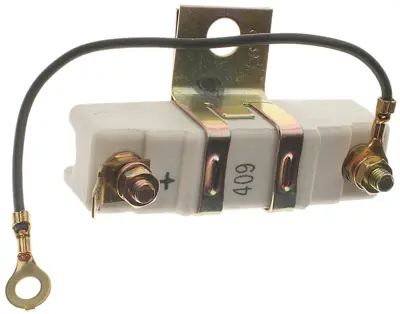
Pictured: NAPA ECHLIN PART # ECH ICR37
On the side of the resistor that has the "+" mark should be the switched 12 volt power feed from the ignition circuit, coming from your ignition switch. Attach your electric choke power feed wire to that.
If you are unsure about this at all, just turn your key on to the "run" position, take a volt meter and measure the voltage on both terminals of the resistor. One side should read full battery power, while the other terminal should read something between 7 - 9.5 volts.
That's the reason why Weber says to not hook up the electric choke to the Coil's "+" terminal, is because that terminal under normal operation gets less than 12 volts, and the electric choke on Webers are designed to use 12 volts. On the lower voltage, the electric choke would open slower than required or not fully, and not work correctly. Weber expected that their carbs would be installed on older vehicles with a points system, which always has a ballast resistor in circuit, hence the instructions to not power the choke from the coil "+" terminal.
20R's from 1978 up (and the later 22R carb'ed engines) have the fully electronic ignition systems (no points) and the ignition coils on those systems receive full 12 volt power. In that case it's fine to power the choke from the coil's "+' terminal. It's very commonly done.
Fun Fact - A 1978-1980 20R Electronic Distributor will drop right into a 1975 to 1977 20R, and you can use a GM HEI Ignition Module to fire the coil and have full 12 volt power to the coil. This gives you a hotter spark than the points system (more power & better mileage), & you never have to fool with replacing or adjusting points ever again. I've done this conversion and have a post up about it. There is also a distributor conversion kit out there made by Pertronics, but I' don't have any personal experience with those.
If your '76 Corona Wagon has the original points style ignition system, it should also have a Ballast Resistor, which should look something like this:
Pictured: NAPA ECHLIN PART # ECH ICR37
On the side of the resistor that has the "+" mark should be the switched 12 volt power feed from the ignition circuit, coming from your ignition switch. Attach your electric choke power feed wire to that.
If you are unsure about this at all, just turn your key on to the "run" position, take a volt meter and measure the voltage on both terminals of the resistor. One side should read full battery power, while the other terminal should read something between 7 - 9.5 volts.
That's the reason why Weber says to not hook up the electric choke to the Coil's "+" terminal, is because that terminal under normal operation gets less than 12 volts, and the electric choke on Webers are designed to use 12 volts. On the lower voltage, the electric choke would open slower than required or not fully, and not work correctly. Weber expected that their carbs would be installed on older vehicles with a points system, which always has a ballast resistor in circuit, hence the instructions to not power the choke from the coil "+" terminal.
20R's from 1978 up (and the later 22R carb'ed engines) have the fully electronic ignition systems (no points) and the ignition coils on those systems receive full 12 volt power. In that case it's fine to power the choke from the coil's "+' terminal. It's very commonly done.
Fun Fact - A 1978-1980 20R Electronic Distributor will drop right into a 1975 to 1977 20R, and you can use a GM HEI Ignition Module to fire the coil and have full 12 volt power to the coil. This gives you a hotter spark than the points system (more power & better mileage), & you never have to fool with replacing or adjusting points ever again. I've done this conversion and have a post up about it. There is also a distributor conversion kit out there made by Pertronics, but I' don't have any personal experience with those.
Trending Topics
Sep 30, 2020 | 01:23 PM
#8
Thread Starter
Registered User
Joined: Jan 2017
Posts: 4
Likes: 1
Thank you very much! I'll dig up some connectors and hook up to the ballast resistor +. I've eyeballed the electronic setups with the GM ignitor, definitely looks like the way to go. Knock on wood, the points/condenser setup has been shockingly trouble-free. I've had motorcycles and equipment that seemed to constantly be in need of love on the ignition system. Hope I didn't just jinx myself.
Thanks again, take care, and have a good un!
Jim
Thanks again, take care, and have a good un!
Jim

Thread
Thread Starter
Forum
Replies
Last Post


