When you click on links to various merchants on this site and make a purchase, this can result in this site earning a commission. Affiliate programs and affiliations include, but are not limited to, the eBay Partner Network.
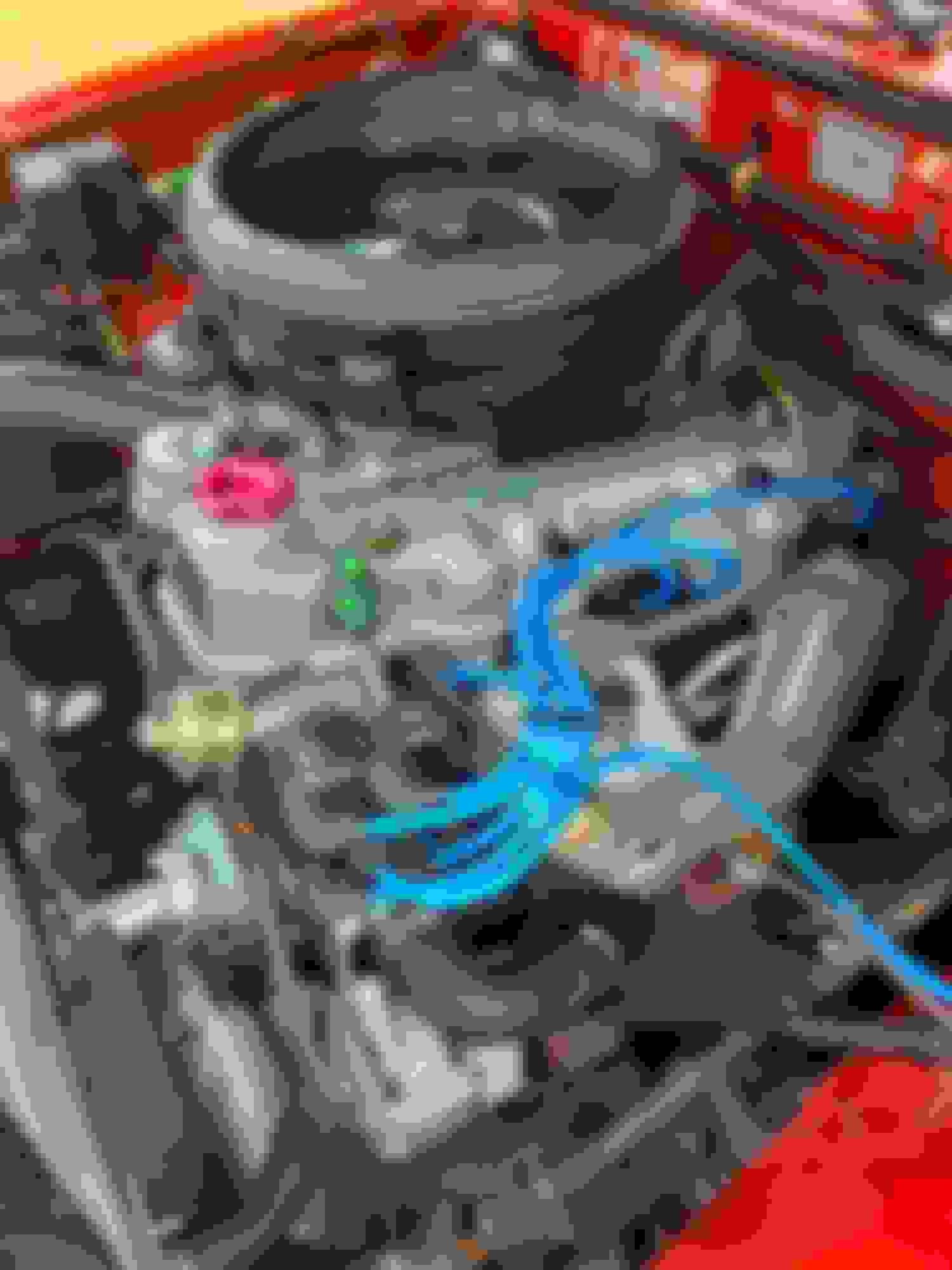
Removed stock cleaner lid, replaced with 14" chrome lid. Fabricated riser from aluminum sheet. Rubber seal from 1970 chevelle.
Pilot scoop bolted and epoxied to hood on hole cut off center over rubber seal. Excellent direct cold air ram air to filter and carb from cool side of the engine away from the exhaust.
It passes the string test at all speeds. With the addition of a 180° thermostat she stays cool and pulls hard.
No dyno results other than butt dyno. However she consistently does 0-60 in around 9 seconds. Typical stock results are 12 to 13 seconds.
Have been wondering if anyone else has tried this type of scoop setup?
Good point however I have been running this setup for well over a year up here in the rainy Northwest with no problems so far. There are small drain holes in the intake pan to mitigate.
No sir 9 seconds. Nothing internal. Rebuilt stock. LCE aluminum pulley and Flexalite fan reducing parasitic draw on the motor. Mostly cold air to the motor and opening up the exhaust with cat delete and glass pack where the cat would be lets her breathe.
Even nine seconds....I can't imagine my truck ever having done that. It's always been slow enough that I've never bothered measuring a 0-60 time. Sometimes it's better not to know.
Even nine seconds....I can't imagine my truck ever having done that. It's always been slow enough that I've never bothered measuring a 0-60 time. Sometimes it's better not to know.
Also it is a 2wd standard cab. No big tires or heavy wheels. Only 2400 lbs so power to weight ratio may be a huge factor.
From what I've read, and I agree, honestly, it's a bad idea.
It allows water down onto/into the engine compartment, where it's not welcome at all. That's why the engines have a cold air intake system that's designed to keep out water when you're driving around in the rain or snow. But just letting it blast in freely, is a bad idea. You'd absolutely need a shield of some sort over the exhaust manifold on down. Water hits the hot piping, crack!
Especially if the engine's air intake is altered to feed off it. You'd need an S curve of some sort, and a drain for any free water that get's in. You know, scoop, down, then up, then back down to the engine compartment in general, or the intake, whichever. Not really a lot of room in there for that kind of thing. Not for a full sized air intake pipe, with an S curve, in a vertical direction, and a water drain on the bottom, under the hood.
From what I've read, and I agree, honestly, it's a bad idea. It allows water down onto/into the engine compartment, where it's not welcome at all. That's why the engines have a cold air intake system that's designed to keep out water when you're driving around in the rain or snow. But just letting it blast in freely, is a bad idea. You'd absolutely need a shield of some sort over the exhaust manifold on down. Water hits the hot piping, crack! Especially if the engine's air intake is altered to feed off it. You'd need an S curve of some sort, and a drain for any free water that get's in. You know, scoop, down, then up, then back down to the engine compartment in general, or the intake, whichever. Not really a lot of room in there for that kind of thing. Not for a full sized air intake pipe, with an S curve, in a vertical direction, and a water drain on the bottom, under the hood.
Does that help? Pat☺
Thanks for your input Pat. I as the OP was not wondering if it was a good idea or not. I have been running this set up for about two years now in rainy Western Washington. This setup is exactly the same as most old school 1960 and 70 muscle cars. In fact I used a rubber seal from a 1970 Chevelle. It is a true functional cold air / ram air intake scoop. Water cannot go anywhere other than into the air filter pan area so no worries about it get on the exhaust. Any water that gets in drains through a small drain hole in the bottom of the pan. Refer to the photos in the OP.
I am asking if anyone else has ever done this or seen anyone else do it on a Toyota pickup with a 20R or 22R motor and if they have are they recieving the same excellent results I have.
Hey man good idea. Obviously works for you just like it did on the old school muscle cars.
I've never seen another like it on a Toyota but, I will be doing something similar except it's for my 3.4 swap. I'm cutting my fender wells where the stock airbox (and battery tray) sits. Making room for 37's. I'm putting on a hood scoop anyway for clearance so I'll come up with a way to get some cool air to the filter. I hope. It will be a while before I get to that point in my build.
Hey man good idea. Obviously works for you just like it did on the old school muscle cars.
I've never seen another like it on a Toyota but, I will be doing something similar except it's for my 3.4 swap. I'm cutting my fender wells where the stock airbox (and battery tray) sits. Making room for 37's. I'm putting on a hood scoop anyway for clearance so I'll come up with a way to get some cool air to the filter. I hope. It will be a while before I get to that point in my build.
Thanks for posting it.
I have a 3.4 swap with the hood scoop. Man there is 0 room between that and your intake manifold on the 3.4 to fit anything in there. Unless you body lift, that would give you some more room but would negate the need for the scoop. Right now I just have a small hole cut out for the corner where the intake manifold hits the hood and water can get down in there. Deciding what type of screen/mesh I need to put in there to prevent such things but haven't settled on a solution yet.
It looks to me that there is no easy way to get cold air to the intake on a 3.4 swap unless you create a box to isolate the filter and maybe draw in air from the fender as the windshield wash fluid reservoir is in the way.



 Nov 26, 2021 | 08:37 PM