


Welcome (back) home 94 pickup
 Jul 1, 2018 | 09:33 PM
#1
Thread Starter
Registered User

Joined: Jun 2018
Posts: 257
Likes: 22
From: Texas
Welcome (back) home 94 pickup


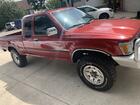
I am new to the Forum. In 1999 my father bought his bosses truck, a 1993 Pickup 4x4 4cycl. He purchased it for me as my first vehicle. I quickly burned out my first clutch and raced up and down the country roads near my home. A few years later I sold it for a string of big v8 Chevys. Well a few days ago I came across a near identical truck and I had to have it. I had not seen a red one rolling around since mine drove away. But …..This 1994 pickup is a V6 with the 3.0.
So it drives well. Does not leak a drop of anything. But the Check Engine Light has come on and even though it still drives great and appears to idle great I have been looking under the hood and found a rubber line that has a screw in the end of it. A previous owner must have done this. I don't mind going to the dealer to get the code read and im sure it will amount to a sensor or something of this nature but thinking back to this hose wont that code be affected by this ? My mechanic buddy looked at it and advised me that the hose ran to a part of the system that fed exhaust back into the system. I guess what I am saying is wont this hose not being connected affect this CEL. I have only put 100 miles on it since Ive owned it so I could not say how long its been on. I did clear it after thinking it was a gas cap but after about 60 miles it came back on.
Just didn't want to pay to have Toyota read the code when this hose could be giving a inaccurate reading to the system.
I have attached a photo of the hose … why would someone plug this up instead of putting it where it goes.... I don't want to mess with it if its running ok and it is for now.
Last edited by Spread5150; Jul 1, 2018 at 09:49 PM.
Jul 1, 2018 | 09:53 PM
#2
Thread Starter
Registered User
Joined: Jun 2018
Posts: 257
Likes: 22
From: Texas
By the way I have been around and no local shop I have been to yet has a scanner for this diagnostic port. Everyone has a more modern hi tech one. Didn’t think I would run into that problem.
Jul 2, 2018 | 06:13 AM
#3

Registered User
Joined: Sep 2015
Posts: 65
Likes: 9
From: Halifax, NS
You do not need a scanner to read your codes. You just jump two ports in the diagnostic port box under the good and turn the key to on and the CEL will flash the codes for you. Have a look on here for the factory service manual for your truck and it will explain in detail .
Jul 2, 2018 | 06:19 AM
#4

Registered User

Joined: Sep 2007
Posts: 8,380
Likes: 871
From: San Francisco East Bay
Welcome to YotaTech! You've come to the right place.
Ah, the scanner. Yes, many "local" shops just don't have the right tool for a vehicle of this vintage. But here's where you can get one: https://www.staples.com/Staples-Jumb...product_525923
Here's how you use the tool: http://web.archive.org/web/201211190...85diagnosi.pdf (Toyota calls the tool the "SST.")
I'm guessing you'll find code 71. This code (all codes) will keep you from passing smog. You have a California vehicle (how do I know?); so there is a good chance you will NEED to pass smog. Even if not, you don't want to be THAT guy poisoning the air around us.
Just so you know, the gas cap won't throw a code. That's on more modern vehicles.
Invest (?) in the tool, check the code(s), report back.
Ah, the scanner. Yes, many "local" shops just don't have the right tool for a vehicle of this vintage. But here's where you can get one: https://www.staples.com/Staples-Jumb...product_525923
Here's how you use the tool: http://web.archive.org/web/201211190...85diagnosi.pdf (Toyota calls the tool the "SST.")
I'm guessing you'll find code 71. This code (all codes) will keep you from passing smog. You have a California vehicle (how do I know?); so there is a good chance you will NEED to pass smog. Even if not, you don't want to be THAT guy poisoning the air around us.
Just so you know, the gas cap won't throw a code. That's on more modern vehicles.
Invest (?) in the tool, check the code(s), report back.
Jul 2, 2018 | 08:11 AM
#6
Registered User
Joined: Sep 2007
Posts: 8,380
Likes: 871
From: San Francisco East Bay
Jul 2, 2018 | 08:39 AM
#7

Registered User
Joined: Jul 2012
Posts: 1,776
Likes: 110
From: Northern Colorado
Some misguided souls defeat the EGR system in the mistaken belief that the truck will then magically have increased horsepower and better fuel economy. While it's true that an improperly working EGR system will cause power loss and mpg decrease, if it's working correctly you'll never notice it's there. Get it plumbed up correctly, make sure the valve moves freely and the ports aren't plugged with carbon, and keep that smog-causing nitrous oxide out of our air.
Keep coming back here for advice and learn to do your own troubleshooting and work. Most mechanics will charge more than the truck is worth for repairs you can easily do yourself. It's the only economically viable way to keep these old trucks running in top shape.
BTW, congratulations on your new ride. It looks like you got a good clean vehicle. It should give you a lot of good times ahead.
Keep coming back here for advice and learn to do your own troubleshooting and work. Most mechanics will charge more than the truck is worth for repairs you can easily do yourself. It's the only economically viable way to keep these old trucks running in top shape.
BTW, congratulations on your new ride. It looks like you got a good clean vehicle. It should give you a lot of good times ahead.
Trending Topics
Jul 2, 2018 | 12:14 PM
#8
Thread Starter
Registered User
Joined: Jun 2018
Posts: 257
Likes: 22
From: Texas
Thank you very much. I dropped it off at my local Toyota dealer for the oil change and air filter. I have zero service records so it’s hard to figure out where it’s at but I figured I should start there. Plus it was 60 bucks for them to do both. Easy first step.
So as I approach 200,000 miles what would be the first things to start replacing since I have no idea what when it last had Service. I’m thinking coolant flush next and sparks and wires is up next. Don’t know. All ears.
As as far as my Check engine light I will get the code done next week and replace whatever is causing it. Hope it to be a O2 sensor or similar. Are they hard to replace on these. I read the sticky on normal stuff for these trucks.
What about timing belt. I do figure this one is a let Toyota do it. Anyone know what it will run.
Another thing that that needs to go are these cheap Chinese tires. They are new but they are crap for street driving. Thinking I will go BFG or Toyo all terrain.
Im all ears and thanks for the advise so far
So as I approach 200,000 miles what would be the first things to start replacing since I have no idea what when it last had Service. I’m thinking coolant flush next and sparks and wires is up next. Don’t know. All ears.
As as far as my Check engine light I will get the code done next week and replace whatever is causing it. Hope it to be a O2 sensor or similar. Are they hard to replace on these. I read the sticky on normal stuff for these trucks.
What about timing belt. I do figure this one is a let Toyota do it. Anyone know what it will run.
Another thing that that needs to go are these cheap Chinese tires. They are new but they are crap for street driving. Thinking I will go BFG or Toyo all terrain.
Im all ears and thanks for the advise so far
 Jul 2, 2018 | 12:33 PM
#10
Registered User
Joined: Jul 2012
Posts: 1,776
Likes: 110
From: Northern Colorado
Timing belt is supposed to be done every 60-90,000 miles or so. Since you have no records, that should be on your list. Figure $800-1200 for a dealer to do it - there's a fair amount of labor involved. The 3vze is a non-interference engine, which means a broken timing belt won't result in further damage - the engine will just stop running. So, if you're staying close to AAA country, it's not absolutely urgent.
Unless the existing O2 sensor is rusted badly into place, changing it is a 15 minute job. Get a Denso (which is what went in at the factory). $40-50 from Rock Auto. Worth doing, especially if you have to pass emissions. (If it's a California truck, there are two sensors. The upstream one is the most important for emissions and running well.)
While you are changing the plugs, do a compression test. Look for uniformity across cylinders.
The valves are probably due for adjustment, but that's also a fairly big job. There are some good writeups about it on this forum.
Unless the existing O2 sensor is rusted badly into place, changing it is a 15 minute job. Get a Denso (which is what went in at the factory). $40-50 from Rock Auto. Worth doing, especially if you have to pass emissions. (If it's a California truck, there are two sensors. The upstream one is the most important for emissions and running well.)
While you are changing the plugs, do a compression test. Look for uniformity across cylinders.
The valves are probably due for adjustment, but that's also a fairly big job. There are some good writeups about it on this forum.
Jul 2, 2018 | 12:49 PM
#11
Registered User
Joined: Sep 2007
Posts: 8,380
Likes: 871
From: San Francisco East Bay
Do you have the owner's manual? It contains this Service Schedule. http://web.archive.org/web/201210210.../1maintena.pdf
Don't worry about past service records; there aren't that many items that are replaced just based on mileage/time. For instance, you'll inspect your brake pads; if they're close to the 1mm (!!) limit, you replace them no matter how many miles they have.
This is a common misconception. "Read the code, replace the part it says to replace." Kinda like a big Lego. But it doesn't work that way. The code tells you what system is not responding correctly. Often there is a "most likely suspect" part, the replacement of which will cure the code. But this forum is full of desperate individuals who replace one part after another, without testing anything, until they go bankrupt. (and specifically to the O2 sensor, you're going to replace that just based on mileage, no matter what code you have.)
Speaking of bankrupt, if you think $60 for an oil and air filter change is a good deal, you may not be happy with where this is all going. As you can guess, many (most?) of the individuals on this forum are here because we do the majority of our own work. You have an old (but good lookin!) truck, and even those at the dealership are not going to be familiar with it. Nursing it along is very rewarding, but it can take time and a good ear, and subcontracting all of that out can be expensive.
The timing belt is sort of the dividing line. If you can do everything short of that (replace the O2 sensor, the belts, plugs and wires, adjust the valves, etc.), leaving the timing belt to a professional won't break the bank. But lots of us have changed ours, and I can assure you I'm no professional mechanic. A desire to learn (and the Factory Service Manual) is all you need.
Don't worry about past service records; there aren't that many items that are replaced just based on mileage/time. For instance, you'll inspect your brake pads; if they're close to the 1mm (!!) limit, you replace them no matter how many miles they have.
Speaking of bankrupt, if you think $60 for an oil and air filter change is a good deal, you may not be happy with where this is all going. As you can guess, many (most?) of the individuals on this forum are here because we do the majority of our own work. You have an old (but good lookin!) truck, and even those at the dealership are not going to be familiar with it. Nursing it along is very rewarding, but it can take time and a good ear, and subcontracting all of that out can be expensive.
The timing belt is sort of the dividing line. If you can do everything short of that (replace the O2 sensor, the belts, plugs and wires, adjust the valves, etc.), leaving the timing belt to a professional won't break the bank. But lots of us have changed ours, and I can assure you I'm no professional mechanic. A desire to learn (and the Factory Service Manual) is all you need.
Jul 2, 2018 | 06:06 PM
#13
Thread Starter
Registered User
Joined: Jun 2018
Posts: 257
Likes: 22
From: Texas
looking at the code it’s the egr. Which looking at the way the previous owner plugged this line I’m guessing it was causing some issue. So looking at what I found under this hood with a screw in the hose and now this code what can I assume and more importantly what would be my next step.
Jul 2, 2018 | 06:27 PM
#14
Registered User
Joined: Jul 2012
Posts: 1,776
Likes: 110
From: Northern Colorado
Check out that FSM section that scope103 referenced in reply #6 above. That shows how to inspect and test the various parts of the EGR system.
First thing I'd do, though, is plug the hose back into the valve where it belongs, clear the code, and see what happens. Might just work fine.
First thing I'd do, though, is plug the hose back into the valve where it belongs, clear the code, and see what happens. Might just work fine.
Jul 2, 2018 | 09:24 PM
#15
Registered User


Joined: Jun 2013
Posts: 3,112
Likes: 582
From: Portland, Oregon, USA
You will not know until you try.
 Jul 2, 2018 | 10:03 PM
#16
Thread Starter
Registered User
Joined: Jun 2018
Posts: 257
Likes: 22
From: Texas
So if I plug the EGR back in and it runs like pooo (which Im guessing is going to happen since the previous owner made this plugging the wire move) is the next step replacing the EGR. (140ish bucks). Is the diaphragm in that unit … Im thinking you will be right on with this guess. I have been reading around that people will throw a resistor in the mix to kill the code. The truck runs fine as far as I can tell for now but I want it fixed right if this is part of the motors design.
Jul 3, 2018 | 07:26 AM
#17
Registered User
Joined: Jul 2012
Posts: 1,776
Likes: 110
From: Northern Colorado
Again, you need to read the FSM section that's been referenced and do the tests that are indicated there. The EGR system isn't complicated, but there are multiple components and just throwing parts at it isn't the most efficient way to fix it. A stuck EGR vacuum modulator could also leave the EGR valve open at all times causing the engine to run poorly.
Basically, the EGR (Exhaust Gas Recirculation) system, under certain condions, recirculates exhaust gas into the intake manifold to reduce high combustion temperatures which are the cause of NOx emissions. However, too much exhaust gas at the wrong time will cause the engine to lose power or stumble. So, the EGR system closes off the recirculation during cold engine operation and/or idle or low throttle operation, or (I think) at wide open throttle. At all other times the recirculation is active. The valve is what controls that.
I do not know where you would put a resistor to kill the code - I'm not sure how the ECM determines that the EGR system is not working properly.
Basically, the EGR (Exhaust Gas Recirculation) system, under certain condions, recirculates exhaust gas into the intake manifold to reduce high combustion temperatures which are the cause of NOx emissions. However, too much exhaust gas at the wrong time will cause the engine to lose power or stumble. So, the EGR system closes off the recirculation during cold engine operation and/or idle or low throttle operation, or (I think) at wide open throttle. At all other times the recirculation is active. The valve is what controls that.
I do not know where you would put a resistor to kill the code - I'm not sure how the ECM determines that the EGR system is not working properly.
Last edited by RJR; Jul 3, 2018 at 07:30 AM.
Jul 3, 2018 | 07:53 AM
#18
Registered User
Joined: Nov 2015
Posts: 165
Likes: 1
Nice truck. I've seen many newer trucks, but I prefer my '94 Yota and the $0 per month payment.
Haha! Well, maybe a lil hyperbole in your comment, but we see things the same way basically. Mine is black.
Haha! Well, maybe a lil hyperbole in your comment, but we see things the same way basically. Mine is black.
Jul 3, 2018 | 08:47 AM
#19
Registered User
Joined: Sep 2007
Posts: 8,380
Likes: 871
From: San Francisco East Bay
You don't want to throw parts at anything, Your guess of a bad diaphragm is just a guess. Your prior owner wouldn't be the first person to fear everything under the hood, and think that he's improving things by mucking up the plumbing. It's not hard to actually determine what's wrong by running the diagnostics.
Remember that the EGR system (significantly) reduces NOx pollution. If you're in an area with smog checks, you'll never pass with a disabled system. If you don't have smog checks, you still breathe the air, and NOx turns to nitric acid on contact with water vapor. It's not something you want to be putting into the air for a few bucks. (a complete EGR valve is as little as $80 from RockAuto -- but DON'T order it until your testing shows the current one IS bad.)
Last edited by scope103; Jul 3, 2018 at 09:02 AM.
Jul 3, 2018 | 08:47 AM
#20
Thread Starter
Registered User
Joined: Jun 2018
Posts: 257
Likes: 22
From: Texas
I am unable to load that guide. But I will run a few Tess and report back. The truck is only being driven about once a week till I get a few things done. (things not related to the truck )


