


Lift...WHY
 Feb 12, 2009 | 11:40 PM
#21
Registered User
Joined: Oct 2007
Posts: 5,377
Likes: 5
I think most people lift for looks. I also think that if you're going to lift for performance, lift with tires first, then, if you have to, suspension. Lift the suspension all you like, but your under-axle clearance stays the same. Lockers should come before a lift.
The adage "look before you leap" seems singularly appropriate here. 
Actually, Toyotas have some of the highest clearance of any stock vehicle. I think some full sizes may have a little tiny bit more, but the break-over angle isn't near as good.
yeah i admit doing lifts for looks. im not the type of guy that beats on trucks. just drive on easy trails thats it. stock, these trucks are pretty low compared to other trucks. and its getting to be a pain bending down to get into my truck. hit my head couple of times already. im used to jumping in.
Actually, Toyotas have some of the highest clearance of any stock vehicle. I think some full sizes may have a little tiny bit more, but the break-over angle isn't near as good.
Last edited by Matt16; Feb 12, 2009 at 11:43 PM.

 Feb 13, 2009 | 07:45 AM
#24

Registered User

Joined: Sep 2004
Posts: 1,515
Likes: 0
From: Plainfield, IL
This thread is a debate between form and function, performance and looking cool. Im not saying lift is all bad but lifting for lifting for lifting sake aint my thing.
I just happen to like form and performance. I like pulling onto a trail and havind a roof line almost as low as stockers. Ive wheeled tall and Ive wheeled low, There is no comparison PERIOD.
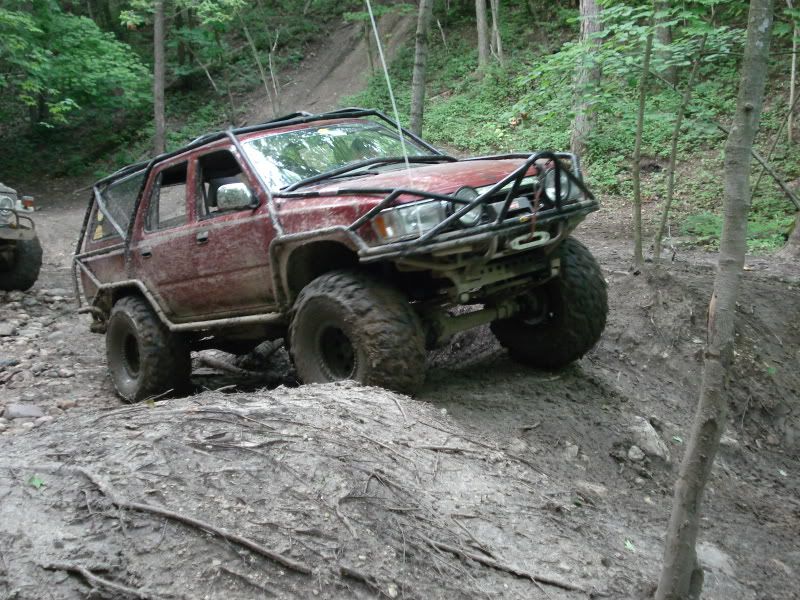
I just happen to like form and performance. I like pulling onto a trail and havind a roof line almost as low as stockers. Ive wheeled tall and Ive wheeled low, There is no comparison PERIOD.

 Feb 13, 2009 | 08:12 AM
#26

Contributing Member
Joined: Dec 2005
Posts: 2,124
Likes: 0
From: Los Osos, CA (we can't agree on crap!)
This thread is funny, it's gone from the OP asking about the good/bad of lifting an IFS rig for hunting and mild trails, to saying no lift and showing pics of exo'd, cut fenders, SAS'd, rigs with 42's. LOL
If you are going to continue with the no lift/ vs. lift at least keep it to the same suspension as the OP. TC had good points as did others, but showing SAS'd rigs, with cut fenders, and 42's has nothing to do with IFS lifting and what the original question was. NOw show me a low IFS rig on 42's wheeling without breaking a ton of crap and you're proving some points. LOL
If you are going to continue with the no lift/ vs. lift at least keep it to the same suspension as the OP. TC had good points as did others, but showing SAS'd rigs, with cut fenders, and 42's has nothing to do with IFS lifting and what the original question was. NOw show me a low IFS rig on 42's wheeling without breaking a ton of crap and you're proving some points. LOL
Feb 13, 2009 | 10:12 AM
#27
Registered User
Joined: Sep 2004
Posts: 1,515
Likes: 0
From: Plainfield, IL
Clearly you have missed my point. Thats ok, unfortunatly I left my crayons at home.
Try reading my posts.
And those rigs, while extreem examples are relevent, maybe not to you, but they were in response to mastacoxs.
Try reading my posts.
And those rigs, while extreem examples are relevent, maybe not to you, but they were in response to mastacoxs.
Feb 13, 2009 | 10:32 AM
#28
Registered User
Joined: Oct 2006
Posts: 366
Likes: 0
From: Some where in Utah
That's why I don't have any lift...
To clarify some of the misinformation above...
- IFS lifts (other than bracket lifts) do NOT provide room for larger tires. The compression bumpstops are still in the same place!
- IFS lifts do not provide more articulation - the bumpstops are still the same distance apart. One exception: Balljoint spacers kind of cheat this a little by movnig the arms apart to gain more droop travel (the falsely claimed merits of droop travel are for a different thread).
IFS lifts as described by what the OP wants to do can result in better approach/departure/breakover angles at static ride height, but offroad, that is rarely the situation.
To clarify some of the misinformation above...
- IFS lifts (other than bracket lifts) do NOT provide room for larger tires. The compression bumpstops are still in the same place!
- IFS lifts do not provide more articulation - the bumpstops are still the same distance apart. One exception: Balljoint spacers kind of cheat this a little by movnig the arms apart to gain more droop travel (the falsely claimed merits of droop travel are for a different thread).
IFS lifts as described by what the OP wants to do can result in better approach/departure/breakover angles at static ride height, but offroad, that is rarely the situation.
1st. Any lift of more than 1.5-2 inches will create room for bigger tire's.
2nd. Ball joint spacers will add suspensioin travel. But its not droop, its compression. Ball joint spacers push the spindal and lower a-arm away from the lower bumpstop giving it more room to travel upward. The location of the upper a-arm stays in the same place, leaving it the same distance from the upper bumpstop and not gaining any room to travel down.
Sorry for the interuption on the thread. Back to your regular program.....
Feb 13, 2009 | 10:36 AM
#29
Contributing Member
Joined: Dec 2003
Posts: 2,893
Likes: 2
From: Fort Worth, TX
Saying that lifting will not let you clear bigger tires is a misnomer, an oversimplification based on a lot of assumptions that are not necessarily correct. And comparing a 12" bracket lift to a 1.5" spring lift with a flattened pinch weld is obviously a mistake.
Last edited by mastacox; Feb 13, 2009 at 10:37 AM.
Feb 13, 2009 | 11:49 AM
#30
Registered User
Joined: Sep 2004
Posts: 1,515
Likes: 0
From: Plainfield, IL
Never said you should never lift, I am lifted x# of inches, I actually have no idea how much. Who said 12" I say anything over 4" is uneccessary.
But lifting for lifting for lifting sake.....ahhh im tired of saying the same old crap over and over in countless threads
But lift and flex are over-rated. Keep em low, stable, and light. Thats my opinion, take it for whatever its worth.
But lifting for lifting for lifting sake.....ahhh im tired of saying the same old crap over and over in countless threads
But lift and flex are over-rated. Keep em low, stable, and light. Thats my opinion, take it for whatever its worth.
Feb 13, 2009 | 12:48 PM
#31
Contributing Member
Joined: Dec 2003
Posts: 2,893
Likes: 2
From: Fort Worth, TX
Feb 13, 2009 | 12:49 PM
#32
Contributing Member
Joined: Dec 2005
Posts: 2,124
Likes: 0
From: Los Osos, CA (we can't agree on crap!)
I don't think anyone would argue with you about the pros of keeping a rig low for stability. That is obvious. You say that lift and flex is overrated but you forget that all those rigs you posted did stuff to gain flex and keep their rigs low. Number one, being they moved their shock towers to get longer shocks for more flex and two clearancing for larger tires. If what you said was true, then no one would move their shock towers for longer shocks. Yes you went to the extreme with your examples and that is what I thought was funny when pertaining to this thread. I find your arguments very true, I just thought it was funny that these threads always end up with pics of built solid axle rigs that have been cut here and there to get great results, but rarely do you see a pic of TC's or AxleIke's to prove the point.
 I've got no problem with you or what you said, just making a statement about what I've seen over the years on these threads.
A little IFS lift can help in many ways especially if you're not looking into doing a lot of trimming and fab work. While it may or may not gain you any flex in the front, depending on how you lift it, it can allow the rear to gain more flex, through longer coils and shocks. We all know that IFS is going to hang a front tire all the time, but if you can keep your rear planted while hanging a front tire, it can be very helpful especially if you're locked or double locked.
On a sidenote, depending on how you set up your bj spacers determines whether you are gaining droop or compression. BJ spacers just thrown in and not touching touching the tbars, the upper arm is in about the same spot while the lower arm is 1.5 inches lower. This means going down the trail your droop is still about the same from stock but you have more uptravel.
Now, bj spacers installed with the tbars backed off to where the lower arms are at a stock angle will gain you droop going down the trail as now the upper arm is 1.5 inches higher.
Feb 13, 2009 | 01:38 PM
#34
Registered User
Joined: Sep 2004
Posts: 1,515
Likes: 0
From: Plainfield, IL
Haha, no crayons needed. I did read your posts, and they are very relevant in a thread purely about a basic lift vs. no lift vs. basic lift w/ trimmed fenders, beds, relocated shock towers, etc..... I guess I missed the relevance in relation to IFS rigs/lifts. And I suppose could be relevant to mastacox's post, but I hightly doubt he was referring to SAS trail rigs with his statement.
I don't think anyone would argue with you about the pros of keeping a rig low for stability. That is obvious. You say that lift and flex is overrated but you forget that all those rigs you posted did stuff to gain flex and keep their rigs low. Number one, being they moved their shock towers to get longer shocks for more flex and two clearancing for larger tires. If what you said was true, then no one would move their shock towers for longer shocks. Yes you went to the extreme with your examples and that is what I thought was funny when pertaining to this thread. I find your arguments very true, I just thought it was funny that these threads always end up with pics of built solid axle rigs that have been cut here and there to get great results, but rarely do you see a pic of TC's or AxleIke's to prove the point. I've got no problem with you or what you said, just making a statement about what I've seen over the years on these threads.
A little IFS lift can help in many ways especially if you're not looking into doing a lot of trimming and fab work. While it may or may not gain you any flex in the front, depending on how you lift it, it can allow the rear to gain more flex, through longer coils and shocks. We all know that IFS is going to hang a front tire all the time, but if you can keep your rear planted while hanging a front tire, it can be very helpful especially if you're locked or double locked.
On a sidenote, depending on how you set up your bj spacers determines whether you are gaining droop or compression. BJ spacers just thrown in and not touching touching the tbars, the upper arm is in about the same spot while the lower arm is 1.5 inches lower. This means going down the trail your droop is still about the same from stock but you have more uptravel.
Now, bj spacers installed with the tbars backed off to where the lower arms are at a stock angle will gain you droop going down the trail as now the upper arm is 1.5 inches higher.
I don't think anyone would argue with you about the pros of keeping a rig low for stability. That is obvious. You say that lift and flex is overrated but you forget that all those rigs you posted did stuff to gain flex and keep their rigs low. Number one, being they moved their shock towers to get longer shocks for more flex and two clearancing for larger tires. If what you said was true, then no one would move their shock towers for longer shocks. Yes you went to the extreme with your examples and that is what I thought was funny when pertaining to this thread. I find your arguments very true, I just thought it was funny that these threads always end up with pics of built solid axle rigs that have been cut here and there to get great results, but rarely do you see a pic of TC's or AxleIke's to prove the point.
I've got no problem with you or what you said, just making a statement about what I've seen over the years on these threads.A little IFS lift can help in many ways especially if you're not looking into doing a lot of trimming and fab work. While it may or may not gain you any flex in the front, depending on how you lift it, it can allow the rear to gain more flex, through longer coils and shocks. We all know that IFS is going to hang a front tire all the time, but if you can keep your rear planted while hanging a front tire, it can be very helpful especially if you're locked or double locked.
On a sidenote, depending on how you set up your bj spacers determines whether you are gaining droop or compression. BJ spacers just thrown in and not touching touching the tbars, the upper arm is in about the same spot while the lower arm is 1.5 inches lower. This means going down the trail your droop is still about the same from stock but you have more uptravel.
Now, bj spacers installed with the tbars backed off to where the lower arms are at a stock angle will gain you droop going down the trail as now the upper arm is 1.5 inches higher.
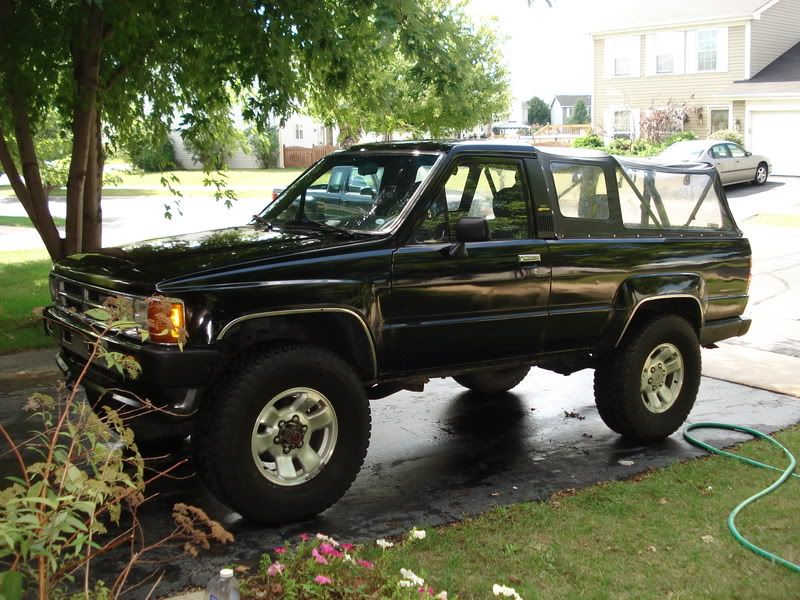
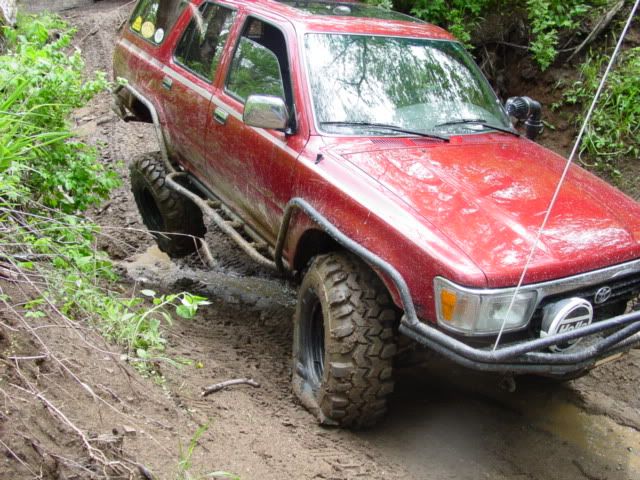
And here is my rig a few years ago on IFS, and it furthers your point about the advantages of a flexy rear end and rear locker to keep IFS moving forward.
 Feb 13, 2009 | 01:46 PM
#35

Contributing Member
Joined: Nov 2005
Posts: 8,875
Likes: 3
From: Longmont, CO
On the street maybe. How you figure ofroad though? The axle will still stuff to the same place, meaning the larger diameter tire is now more likely to be in the sheetmetal. It will take more force to get there because you have compressed the spring more, but it will still go to the same compression limit given enough force.
Feb 13, 2009 | 01:48 PM
#36
Contributing Member
Joined: Nov 2005
Posts: 8,875
Likes: 3
From: Longmont, CO
Tons of pix at www.4wheelingoh.shutterfly.com and www.cottora.shutterfly.com

 Feb 13, 2009 | 01:57 PM
#39
Contributing Member
Joined: Dec 2005
Posts: 2,124
Likes: 0
From: Los Osos, CA (we can't agree on crap!)
Tons of pix at www.4wheelingoh.shutterfly.com and www.cottora.shutterfly.com
4rnr, nice first gen, I don't remember you having that. I've got another question for you concerning your 4runner but I'll pm that one.
To the OP, x's 2 on what mic09dsm just said.
I for one enjoy the extra travel I got with the bj spacers but it may not be needed for what you plan. I also tend to do a wide variety of wheeling, some of it at higher speeds and the extra travel is nice, although I long for more. LOL
Last edited by slosurfer; Feb 13, 2009 at 02:05 PM. Reason: It's a debate not an "argument" :)


