


Is disconnecting an IFS front swabar stupid ???
 Jul 18, 2005 | 07:59 AM
#43
Registered User
Joined: Apr 2004
Posts: 2,685
Likes: 1
From: Ashburnham, MA
Originally Posted by Cebby
OK, so we've established that excessive droop breaks parts, right?
I'd like to play devil's advocate for a minute. The purpose of a swaybar is to reduce bodyroll by limiting stuff and pushing back to keep both wheels firmly planted. So what happens in off-camber situations? The wheel with the weight on it will push down the wheel without weight on it to keep them both on the ground. Wouldn't this be a disadvantage in offcamber situations?
I'd like to play devil's advocate for a minute. The purpose of a swaybar is to reduce bodyroll by limiting stuff and pushing back to keep both wheels firmly planted. So what happens in off-camber situations? The wheel with the weight on it will push down the wheel without weight on it to keep them both on the ground. Wouldn't this be a disadvantage in offcamber situations?
Jul 18, 2005 | 08:48 AM
#44
Contributing Member
Joined: May 2002
Posts: 6,033
Likes: 3
From: Wandering around Phoenix
I've been out working on my friends truck all weekend so this is the first I've seen of this thread. Here are my thoughts.
>>>Yes, they do. Whether they push down with enough force to matter...I don't know.
>>>Bingo! That's the reason to disconnect the sway bar, not necessarily for traction. It's to keep you more level and not so tippy.
>>>The sway bar is a torsion bar and it's a lever. You're both right.
>>>Andy, steel can actually be designed to have an infinity fatigue life, especially spring steel. Other metals cannot not, like aluminum. So for example, take your paper clip and bend it into a U. Now torque it like a sway bar would be bent but only bend it 1 deg. It'll last forever. Once you start getting toward the yield stress of the steel, that's when you have to start worrying about fatigue failure. Within the normal window of travel I would expect a sway bar to last longer than the truck unless the sway bar was somehow damaged. I know that schaefer has bent the rear sway bar, but I don't think anybody will bent a front sway bar on and IFS rig. The sway bar only has to oppose the force of the suspension spring.
Originally Posted by sschaefer3
Do the air shocks push down or apply pressure to the drooped wheel?
Originally Posted by Cebby
The purpose of a swaybar is to reduce bodyroll by limiting stuff and pushing back to keep both wheels firmly planted. The wheel with the weight on it will push down the wheel without weight on it to keep them both on the ground. Wouldn't this be a disadvantage in offcamber situations?
>>>The sway bar is a torsion bar and it's a lever. You're both right.
>>>Andy, steel can actually be designed to have an infinity fatigue life, especially spring steel. Other metals cannot not, like aluminum. So for example, take your paper clip and bend it into a U. Now torque it like a sway bar would be bent but only bend it 1 deg. It'll last forever. Once you start getting toward the yield stress of the steel, that's when you have to start worrying about fatigue failure. Within the normal window of travel I would expect a sway bar to last longer than the truck unless the sway bar was somehow damaged. I know that schaefer has bent the rear sway bar, but I don't think anybody will bent a front sway bar on and IFS rig. The sway bar only has to oppose the force of the suspension spring.
Last edited by Robinhood150; Jul 18, 2005 at 09:01 AM.
 Jul 18, 2005 | 09:28 AM
#46
Contributing Member
Joined: Feb 2003
Posts: 613
Likes: 0
From: CT
In my limited experience I have found that stuffing a front tire with the swaybar connected is almost impossible. I climbed the same tree stump on two different occasions- once with swaybar connected and once without.
With it connected, the only way to get one front tire onto the stump was to use a little momentum. The result was a lifted rear tire and a nearly tipped over vehicle.
At that point there is no IFS. It's just FS
The second time without the swaybar connected I was able to drive up and actually use the front suspension. The one front tire stuffed and the rear tire on the same side was in close contact to the ground.
With open diffs, there is a difference.
With it connected, the only way to get one front tire onto the stump was to use a little momentum. The result was a lifted rear tire and a nearly tipped over vehicle.
At that point there is no IFS. It's just FS
The second time without the swaybar connected I was able to drive up and actually use the front suspension. The one front tire stuffed and the rear tire on the same side was in close contact to the ground.
With open diffs, there is a difference.
Jul 18, 2005 | 09:47 AM
#47

Banned
Joined: Jun 2003
Posts: 0
Likes: 1
Originally Posted by Robinhood150
>>>Andy, steel can actually be designed to have an infinity fatigue life, especially spring steel. Other metals cannot not, like aluminum. So for example, take your paper clip and bend it into a U. Now torque it like a sway bar would be bent but only bend it 1 deg. It'll last forever. Once you start getting toward the yield stress of the steel, that's when you have to start worrying about fatigue failure. Within the normal window of travel I would expect a sway bar to last longer than the truck unless the sway bar was somehow damaged. I know that schaefer has bent the rear sway bar, but I don't think anybody will bent a front sway bar on and IFS rig. The sway bar only has to oppose the force of the suspension spring.

i bent it when taking these pics...


Last edited by bamachem; Jul 18, 2005 at 09:52 AM.
Jul 18, 2005 | 09:59 AM
#49
Contributing Member
Joined: May 2002
Posts: 6,033
Likes: 3
From: Wandering around Phoenix
Originally Posted by bamachem
mine is bent upwards on the driver side (higher than the passenger side at the endlinks) by about an inch...
 Jul 18, 2005 | 05:47 PM
#50

Contributing Member
Joined: Nov 2003
Posts: 2,315
Likes: 0
The front sway bar can fail, one of the guys at work, snapped a Tacoma one driving around the jobsite.
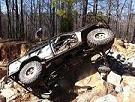
Ever since I installed the LT kit I haven't had a front swaybar, the wider stance and raising the roll center has compensated for it. In the picture depicted, I actually got hung up on the drivers side lower link mount, which is a common problem that I will soon change.
A swaybar is added to a suspension to reduce body roll, raising the roll center does the same thing, so for offcamber situations both work equally as well, that's why many have gone to links on their rock buggies, since a leaf spring set-up has a low roll center.
Originally Posted by jacksonpt
Now, obviously, the guy in the pic doesn't have a "typical" IFS setup... I think the long travel IFS and a good driver is what made the difference - not the swaybar.
A swaybar is added to a suspension to reduce body roll, raising the roll center does the same thing, so for offcamber situations both work equally as well, that's why many have gone to links on their rock buggies, since a leaf spring set-up has a low roll center.
Last edited by BruceTS; Jul 18, 2005 at 05:50 PM.
 Jul 18, 2005 | 06:52 PM
#52

Registered User
Joined: Dec 2003
Posts: 792
Likes: 0
From: Minnesota
Originally Posted by sschaefer3
So the real entire reason to convert to a straight front axle is that both front tires carry the weight of the truck all the time or at least most of the time, a lot more than an IFS truck.
So go back to the fulcrum vs. equal weight argument. It's very easy to prove: cross your truck up in dirt with the selectable lockers unlocked - see what tires spin first. It's the tires that are at droop. Why? Less pressure on the tires = less traction = less ability to overcome power transmitted to the tires. If your theory were indeed true, any of the 4 tires would be equally capable of spinning in the above scenerio.
Keep in mind this as well: in an IFS suspension, the droop is limited by limiting straps or bump stops. There is no upward "pull" on the tire by the spring. This is not the case in a leaf spring setup. Past a certain point in droop (the springs natural arch), the spring will actually pull up on the axle, further reducing the pressure the tire is able to put on the ground. This is true of captured coil springs as well.
So, with those statements made, the entire argument has to change directions.
The function of a sway bar is to not really put additional downward pressure on the compressed wheel, though that may be a by-product of the intent of the bar. The sway bar itself is intended to maintain equal pressure on both tires; it does this by acting as a levered torsion bar, that in a "cross-up" situation will increast upward pressure on the drooping tire. This is what helps vehicles corner "flatter" in a corner. Keep in mind that the droop tire doesn't have the force capable to overcome the entire weight of the vehicle. In a corner, for instance, velocity pushes a good portion of the weight of teh vehicle to the outer tire - that mass cannot be overcome by the torsional effect of the inside weight of the tire or pressure of the inner spring pushing that tire down. So like I said, there may be a minimal biproduct of downward pressure of the drooping tires isn't as great an affect on the compressed tire as the compressed tire is on the dropping tire...
Jul 18, 2005 | 09:56 PM
#53
Contributing Member
Joined: May 2002
Posts: 6,033
Likes: 3
From: Wandering around Phoenix
Originally Posted by BruceTS
The front sway bar can fail, one of the guys at work, snapped a Tacoma one driving around the jobsite.
Jul 20, 2005 | 09:18 AM
#54
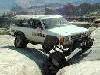

If the sway bar is connected and the axle (solid or IFS) is articulated, the compressed side is pushing up on the sway bar end. That imparts a torque into the bar and that is transferred to the drooping side where it lifts UP on that wheel. In the extreme, if you had a perfectly rigid sway bar, the drooping wheel would be pulled up just as far as the compressed wheel. The amount of "lift" is related to the ratio of the suspension and sway bar stiffness.
And a sway bar (or properly anti-sway bar) does not keep the loads on the tires equal. In fact it does the opposite. It puts more load on the compressed side by "stealing" weight from the drooping side. Its purpose is to stiffen the roll rate of the suspension. Say you had a 300 lbs. per inch set of springs on the truck. Then the suspension stiffness would be that same 300 lbs/in. in normal up/down motion or in side to side roll in a turn or in uneven terrain. Adding a sway bar, of say 150 lbs/in would then increase the roll rate to 450 lbs/in while leaving the springs at 300 for a softer ride. You could get essentially the same roll rate by increasing the springs to 450 lbs/in, but then the ride would be stiffer.
http://www.automotivearticles.com/Anti-sway_bars.shtml
With a solid front axle and leaf springs (w/ no sway bar) you get a "forced articulation" effect when one side is compressed, since the springs are inboard (about 1/2 the width of the axle) from the wheel. Sort of like a teeter totter, the axle pivots on the compressed spring and the upward force on the compressed wheel is cantilevered to the opposite wheel and spring where it acts to pull that side down farther.
And a sway bar (or properly anti-sway bar) does not keep the loads on the tires equal. In fact it does the opposite. It puts more load on the compressed side by "stealing" weight from the drooping side. Its purpose is to stiffen the roll rate of the suspension. Say you had a 300 lbs. per inch set of springs on the truck. Then the suspension stiffness would be that same 300 lbs/in. in normal up/down motion or in side to side roll in a turn or in uneven terrain. Adding a sway bar, of say 150 lbs/in would then increase the roll rate to 450 lbs/in while leaving the springs at 300 for a softer ride. You could get essentially the same roll rate by increasing the springs to 450 lbs/in, but then the ride would be stiffer.
http://www.automotivearticles.com/Anti-sway_bars.shtml
With a solid front axle and leaf springs (w/ no sway bar) you get a "forced articulation" effect when one side is compressed, since the springs are inboard (about 1/2 the width of the axle) from the wheel. Sort of like a teeter totter, the axle pivots on the compressed spring and the upward force on the compressed wheel is cantilevered to the opposite wheel and spring where it acts to pull that side down farther.
Last edited by 4Crawler; Jul 20, 2005 at 09:50 AM.
Jul 20, 2005 | 09:28 AM
#55
Thread Starter
Contributing Member
Joined: May 2002
Posts: 5,278
Likes: 0
From: Tempe, Arizona
Originally Posted by 4Crawler
With a solid front axle and leaf springs (w/ no sway bar) you get a "forced articulation" effect when one side is compressed, since the springs are inboard (about 1/2 the width of the axle) from the wheel. Sort of like a teeter totter, the axle pivots on the compressed spring and the upward force on the compressed wheel is cantilevered to the opposite wheel and spring where it acts to pull that side down farther.


Thread
Thread Starter
Forum
Replies
Last Post
FS[GreatLakes]: Toyota collection part out
88sasturbotoy
Axles - Suspensions - Tires - Wheels
3
Jan 30, 2026 01:57 PM
Flying91
86-95 Trucks & 4Runners (Build-Up Section)
45
Apr 11, 2024 04:39 PM
coffey50
Offroad Tech
17
Jul 28, 2015 10:55 AM
scottyg486
Offroad Tech
3
Jul 19, 2015 05:34 PM


