


Oil Sludge Monster Attacks!!
 Feb 23, 2009 | 09:17 AM
#61

Registered User
Joined: Mar 2008
Posts: 3,870
Likes: 4
From: Chico, California
In one of those links, i was reading, it discussed sludge, somewhat enlightening.
Feb 23, 2009 | 11:33 AM
#62

Contributing Member
Joined: Sep 2005
Posts: 199
Likes: 0
From: Colorado
Feb 23, 2009 | 08:38 PM
#63
Registered User
Joined: Feb 2009
Posts: 18
Likes: 0
From: Las vegas
this build up is minimal compared to a vw motor that people haven't taken care of. I have seen this in many vw's and the fix i use is removing the valve cover and scraping off as much of the sludge is i can and clean using a wire brush and brake clean, remove oil pan clean off all sludge and replace the pickup tube or clean the screen if you can. i have seen this to where i had to replace motors from lack of oil pressure i have used a special tool i think from BG service it is a very large external filter and chemicals
Feb 24, 2009 | 12:03 AM
#64
Contributing Member
Joined: Sep 2005
Posts: 199
Likes: 0
From: Colorado
this build up is minimal compared to a vw motor that people haven't taken care of. I have seen this in many vw's and the fix i use is removing the valve cover and scraping off as much of the sludge is i can and clean using a wire brush and brake clean, remove oil pan clean off all sludge and replace the pickup tube or clean the screen if you can. i have seen this to where i had to replace motors from lack of oil pressure i have used a special tool i think from BG service it is a very large external filter and chemicals
Feb 25, 2009 | 10:31 PM
#65
Thread Starter
Registered User
Joined: Dec 2007
Posts: 710
Likes: 2
From: Santa Rosa, CA
Following the good advice from many in this thread, we dropped the front differential and got the pan off the motor tonight. We ended up having to jack the motor up about 1" to get the diff out. For some reason Toyota did the rear mount on the diff with a stud, instead of a bolt threading into a captured nut. Because of this stud sticking down, we could not remove the diff without jacking up the motor. Pain in the arse.
So, the bottom end:

Oil pickup screen:
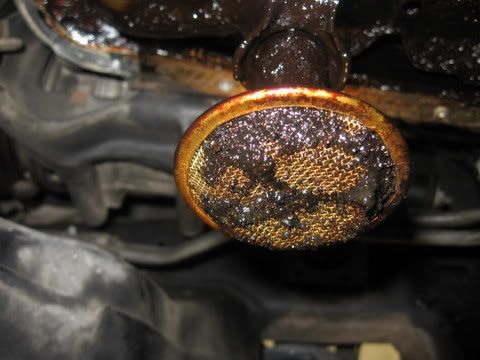
Oil pickup tube:

Gunk in bottom of the pan:

The motor had sat since Sunday with 1.5 gallons of #2 diesel in the pan. All of the sludge down in the bottom end is soft, jelly. Not sure if this was due to the diesel soak, or if that is just the way it is. It cleans off with a brush in nothing flat.
We did not find much in the way of bearing material in the bottom of the pan, just a lot of RTV chunks and the sludge. The cast iron surfaces of the block in the bottom end are amazingly clean. The windage tray or baffle was coated severely.
We will be cleaning up the bottom end this weekend, as best we can without removing the motor. From there we plan on getting it back together and then doing a series of oil flushes. The plan is to:
1. Start it with a new filter and a normal fill of dino oil. Run 10 minutes, drain, cut filter open for inspection.
2. Fill with dino oil and a can of BG Quick Clean. Run for 15 minutes, shut down, drain, pull the pan, check the screen, cut the filter open.
3. Fill again with dino oil and another can of BG Quick Clean. Run for 15 minutes, shut down, drain, pull the pan, check the screen, cut the filter open.
4. Fill with dino oil, run for 15 minutes, drain to check the condition of the oil and check the filter.
5. Fill with dino oil, install front diff/CV's, drive for 500 miles, drain, cut open the filter.
6. Fill with dino oil, start Auto-RX cycle.
7. At the end of the Auto-RX cylce, pull the P-side valve cover, see if there is any differnence from when it was buttoned up.
Thoughts on this?
Thanks,
Mike
So, the bottom end:
Oil pickup screen:
Oil pickup tube:
Gunk in bottom of the pan:
The motor had sat since Sunday with 1.5 gallons of #2 diesel in the pan. All of the sludge down in the bottom end is soft, jelly. Not sure if this was due to the diesel soak, or if that is just the way it is. It cleans off with a brush in nothing flat.
We did not find much in the way of bearing material in the bottom of the pan, just a lot of RTV chunks and the sludge. The cast iron surfaces of the block in the bottom end are amazingly clean. The windage tray or baffle was coated severely.
We will be cleaning up the bottom end this weekend, as best we can without removing the motor. From there we plan on getting it back together and then doing a series of oil flushes. The plan is to:
1. Start it with a new filter and a normal fill of dino oil. Run 10 minutes, drain, cut filter open for inspection.
2. Fill with dino oil and a can of BG Quick Clean. Run for 15 minutes, shut down, drain, pull the pan, check the screen, cut the filter open.
3. Fill again with dino oil and another can of BG Quick Clean. Run for 15 minutes, shut down, drain, pull the pan, check the screen, cut the filter open.
4. Fill with dino oil, run for 15 minutes, drain to check the condition of the oil and check the filter.
5. Fill with dino oil, install front diff/CV's, drive for 500 miles, drain, cut open the filter.
6. Fill with dino oil, start Auto-RX cycle.
7. At the end of the Auto-RX cylce, pull the P-side valve cover, see if there is any differnence from when it was buttoned up.
Thoughts on this?
Thanks,
Mike
Last edited by OutlawMike; Mar 29, 2010 at 09:25 AM.
Feb 26, 2009 | 05:51 AM
#67

Contributing Member
Joined: Nov 2006
Posts: 1,562
Likes: 0
From: Dickson,Tennessee
I remember having similar issues with an old chevy my father owned when i was young. It was a 58 with the "348" (bigblock). We used oven cleaner...looking back it prob. wasnt the best thing to use but we flushed it out and changed the oil a few times and it was good as new.
Feb 26, 2009 | 06:16 AM
#68

Registered User
Joined: Apr 2008
Posts: 847
Likes: 1
Feb 26, 2009 | 07:47 AM
#69
Thread Starter
Registered User
Joined: Dec 2007
Posts: 710
Likes: 2
From: Santa Rosa, CA
Feb 26, 2009 | 08:24 AM
#70
Registered User
Joined: Nov 2008
Posts: 261
Likes: 0
From: Oakley Ca
i had rtv, sludge, and believe or not a ziptie kill the motor in my old mustang, i did an oil change on it and a couple minutes later lost all oil pressure and had a rod knock.
looks like your doing a good job so far keep up the good work.
looks like your doing a good job so far keep up the good work.
 Mar 1, 2009 | 09:39 PM
#72
Thread Starter
Registered User
Joined: Dec 2007
Posts: 710
Likes: 2
From: Santa Rosa, CA
Jon is getting me a new tube for my shopvac, we stuck the old one in the trash tonight. I forgot I had a key to your house, but I was glad that I did, we needed that plate to hold the crank for disassembly.
Jon drove it home tonight, we got it all back together today, flushed with GB Quick Clean, and off on its merry way. We pulled the pan after the second Quick Clean cycle, man, a fairly large amount of sludge had come loose and made it's way to the pan. The pickup was fairly clean, better than I thought it would be.
Thanks for the 1/2 to 3/4" adapter, we needed that to torque the axle nuts with my 1 3/8" 3/4 drive socket. Also, thanks for the 12 mm hex key socket, we could not have gotten the front diff back in without it.
Ok if I hold onto them for a few weeks? The rig might be back over here if something happens.
Thanks Brian,
Mike
Jon drove it home tonight, we got it all back together today, flushed with GB Quick Clean, and off on its merry way. We pulled the pan after the second Quick Clean cycle, man, a fairly large amount of sludge had come loose and made it's way to the pan. The pickup was fairly clean, better than I thought it would be.
Thanks for the 1/2 to 3/4" adapter, we needed that to torque the axle nuts with my 1 3/8" 3/4 drive socket. Also, thanks for the 12 mm hex key socket, we could not have gotten the front diff back in without it.
Ok if I hold onto them for a few weeks? The rig might be back over here if something happens.
Thanks Brian,
Mike
 Mar 2, 2009 | 02:27 PM
#74
Registered User
Joined: Apr 2005
Posts: 113
Likes: 0
From: Denver, CO
 Mar 20, 2009 | 06:18 AM
#76

Registered User
Joined: Mar 2009
Posts: 78
Likes: 0
From: Central Va
WoW! I've been their killed that...
Sounds like yall are giving it a fighting chance. 2thumbs for the effort, hope it pays ya 10 fold.
Have you consider one of the merical bearing addatives (Sick-50) or somthing just incase it looses oil preesure. Are you running a good Oil psi guage?
Sounds like yall are giving it a fighting chance. 2thumbs for the effort, hope it pays ya 10 fold.
Have you consider one of the merical bearing addatives (Sick-50) or somthing just incase it looses oil preesure. Are you running a good Oil psi guage?
Mar 21, 2009 | 09:14 PM
#77
Registered User
Joined: Feb 2009
Posts: 498
Likes: 0
From: Miami, Florida
Wow im assuming everything worked out because i see no updates.. And that first pic really was kinda scary..Made me go out and get some sea foam.. Ive always used mobil 1 high mileage replaced every 3k but i just got this 4runner so...And one thing im wondering is everyone is saying that mobil1 high mileage will slowly work away at the sludge but you say your buddy had ran m1 for 2 years? and still the sludge was obviously thriving..Whats the deal? and what exactly is the PVC valve so i can check mine out.. never replaced one so i dont even know what it is.. 
Mar 22, 2009 | 04:50 AM
#78
Registered User
Joined: Sep 2007
Posts: 74
Likes: 3
From: Big Sandy, Texas
A PCV Valve is a little plastic elbow that comes from the passenger side valve cover into a hose that recircles and ventilates the crankcase. IE "Positive Crankcase Ventilation" = PCV. Should be changed at least every 50K to 60K miles. Can't hurt to change em every other oil change as well....cuz their a couple of bucks. Easiast way to check 'em is to take it out and shake it. If it rattles like a dried bean pod....it's usually fine. If it don't...replace it.
Mar 22, 2009 | 09:18 AM
#79
Registered User
Joined: May 2002
Posts: 2,479
Likes: 2
From: Cincinnati Ohio
Everyone needs to stop blaming this on cheap oil. I've run cheap oil in EVERY vehicle I've ever owned. All of them have nice golden brown oil and no sludge.
I had an Accord with 325k on it, cheap oil since day one, every 3k miles. Pulled the valve cover off it at 300k and there was NO sludge.
This 4Runner NEVER had frequent oil changes.
I had an Accord with 325k on it, cheap oil since day one, every 3k miles. Pulled the valve cover off it at 300k and there was NO sludge.
This 4Runner NEVER had frequent oil changes.
Mar 22, 2009 | 12:37 PM
#80

Registered User
Joined: Feb 2007
Posts: 365
Likes: 1
From: North Texas
Everyone needs to stop blaming this on cheap oil. I've run cheap oil in EVERY vehicle I've ever owned. All of them have nice golden brown oil and no sludge.
I had an Accord with 325k on it, cheap oil since day one, every 3k miles. Pulled the valve cover off it at 300k and there was NO sludge.
This 4Runner NEVER had frequent oil changes.
I had an Accord with 325k on it, cheap oil since day one, every 3k miles. Pulled the valve cover off it at 300k and there was NO sludge.
This 4Runner NEVER had frequent oil changes.


