


98 tacoma V6.valve adjustment ???
 Sep 14, 2006 | 05:23 PM
#1

Thread Starter
Registered User
Joined: Oct 2005
Posts: 61
Likes: 0
From: Calera Alabama
 98 tacoma V6.valve adjustment ???
I recently got a rebuilt head and I think the valves are tapping. If they are to loose can I get replacement shims???? I'm going to check the clearence saturday. THANK YOU
 Sep 15, 2006 | 04:15 AM
#4
Contributing Member
Joined: Jul 2003
Posts: 8,807
Likes: 3
From: Montreal, QC Canada
Sep 15, 2006 | 10:18 AM
#5
Registered User
Joined: Apr 2006
Posts: 503
Likes: 0
From: TX
i had one of my head (not 4runner) rebuilt due to excessive oil loss through the valve stem seals, and that shiet came back w/ a tapping noise..... its was smooth b4 and its driving me nuts now.
but yeah.... those heads of urs have a shim lying on top of each lifters and its not adjustable.
but yeah.... those heads of urs have a shim lying on top of each lifters and its not adjustable.
Last edited by profuse007; Sep 15, 2006 at 10:20 AM.

Trending Topics
Sep 7, 2009 | 07:20 AM
#8

Registered User
Joined: Sep 2009
Posts: 6
Likes: 0
From: Evansville, WI
Loud clackety tappet noises
I'm a long time mechanic - but rather new with Toyota. Recently bought a 98 4Runner with 3.4 - ran great but made a LOT of "lifter noise". Checked valve shim lash (these are NOT self-adjusting cause they are not hydraulic) and all were within spec save one which was .001 over - not enough to make any noise much less all the clatter I heard. Went after the front end idler pulleys cause sometimes thay will make strange noises - all were tight. Previous owner said it got hot and would have to cool down before it would start again. Drained cooling system which had maybe 1 quart of coolant in it (oh great). Pulled intake - valves wet with oil - prolly burned up stem seals. Did compression test - ok. Under the intake the knock sensor wires are held by a plastic connector that snaps into the coolant tube there. The plastic connector melted and dripped into the block valley (oh great). This thing got hot! Pulled heads off. Cylinder walls are not scored but the center holes on each bank have what looks like score marks but is more discoloring running vertical at the wrist pin location. With pistons at TDC they can be "rocked" and make a tapping against the block (my former boss - owner of a machine shop engine rebuilding service says the piston slap on these can sound just like tappets). I have personally heard that before - but usually just one piston...not all six. With the heat generated here I suspect alll the valve springs are weak and cannot follow the cam lobes fast enough - making clatter. Also suspect one or more pistons are making noise. At this point I plan on all new valve springs, head resurface (if not too warped - although the head gaskets didnt blow)....along with cylinder hone and re-ring pistons. If the piston skirts look bad - new pistons. I'll post again later today - after I pull the pistons out.
 Sep 10, 2009 | 07:52 PM
#10
Registered User
Joined: Sep 2009
Posts: 6
Likes: 0
From: Evansville, WI
UPDATE: The valve springs I thought were bad were checked at a local machine shop - just slightly under spec for Lbs of force at specified height. Not bad enough to clatter. The pistons are the cilprit though. With the engine black on a stand and heads off/pan off I was able to rotate the engine one-handed with a short 3/8 breaker bar on the crank bolt. As I mad ethe full 360 degree rotation I heard a ....click.........click..click...........click.... .......click..click. Didn't know what the noise was.....rods?....piston slap?...the oil pump? I slid my hand in #2 cyl and put my fingertips on the piston - following it as it went up and down....felt nothing. Then #4 cyl.....felt a tick on my fingertips at the same time I heard one of the clicks. #6 - nothing. #1 and #3 - ticks. #5 - nothing. So I studied it a bit more and found the noise occurred as the piston (and rod) change direction. I applied pressure to either thrust side of the piston and the noise went away. Piston slap for sure. I'll be doing plastigauge on the rods to confirm my analysis.
I have only a vernier caliper - although a good one - to measure the piston and nothing to measure the cylinder bore. UPS is bringing me a bore gauge dial indicator tomorrow and I ordered a set of micrometers yesterday.....so they will come next week. I learned from the machine shop that the recommended difference between bore and piston size is about .0053 - .0060 . Maximum allowable of .0069 . My piston is about .005 smaller than is was when installed (based on my caliper reading). When compare to a "good" piston (#5 that had no scoring or galling) its almost .007 smaller. Assuming the bore has worn larger as well (not so much due to damage but more due to the 155k miles) I would guess the bad cylinders have a clearance of about .010. Too much. I should also note that my vernier caliper readings could only be taken on the thrust surface and not all around the piston. The part I measured was the best and not where scoring and galling occurred. Just a limitation of the jaws of that tool - thats why I ordered a set of micrometers - six of them (0 - 6".....almost pissing myself to have a real set of my own micrometers in a nice wooden box).
Its late....time for bed. Dial indicator bore gauge comes tomorrow - will post more then.
I have only a vernier caliper - although a good one - to measure the piston and nothing to measure the cylinder bore. UPS is bringing me a bore gauge dial indicator tomorrow and I ordered a set of micrometers yesterday.....so they will come next week. I learned from the machine shop that the recommended difference between bore and piston size is about .0053 - .0060 . Maximum allowable of .0069 . My piston is about .005 smaller than is was when installed (based on my caliper reading). When compare to a "good" piston (#5 that had no scoring or galling) its almost .007 smaller. Assuming the bore has worn larger as well (not so much due to damage but more due to the 155k miles) I would guess the bad cylinders have a clearance of about .010. Too much. I should also note that my vernier caliper readings could only be taken on the thrust surface and not all around the piston. The part I measured was the best and not where scoring and galling occurred. Just a limitation of the jaws of that tool - thats why I ordered a set of micrometers - six of them (0 - 6".....almost pissing myself to have a real set of my own micrometers in a nice wooden box).
Its late....time for bed. Dial indicator bore gauge comes tomorrow - will post more then.
Sep 12, 2009 | 07:05 PM
#11
Registered User
Joined: Sep 2009
Posts: 6
Likes: 0
From: Evansville, WI
UPDATE: The cylinder bores are fairly good. Two pistons are very worn causing the piston slap. Since the cylinders aren't bad - I will hone them slightly just to break the glaze. New standard sized pistons and new rings (got all engine bearings too for about $20 on Ebay. Toyota stock pistons are $70 each...my cost at Toyota having a wholesale acct (if you want a good price on original parts also check ToyotaPartsBarn.com . the prices are slightly better than my wholesale cost - but slightly worse when you add the shipping). On Ebay I bought aftermarket NPR pistons and rings, and some other brand bearings for $125 + $20 shipping. Also bought an aftermarket complete gasket set for $57 + $12 shipping. Toyota gets $410 wholesale for engine gasket set. If you go to toyota - better off getting a junkyard engine when it comes to cost of repairing one. I googled the aftermarket pistons - folks have had good luck with them.
So for new gaskets, pistons, rings, main & rod bearings - then I'll get a new timing belt directly from Toyota....I'll have under $250 in parts costs and that should include fluids. Not bad at all. I'd be at $1000 at toyota.
Still taking a bit of a gamble here - but I just can't believe the little bit of cylinder wear could cause issues. If the guy before me hadnt run it out of coolant and got it hot (multiple times) the pistons would never have failed. Part will be on later this week. Hope to have it running by next weekend. We keep y'all posted.
So for new gaskets, pistons, rings, main & rod bearings - then I'll get a new timing belt directly from Toyota....I'll have under $250 in parts costs and that should include fluids. Not bad at all. I'd be at $1000 at toyota.
Still taking a bit of a gamble here - but I just can't believe the little bit of cylinder wear could cause issues. If the guy before me hadnt run it out of coolant and got it hot (multiple times) the pistons would never have failed. Part will be on later this week. Hope to have it running by next weekend. We keep y'all posted.
Nov 15, 2009 | 07:01 AM
#12
Registered User
Joined: Sep 2009
Posts: 6
Likes: 0
From: Evansville, WI
UPDATE: Here it is November 15 already. When the NPR (Nippon Piston Ring) piston/ring set came I measure them with my new micrometers. Toyota sells Standard pistons in 3 different sizes (numbered 1, 2, and 3). The NPR's I got were sized at the number 3 dimensions - although they just call them standard. The point is - they are on the large side of standard which is really great when your cylinders are scored and need honing. I had to do more than just break the glaze to remove some deep grooves. The two center cylinders were the worst - by far. Hindsight tells me that for $125 I could have had the engine bored to oversize and doing that would have been less nerve wracking. But I was bound to see what would work on the cheap. I measured all the new pistons and measured all the finished bores. Then matched them small to large to obtain the best fit.....all were well within Toyota spec.
Initially ran the engine untill completely wwarmed up then gave some strong break-in. I had a loud clatter. I was worried. But was a little relieved to find it on the driver side only. Passenger side was very quiet. So I didn't think there was any piston slap. I pulled the left (driver side) valve cover. Toyota say to measure the valve lift clearance with engine cold. I tried it with engine hot. Five exhaust were out of spec. Two severely out. One worse - near ready to jump out. I waited till engine cold and remeasured. I was surprised to learn the gap will be less cold than hot....opposite what an overhead valve (not OHC) would be. Still exhaust was way out of spec - all across. I measure the gap carefully and used the Toyota replacement chart/guide. Then ordered new shims from Toyota.
Installed new shims and all quiet. Strong running - all is good. The Ebay purchased Erista gaskets and NPR pistons made a cheap build a reality.
Initially ran the engine untill completely wwarmed up then gave some strong break-in. I had a loud clatter. I was worried. But was a little relieved to find it on the driver side only. Passenger side was very quiet. So I didn't think there was any piston slap. I pulled the left (driver side) valve cover. Toyota say to measure the valve lift clearance with engine cold. I tried it with engine hot. Five exhaust were out of spec. Two severely out. One worse - near ready to jump out. I waited till engine cold and remeasured. I was surprised to learn the gap will be less cold than hot....opposite what an overhead valve (not OHC) would be. Still exhaust was way out of spec - all across. I measure the gap carefully and used the Toyota replacement chart/guide. Then ordered new shims from Toyota.
Installed new shims and all quiet. Strong running - all is good. The Ebay purchased Erista gaskets and NPR pistons made a cheap build a reality.
Apr 6, 2011 | 11:32 PM
#13

Registered User
Joined: Mar 2011
Posts: 20
Likes: 0
From: arizona from the 808
wow
my truck taps ticks what ever u wanna call it only at full temp after boosting 7 pounds , my cams have hott spots , valve lash/ clearnce in inside spec,, but on the tight side . i hop its not slap , i have trd s/c 100k only , i read a forums saying set the valve laash to .015 exhaust for ideal heat expansion . i am going to reset lash to .008 intake and .015 pray to god thats it gap is less when cold how could that be hot expansion so what do u think is a good number to set them cold since my trucks in 500 pieces, i dont have money for all the fun u are doing . my shims have madd hot spots think i can reuse them?// i am a broke ass fool... i go to uti and the teacher dont even know what valve shims r, they only care about gay ass chevys pissing me off

UPDATE: Here it is November 15 already. When the NPR (Nippon Piston Ring) piston/ring set came I measure them with my new micrometers. Toyota sells Standard pistons in 3 different sizes (numbered 1, 2, and 3). The NPR's I got were sized at the number 3 dimensions - although they just call them standard. The point is - they are on the large side of standard which is really great when your cylinders are scored and need honing. I had to do more than just break the glaze to remove some deep grooves. The two center cylinders were the worst - by far. Hindsight tells me that for $125 I could have had the engine bored to oversize and doing that would have been less nerve wracking. But I was bound to see what would work on the cheap. I measured all the new pistons and measured all the finished bores. Then matched them small to large to obtain the best fit.....all were well within Toyota spec.
Initially ran the engine untill completely wwarmed up then gave some strong break-in. I had a loud clatter. I was worried. But was a little relieved to find it on the driver side only. Passenger side was very quiet. So I didn't think there was any piston slap. I pulled the left (driver side) valve cover. Toyota say to measure the valve lift clearance with engine cold. I tried it with engine hot. Five exhaust were out of spec. Two severely out. One worse - near ready to jump out. I waited till engine cold and remeasured. I was surprised to learn the gap will be less cold than hot....opposite what an overhead valve (not OHC) would be. Still exhaust was way out of spec - all across. I measure the gap carefully and used the Toyota replacement chart/guide. Then ordered new shims from Toyota.
Installed new shims and all quiet. Strong running - all is good. The Ebay purchased Erista gaskets and NPR pistons made a cheap build a reality.
Initially ran the engine untill completely wwarmed up then gave some strong break-in. I had a loud clatter. I was worried. But was a little relieved to find it on the driver side only. Passenger side was very quiet. So I didn't think there was any piston slap. I pulled the left (driver side) valve cover. Toyota say to measure the valve lift clearance with engine cold. I tried it with engine hot. Five exhaust were out of spec. Two severely out. One worse - near ready to jump out. I waited till engine cold and remeasured. I was surprised to learn the gap will be less cold than hot....opposite what an overhead valve (not OHC) would be. Still exhaust was way out of spec - all across. I measure the gap carefully and used the Toyota replacement chart/guide. Then ordered new shims from Toyota.
Installed new shims and all quiet. Strong running - all is good. The Ebay purchased Erista gaskets and NPR pistons made a cheap build a reality.
Last edited by vital22re; Apr 27, 2011 at 09:18 PM. Reason: language
Apr 27, 2011 | 10:07 AM
#14
Registered User
Joined: Sep 2009
Posts: 6
Likes: 0
From: Evansville, WI
ticky tacky
If you have a Toyota V6 3.4 liter engine, you won't be adjusting lash through conventional means. The only way to change the lash between a cam lobe and the shim is to replace the shim. Toyota manuals post a graph showing which shim to use given the thickness of the current shim (you need a micrometer to measure it) and the amount of valve lash you currently have cold.
Lash gap increases as the aluminum head overhead cam engine warms. I recommend getting the manual before you go at it. The recommendations from it will take the lash down pretty tight. Doing this quieted my engine.
Lash gap increases as the aluminum head overhead cam engine warms. I recommend getting the manual before you go at it. The recommendations from it will take the lash down pretty tight. Doing this quieted my engine.
Apr 27, 2011 | 08:49 PM
#15
Registered User
Joined: Mar 2011
Posts: 20
Likes: 0
From: arizona from the 808
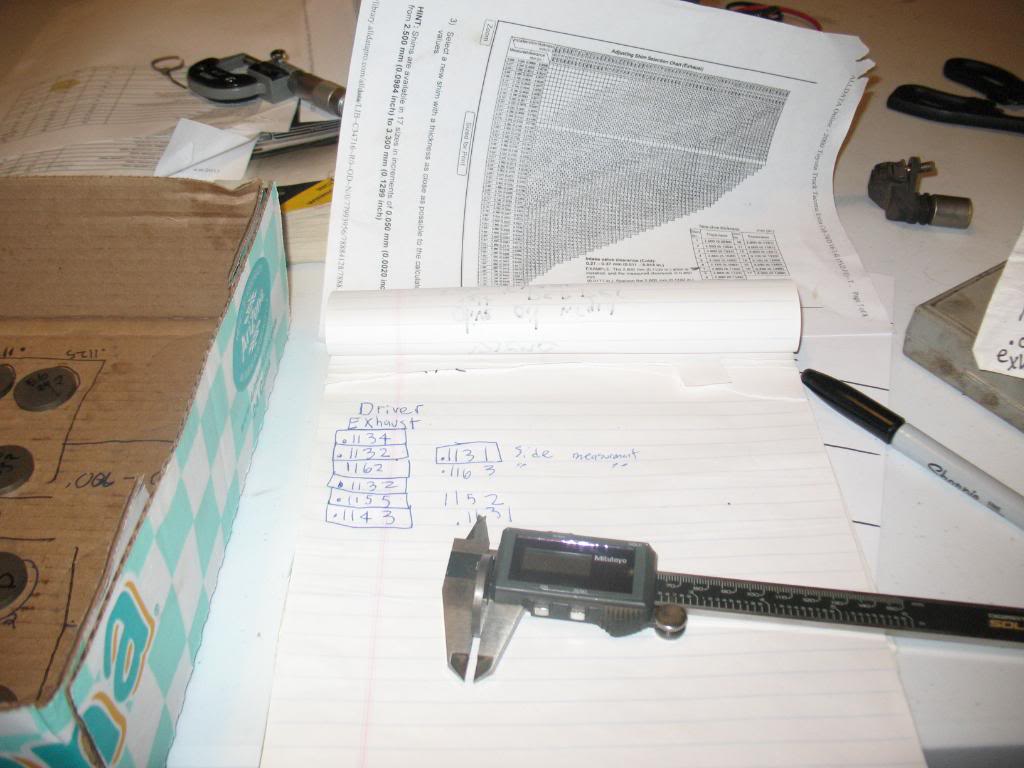 recently did the valve adustment , ,,, took me a while to figure it out, the manuel u need a dial caliper micormeter is worthless for these job since my shims had hot spots ., my exhaust were at like .012 to .013 and ticking , read a thread saying set them to .015 for heat expansion, also look at the 1gr spec which includes .015. u need 2 wedge tools and the pliers from blue point depress the lifter , wedge on the shim first then stick the other wedge on the side of the bucket slowing relase first wedge tool found it very easy ,and a dial caliper is a way easier to use , i am broke and didnt want to reaplace all 24 which needed it so so i took the cams off cataloged all shims and measued clearences and simple subtraction is very easy //so i then played checkers with the shims to find them , in the end i had to buy 1 shim , evne though my shims had madd hot spots ? truck runsss great
quote=brooster42;51711509]If you have a Toyota V6 3.4 liter engine, you won't be adjusting lash through conventional means. The only way to change the lash between a cam lobe and the shim is to replace the shim. Toyota manuals post a graph showing which shim to use given the thickness of the current shim (you need a micrometer to measure it) and the amount of valve lash you currently have cold.
Lash gap increases as the aluminum head overhead cam engine warms. I recommend getting the manual before you go at it. The recommendations from it will take the lash down pretty tight. Doing this quieted my engine.[/quote]
Last edited by vital22re; Apr 27, 2011 at 09:16 PM. Reason: language.

Thread
Thread Starter
Forum
Replies
Last Post
Blamalam
86-95 Trucks & 4Runners
22
Mar 12, 2022 07:34 AM
kirkrunner
86-95 Trucks & 4Runners
2
Jul 27, 2015 07:59 PM
34, 4runner, 98, adjust, adjustingshimming, adjustment, deflectors, noise, price, shims, tacoma, toyota, valve, valves, wind


