


Marine grade wire if running under chassis?
 Apr 14, 2013 | 10:23 AM
#1

Thread Starter
Registered User
Joined: Mar 2013
Posts: 62
Likes: 0
From: PNW
Marine grade wire if running under chassis?
Hey guys,
I searched and didn't see much mention of marine grade wire on the site, so I hope this isn't too redundant a thread.
I'm running some wire to the bed of the truck and am planning to follow the wiring for the brake lights etc. I'll put the new wire into wire loom with UV resistant ties, but I'm wondering if folks who have done something similar have decided to use marine grade wire. I live in an area that does get snow (and salt), rain and mud, and go offroad somewhat regularly. If I had a decent supply house for auto/marine electric I would probably just go ahead with marine wire, but I am at least 50 miles from the closest place that MIGHT have a bulk selection. I can order some online but if I it isn't necessary I'd rather just save the shipping and use the SAE wire I have.
If you do respond and have run non-marine wire under the chassis, please say how long you've been running it and what sort of climate your vehicle is used in.
Thanks!
I searched and didn't see much mention of marine grade wire on the site, so I hope this isn't too redundant a thread.
I'm running some wire to the bed of the truck and am planning to follow the wiring for the brake lights etc. I'll put the new wire into wire loom with UV resistant ties, but I'm wondering if folks who have done something similar have decided to use marine grade wire. I live in an area that does get snow (and salt), rain and mud, and go offroad somewhat regularly. If I had a decent supply house for auto/marine electric I would probably just go ahead with marine wire, but I am at least 50 miles from the closest place that MIGHT have a bulk selection. I can order some online but if I it isn't necessary I'd rather just save the shipping and use the SAE wire I have.
If you do respond and have run non-marine wire under the chassis, please say how long you've been running it and what sort of climate your vehicle is used in.
Thanks!
Apr 14, 2013 | 12:45 PM
#2
Registered User
iTrader: (1)
Joined: Apr 2009
Posts: 13,381
Likes: 100
From: I live in New Tripoli Pa out in the woods

Not living closer than a Hundred miles to the ocean and not really being a boat person.
I never heard of marine grade wire. just what is different about it??
I have bought most of my wire in the last 20 years from East Penn Manufacturing (Deka Battery) 250' or 500' spools .
So I have been using their wire for 20 years or so.
Been installing trailer plugs since the late seventies and assorted other wiring.
I live in eastern Pa the liquid Brine they put on the roads is brutal .
The wire is not a issue it is where ever you make a splice or connection.
I solder all my connections dielectric grease electrical tape then heat shrink
it seems all the lights either have plugs or pigtails
I never heard of marine grade wire. just what is different about it??
I have bought most of my wire in the last 20 years from East Penn Manufacturing (Deka Battery) 250' or 500' spools .
So I have been using their wire for 20 years or so.
Been installing trailer plugs since the late seventies and assorted other wiring.
I live in eastern Pa the liquid Brine they put on the roads is brutal .
The wire is not a issue it is where ever you make a splice or connection.
I solder all my connections dielectric grease electrical tape then heat shrink
it seems all the lights either have plugs or pigtails
Apr 19, 2013 | 02:22 AM
#4

Registered User
Joined: May 2009
Posts: 684
Likes: 1
From: Downingtown, PA
Marine grade wire is about the same as THHN grade that is available at most electrical supply houses. It is coated to resist corrosion. Actually THHN grade is teflon coated, holds up better and is usually cheaper.
May 26, 2013 | 11:39 AM
#6

Marine grade is AWG which stands for American Wire Gauge which is different than SAE which stands for Society of American Engineers which is the standard for auto wire. Typically, AWG wire contains more strands of wire and usually gives around 10 to 20% more copper per gauge size. The AWG wire is also tinned for more corrosion resistance. I've used AWG in my Ford truck because I am all about OVERKILL but that was when it was cheaper. Check out here for better explanation.
May 29, 2013 | 07:48 PM
#7
THHN building wire has several main distinctions compared to other building wire products. THHN uses a thinner PVC insulation which is a key factor in terms of its electrical properties. This thinner insulation can often lead to a current leakage and even a breakdown during chemical or environmental exposure. The PVC insulation in THHN also creates a toxic smoke when burned therefore making it undesireable in certain applications. And last but not least, THHN is not a very flexible product due to its nylon coating.
So, using common sense, I would say that THHN building wire is no where near the same as AWG (marine grade) wire. Building wire is made for stationary applications where vibration and constant exposure to the environment are not present.
The reason I like marine grade wire is that you get more copper and strands than you would with standard SAE automotive wire. You also get tinned wire which helps with corrosion in the rust belt in the Northeast. Do you absolutely need marine wire? No, not at all. Like Wyoming said and uses, standard automotive grade wire is just fine. What is more important is the quality of the splice that you make and doing the job right; and also protecting the wire from abrasion. I'm not busting on you, suncomb. I just think that a better wire could be used for this application than the building wire. But if you had to....to each his own.
Wyoming said it best:
"I live in eastern Pa the liquid Brine they put on the roads is brutal .
The wire is not a issue it is where ever you make a splice or connection.
I solder all my connections dielectric grease electrical tape then heat shrink"
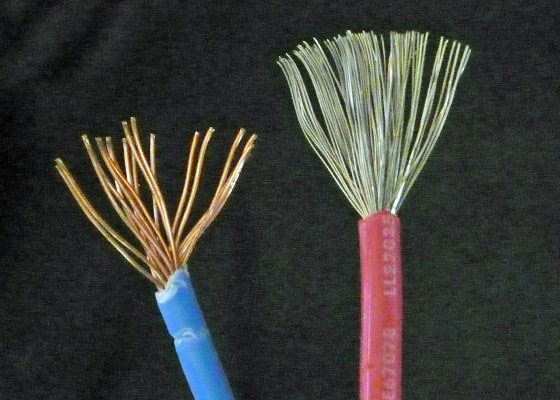
Here's a pic comparing 10 gauge sae and awg: from here.
Here's the article from that site also:
Boat vs. Automotive Grade Wire
A friend and I have been arguing about whether there is a difference between automotive wire and marine grade wire. I’m planning on doing some major re-wiring on my boat over the winter. I think 10 gauge wire is 10 gauge wire, period. My buddy says he thinks there are distinct differences. Who’s right?
10gauge-difference
The blue wire is 10 gauge automotive grade wire. The red wire is 10 gauge boat cable. Not the same, even by eye.
Well I hope you didn’t bet on this one, because you lose. All 10 gauge (or any gauge for that matter) wire is not created equal.
The photo here illustrates some of the differences. On the left the blue wire is 10 gauge SAE automotive grade primary wire. On the right is a piece of 10 gauge boat cable. Without looking too hard you can see that the boat cable has many more strands of copper. Also, if you look at the insulation jackets on the two cables closely you’ll notice some cryptic lettering on the red cable but nothing on the blue cable. Further, the strands of the red wire are silver in color vs. the copper color of the blue cable. The silver color is “tinning,” which although not a Standards requirement, we often see on marine graded wire. The tinning is to minimize the effects of corrosion to the individual strands.
The letters and numbers found on the red wire are required under ABYC recommendations for wiring. This information tells the user about actual gauge size, insulation temperature rating, chemical resistance properties and minimum voltage rating for the wire. Nice stuff to know about.
So there is a difference between circular mil area minimum requirements for 10 gauge SAE-rated wire vs. 10 gauge AWG (American Wire Gauge) sizing. The actual differential varies a little from one gauge size to another, but the percentage variation is around 10-20%. The AWG sizing always offers more copper for a given gauge size.
The bottom line here? More copper is better. On boat wiring one of the things you should always be concerned with is voltage drop, which is in part controlled by a wire’s ability to carry current with a minimum amount of electrical resistance. Also, since the boat cable will have more strands for a given gauge size, the wire will by its very nature be more flexible. This characteristic is superior for dealing with vibration and the inherent flexing that occurs in boat cable wire runs.
—Ed Sherman

Thread
Thread Starter
Forum
Replies
Last Post


