


Aux. lighting wiring......
 Sep 29, 2009 | 04:28 AM
#1

Thread Starter
Registered User
Joined: Aug 2006
Posts: 1,691
Likes: 2
From: Colorado Springs, Co
Aux. lighting wiring......
Well, I'm getting ready to wrap the mods up on my 4runner for awhile and last couple of things on the list involves a set of lights namely (Lightforce) and a Blue Sea fuse block (6).
Currently, I have my CB and a set of PIAA 510 fog lights wired directly to the battery put the power/hot connector for the battery is a pos and needs replacing and I don't like running those accessories off of it because of that fact (yes, I know I can replace it).
So the plan is to wire them to a blue sea fuse block (found on for a good price off a marine equpiement site) to help clean things up a bit. As well as wire in a second set of lights (got to love Shrockworks for including spaces for additional lights on the bumper.
Now the question I have is what guage wire should I run from the fuse block to the battery? How would you all attach the fuse block: just velco it to the top of one of the factory fuse blocks or attach it to the firewall? I've used the search function and my head is just spinning from reading it all.
Currently, I have my CB and a set of PIAA 510 fog lights wired directly to the battery put the power/hot connector for the battery is a pos and needs replacing and I don't like running those accessories off of it because of that fact (yes, I know I can replace it).
So the plan is to wire them to a blue sea fuse block (found on for a good price off a marine equpiement site) to help clean things up a bit. As well as wire in a second set of lights (got to love Shrockworks for including spaces for additional lights on the bumper.
Now the question I have is what guage wire should I run from the fuse block to the battery? How would you all attach the fuse block: just velco it to the top of one of the factory fuse blocks or attach it to the firewall? I've used the search function and my head is just spinning from reading it all.
 Sep 29, 2009 | 08:22 PM
#3
Thread Starter
Registered User
Joined: Aug 2006
Posts: 1,691
Likes: 2
From: Colorado Springs, Co
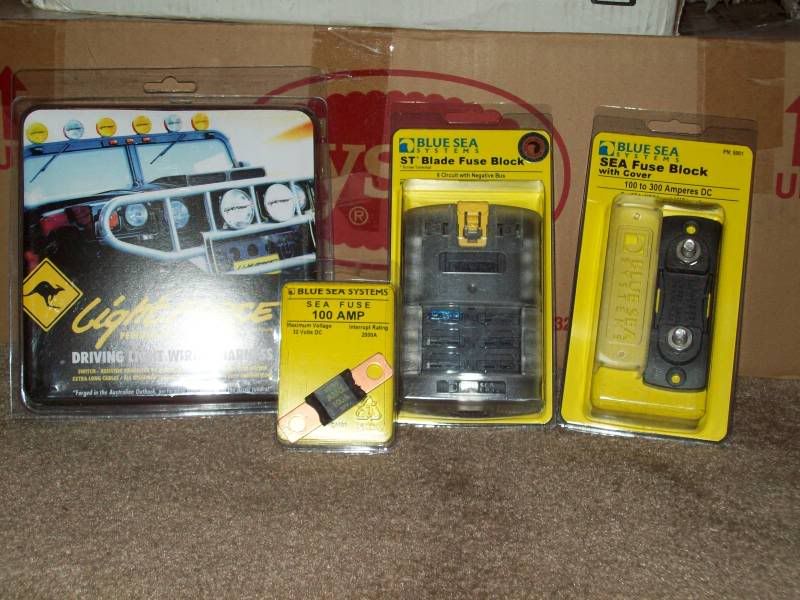
Well, I ended up ordering the following from Marine Technology.
Blue Sea 5025 ATO Fuse Block, 6-Circuit with Cover and Negative Bus
Blue Sea 5001 SEA Mega Fuse Block
Blue Sea Mega SEA Fuses 100A-300A (ordered a 100amp fuse, fiqured that be enough).
OEM Toyota Foglight Switch
Blue Sea 5025 ATO Fuse Block, 6-Circuit with Cover and Negative Bus
Blue Sea 5001 SEA Mega Fuse Block
Blue Sea Mega SEA Fuses 100A-300A (ordered a 100amp fuse, fiqured that be enough).
OEM Toyota Foglight Switch
Last edited by wormhole; Sep 29, 2009 at 09:01 PM.
Oct 4, 2009 | 09:53 PM
#4

Registered User
Joined: Sep 2009
Posts: 4
Likes: 0
if i was you i would run relays if your not already... provides for a cheaper install as you dont have to run heavier wire to your switch and back. dont know how much experience you have in electrical so dont take this the wrong way if you know what your doing, if your using a 100 amp fuse for the power to the distrubution block make sure the wire you are using is rated for 100 amp's... i can tell you that 8 gauge is NOT rated for 100 amps. i would run 2 gauge wire from the positive terminal to the block and depending on what your draw is, run the required gauge wire to your relay from the block and from the relay to the load. let me know if you want more help.
-Mitch
-Mitch
 Oct 11, 2009 | 11:41 PM
#7

Registered User
Joined: Mar 2009
Posts: 359
Likes: 2
From: Kenai, AK
Some thoughts for you:
1. Your main fuse (100A) should be as close to the battery as possible. This is sized quite large for an auxiliary fuse block. You should add up your expected load and consider what devices will be used concurrently, then size the main fuse slightly larger. 100A may be fine, smaller is better if you can get away with it. Carry a few spares and maybe keep the 100A in the glove box for emergency use if you go with a smaller main.
2. Downstream fuses (in your fuse block) should be rated for a current slightly higher than the end device consumes. For instance, if your lights are rated 100 watts @ 12 volts then 100/12 = 8.33 Amps. Choose a fuse size of 10, 12 (do they make a 12?) or 15 amps.
3. Wire should be sized at least to expected load and then slightly larger would be good. I don't recall small wire current ratings (I'm a power engineer, not electronics!) but again if your lights are 100 watts, choose a wire that will cary at least 20 amps or so. This is of course more current than your lights will draw, but if you choose a wire which is rated at 20 amps and fused at 15 amps then you won't cook your wire if something shorts. Generally the current rating of a wire will be somewhere on the package.
4. Screw the fuse blocks down to the firewall, 700 amps @ 12 volts (typical truck battery) can do devastating damage under the hood if your velcro failed!
1. Your main fuse (100A) should be as close to the battery as possible. This is sized quite large for an auxiliary fuse block. You should add up your expected load and consider what devices will be used concurrently, then size the main fuse slightly larger. 100A may be fine, smaller is better if you can get away with it. Carry a few spares and maybe keep the 100A in the glove box for emergency use if you go with a smaller main.
2. Downstream fuses (in your fuse block) should be rated for a current slightly higher than the end device consumes. For instance, if your lights are rated 100 watts @ 12 volts then 100/12 = 8.33 Amps. Choose a fuse size of 10, 12 (do they make a 12?) or 15 amps.
3. Wire should be sized at least to expected load and then slightly larger would be good. I don't recall small wire current ratings (I'm a power engineer, not electronics!) but again if your lights are 100 watts, choose a wire that will cary at least 20 amps or so. This is of course more current than your lights will draw, but if you choose a wire which is rated at 20 amps and fused at 15 amps then you won't cook your wire if something shorts. Generally the current rating of a wire will be somewhere on the package.
4. Screw the fuse blocks down to the firewall, 700 amps @ 12 volts (typical truck battery) can do devastating damage under the hood if your velcro failed!
Trending Topics
Oct 12, 2009 | 04:58 PM
#8
Thread Starter
Registered User
Joined: Aug 2006
Posts: 1,691
Likes: 2
From: Colorado Springs, Co
Ok. If I got this fiqured correctly.
Lightforce 170 lights - 12v x 100w = 8.33 amps per light
Piaa 510's - 12v x 55w = 4.5833 amps per light
Cobra ST WXST II CB - 12v x 4w (I believe) = .33 amps
Total amp - approx. 30 amps. So 7 gauge wire would then (I won't use it though)? Could I get away with 6 gauage?
http://www.powerstream.com/Wire_Size.htm
Lightforce 170 lights - 12v x 100w = 8.33 amps per light
Piaa 510's - 12v x 55w = 4.5833 amps per light
Cobra ST WXST II CB - 12v x 4w (I believe) = .33 amps
Total amp - approx. 30 amps. So 7 gauge wire would then (I won't use it though)? Could I get away with 6 gauage?
http://www.powerstream.com/Wire_Size.htm
Last edited by wormhole; Oct 12, 2009 at 04:59 PM.
Oct 12, 2009 | 10:59 PM
#9
Registered User
Joined: Mar 2009
Posts: 359
Likes: 2
From: Kenai, AK
You'd be ok with 6 but I would suggest using 8 and a 60 amp fuse. Those sizes would be for your main of course.
Something else worth mentioning. I would try and stick with the same size conductor that is supplied with your devices, likely 12 or 14 for your lights and 16, 18 or 20 for your radio. You'll notice that the table lists the MAXIMUM current capacity, no reason to push this limit. Your lights especially, use 12, it will be more durable and you'll never approach burning up your wire before you blow a fuse.
Something else worth mentioning. I would try and stick with the same size conductor that is supplied with your devices, likely 12 or 14 for your lights and 16, 18 or 20 for your radio. You'll notice that the table lists the MAXIMUM current capacity, no reason to push this limit. Your lights especially, use 12, it will be more durable and you'll never approach burning up your wire before you blow a fuse.
Oct 14, 2009 | 07:33 PM
#11
Registered User
Joined: Mar 2009
Posts: 359
Likes: 2
From: Kenai, AK
Hmm... depends on the type of switch you have, does it have two terminals on the back or three?
Were you supplied a relay with your kit? If not you might think about getting one.
Let me know, we'll go from there.
Also, many of the light manufacturers have wiring directions on their sites with diagrams, might want to check that out.
Were you supplied a relay with your kit? If not you might think about getting one.
Let me know, we'll go from there.
Also, many of the light manufacturers have wiring directions on their sites with diagrams, might want to check that out.
Oct 14, 2009 | 07:58 PM
#12
Thread Starter
Registered User
Joined: Aug 2006
Posts: 1,691
Likes: 2
From: Colorado Springs, Co
Hmm... depends on the type of switch you have, does it have two terminals on the back or three?
Were you supplied a relay with your kit? If not you might think about getting one.
Let me know, we'll go from there.
Also, many of the light manufacturers have wiring directions on their sites with diagrams, might want to check that out.
Were you supplied a relay with your kit? If not you might think about getting one.
Let me know, we'll go from there.
Also, many of the light manufacturers have wiring directions on their sites with diagrams, might want to check that out.
I'm using Toyota fog light switches. The PIAA lights I'm untilizing all three pongs on the back of the switch. However on the Lightforce lights the switch they provided only has two pongs where the Toyota switch has the three (as I mentioned).
Now does this make sense on my thinking with the wiring: Would I just need to splice together the positive, negative and ground wire together for each respective wire (ie. positive from lights and postive from a switch to one of the positive post on the fuse block, like wise for negative and ground) or is there something else I'm not thinking of.
Hopefully, this make sese I've never been very good with wiring up switches like this.
Oct 14, 2009 | 10:11 PM
#13
Registered User
Joined: Sep 2009
Posts: 4
Likes: 0
so your using the supplied wiring kits? then using your toyota switc instead of the other one... okay the three prong switches have a load 12v, line 12v and gound. (dont need the ground unless you want to have it light up) line is your voltage in and load is voltage out. hope thie makes sence. also please do not over size the fuse as limon43 mentioned... 8 gauge is not rated for 60 amp, its rated for 40... use a 40 amp fuse.
Oct 14, 2009 | 10:39 PM
#14
Registered User
Joined: Mar 2009
Posts: 359
Likes: 2
From: Kenai, AK
To be clear, I suggested UNDER sizing the fuse, not over, which I completely agree with.
As for current carrying capacity of your wire, it can vary with the type of wire used (number of strands being the primary difference), 60 amps for 8 gauge happened to be the spec for the table i was reading.
To the original poster, i'd suggest you find a data sheet for your particular wire and determine the actual rated ampacity, or fuse it for 20 percent less than the average of a few tables worth of values from google, if you can't find the data sheet.
Lastly, both of your switches work in a basic manner, interupt the 12v lead which operates your relays. The switch with two terminals can be wired between your +12V source (likely an ignition controlled fuse in your main fuse box) and your relay.
The three terminal switch works the same way, save for a third terminal which is usually a ground if it is a lighted switch (most likely your case?). You need to figure out which terminal is the ground and make sure its grounded if you want the light to work. If your using the light, then the load side of the switch becomes important. It must be the terminal to which your relay is connected. The source side of the switch would go to your 12V source.
If you don't want the light in the switch, the ground doesn't need to be hooked up and the source and load terminals no longer serve a distinctly different purpose, unless there is an off/on label on the button.
Oct 18, 2009 | 06:49 PM
#15
Thread Starter
Registered User
Joined: Aug 2006
Posts: 1,691
Likes: 2
From: Colorado Springs, Co
The wiring kit I got with the lights has the connections to connect to the positive and nagative battery post. Since I'm going to be running the lights off an auxiliary fuse block would I just then connect those wires to the fuse box since the block will already be wired to the battery?
Oct 18, 2009 | 08:56 PM
#16
Registered User
Joined: Mar 2009
Posts: 359
Likes: 2
From: Kenai, AK
Depends on which wires your talking about.
The positive lead should be connected to your fuse block. Your grounds should be grounded at the closest point possible. For example, each light should be grounded individually to the frame or some other good ground point. I usually use the mounting bolt of the light. The ground to your switch should be grounded somewhere near the switch, the ground for your relay can go under the relay mounting screw, and so on.
Does that make sense?
The positive lead should be connected to your fuse block. Your grounds should be grounded at the closest point possible. For example, each light should be grounded individually to the frame or some other good ground point. I usually use the mounting bolt of the light. The ground to your switch should be grounded somewhere near the switch, the ground for your relay can go under the relay mounting screw, and so on.
Does that make sense?
Nov 2, 2009 | 09:52 PM
#17

Registered User
Joined: Aug 2004
Posts: 1,209
Likes: 0
From: Pueblo, CO
What's the best way to wire an aux. fuse block to only turn on while the ignition is on? Is this the best way to wire an aux. fuse block? Or should it be wired to be on all the time, regardless if the ignition is on or off? I plan on running 2 forward facing lights and probably 3 pair of rock lights (all on relays of course).


 Nov 3, 2009 | 06:49 PM
#20
Registered User
Joined: Mar 2009
Posts: 359
Likes: 2
From: Kenai, AK
What's the best way to wire an aux. fuse block to only turn on while the ignition is on? Is this the best way to wire an aux. fuse block? Or should it be wired to be on all the time, regardless if the ignition is on or off? I plan on running 2 forward facing lights and probably 3 pair of rock lights (all on relays of course).
One note of caution, typical automotive relays are 30A or 40A, if you need more than that you might be able to find a higher rated 12V DC relay online or you can run multiple "main" wires and multiple relays in parallel, like 2 40's if you need 80A.


