


Sequoia wheels: lug or hub centric?
 Oct 10, 2006 | 07:40 PM
#2

Registered User
Joined: Jan 2003
Posts: 424
Likes: 0
From: Sunny with a continued chance of hot, AZ
Oh boy.
There is soooooooooooooo much web conjecture on this issue it's sickening. Get the lug centric (as most aftermarket wheels are lug centric) and you should be fine.
Why not use a 1/4 spacer and put in longer wheel studs?
There is soooooooooooooo much web conjecture on this issue it's sickening. Get the lug centric (as most aftermarket wheels are lug centric) and you should be fine.
Why not use a 1/4 spacer and put in longer wheel studs?
Oct 10, 2006 | 08:03 PM
#4
Registered User
Joined: Jan 2003
Posts: 424
Likes: 0
From: Sunny with a continued chance of hot, AZ
Seems to me that any wheel spacer that bolts to the hub (more than a half inch) would be lug-centric, period (i.e Spidertrax, All-Pro, etc.) The wheel spacer that is a shim type (1/4" - 5/16") is just a shim that fits between the disc and the wheel.
Discard the whole issue by using aftermarket wheels with appropriate backspacing or be a stubborn old coot like me and find a way to make OEM wheels and big tires work...
Oct 10, 2006 | 08:26 PM
#7
Registered User
Joined: Jan 2003
Posts: 424
Likes: 0
From: Sunny with a continued chance of hot, AZ
So, if you put a 1/4" to 5/16" between your wheel mounting surface and the wheel, thereby eliminating that much thread engagement, that's OK? Not trying to be an e-toughguy here, just trying to understand the logic. Bolt on spacers are a different story...
Are they? Nobody has empirically proven to this point that Toyota 4WD OEM wheels are hub-centric IMO. My OEM wheels on both my old 4Runner and my new Taco look and measure like they could be hub-centric, but sure snugged up like lug-centric.
Anyhow, this is all deviating from the original intent of the thread. Get a bolt on wheel spacer of any type. Make sure to use Loctite on the spacer and you'll be fine.
EDIT: Hehe, this was post 420. LOL
Are they? Nobody has empirically proven to this point that Toyota 4WD OEM wheels are hub-centric IMO. My OEM wheels on both my old 4Runner and my new Taco look and measure like they could be hub-centric, but sure snugged up like lug-centric.
Anyhow, this is all deviating from the original intent of the thread. Get a bolt on wheel spacer of any type. Make sure to use Loctite on the spacer and you'll be fine.
EDIT: Hehe, this was post 420. LOL
Last edited by azrain; Oct 10, 2006 at 08:27 PM.
Trending Topics
Oct 10, 2006 | 08:42 PM
#8
Registered User
Joined: Aug 2006
Posts: 4,940
Likes: 2
From: Central NJ
Got it backwards
Oct 10, 2006 | 09:19 PM
#9

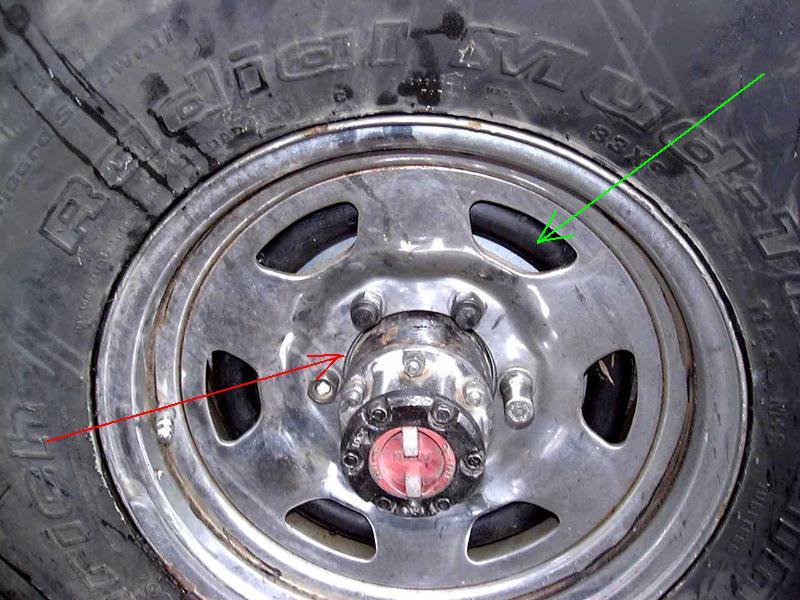
Why lug-centric wheels? Look at where the wheel fits over the (front) hubs. There is a gap, at least there is on my '85 with the stock steel wheels and the OEM hubs. Hole in the hub is ~4-1/4"" ID, hubs are about ~4-1/8" OD, so the hole in the wheel does not make contact with the OD of the hubs. Therefore the wheel must be centered by the lugs:
http://www.4crawler.com/4x4/CheapTri...ce/index.shtml
The big issue is that there are 3 different circles in play with a wheel. The outer circle is the bead seating surface where the tire mounts. The next circle is the bolt hole circle (5.5" dia. on the Toyota truck wheels) and the 3rd circle is the hole in the center of the wheel. In a perfect world (and on the CAD system where the wheel was designed) all 3 circles share a common center. If the wheel is built accurately, it will have a single center and will make no difference how it is mounted or balanced. If something happened in mfg. and the center hole and bolt circle centers do not line up with the bead center then you run into problems on many tire balancer machines that use a conical centering device to put the wheel on the balancer. So the wheel/tire gets balanced with the center hole but installed on the vehicle with the bolt hole circle.
http://www.4crawler.com/4x4/CheapTri...ce/index.shtml
The big issue is that there are 3 different circles in play with a wheel. The outer circle is the bead seating surface where the tire mounts. The next circle is the bolt hole circle (5.5" dia. on the Toyota truck wheels) and the 3rd circle is the hole in the center of the wheel. In a perfect world (and on the CAD system where the wheel was designed) all 3 circles share a common center. If the wheel is built accurately, it will have a single center and will make no difference how it is mounted or balanced. If something happened in mfg. and the center hole and bolt circle centers do not line up with the bead center then you run into problems on many tire balancer machines that use a conical centering device to put the wheel on the balancer. So the wheel/tire gets balanced with the center hole but installed on the vehicle with the bolt hole circle.
Last edited by 4Crawler; Oct 10, 2006 at 09:25 PM.
Oct 11, 2006 | 08:04 AM
#11

Thread Starter
Registered User
Joined: Jul 2006
Posts: 148
Likes: 0
Thank you for the infor. After reading 10 posts on this tread, the conclusion is "don't waste your money and get lug centric spacers". Is that correct? I searched and some of the members here had lug centric spacers. Their steering wheel vibrated at high speed. That worries me.
Oct 18, 2006 | 08:07 AM
#13

Registered User
Joined: Aug 2003
Posts: 513
Likes: 0
From: Glenville, NY
Before you decide which type of spacer you need, you have to determine what type of wheel you are going to use. Contrary to an earlier post, most Toyota's are not lug centric, it depends on the wheel. If you have steel wheels, they are most likely lug centric, but if you have alloys they are probably hub centric. It depends on how the wheel was designed. If you have alloys that are hub centric, and you try to use a spacer that is lug centric, you will probably have balance problems.
Oct 19, 2006 | 12:08 PM
#14

Registered User
Joined: Sep 2005
Posts: 1,080
Likes: 0
From: Fort Worth, TEXAS
iirc, toyota wheels are LUG centric. hence the issues that we all have getting our OEM wheels balanced at places that use HUB centric balancers instead of a LUG centric adapter. If you notice that our LUGS have collars that center the wheel on the hub. not a ring on the wheel. I know for a fact that 3rd and 4th gens are LUG centric, not sure about the pre-tacos and 2nd gens ect...
As far as i have gathered, toyota/Lexus are the only manufacture using LUG centric wheels. I have never seen a true LUG centric spacer.
Conical lug nuts do not mean that a wheel is lug centric either. why do we have to use those collared lugs on our wheels, because thats what centers the wheel on the hub. sometimes they do use conical lugs though.
(not trying to sound rash or jump on anyones toes, but there is too much debate over this when there shouldnt be)
I have 4 ebay knock off 1.5" spacers and torqued them down carefully and have had no vibration issues. they run as smooth as can be.
As far as i have gathered, toyota/Lexus are the only manufacture using LUG centric wheels. I have never seen a true LUG centric spacer.
Conical lug nuts do not mean that a wheel is lug centric either. why do we have to use those collared lugs on our wheels, because thats what centers the wheel on the hub. sometimes they do use conical lugs though.
(not trying to sound rash or jump on anyones toes, but there is too much debate over this when there shouldnt be)
I have 4 ebay knock off 1.5" spacers and torqued them down carefully and have had no vibration issues. they run as smooth as can be.
Last edited by KyleT; Oct 19, 2006 at 12:12 PM.
Oct 20, 2006 | 07:52 AM
#15
Registered User
Joined: Aug 2003
Posts: 513
Likes: 0
From: Glenville, NY
iirc, toyota wheels are LUG centric. hence the issues that we all have getting our OEM wheels balanced at places that use HUB centric balancers instead of a LUG centric adapter. If you notice that our LUGS have collars that center the wheel on the hub. not a ring on the wheel. I know for a fact that 3rd and 4th gens are LUG centric, not sure about the pre-tacos and 2nd gens ect...
As far as i have gathered, toyota/Lexus are the only manufacture using LUG centric wheels. I have never seen a true LUG centric spacer.
Conical lug nuts do not mean that a wheel is lug centric either. why do we have to use those collared lugs on our wheels, because thats what centers the wheel on the hub. sometimes they do use conical lugs though.
(not trying to sound rash or jump on anyones toes, but there is too much debate over this when there shouldnt be)
I have 4 ebay knock off 1.5" spacers and torqued them down carefully and have had no vibration issues. they run as smooth as can be.
As far as i have gathered, toyota/Lexus are the only manufacture using LUG centric wheels. I have never seen a true LUG centric spacer.
Conical lug nuts do not mean that a wheel is lug centric either. why do we have to use those collared lugs on our wheels, because thats what centers the wheel on the hub. sometimes they do use conical lugs though.
(not trying to sound rash or jump on anyones toes, but there is too much debate over this when there shouldnt be)
I have 4 ebay knock off 1.5" spacers and torqued them down carefully and have had no vibration issues. they run as smooth as can be.
My '03 is a perfect example. It came with the alloy wheels, but the standard wheel is a steel one. I have one set of each. I use the alloys for summer, and the steel wheels with REVOs for winter. I have to have two sets of lug nuts which get swapped when the wheels do. The steel wheels use the acorn type lug nuts, and the center hole does not fit tightly to the hub. They are lug-centric. The alloys use the shoulder type lug nuts with washers, and the center hole on the wheels fit tightly on the vehicle hub. They are hub-centric. The wheel design determines the way it is centered, not the vehicle.
Oct 20, 2006 | 08:43 AM
#17

Registered User
Joined: Apr 2005
Posts: 358
Likes: 0
From: San Antonio TX
OMFG, Toyota has a TSB that calls for all 5 and 6 Lug ALLOY wheels to use a LUG CENTRIC ADAPTER for balance, therefore the wheels MUST BE LUG CETRIC. You do not use the lug centric adapters on hub centric wheels. The only hub centric wheels Toyota uses is the 4 lug wheels, steel or alloy. If you take a lug centric wheel and put it on a balance machine with the adapters for a hub centric wheel you will notice right away the wobble and inability to properly balance the wheel. Take what you will from what I have said but after having 8 Toyotas, one 4 lug alloy and the rest different versions of the 6 lug 4x4 alloys and steel I can tell you hands down what I just said applies.
Oct 21, 2006 | 05:45 PM
#18
Registered User
Joined: Aug 2003
Posts: 513
Likes: 0
From: Glenville, NY
OMFG, Toyota has a TSB that calls for all 5 and 6 Lug ALLOY wheels to use a LUG CENTRIC ADAPTER for balance, therefore the wheels MUST BE LUG CETRIC. You do not use the lug centric adapters on hub centric wheels. The only hub centric wheels Toyota uses is the 4 lug wheels, steel or alloy. If you take a lug centric wheel and put it on a balance machine with the adapters for a hub centric wheel you will notice right away the wobble and inability to properly balance the wheel. Take what you will from what I have said but after having 8 Toyotas, one 4 lug alloy and the rest different versions of the 6 lug 4x4 alloys and steel I can tell you hands down what I just said applies.
How can you make that type of 'logic' leap, just because a TSB suggests what type of balance adapter to use. The mechanical principles are really quite simple here. And though I admit I am not a mechanical engineer, I do have over 35 years working as a professional mechanic. If my logic is faulty, I ask any of the engineering trained members to correct my understanding of how this works. I will listen to logic and fact, not supposition.
Though I have only owned 2 Toyotas, I have owned many different types of vehciles, all of which I have mounted, dismounted, and balanced wheels on. In addition to hundreds of customer vehicles. It doesn't matter if it has 3, 4, 5, 6, or 8 lugs, there are basically only two methods of aligning a wheel on a vehicle hub. Either the fit between the center hole on the wheel and the hub, or the fit between the lug nuts, wheel lug holes and wheel studs determine the center position of the wheel in relation to the hub. Which method being used is determined by the construction of the wheel, and the type of lug nut it uses. I just finished switching my summer tires/wheels for the set of tires/wheels I use in winter, and I took detailed pics and measurements which I hope will illustrate the points I am trying to make. My present vehicle is an '03 SR5, which came with the optional 17" factory alloy wheels. I also have a set of 16" factory OEM '03 SR5 steel wheels which I use for winter. On the same vehicle, the alloy wheels are centered by the center hole in the wheel aligning to the center hub where the wheel mounts to the vehicle (hub centric), while the steel wheels are centered by the lug nuts on the wheel studs (lug centric).
With the alloy wheels, the holes for the wheel studs are straight bored holes, with no chamfer and a shoulder type lug nut with a flat washer is used to secure the wheel in place. The diameter of the part of the lug nut that fits inside the wheel hole is .721". The diameter of the hole itself is .750", a difference of .029" which may not sound like much, but certainly allows for play between the wheel hole and the lug nut. With that amount of play, how can the lug nuts on the alloy possibly be expected to ensure the wheel is in the exact correct position on the hub. I'm sure many have noted that quite often alloys become stuck to the hub so hard that it takes a lot of force to break the wheel loose even after the lug nuts have been removed. This is because the center hole in the alloy wheel is machined to fit the hub with no extra play, so that it is centered properly. All the lug nuts, on alloy wheels of this type, do is fasten the wheel in place. The lug nuts do not determine the center line of the wheel to the hub.
As for the steel wheels, they use a different type of lug nut. I earlier refered to them as 'acorn lug nuts', but the correct term should be conical. This is because they have a conical end which when mated to the same type of conical surface on the steel wheel lug hole when tightening the lug nut on the wheel stud causes the wheel hole to center itself on the lug nut and stud. As long as the wheel hole is not damaged or hogged out, the hole in the wheel is forced into proper alignment with the stud. Because this process is repeated by the rest of the lug nuts and wheel studs, they alone determine the center position of the wheel. The center hole in a steel wheel that uses conical lug nuts does not serve to center the wheel on the hub. After mounting any of the factory steel wheels on the vehicle and torquing the lug nuts to the proper specs, I was able to slip a .05 mm feeler gauge in between at least three or more of the 6 tabs that serve to make up the center hole on the steel wheels and the hub. This shows that some of the 6 tabs are not in direct contact with the hub at all. How could they possibly be use to align the center of the wheel with the hub when they don't contact it at all?
I have seen some types of alloy wheels that have hardened conical inserts in the stud holes and are designed to use conical lug nuts, so they would be lug centric instead of hub centric. I have never seen any type of steel wheel that uses anything other than a conical type fastener. They were all lug centric. There may be some steel wheels out there that don't use a conical type lug nut, but I have not seen one yet.
I love my SR5, but Toyota didn't invent the wheel, nor how it is fastened to the hub. As for balancing wheels to eliminate vibration, it isn't all that hard. First you need good equipment, you have to know how to use it properly, and you have to be balancing well made tires and wheels. If you give up one of the three, most likely you will have a problem.
As I said at the beginning, I do have pics to demonstrate my findings from today. I am trying to save site bandwidth, but will post them if requested, or I will send them to anyone who is interested. Whether or not you wish to believe what I have said is up to you. I can't give you an answer as to why the TSB you read suggests that the only way to balance an alloy wheel is to use a lug centric adapter. Not everything one reads is accurate. All I know is that the TSB doesn't keep the wheels on the vehicle, mechanical principles do.
Last edited by TechWrench; Oct 21, 2006 at 05:52 PM.

 Oct 22, 2006 | 09:38 AM
#20
Registered User
Joined: Aug 2006
Posts: 4,940
Likes: 2
From: Central NJ
Lug centric defined: When the wheel is centered by the bolt holes/ lug nuts of the wheel, rather than by the center bore. Lug centric wheels should be balanced from the bolt holes.
Hub centric define: The wheel centers on the hub instead of the lugs. In these applications the hub center of the wheel must fit the hub of the vehicle.
Obtained from google search..
Now I am gonna take a stab at it, but I have had countless yotas-all of them and I mean all of them that have the alloy wheels at least (never had steelies) use lug centric wheels b/c the wheel balances on the lugs and not the hub. How more clear can it be? If it were to balance ont he hub putting the wheel on would be easier, it sure isnt and its a pain to get them lined up sometimes.
Hub centric define: The wheel centers on the hub instead of the lugs. In these applications the hub center of the wheel must fit the hub of the vehicle.
Obtained from google search..
Now I am gonna take a stab at it, but I have had countless yotas-all of them and I mean all of them that have the alloy wheels at least (never had steelies) use lug centric wheels b/c the wheel balances on the lugs and not the hub. How more clear can it be? If it were to balance ont he hub putting the wheel on would be easier, it sure isnt and its a pain to get them lined up sometimes.


