


Disconnected hose, is this ok?
 Dec 14, 2012 | 12:44 PM
#1

Thread Starter
Registered User
Joined: Oct 2012
Posts: 148
Likes: 0
From: NW PA
Disconnected hose, is this ok?
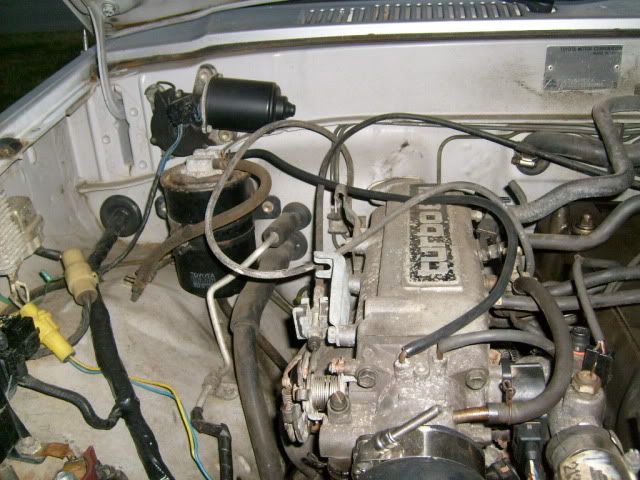
I was under the hood today and found that this hose/line is not connected to anything. It had a rubber coupler on the end (not pictured), which made me think it used to be connected to another section of hose.... I am wondering if it should be connected, capped off, or neither.
The truck is a 1990, 22RE.

Thank you
The truck is a 1990, 22RE.
Thank you
Dec 14, 2012 | 02:39 PM
#2

I don't have a 1990 and the vacuum hoses are routed different from my 87. On the bottom of the hood there is usually a vacuum hose diagram that will show how to hook everything up. Refer to that.

 Dec 14, 2012 | 07:04 PM
#5

Registered User
Joined: Dec 2011
Posts: 1,388
Likes: 8
From: CA, Until TSHTF!
That hose goes to a valve (purge) on the intake to burn off gasoline vapors. The other end goes to fuel tank. Some states will test the operation as part of a smog test, thus gas cap must seal properly.
Dec 14, 2012 | 07:09 PM
#6

Registered User

Joined: Sep 2007
Posts: 8,384
Likes: 875
From: San Francisco East Bay
If you look at the back of the engine near the firewall, you will see the Thermal Vacuum Valve, which looks like this:
(c5CBO0wjiqWbQ~~60_12.JPG)
Except yours is missing one of the nipples (well, you know where it went, it's in the end of the hose you're holding). There are those who say they've successfully repaired one, but I couldn't as the plastic on mine was too crumbly.
It's about $50 http://www.toyotapartszone.com/oem/t...925-05047.html . If you don't replace it (or repair it), the vacuum canister will not be emptied, and you will soon smell gasoline on the passenger side. (You will also have a tiny vacuum leak, but you don't need to worry too much about that.)
Except yours is missing one of the nipples (well, you know where it went, it's in the end of the hose you're holding). There are those who say they've successfully repaired one, but I couldn't as the plastic on mine was too crumbly.
It's about $50 http://www.toyotapartszone.com/oem/t...925-05047.html . If you don't replace it (or repair it), the vacuum canister will not be emptied, and you will soon smell gasoline on the passenger side. (You will also have a tiny vacuum leak, but you don't need to worry too much about that.)
Dec 14, 2012 | 07:28 PM
#7
Registered User
Joined: Dec 2011
Posts: 1,388
Likes: 8
From: CA, Until TSHTF!
If you look at the back of the engine near the firewall, you will see the Thermal Vacuum Valve, which looks like this:
Except yours is missing one of the nipples (well, you know where it went, it's in the end of the hose you're holding). There are those who say they've successfully repaired one, but I couldn't as the plastic on mine was too crumbly.
It's about $50 http://www.toyotapartszone.com/oem/t...925-05047.html . If you don't replace it (or repair it), the vacuum canister will not be emptied, and you will soon smell gasoline on the passenger side. (You will also have a tiny vacuum leak, but you don't need to worry too much about that.)
Except yours is missing one of the nipples (well, you know where it went, it's in the end of the hose you're holding). There are those who say they've successfully repaired one, but I couldn't as the plastic on mine was too crumbly.
It's about $50 http://www.toyotapartszone.com/oem/t...925-05047.html . If you don't replace it (or repair it), the vacuum canister will not be emptied, and you will soon smell gasoline on the passenger side. (You will also have a tiny vacuum leak, but you don't need to worry too much about that.)
Trending Topics
 Dec 15, 2012 | 10:34 AM
#10
Registered User
Joined: Sep 2007
Posts: 8,384
Likes: 875
From: San Francisco East Bay
And there's this one:
http://personal.utulsa.edu/~nathan-b...ne/15layou.pdf
(Maybe even more vague).
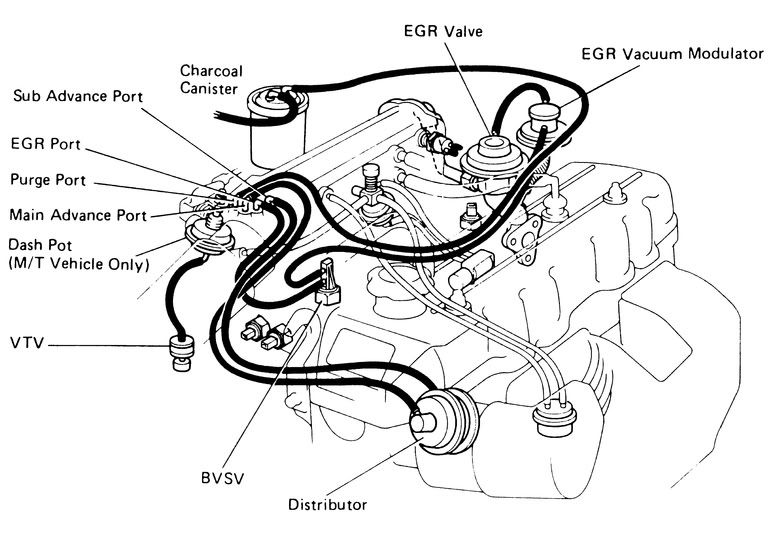
But it appears that while a 22re DOES have a TVV (called a BVSV for Bi-metallic Vacuum switching valve, but apparently the same function) it is in the EGR circuit. The EVAP (canister) goes to the "purge" port, which appears to be directly into the throttle body somewhere.
I don't have a 4-cyl, so this is just a learning experience for me. Thanks for pointing me in the right direction.
http://personal.utulsa.edu/~nathan-b...ne/15layou.pdf
(Maybe even more vague).
But it appears that while a 22re DOES have a TVV (called a BVSV for Bi-metallic Vacuum switching valve, but apparently the same function) it is in the EGR circuit. The EVAP (canister) goes to the "purge" port, which appears to be directly into the throttle body somewhere.
I don't have a 4-cyl, so this is just a learning experience for me. Thanks for pointing me in the right direction.
Dec 15, 2012 | 11:11 AM
#11
Registered User
Joined: Dec 2011
Posts: 1,388
Likes: 8
From: CA, Until TSHTF!
And there's this one:
http://personal.utulsa.edu/~nathan-b...ne/15layou.pdf
(Maybe even more vague).
But it appears that while a 22re DOES have a TVV (called a BVSV for Bi-metallic Vacuum switching valve, but apparently the same function) it is in the EGR circuit. The EVAP (canister) goes to the "purge" port, which appears to be directly into the throttle body somewhere.
I don't have a 4-cyl, so this is just a learning experience for me. Thanks for pointing me in the right direction.
http://personal.utulsa.edu/~nathan-b...ne/15layou.pdf
(Maybe even more vague).
But it appears that while a 22re DOES have a TVV (called a BVSV for Bi-metallic Vacuum switching valve, but apparently the same function) it is in the EGR circuit. The EVAP (canister) goes to the "purge" port, which appears to be directly into the throttle body somewhere.
I don't have a 4-cyl, so this is just a learning experience for me. Thanks for pointing me in the right direction.
If possible, and just a side note I've learned a lot from your posts, So I Thank you

Last edited by ksti; Dec 15, 2012 at 11:12 AM.
 Dec 15, 2012 | 07:23 PM
#13
Thread Starter
Registered User
Joined: Oct 2012
Posts: 148
Likes: 0
From: NW PA
Thanks guys, this is all helpful. I ended up plugging it in to one of the vacuum ports on the intake that would be for the AC idle up valve because my truck doesn't have AC. I drove it for 45 min - 1 hour today. I didn't really notice any change, or maybe a very slight positive change in how it ran. I do feel good just knowing it's hooked up to something that is close to how it should be hooked up 
Dec 17, 2012 | 07:10 PM
#14

Registered User
Joined: Aug 2005
Posts: 2,419
Likes: 8
From: Peoria IL

Thread
Thread Starter
Forum
Replies
Last Post
LotOMiles
95.5-2004 Tacomas & 96-2002 4Runners
8
Sep 14, 2015 11:45 PM
anniesball
95.5-2004 Tacomas & 96-2002 4Runners
3
Sep 7, 2015 11:20 AM


