


Did EGR removal and WoW
 Mar 1, 2010 | 06:19 PM
#21
Registered User
Joined: Dec 2007
Posts: 710
Likes: 2
From: Santa Rosa, CA
There is always Wikipedia, for what it is worth:
EGR in spark-ignited engines
The exhaust gas, added to the fuel, oxygen, and combustion products, increases the specific heat capacity of the cylinder contents, which lowers the adiabatic flame temperature.
In a typical automotive spark-ignited (SI) engine, 5 to 15 percent of the exhaust gas is routed back to the intake as EGR. The maximum quantity is limited by the requirement of the mixture to sustain a contiguous flame front during the combustion event; excessive EGR in an SI engine can cause misfires and partial burns. Although EGR does measurably slow combustion, this can largely be compensated for by advancing spark timing. The impact of EGR on engine efficiency largely depends on the specific engine design, and sometimes leads to a compromise between efficiency and NOx emissions. A properly operating EGR can theoretically increase the efficiency of gasoline engines via several mechanisms:
Reduced throttling losses. The addition of inert exhaust gas into the intake system means that for a given power output, the throttle plate must be opened further, resulting in increased inlet manifold pressure and reduced throttling losses.
Reduced heat rejection. Lowered peak combustion temperatures not only reduces NOx formation, it also reduces the loss of thermal energy to combustion chamber surfaces, leaving more available for conversion to mechanical work during the expansion stroke.
Reduced chemical dissociation. The lower peak temperatures result in more of the released energy remaining as sensible energy near TDC, rather than being bound up (early in the expansion stroke) in the dissociation of combustion products. This effect is minor compared to the first two.
It also decreases the efficiency of gasoline engines via at least one more mechanism:
Reduced specific heat ratio. A lean intake charge has a higher specific heat ratio than an EGR mixture. A reduction of specific heat ratio reduces the amount of energy that can be extracted by the piston.
EGR is typically not employed at high loads because it would reduce peak power output. This is because it reduces the intake charge density. EGR is also omitted at idle (low-speed, zero load) because it would cause unstable combustion, resulting in rough idle. The EGR valve also cools the exhaust valves and makes them last far longer (a very important benefit under light cruise conditions)
EGR in spark-ignited engines
The exhaust gas, added to the fuel, oxygen, and combustion products, increases the specific heat capacity of the cylinder contents, which lowers the adiabatic flame temperature.
In a typical automotive spark-ignited (SI) engine, 5 to 15 percent of the exhaust gas is routed back to the intake as EGR. The maximum quantity is limited by the requirement of the mixture to sustain a contiguous flame front during the combustion event; excessive EGR in an SI engine can cause misfires and partial burns. Although EGR does measurably slow combustion, this can largely be compensated for by advancing spark timing. The impact of EGR on engine efficiency largely depends on the specific engine design, and sometimes leads to a compromise between efficiency and NOx emissions. A properly operating EGR can theoretically increase the efficiency of gasoline engines via several mechanisms:
Reduced throttling losses. The addition of inert exhaust gas into the intake system means that for a given power output, the throttle plate must be opened further, resulting in increased inlet manifold pressure and reduced throttling losses.
Reduced heat rejection. Lowered peak combustion temperatures not only reduces NOx formation, it also reduces the loss of thermal energy to combustion chamber surfaces, leaving more available for conversion to mechanical work during the expansion stroke.
Reduced chemical dissociation. The lower peak temperatures result in more of the released energy remaining as sensible energy near TDC, rather than being bound up (early in the expansion stroke) in the dissociation of combustion products. This effect is minor compared to the first two.
It also decreases the efficiency of gasoline engines via at least one more mechanism:
Reduced specific heat ratio. A lean intake charge has a higher specific heat ratio than an EGR mixture. A reduction of specific heat ratio reduces the amount of energy that can be extracted by the piston.
EGR is typically not employed at high loads because it would reduce peak power output. This is because it reduces the intake charge density. EGR is also omitted at idle (low-speed, zero load) because it would cause unstable combustion, resulting in rough idle. The EGR valve also cools the exhaust valves and makes them last far longer (a very important benefit under light cruise conditions)
Mar 1, 2010 | 06:20 PM
#22
Registered User
Joined: Sep 2008
Posts: 3,887
Likes: 16
From: Spokane, WA
Hahahaha
All you EFI guys arguing over stupid stuff.
Carb>EFI
All you EFI guys arguing over stupid stuff.
Carb>EFI
Mar 1, 2010 | 06:22 PM
#23
Registered User
Joined: Dec 2007
Posts: 710
Likes: 2
From: Santa Rosa, CA
Sorry, did not intend to claim that as my own, that was cut and pasted, as with the EGR summary for spark ignited engines from Wikipedia above.
It seems that a properly designed and functioning EGR system has distinct advantages to engine performance and longevity, in addition to NOX reduction.
Now, are Toyota systems properly designed? And are they functioning properly after 200k miles?
Never even thought about that system until this thread, now I am reading up on them all over the web.
Interesting stuff.

It seems that a properly designed and functioning EGR system has distinct advantages to engine performance and longevity, in addition to NOX reduction.
Now, are Toyota systems properly designed? And are they functioning properly after 200k miles?
Never even thought about that system until this thread, now I am reading up on them all over the web.
Interesting stuff.
Mar 1, 2010 | 06:41 PM
#24

Registered User
Joined: May 2008
Posts: 3,948
Likes: 11
From: Calgary, AB Canaduh
Anyone who says "22re egr gains performance" in one sentence is a moron. Only reason I removed my egr was due to it not working and the lack of emissions up here. Fixed my idle to.
Mar 1, 2010 | 10:11 PM
#25

Registered User
Joined: Mar 2009
Posts: 359
Likes: 2
From: Kenai, AK
I like this thread 
I'm amazed no one suggested water injection to reduce nox like we use on our gas turbines at work!!!
Actually I know it wouldn't work on a piston engine so don't flame me...
I'm amazed no one suggested water injection to reduce nox like we use on our gas turbines at work!!!
Actually I know it wouldn't work on a piston engine so don't flame me...
Mar 2, 2010 | 03:44 AM
#26

Contributing Member
Joined: Nov 2002
Posts: 10,666
Likes: 5
From: Oklahoma State
Aquamist 2d system: http://www.urdusa.com/index.php?cPat...fmpquj203jsmd7

Last edited by mt_goat; Mar 2, 2010 at 03:47 AM.
Mar 2, 2010 | 04:40 AM
#27

Thread Starter
Registered User
Joined: Oct 2004
Posts: 297
Likes: 2
From: Ringgold Ga/Chattanooga Tn
haha,
Like I stated, WoW, it made a difference on my truck, not in top end, but idle, and mid range HUGE difference, the reason is simple, mine was broke and on my high milage vehicle it was KILLING the truck, it would Stumble bad from off idle to about 3k, then if you were driving, and hit that "sweet" spot, it would feel like it was going to die.
Hard to explain, but Holy balls Batman, it made a huge difference on my truck, HUGE.
Still makes alot of noise and goes nowhere above 3200, but below it is whwere I drive 90% of the time and it's where it is very noticable.
I run Water Meth on my car as well, a Snow kit and it works GREAT, run 17 degree's of timing without it, 24 degree's with it, about 90 hp difference At the Wheels
Like I stated, WoW, it made a difference on my truck, not in top end, but idle, and mid range HUGE difference, the reason is simple, mine was broke and on my high milage vehicle it was KILLING the truck, it would Stumble bad from off idle to about 3k, then if you were driving, and hit that "sweet" spot, it would feel like it was going to die.
Hard to explain, but Holy balls Batman, it made a huge difference on my truck, HUGE.
Still makes alot of noise and goes nowhere above 3200, but below it is whwere I drive 90% of the time and it's where it is very noticable.
I run Water Meth on my car as well, a Snow kit and it works GREAT, run 17 degree's of timing without it, 24 degree's with it, about 90 hp difference At the Wheels
Mar 2, 2010 | 04:42 AM
#28
Thread Starter
Registered User
Joined: Oct 2004
Posts: 297
Likes: 2
From: Ringgold Ga/Chattanooga Tn
I sometimes like to pull the coolant line off the throttle body and let the air out. I'm pretty sure the 3.0 also has this coolant line, right?
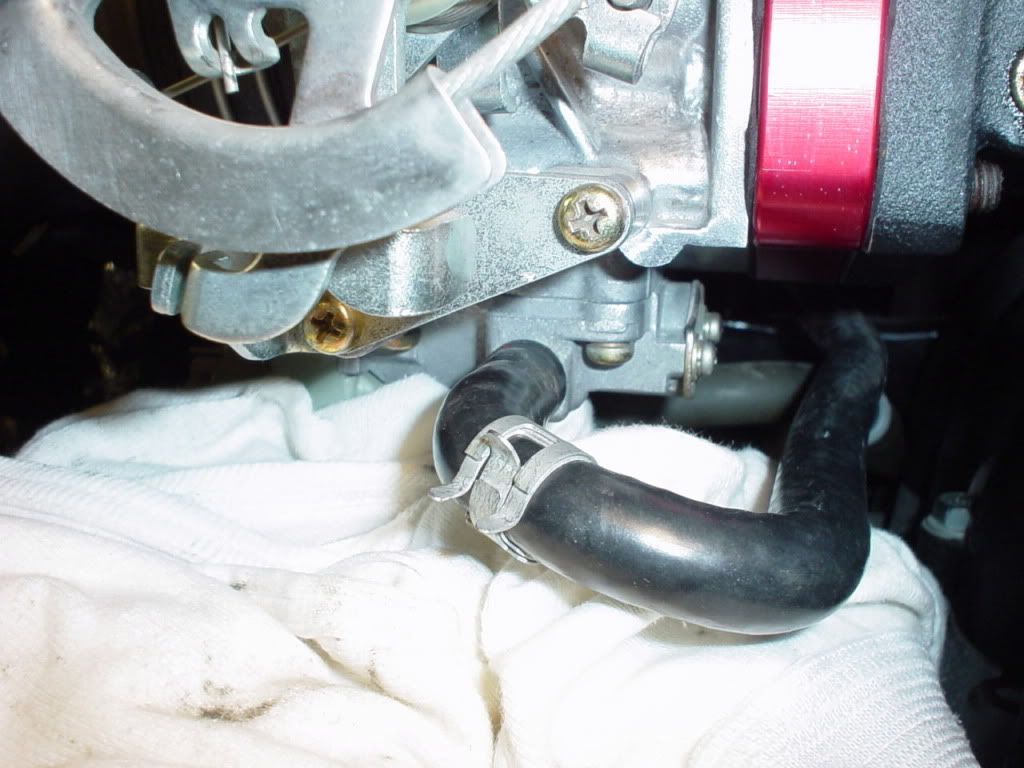
I also installed a "T" on the heater hose for the purpose of burping. Off the "T" I have an extra heater hose with a plug for the end, held in with a hose clamp (not shown in the pics). Remove the plug and swivel the hose up high, air comes out coolant stays in.
Swiveled up for burping:
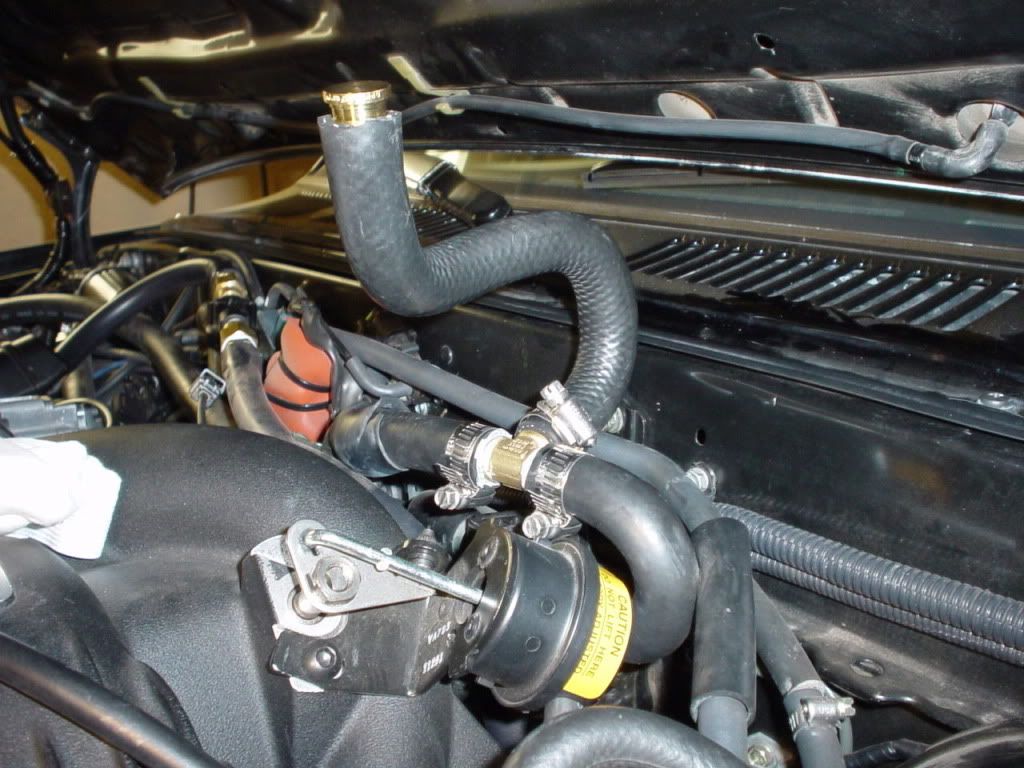
Swiveled down for driving:
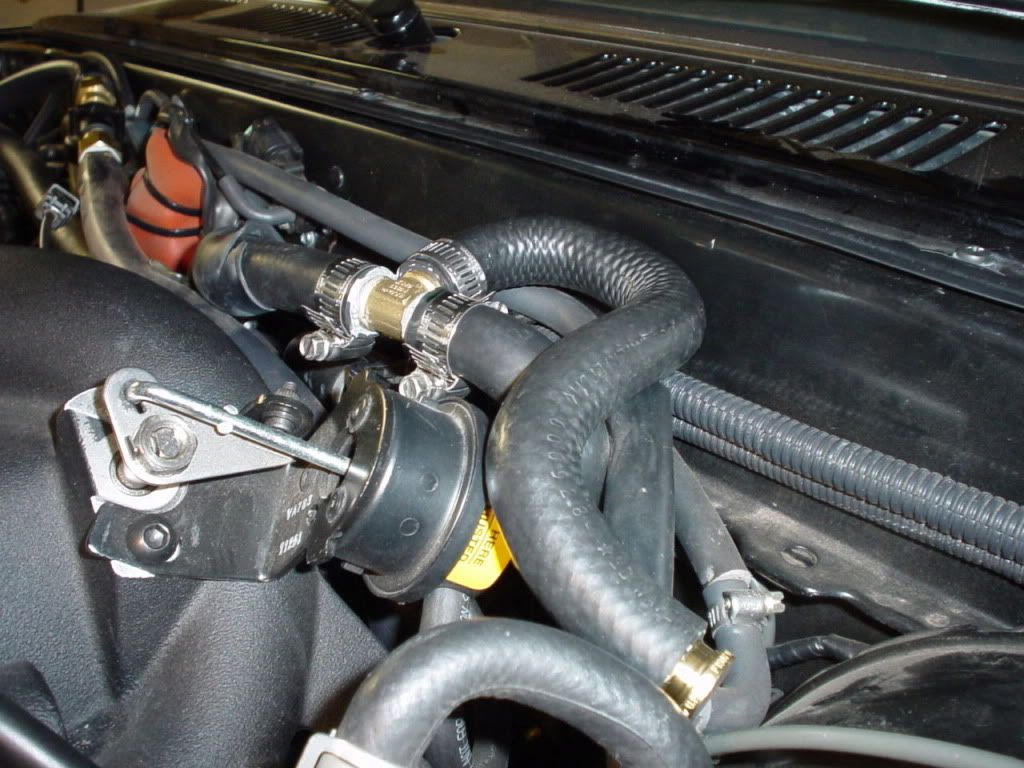
I also installed a "T" on the heater hose for the purpose of burping. Off the "T" I have an extra heater hose with a plug for the end, held in with a hose clamp (not shown in the pics). Remove the plug and swivel the hose up high, air comes out coolant stays in.
Swiveled up for burping:
Swiveled down for driving:
Mar 2, 2010 | 10:50 AM
#29

Registered User
Joined: Oct 2009
Posts: 205
Likes: 0
haha,
Like I stated, WoW, it made a difference on my truck, not in top end, but idle, and mid range HUGE difference, the reason is simple, mine was broke and on my high milage vehicle it was KILLING the truck, it would Stumble bad from off idle to about 3k, then if you were driving, and hit that "sweet" spot, it would feel like it was going to die.
Hard to explain, but Holy balls Batman, it made a huge difference on my truck, HUGE.
Still makes alot of noise and goes nowhere above 3200, but below it is whwere I drive 90% of the time and it's where it is very noticable.
I run Water Meth on my car as well, a Snow kit and it works GREAT, run 17 degree's of timing without it, 24 degree's with it, about 90 hp difference At the Wheels
Like I stated, WoW, it made a difference on my truck, not in top end, but idle, and mid range HUGE difference, the reason is simple, mine was broke and on my high milage vehicle it was KILLING the truck, it would Stumble bad from off idle to about 3k, then if you were driving, and hit that "sweet" spot, it would feel like it was going to die.
Hard to explain, but Holy balls Batman, it made a huge difference on my truck, HUGE.
Still makes alot of noise and goes nowhere above 3200, but below it is whwere I drive 90% of the time and it's where it is very noticable.
I run Water Meth on my car as well, a Snow kit and it works GREAT, run 17 degree's of timing without it, 24 degree's with it, about 90 hp difference At the Wheels
Mar 2, 2010 | 11:21 AM
#30
Thread Starter
Registered User
Joined: Oct 2004
Posts: 297
Likes: 2
From: Ringgold Ga/Chattanooga Tn
 BAH, WTF is that
 , no, it's not Closed if it is Malfunctioning and STUCK Open.
I think somebody read someone elses word and doesn't know his butt from his head unless someone tells him.
Trust Me - 12 years of military service active duty AF, now in the Reserves, the majority of that time in Mechanic's and I know my .

The truck runs EXTREMELY better during the time that your talking about, which is the time when a functioning EGR would not be dumping gasses in the intake, however, MINE WAS STUCK OPEN, therefore removing it added the lost power back and increased DRASTICALLY driveablility.
However, you belive everythign you read on the internet and say my Butt dyno is telling me it increased, sorry buddy, your Wrong, plain and simple. If your EGR is functioning properly, you wouldn't notice, however mine wasn't so it's a HUGE difference.
But while your at it, and you know it didn't make any difference on my truck because you read it somewhere, did you know that Al Gore invented the internet?
Mar 2, 2010 | 02:00 PM
#31

Registered User
Joined: Dec 2006
Posts: 912
Likes: 9
From: Hudson Valley, NY
If you had a properly functioning EGR in the first place, you'd notice no difference anyway. Aside from that, you'll get better gas mileage with a proper EGR setup, along with cooler engine temps under load (IE: driving up a hill not under WOT)
There is no performance benefit to removing it.
There is no performance benefit to removing it.
Mar 2, 2010 | 02:23 PM
#32

Contributing Member
Joined: Feb 2008
Posts: 12,248
Likes: 33
From: Lake City, Fl
I see this thread getting out of hand very quickly...
why does the "EGR Thread" always come to this...
why does the "EGR Thread" always come to this...
Mar 2, 2010 | 02:40 PM
#33

Registered User
Joined: Aug 2008
Posts: 1,758
Likes: 3
From: Northern Colorado :-(
Mar 2, 2010 | 02:50 PM
#34
Contributing Member
Joined: Feb 2008
Posts: 12,248
Likes: 33
From: Lake City, Fl
 Mar 2, 2010 | 08:54 PM
#35
Registered User
Joined: Oct 2009
Posts: 205
Likes: 0
BAH, WTF is that, no, it's not Closed if it is Malfunctioning and STUCK Open.I think somebody read someone elses word and doesn't know his butt from his head unless someone tells him.
Trust Me - 12 years of military service active duty AF, now in the Reserves, the majority of that time in Mechanic's and I know my .
The truck runs EXTREMELY better during the time that your talking about, which is the time when a functioning EGR would not be dumping gasses in the intake, however, MINE WAS STUCK OPEN, therefore removing it added the lost power back and increased DRASTICALLY driveablility.
However, you belive everythign you read on the internet and say my Butt dyno is telling me it increased, sorry buddy, your Wrong, plain and simple. If your EGR is functioning properly, you wouldn't notice, however mine wasn't so it's a HUGE difference.
But while your at it, and you know it didn't make any difference on my truck because you read it somewhere, did you know that Al Gore invented the internet?
I missed the point where you said it your EGR was malfunctioning prior to removal...In that case welcome to the world of stock performance. Your truck is one step closer to running like how it was designed to.
Mar 2, 2010 | 09:42 PM
#36
Registered User
Joined: Feb 2008
Posts: 1,417
Likes: 0
From: hendersonville, TN.
hmm. higher numbers after removing the EGR.
Mar 2, 2010 | 09:44 PM
#37
Registered User
Joined: Feb 2008
Posts: 1,417
Likes: 0
From: hendersonville, TN.
the difference is obvious, not to mention lower EGT's
Mar 3, 2010 | 01:39 AM
#38
Registered User
Joined: Oct 2009
Posts: 205
Likes: 0
Unless your EGR was stuck open like the OP this dyno is rubbish. What are the power figures representing anyway? As has been made clear a working EGR is closed at WOT. There is no extra performance available unless there was a faulty EGR system in the first place
Mar 3, 2010 | 04:09 AM
#39
Thread Starter
Registered User
Joined: Oct 2004
Posts: 297
Likes: 2
From: Ringgold Ga/Chattanooga Tn
Cool cool,
I was a little pissy yesterday, been on this board around 6 years and never did any post like that response, sorry if it was a bit offensive - just get that way occasionally I guess.
I was a little pissy yesterday, been on this board around 6 years and never did any post like that response, sorry if it was a bit offensive - just get that way occasionally I guess.
Mar 3, 2010 | 04:41 AM
#40

Registered User
Joined: Feb 2010
Posts: 4
Likes: 0
Hi , this worked for me too , now the idle is more stable and the flat spot on the acceleration is smaller , thanx for posting this, i did mine blocking both ports with soda can material and felpro gasket.


