When you click on links to various merchants on this site and make a purchase, this can result in this site earning a commission. Affiliate programs and affiliations include, but are not limited to, the eBay Partner Network.
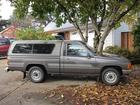
Trying to solve a weird carb issue on an '86 Auto with a 22R and stock carb. The truck runs and drives really nice when the engine is cold and when warm it still drives really good around town. But if you get it up to like 45-50 or above when it's warm and then you hit a light as soon as you slow down it bucks and shakes and often it will die. It's worse in gear (auto remember) if you throw it in park it will often even out. If it doesn't die it usually evens out and starts purring again in like 10-20 seconds. I've got two theories at the moment - #1 is that the low idle circuit of the carb isn't working well so it's ok when it's warm because the choke makes up for this but when the choke opens it becomes an issue. This doesn't really make sense though because it runs great at idle and low speeds warm or cold as long as you don't slow down quickly from highway speeds. Idea #2 came from a mechanic he thinks that when you slow down from high speed the carb for some reason is still dumping the same amount of fuel and choking out the engine. There is no smoke in the exhaust though I would have thought this would make it smoke.
This is a stock engine, stock carb. Most of the emissions stuff is there and original as far as I can tell but there is one large (3/8" or so) vacuum line that's plugged with a bolt which is coming off the passenger side of the carb. The PCV is run to the driver's side of the carb which is the opposite of another one I looked at with the same setup but that one had some stuff deleted and changed around so I'm not sure what's right.
I recently rebuilt the carb due to dirty fuel I didn't find anything obvious but I don't really understand these stock carbs very well. The problem was exactly the same before and after the rebuild.
Any ideas? What direction should I be looking next? I need to check the timing, haven't done that yet and I would like to figure out where the plugged vacuum line went but I'm mostly just confused because it runs so good 90% of the time, cold or hot, high speeds or low speeds or at idle, it's just this one really specific thing that kills it which is when the engine is warm AND you're driving fast AND you come to relatively quick stop.
I've never worked on a 22r Carb. So this is "general" advice, based on working on other carbs.
When you are at speed, there is a certain amount of fuel hanging around the intake manifold that has not yet evaporated. As it evaporates, more "cold" fuel is being added, so it is balanced. At higher fuel flows, there is more static fuel, constantly being evaporated and replaced. So, when you jump on the accelerator, the system has to (effectively) increase the amount of fuel to get to that higher static point. That's why the carb has an accelerator pump; while the accelerator is opening the throttle plate, it squirts in extra fuel to keep the engine from leaning out. Once the throttle is open (the angle isn't changing), you're back to balance, and the accelerator pump stops adding fuel.
What does this have to do with your problem? The fuel load does the reverse when you come off the throttle. That static fuel in the intake manifold has to go someplace (there is less static fuel at lower rpm). If you just slam the throttle plate closed (by lifting your foot off the accelerator), you have very little air and still a bunch of fuel evaporating into that small amount of air. So your mixture goes way rich for about 1/2 second.
For most vehicles, that 1/2 second of extra-rich releases a lot of pollution. So all carbs I've worked on have a damper to keep the throttle plate from "slamming" closed. Just a dash-pot to make the throttle plate close gently (over about 1/2 second). If your damper isn't working, the mixture would jump so rich it could kill the engine.
If you can prevent your problem by always easing off the throttle at stops, I would check the throttle linkage for the action of that damper. You should be able to just open the throttle plate with your finger, then let go. The plate should close gently, not with a "snap."
All of my comments will be based on my previous '87 22R truck with California emissions (Feedback Carburetor) and manual transmission.
Originally Posted by calderp
Idea #2 came from a mechanic he thinks that when you slow down from high speed the carb for some reason is still dumping the same amount of fuel and choking out the engine.
Carburetors work on pressure differential, where there is negative pressure (high vacuum) below the Primary Throttle Valve (or in the venturi), and high pressure (atmospheric pressure) in the Float Bowl pushing the fuel into an active circuit. On a warm engine, when the throttle plate(s) closes, vacuum is removed from Primary and Secondary Fuel Circuits. Therefore no fuel is flowing because no vacuum is present within those circuits. The only circuit active in that position (on a properly working Aisan carb), is the Idle Circuit. However, there is a Fuel Cut Solenoid on the carburetor to function on deceleration.
Originally Posted by calderp
but there is one large (3/8" or so) vacuum line that's plugged with a bolt which is coming off the passenger side of the carb
Originally Posted by old87yota
Do you have a picture of the large plugged vacuum line?
That's probably the Float Bowl Vent line (charcoal canister). It's below the Outer Vent Control Valve (OVCV) in the above picture. If it is, it wont necessarily affect engine condition.
Originally Posted by scope103
That's why the carb has an accelerator pump; while the accelerator is opening the throttle plate, it squirts in extra fuel to keep the engine from leaning out.
And calderp, this "accelerator pump" is not to be confused with the stock Aisin carb's Auxiliary Accelerator Pump (AAP) which only operates on a cold engine (cold coolant). Once the coolant gets up to a set temperature, the AAP stops functioning (on a properly working vacuum valve).
The trucks that have automatic transmissions do have a Dash Pot on the carburetor. If it's for this purpose, I don't know, but it is something to look at. I believe it's at the front of the carb to the left of the fuel sight glass.
Initially I was going to say that there may be an issue with the transmission not dropping down in gear, or the torque convertor not disengaging, but I believe this era of Aisin transmissions are not computer controlled.
Yes, only the automatic carbureted trucks have dashpots.
Scope103 is correct. The dashpot's purpose is to basically cushion the throttle plate and prevent it from slamming closed.
The 2 Wheel Drive trucks have mechanically / hydraulically controlled transmissions (except for the overdrive selector) while the 4 Wheel Drive Trucks got electronically controlled transmissions.
I have a question. Im from South Africa and drive a 75 series Land cruiser with a 1 fz carburetor engine.
The OVCV has stopped working in the open position and causing a vacuum leak, Can I just block it off?
Also is there a way to fix it? as I am struggling to find a replacement part.
The carb on my vehicle looks very similar to your 22r carb maybe a few internal differences, but not sure, and very limited info floating around on my version.
I have a question. Im from South Africa and drive a 75 series Land cruiser with a 1 fz carburetor engine.
The OVCV has stopped working in the open position and causing a vacuum leak, Can I just block it off?
Also is there a way to fix it? as I am struggling to find a replacement part.
The carb on my vehicle looks very similar to your 22r carb maybe a few internal differences, but not sure, and very limited info floating around on my version.
Thank you
Warren
Hey man I can't really help you and this is an old thread but try a new post in the land cruiser area here: https://www.yotatech.com/forums/f25/ . I don't see why you couldn't block the OVCV off because I think on most toyota engines it's supposed to be off when the truck is running. But I don't really know what I'm talking about...
This is Toyota Corolla info: Carburetor port (for carbureted cars) is connected to the float chamber through the outer-vent control valve (OVCV), which is off when the ignition is on and on when the ignition is off. You can see the filter through this port if you shine a light. It collects the float-chamber vapors when the engine is not running.
(https://www.corolland.com/index.php?...-repair.24344/
Hey man I can't really help you and this is an old thread but try a new post in the land cruiser area here: https://www.yotatech.com/forums/f25/ . I don't see why you couldn't block the OVCV off because I think on most toyota engines it's supposed to be off when the truck is running. But I don't really know what I'm talking about...
This is Toyota Corolla info: Carburetor port (for carbureted cars) is connected to the float chamber through the outer-vent control valve (OVCV), which is off when the ignition is on and on when the ignition is off. You can see the filter through this port if you shine a light. It collects the float-chamber vapors when the engine is not running.
(https://www.corolland.com/index.php?...-repair.24344/



 Apr 4, 2019 | 07:39 PM