need help, totally confused about tire sizes
 Feb 19, 2004 | 07:21 PM
#1
Thread Starter
Registered User
Joined: Dec 2003
Posts: 81
Likes: 0
need help, totally confused about tire sizes
Ive tried searching and i seem to have confused myself even more.
I have 16in rims on my 4runner right now. I want to get a wider and taller tire. Whats the biggest tire I can get without and rubbing on a stock suspension. I was thinking about getting a 265/75/16 tire or can i get wider or taller. how do you measure size, i didnt understand the webpage at tirerack.com, thanks

I have 16in rims on my 4runner right now. I want to get a wider and taller tire. Whats the biggest tire I can get without and rubbing on a stock suspension. I was thinking about getting a 265/75/16 tire or can i get wider or taller. how do you measure size, i didnt understand the webpage at tirerack.com, thanks
Feb 19, 2004 | 07:25 PM
#2

Contributing Member
Joined: Aug 2002
Posts: 879
Likes: 1
From: Sacramento, CA
well, before you get throunced to search more, yes, you can fit a 265 75r16 on a stock 97 (that's what I have)
bigger than that will *likely* cause you problems, unless you do some lift and/or trim operations.
Also check out the tire size calculator on the Yotatech on the Web page
which is here...
basically, that tire is 265 mm wide, with the sidewall height being 75% of that. About a 32" tire, in short.
bigger than that will *likely* cause you problems, unless you do some lift and/or trim operations.
Also check out the tire size calculator on the Yotatech on the Web page
which is here...
basically, that tire is 265 mm wide, with the sidewall height being 75% of that. About a 32" tire, in short.
Last edited by Scottiac; Feb 19, 2004 at 07:30 PM.
Feb 19, 2004 | 07:45 PM
#4

Contributing Member
Joined: Sep 2002
Posts: 801
Likes: 0
From: Albuquerque, NM
Here's a couple more tire size calculators.
http://www.csgnetwork.com/lttrucktireinfocalc.html
http://www.miata.net/garage/tirecalc.html
Another choice would be 275/70/16 which is a bit wider but not much taller.
http://www.csgnetwork.com/lttrucktireinfocalc.html
http://www.miata.net/garage/tirecalc.html
Another choice would be 275/70/16 which is a bit wider but not much taller.

 Feb 21, 2004 | 09:57 AM
#7
Registered User
Joined: Jan 2004
Posts: 211
Likes: 0
From: Santa Maria, CA
Ok, I'm in the tire industry, so let me see if I can help explain this some.
On an metric size tire (P265/75R16 or LT265/75R16 for example) the first thing to look at is the FIRST letter. P stands for Passanger, LT stands for Light Truck. Light Truck is the designation for trucks that tend to carry more weight than just a few hundred pounds of cargo. LT tires are pretty much on anything heavier than a half ton truck. These tires are Load range C,D,E and so on with the weight capacity going up with each letter.
The next thing to look at is the first group of numbers 265. This is the width of the tire at its widest point, sidewall to sidewall, in millimeters. So the tire is 265 mm wide. The 75 stands for 75%. The Height of the sidewall is 75% the width of the tire, or 75% of 265 mm= 198.75mm.
R stands for radial. The tire is a radial versus a bias ply.
Last is the 16. The tire fits on a 16" wheel.
On a standard tire (LT32x11.50R15) it's a little different, but not much.
Again, LT=light truck
32 is the diameter of the tire in inches. So the tire is a 32" diameter tire.
11.50 is the width of the tire sidewall to siedwall at it's widest point in inches.
R again=radial
15 means it fits a 15" wheel.
To do the conversion from metric to standard takes a little math, but it can be done if you know how to convert mm to inches.
265mm= 10.43 inches, so roughly a 10.50 tire wide
75% of this=198.75mm or 7.82" is the sidewall, times 2 (top of tire above the wheel and bottom beo=low the wheel) = 15.64" add 16" (for the wheel) and you have a 31.64" diameter tire or to put it in standard form 31.6x10.50R16, which would be set at a 32x10.50R16 by industry standards.
On an metric size tire (P265/75R16 or LT265/75R16 for example) the first thing to look at is the FIRST letter. P stands for Passanger, LT stands for Light Truck. Light Truck is the designation for trucks that tend to carry more weight than just a few hundred pounds of cargo. LT tires are pretty much on anything heavier than a half ton truck. These tires are Load range C,D,E and so on with the weight capacity going up with each letter.
The next thing to look at is the first group of numbers 265. This is the width of the tire at its widest point, sidewall to sidewall, in millimeters. So the tire is 265 mm wide. The 75 stands for 75%. The Height of the sidewall is 75% the width of the tire, or 75% of 265 mm= 198.75mm.
R stands for radial. The tire is a radial versus a bias ply.
Last is the 16. The tire fits on a 16" wheel.
On a standard tire (LT32x11.50R15) it's a little different, but not much.
Again, LT=light truck
32 is the diameter of the tire in inches. So the tire is a 32" diameter tire.
11.50 is the width of the tire sidewall to siedwall at it's widest point in inches.
R again=radial
15 means it fits a 15" wheel.
To do the conversion from metric to standard takes a little math, but it can be done if you know how to convert mm to inches.
265mm= 10.43 inches, so roughly a 10.50 tire wide
75% of this=198.75mm or 7.82" is the sidewall, times 2 (top of tire above the wheel and bottom beo=low the wheel) = 15.64" add 16" (for the wheel) and you have a 31.64" diameter tire or to put it in standard form 31.6x10.50R16, which would be set at a 32x10.50R16 by industry standards.
Trending Topics
Feb 21, 2004 | 04:13 PM
#9
Registered User
Joined: Jan 2004
Posts: 211
Likes: 0
From: Santa Maria, CA
Originally Posted by legend4ever
thanks for the in depth info, so how is it that chuckD rubs and halza doesnt, since both are the same exact trucks.

 Feb 23, 2004 | 12:23 PM
#14
Contributing Member
Joined: Sep 2002
Posts: 801
Likes: 0
From: Albuquerque, NM
Originally Posted by Skeeziks
does anyone have pictures of a 3rd gen. with 275/70/16 ?


No loss of power and a lot better handling than the stock Dunflops.
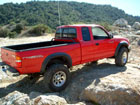
I just put these Michelins on my Wife's Pre-Runner and 265/75/16 REVOS on the Runner last week.

 Feb 23, 2004 | 07:50 PM
#18
Contributing Member
Joined: Sep 2002
Posts: 801
Likes: 0
From: Albuquerque, NM
Originally Posted by legend4ever
those look good, and you dont have any lift correct
thanks!
thanks!
But, they fit nicely on my wife's Tacoma Pre-Runner which has no lift
and possibly less room than the 4-Runner.

Last edited by ALBPM; Feb 23, 2004 at 07:52 PM.