


How do I Compress my caliper pistons after brake job???
 Mar 27, 2008 | 02:07 PM
#1

Thread Starter
Registered User
Joined: Mar 2008
Posts: 230
Likes: 0
From: Boulder, Colorado
 How do I Compress my caliper pistons after brake job???
hi i just did a full caliper,rotor, and pad replacement on my front right wheel
how do i compress my caliper pistons now that im done to basically make my brakes work
i obviously disconnected the brake line
Is the only way to make them compress is to bleed all brake lines then my brakes should work?
Also the car doesnt have to be on during bleeding
thanks
Matt
how do i compress my caliper pistons now that im done to basically make my brakes work
i obviously disconnected the brake line
Is the only way to make them compress is to bleed all brake lines then my brakes should work?
Also the car doesnt have to be on during bleeding
thanks
Matt
 Mar 27, 2008 | 02:24 PM
#4
Registered User
Joined: May 2006
Posts: 1,765
Likes: 3
From: Central Florida
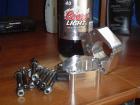
Just pony up the $8 at Pep Boys for the disc brake spreader tool. I used a c-clamp for years with a block of wood and finally gave in and bought the tool. It is worth 10x more than what they charge for it especially for 4 piston calipers like we have.



Trending Topics
 Mar 28, 2008 | 04:04 AM
#10

Registered User
Joined: Mar 2008
Posts: 32
Likes: 1
From: Ames, Iowa
If you disconnected the brake line to change out the caliper, you will have introduced air into the line from the master cylinder to the caliper. When you apply the brake pedal, the trapped air will compress within the brake line preventing the brake fluid from doing its job of extending the pistons in the calipers and/or wheel cylinders to push out the pads or shoes. The trapped air will make the pedal feel soft or spongy when you attempt to apply the brakes.
The air must be bled from the line(s) to restore your brakes to normal operation. If you allowed brake fluid to drain from the open line to the point where the reservoir for the master cylinder emptied, you will need to bleed the master cylinder as well. So, first check the brake fluid level in the master cylinder. If it is empty on one side or both, you will need to bleed the master cylinder. This is usually done with the master cylinder off the car with the master cylinder in a vise, (bench bleed). This involves disconnecting the lines from the master cylinder to the brakes and connecting temporary lines (usually vinyl with plastic fittings) that loop into and under the surface of the brake fluid in the reservoir. The master cylinder piston is slowly depressed all the way in and released until no air bubbles can be seen coming from the temporary lines. The reservoir must not be allowed to empty while the brake lines to the wheels are reconnected or the master cylinder will need to be bled again.
If you did not drain the reservoir, you will only need to bleed the brakes at the wheels. Bleeding at the wheels or master cylinder does not require that the engine be running, even if you have power brakes. The master cylinder reservoir must be topped up repeatedly during bleeding at the wheels to ensure it does not empty. You start bleeding at the longest run (right rear) and proceed to the shortest (left front) from the master cylinder.
Bleeding brakes at home usually involves a helper to pump the pedal then press and hold while you open the bleeder screw. Once the bleeder is opened, fluid should flow out the bleeder. The helper must not let the pedal travel back (up) or air will be sucked into the system at the bleeder. When the fluid flow stops, the bleeder is closed and the helper can release the pedal and pump and press again. This must be done many times (maybe ten or more) to move air from the master cylinder all the way to the right rear wheel. It will be obvious when air comes out the bleeder. It makes a bubbling, spitting sound. Bleeding must continue until the fluid flows in a solid stream from the bleeder. After several squirts, check and re-fill the master cylinder reservoir.
As others have said, brakes are normally changed out on both sides so that wear and braking performance will be equal side to side. It is advisable that you find someone who has done this before to help you, or that you read up on the procedure until you are sure you understand what you are doing. It is incredibly dangerous to yourself and to all the rest of us on the road to drive with faulty brakes. If you have any doubts that you are able to do this properly, pay to have a professional do it for you.
Last edited by bill buttermore; Mar 28, 2008 at 04:22 AM. Reason: clarification
Mar 28, 2008 | 05:26 AM
#11

Registered User
Joined: Feb 2007
Posts: 1,267
Likes: 1
From: Searcy, Arkansas
After reading this post & the other I recommend you get help in person. Your brakes are a safety item & it's not just your safety on the line. If you have to ask how to get the brakes to engage the rotor after you've broken the loop & introduced air you are a danger to yourself & others.
Ask your father, an older sibling, a neighbor or a local mechanic for help - you need it & that's truly the most honest & thoughtful advice I can give you.
If you're DEAD set on doing it yourself; you must bleed the brakes. There are plenty of people telling you how to do it in these two threads. I prefer the gravity then assistant pedal push method myself. A little less messy since I just use a rag instead of tubing & a bottle to catch the ejected fluid.
Ask your father, an older sibling, a neighbor or a local mechanic for help - you need it & that's truly the most honest & thoughtful advice I can give you.
If you're DEAD set on doing it yourself; you must bleed the brakes. There are plenty of people telling you how to do it in these two threads. I prefer the gravity then assistant pedal push method myself. A little less messy since I just use a rag instead of tubing & a bottle to catch the ejected fluid.

Thread
Thread Starter
Forum
Replies
Last Post
jasonty
Pre 84 Trucks (Build-Up Section)
41
Dec 23, 2018 01:00 PM
GreatLakesGuy
The Classifieds GraveYard
8
Sep 4, 2015 09:27 AM


